DEEP
ANTERIOR
LEMELLAR
KERATOPLASTY
PRESENTED BY DR.
SHRIKANT
OPTHALMOLOGY RESIDENT
2nd YR
ST.STEPHEN HOSPITAL,DELHI
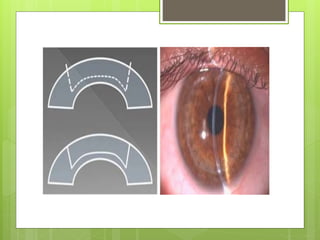
Lamellar keratoplasty is a process in which a
partial thickness graft of donor tissue is used
to provide tectonic stability/optical
improvement.
Two type of lamellar keratoplasty exist-
anterior lamellar keratoplasty and posterior
lamellar keratoplasty.
HISTORY
 the first successful lamellar cornea transplantation was
performed by von hippel at end of 19 century.
 In 1950 jose barraquer and colleague in Colombia
applied the new technique of lamellar keratoplasty,
dissecting the corneal stroma down to 2/3 rd of its
thickness in both donor and the recipient tissue.
 In 1980 eduardo arenas archila used intra stromal air
injection to facilitate host tissue removal.
INDICATION
 KERATOCONUS
o The patient ranging from 20 to 40 year of age need reliable
and effective method of corneal transplantation.
o Acceptable visual acuity of 20/40 or better has been
reported in patient in 77.8-92.3 % of keratoconus patient.
o After DALK visual outcome; contrast sensitivity and higher
order aberration are comparable to those with PK.
Post Lasik keracto ectasia
 The big bubble can be successfully formed in post
Lasik cases with a final clear graft and significant
improvement in best spectacle corrected visual acuity
(BSCVA).
Hereditary stromal dystrophy
 Patient with Avellino, lattice and granular corneal
dystrophy is good candidate for DALK.
 because this technique maximise depth of dissection
removing diseased stroma as for as DM .
 However DALK is not suitable for macular corneal
dystrophy due to involvement of deeper layer of stroma
Infectious keratitis
 DALK is superior to PK in infectious keratitis.
 Advantage of DALK in infectious keratitis include lower
risk of intraocular extension of infectious organism at
time of surgery.
 and potential for improved graft survival rate due to
elimination of endothelial rejection reaction.
Tectonic indication
 DALK can be used to restore the globe integrity when
there is an area of small perforated ulcer.
 DALK using manual dissection with the aid of intra
stromal air or fluid injection has been used for small
and peripherally located corneal perforation.
CONTRAINDICATION-
Endothelial dysfunction is an absolute
contraindication for DALK.
Deep scar involving DM over entrance pupil
and pre-existing defect and break in DM
(acute hydrop) are relative contraindication.
SURGICAL
TECHNIQUE-
Manual dissection
 The basic technique of layer by layer manual dissection
is still useful in some case such as in pre-existing
corneal perforation, stroma to DM adhesion or in
adequate visualisation.
 A partial trephination of approx. 2/3 rd ( I.e 300
micrometer ) of total corneal thickness is performed,
followed by stromal removal using bevel up crescent
knife.
 procedure is technically challenging, time consuming
and high rate of perforation
air assisted manual dissection-
(archilla technique)
• After partial thickness trephination, intra
stromal air is injected until the cornea
become opaque.
• And then manual deep dissection is carried
down deep to DM, which appear clear using
either crescent or blunt spatula.
air guided deep stromal
technique(melles technique)
• In this technique AC aqueous is completely replaced
with an air bubble to generate mirror reflection of the
spatula inserted into stromal pocket.
• The difference in the refractive index between air and
corneal tissue create a mirror image aiding in
determining the depth of dissection.
 A scleral incision 1-2 mm from limbus is made at 12 o’
clock position.
 A sclero corneal tunnel is dissected extending 1 mm to
clear cornea.
 Through the scleral tunnel bevelled spatula is gradually
advanced into deep stroma until mirror reflex of spatula
narrow down to fine line, indicating 95& of corneal
depth.
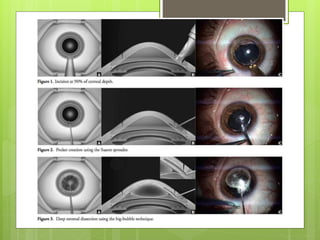
Anwar big bubble technique
 Introduced by Anwar and Teichmann.
 provide quick safe and planned exposure of DM by
injection of air deep into deep stroma.
 Air is gently injected into deep stroma until round well
demarcated air bubble is formed.
 after big bubble formation debulking of anterior 2/3 rd
of corneal stroma is formed with a crescent blade.
viscoelastic dissection technique
 Cornea is trephined to 2/3rd of its thickness then
anterior stromal resection, and air is injected into AC.
 And remaining stroma is dissected down down to DM
and a small pocket is created.
 viscoelastic is injected into pocket to complete the
detachment of DM from posterior stroma.
Hydro delamination
technique
 After partial trephination of recipient cornea, balance
salt solution is injected with a 30 gauze needle in four
quadrants to make trephined area completely opaque.
 A limbal paracentesis is performed to lower the
intraocular pressure and to decrease incidence of
perforation.
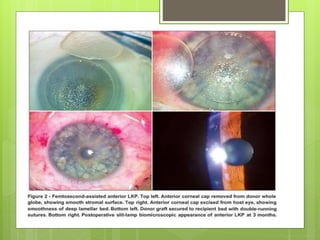
Femto second assisted LKP
 The DALK technique has been enhanced by use of
customised femtosecond trephination such as zig-
zag or mushroom pattern.
 By creating a posterior cut whose posterior depth lies
within 50 to 100 micro meter of endothelium.
 Providing a guide for needle insertion and big bubble
dissection.
PREPARATION OF DONOR
 The main requirement for donor tissue is a clear and
healthy bowman’s layer and stroma.
 The recipient trephine size is selected to be large.
 The disparity between recipient and donor trephine
size is based on vitreous length.
 Endothelium may present potential for immunologic
reaction, so preferable to remove DM.
Complications of anterior lamellar
keratoplasty
DM perforation
 Keratoconus patient are more prone to DM rupture
than any other corneal ds.
 Micro perforation rate are higher with manual layer by
layer dissection and lowest with Anwar big bubble
technique.
Pseudo anterior chamber
 Pseudo anterior chamber occur due secondary to break
in DM.
 Surgical correction of pseudo anterior chamber may be
performed by injection of air or SF6.
fixed dilated pupil (urrets-zavelia syndrome)
 Intra cameral gas injection to seal intraoperative DM
perforation to treat pseudo anterior chamber may cause
pupillary block leading to iris atrophy, iridoplegia,
posterior synaechia and anterior sub capsular cataract.
interface wrinkling
 Fold in DM following DALK are usually transient and
improve over time.
 The fold are often located peripheral and have no impact on
vision.
 A mismatch between recipient bed size and donor button is
responsible for fold.
interface vascularisation and opacification
 Occurrence of surface and suture complication may
stimulate vascularisation of the graft and interface
suture related complication
 Such as sterile reaction, early suture loosening,
cheese wiring and vascularisation.
interface keratitis
 The interface left during DALK is a potential dead
space and introduction of microorganism can
proliferate within space.
 The most common organism is candida.
CONCLUSION
 The major advantage of anterior lamellar
keratoplasty Surgery results from the retention of
unaffected healthy Endothelium while replacing
epithelium and corneal Stroma.
 Thereby eliminating endothelial Allograft rejection,
the major cause of graft failure affecting
penetrating keratoplasty.
 The surgical Challenge of anterior lamellar
keratoplasty surgery is the technical difficulty inherent
in separating the anterior stromal layers from
Descemet’s membrane and endothelium.
 the most important advantages is the fact that the
late corneal failure, due to endothelial cell loss, which
is common after penetrating keratoplasty, is not
anticipated after anterior lamellar keratoplasty.
THANK YOU

Dalk

  • 1.
  • 3.
    Lamellar keratoplasty isa process in which a partial thickness graft of donor tissue is used to provide tectonic stability/optical improvement. Two type of lamellar keratoplasty exist- anterior lamellar keratoplasty and posterior lamellar keratoplasty.
  • 4.
    HISTORY  the firstsuccessful lamellar cornea transplantation was performed by von hippel at end of 19 century.  In 1950 jose barraquer and colleague in Colombia applied the new technique of lamellar keratoplasty, dissecting the corneal stroma down to 2/3 rd of its thickness in both donor and the recipient tissue.  In 1980 eduardo arenas archila used intra stromal air injection to facilitate host tissue removal.
  • 5.
    INDICATION  KERATOCONUS o Thepatient ranging from 20 to 40 year of age need reliable and effective method of corneal transplantation. o Acceptable visual acuity of 20/40 or better has been reported in patient in 77.8-92.3 % of keratoconus patient. o After DALK visual outcome; contrast sensitivity and higher order aberration are comparable to those with PK.
  • 6.
    Post Lasik keractoectasia  The big bubble can be successfully formed in post Lasik cases with a final clear graft and significant improvement in best spectacle corrected visual acuity (BSCVA).
  • 7.
    Hereditary stromal dystrophy Patient with Avellino, lattice and granular corneal dystrophy is good candidate for DALK.  because this technique maximise depth of dissection removing diseased stroma as for as DM .  However DALK is not suitable for macular corneal dystrophy due to involvement of deeper layer of stroma
  • 8.
    Infectious keratitis  DALKis superior to PK in infectious keratitis.  Advantage of DALK in infectious keratitis include lower risk of intraocular extension of infectious organism at time of surgery.  and potential for improved graft survival rate due to elimination of endothelial rejection reaction.
  • 9.
    Tectonic indication  DALKcan be used to restore the globe integrity when there is an area of small perforated ulcer.  DALK using manual dissection with the aid of intra stromal air or fluid injection has been used for small and peripherally located corneal perforation.
  • 10.
    CONTRAINDICATION- Endothelial dysfunction isan absolute contraindication for DALK. Deep scar involving DM over entrance pupil and pre-existing defect and break in DM (acute hydrop) are relative contraindication.
  • 11.
    SURGICAL TECHNIQUE- Manual dissection  Thebasic technique of layer by layer manual dissection is still useful in some case such as in pre-existing corneal perforation, stroma to DM adhesion or in adequate visualisation.  A partial trephination of approx. 2/3 rd ( I.e 300 micrometer ) of total corneal thickness is performed, followed by stromal removal using bevel up crescent knife.  procedure is technically challenging, time consuming and high rate of perforation
  • 12.
    air assisted manualdissection- (archilla technique) • After partial thickness trephination, intra stromal air is injected until the cornea become opaque. • And then manual deep dissection is carried down deep to DM, which appear clear using either crescent or blunt spatula.
  • 13.
    air guided deepstromal technique(melles technique) • In this technique AC aqueous is completely replaced with an air bubble to generate mirror reflection of the spatula inserted into stromal pocket. • The difference in the refractive index between air and corneal tissue create a mirror image aiding in determining the depth of dissection.
  • 14.
     A scleralincision 1-2 mm from limbus is made at 12 o’ clock position.  A sclero corneal tunnel is dissected extending 1 mm to clear cornea.  Through the scleral tunnel bevelled spatula is gradually advanced into deep stroma until mirror reflex of spatula narrow down to fine line, indicating 95& of corneal depth.
  • 15.
    Anwar big bubbletechnique  Introduced by Anwar and Teichmann.  provide quick safe and planned exposure of DM by injection of air deep into deep stroma.  Air is gently injected into deep stroma until round well demarcated air bubble is formed.  after big bubble formation debulking of anterior 2/3 rd of corneal stroma is formed with a crescent blade.
  • 17.
    viscoelastic dissection technique Cornea is trephined to 2/3rd of its thickness then anterior stromal resection, and air is injected into AC.  And remaining stroma is dissected down down to DM and a small pocket is created.  viscoelastic is injected into pocket to complete the detachment of DM from posterior stroma.
  • 18.
    Hydro delamination technique  Afterpartial trephination of recipient cornea, balance salt solution is injected with a 30 gauze needle in four quadrants to make trephined area completely opaque.  A limbal paracentesis is performed to lower the intraocular pressure and to decrease incidence of perforation.
  • 19.
    Femto second assistedLKP  The DALK technique has been enhanced by use of customised femtosecond trephination such as zig- zag or mushroom pattern.  By creating a posterior cut whose posterior depth lies within 50 to 100 micro meter of endothelium.  Providing a guide for needle insertion and big bubble dissection.
  • 21.
    PREPARATION OF DONOR The main requirement for donor tissue is a clear and healthy bowman’s layer and stroma.  The recipient trephine size is selected to be large.  The disparity between recipient and donor trephine size is based on vitreous length.  Endothelium may present potential for immunologic reaction, so preferable to remove DM.
  • 22.
    Complications of anteriorlamellar keratoplasty DM perforation  Keratoconus patient are more prone to DM rupture than any other corneal ds.  Micro perforation rate are higher with manual layer by layer dissection and lowest with Anwar big bubble technique.
  • 23.
    Pseudo anterior chamber Pseudo anterior chamber occur due secondary to break in DM.  Surgical correction of pseudo anterior chamber may be performed by injection of air or SF6. fixed dilated pupil (urrets-zavelia syndrome)  Intra cameral gas injection to seal intraoperative DM perforation to treat pseudo anterior chamber may cause pupillary block leading to iris atrophy, iridoplegia, posterior synaechia and anterior sub capsular cataract.
  • 24.
    interface wrinkling  Foldin DM following DALK are usually transient and improve over time.  The fold are often located peripheral and have no impact on vision.  A mismatch between recipient bed size and donor button is responsible for fold. interface vascularisation and opacification  Occurrence of surface and suture complication may stimulate vascularisation of the graft and interface
  • 25.
    suture related complication Such as sterile reaction, early suture loosening, cheese wiring and vascularisation. interface keratitis  The interface left during DALK is a potential dead space and introduction of microorganism can proliferate within space.  The most common organism is candida.
  • 26.
    CONCLUSION  The majoradvantage of anterior lamellar keratoplasty Surgery results from the retention of unaffected healthy Endothelium while replacing epithelium and corneal Stroma.  Thereby eliminating endothelial Allograft rejection, the major cause of graft failure affecting penetrating keratoplasty.
  • 27.
     The surgicalChallenge of anterior lamellar keratoplasty surgery is the technical difficulty inherent in separating the anterior stromal layers from Descemet’s membrane and endothelium.  the most important advantages is the fact that the late corneal failure, due to endothelial cell loss, which is common after penetrating keratoplasty, is not anticipated after anterior lamellar keratoplasty.
  • 28.