Neuro-Ophthalmology
manifestations of cerebro
vascular diseases
By
Dr. K.Anudeep
Atherosclerosis
• Affects the larger intracranial and extra cranial
vessels
• Internal carotid artery and middle cerebral artery -
most commonly affected
• Atheromatous plaques have been described in retinal
blood vessels
• Peripheral retinal arterioles surrounded by one or two
layers of smooth muscle cells and thus have some
tendency to develop atheromatous plaques
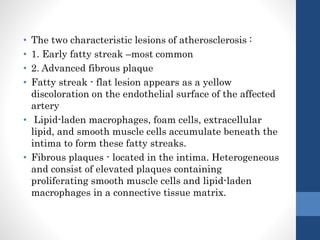
• The two characteristic lesions of atherosclerosis :
• 1. Early fatty streak –most common
• 2. Advanced fibrous plaque
• Fatty streak - flat lesion appears as a yellow
discoloration on the endothelial surface of the affected
artery
• Lipid-laden macrophages, foam cells, extracellular
lipid, and smooth muscle cells accumulate beneath the
intima to form these fatty streaks.
• Fibrous plaques - located in the intima. Heterogeneous
and consist of elevated plaques containing
proliferating smooth muscle cells and lipid-laden
macrophages in a connective tissue matrix.
• Fibrous plaques increase in size
• extensive degeneration and calcification.
• Wall of an affected artery becomes eccentrically thickened
• Lumen becomes narrowed
• Plaques themselves develop ulcerations, cracks, and
fissures
• Breach of the vascular endothelium
• Activates platelets and the coagulation cascade,
• Formation of thrombin and clot
• Ultimately produces thrombosis and occlusion of the
affected artery
Ophthalmoscopic appearance shows multiple
atheromatous plaques
C- Frozen section through an inferonasal artery
shows lipid deposits in the wall of the vessel. D -
Frozen section through the superior branch of the
central retinal artery shows deposition of lipids in
the vessel wall.
• Stroke :
• Types of Stroke - 1. Ischemic - Embolic and Thrombotic
• 2. Hemorrhagic - Intracerebral hemorrhage and
Subarachnoid hemorrhage
• Risk Factors :
• Stroke in Older Patients
• 1. Giant Cell Arteritis
• 2. Hypertension
• 3. Diabetes
• 4. Hypercholesterolemia
• 5. Smoking
• 6. Carotid Stenosis
• 7. Ocular Ischemic Syndrome – chronic ocular
hypoperfusion secondary to ipsilateral atherosclerotic
carotid stenosis ass. With DM,HTN cardio and
cerebrovacular diseases
• Ocular Manifestations Of OIS :
• i. Transient Vision Loss - Amaurosis Fugax
• ii. Red Eye
• iii. Eye Pain
• iv. Mid-Peripheral Retinal Hemorrhages
• v. Uveitis
• vi. Iris Neovascularization
• vii. Neovascular Glaucoma
• viii. Emboli (Hollenhorst Plaques)
• ix. Optic Disc Edema (Ischemic Optic Neuropathy)
• x. Retinal Artery Occlusion (CRAO / BRAO)
• xi. Ophthalmic Artery Occlusion
• xii. Retinal Or Disc Neovascularization
• xiii. Venous Stasis Retinopathy
• Stroke in Younger Patients
• 1. Hypercoagulable States
• 2. Sickle Cell Disease
• 3. Patent foramen ovale
• 4. Carotid artery dissection
• Neuro-Ophthalmic Features of Stroke
• i. Retinal artery occlusion
• 1. Types
• a. BRAO
• b. CRAO
• 2. . Internuclear Ophthalmoplegia (INO)
• 3. Gaze palsy
• 4. Vertical eye movement restriction
• Raised ICP :
• Headache, nausea, deterioration of consciousness
• Transient visual loss lasting upto 30sec
• Horizontal diplopia due to 6th nerve palsy – stretching
of abducens nerve over the pitrous pit – false localising
sign
• Papilloedema
• Enlargement of blind spot
• Causes of raised ICP :
• Idiopathic intracranial HTN
• Space occupying lesions
• Meningitis, SAH, trauma
• Cerebral venous sinus thrombosis
• Cerebral aneurysms :
• Localised dilatation of vessel wall
• Predisposing factors – AV malformations, coarcotation
of aorta, polycystic kidney disease and connective
tissue disease – fibromuscular dysplasia, marfans
syndrome and ehler danlos syndrome
• Most common type – saccular or berry aneurysm
arises at arterial bifurcation
• Aneurysms > 10mm – rupture
• Aneurysms > 25mm – giant aneurysms
• Ophthalmic artery aneurysm – progressive unilateral
optic neuropathy and ipsilateral periocular pain
• Anterior communicating artery aneurysm – loss of
vision by compressing the optic chiasm or optic tract
• Aneurysm at the junction of internal carotid and
posterior communicating artery – ipsilateral 3rd nerve
palsy
• Complete 3rd nerve palsy with pupil involvement and
partial 3rd nerve palsy with or without pupil
involvement - aneurysm
• Intracavernous carotid artery aneursym – cavernous
sinus syndrome - fusiform enlargement
• 3,4,6 and ophthalmic branch of 5th cranial nerve are
involved
• Ruptured aneursym – headache - the worst of my life
• Nausea, vomiting, neck stiffness and raised ICP may
produce papilloedema and 6th nerve palsy
• Disoriented, lethargic and comatose
• Diagnosis :
• Immediate neuroimaging
• CT angiography and MRI - gold standard
• Treatment :
• Stabilise the patient
• Lower the intracranial pressure – mannitol
• Cerebral vasospasm with calcium channel blockers
• Definitive treatment – surgical clipping of aneurysm
• Intravascular techniques – coil embolisation or stent
placement
• Cerebral venous thrombosis :
• Most common
• Cavernous sinus thrombosis
• Lateral sinus thrombosis
• Superior sagittal sinus
• Occlusion of cortical and subcortical veins – focal
neurologic signs
• Cavernous sinus thrombosis :
• Septic form from infection of face, sphenoid or ethmoid
sinus
• Ocular signs :
• Orbital congestion
• Lacrimation
• Conjunctival oedema
• Eyelid swelling
• Ptosis and proptosis
• Ophthalmoplegia
• 6th nerve palsy
• Corneal anaesthesia and horner syndrome
• Headache, nausea, vomiting, fever, chills and signs of
meningitis
• Septic CST – emergency should be treated with antibiotics
and steroids
• Lateral sinus thrombosis :
• Neck pain, tenderness of ipsilateral jugular vein
• Retroauricular edema and facial weakness
• Severe facial pain with 6th nerve palsy – gradenigo
syndrome
• Superior sagittal sinus thrombosis :
• Most common
• Thrombosis of anterior third of sinus – symptoms are mild
or absent
• Posterior SSS thrombosis – IIH with headache and
papilloedema
• Diagnosis :
• CT or MRI initially
• MRV or CTV should be considered
• Treatment :
• Treat the underlying condition
• Anticoagulants and fibrinolytic drugs
• Migraine :
• Unilateral headache with nausea and vomitings
• Associated with neurological and mood disturbances
• Migraine with aura - classic migraine
• Binocular visual aura affects central visual field on
one side and lasts for 5-30min
• Binocular negative scotoma
• Scintillating scotoma – zig-zag or fortification spectra
• Paraesthesia, weakness and dysphasia
• Retinal migraine – visual disturbance affects only one
eye
• Ophthalmoplegic migraine – rare, age < 10yrs,
recurrent headache followed by a 3rd nerve palsy
• Familial hemiplegic migraine – failure of full recovery
of focal neurological features after an attack of
migraine subsides
• Basilar migraine – typical migrainous aura with
vertebrobasilar insufficiency symptoms
• Embolism –
• Piece of material that lodges in a blood vessel and
blocks the flow of blood.
• Embolus is not caused by a localized process
originating within the vessel but rather has formed
elsewhere. Arise proximal to the vessel in which they
lodge
• Embolism - Cause of stroke in young adults
• Two important clinical implications associated with
retinal emboli:
• 1. Distal portions of the occluded arterioles may be in
an ischemic state - overt retinal artery occlusion may
develop
• 2. Patients with retinal emboli with or without retinal
artery occlusion seem to be at higher risk of stroke and
mortality from cardiovascular disease
• Retinal emboli –
• The most common emboli that travel to the retinal
arterial circulation - cholesterol emboli, platelet-fibrin
emboli, and emboli composed of calcium.
• Less common - tumor emboli from cardiac myxoma,
metastatic neoplasms, fat emboli from fractures of
long bones, septic emboli, talc emboli, and
miscellaneous emboli of depot drugs, silicone, or air
that occur after injections in the region of the face or
scalp
cholesterol emboli
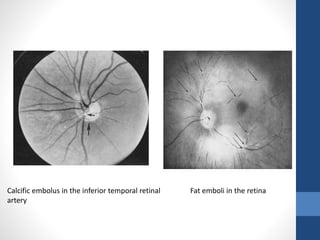
Calcific embolus in the inferior temporal retinal
artery
Fat emboli in the retina
• Cervicocerebral arterial dissections :
• Blood extrudes into the wall of an artery supplying the
brain.
• Intramural hematoma may compromise the lumen
• Aneurysmal dilatation
• Results in symptoms of cerebral or ocular ischemia
• decrease in blood flow secondary to luminal narrowing
or occlusion or from local thrombosis and secondary
embolization
• The major presenting features of cervicocerebral
dissections
• 1.Horner syndrome in carotid dissections
• 2. Stroke or TIA associated with pain in the ipsilateral
neck, the face, or head
• ICA artery dissection :
• Painful horner syndrome, transient monocular vision
loss, ischaemic optic neuropathy, CRAO, ischaemic
ocular syndrome, ocular motor nerve palsy.
• Painful horner syndrome - damage to the sympathetic
pathway at or distal to the superior cervical ganglion
• Due to ischemia or compression
• Oculomotor nerve palsy - direct compression of an
ocular motor nerve by extension of the dissection into
the carotid canal and cavernous sinus
• The inferolateral trunk supplies cranial nerves III, IV,
and VI and the first division of cranial nerve V -
interrupted by the dissection of the internal carotid
artery
A - there is anisocoria worse in the dark (middle)
than in the light (top), suggesting a left Horner
syndrome.
B - T2-weighted MRI showing a hypersignal within
the left internal carotid artery wall - characteristic
of subacute dissection.
C - MRA showing decreased signal in the left
internal carotid artery associated with a focal signal
(arrow) corresponding to the hematoma in the wall
of the dissected internal carotid artery.
• Vertebrobasilar system – posterior
circulation
• Vertebral, basilar and posterior cerebral arteries
• Blurring or complete loss of vision
• Usually BE affected simultaneously
• Sudden greyout of vision
• Associated with flashing of silvery light in a
homonymous or altitudinal field of vision.
• Should be differentiated from increased intracranial
pressure and migraine
• Increased ICP – brief episodes of blurring of vision
associated with papilloedema
• Migraine – bilateral visual loss usually lasts about
20min
• Transient horizontal or vertical diplopia is a common
manifestation of vertebrobasilar ischemia.
• Diplopia may result from transient ischemia of the
ocular motor nerves or their nuclei or from transient
ischemia to supranuclear or internuclear ocular motor
pathways. Lasts for 5 to 10 min
• Horizontal or vertical gaze palsies
• Internuclear ophthalmoplegia
• Ocular motor nerve palsy
• Nystagmus
• Homonymous visual field changes without
neurological signs – posterior circulation
• Etilology of vertebrobasilar insufficiency :
• Atheromatous occlusion
• Lacunar infarction
• Microembolisation
• Arterial dissection
• Polycythemia, hypercoagulable states, cervical
spondylosis
• Diagnosis :
• Neuroimaging
• MRA and CTA
• Treatment – antiplatelets or anticoagulants
• Intravascular stent placement – vertebrobasilar
stenosis
• Internal carotid arterial system :
• Homonymous and bitemporal visual field defects and
bilateral simultaneous visual loss
• Transient monocular visual loss - most common and
most important ophthalmologic symptom of disease of
the internal carotid arterial system - amaurosis fugax
• Most episodes of transient monocular visual loss last
20 to 30 minutes and then resolve spontaneously
• Transient monocular visual loss precipitated by
rotation of the head or external compression of the
neck.
• Due to intermittent compression of the internal
carotid artery in patients with severe carotid stenosis
Ocular manifestations of carotid disease :
Asymptomatic retinal emboli
Transient monocular vision loss
CRAO
Ophthalmic artery occlusion
Venous stasis retinopathy
Ocular ischemic syndrome
Ischemic optic neuropathy
Optic nerve compression
Horners syndrome
Ocular motor nerve paresis
• Ophthalmic artery occlusion :
• Transient monocular loss of vision
• Ocular ischemic syndrome
• When both the retinal and choroidal circulations are
compromised from ophthalmic artery occlusion, more
dramatic clinical symptoms and signs occur than
result from a CRAO or an ION alone
• Visual loss is severe with no PL or PL
• Pupillary dilation, eye may be hypotonous
• Visual loss is usually permanent
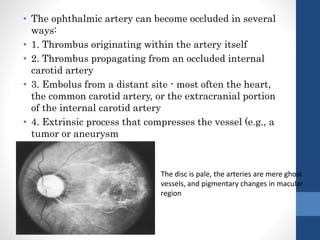
• Most patients develop a characteristic fundus
appearance - optic atrophy, arterial attenuation, and
diffuse pigmentary changes
• The ophthalmic artery can become occluded in several
ways:
• 1. Thrombus originating within the artery itself
• 2. Thrombus propagating from an occluded internal
carotid artery
• 3. Embolus from a distant site - most often the heart,
the common carotid artery, or the extracranial portion
of the internal carotid artery
• 4. Extrinsic process that compresses the vessel (e.g., a
tumor or aneurysm
The disc is pale, the arteries are mere ghost
vessels, and pigmentary changes in macular
region
• Blood loss :
• Pathophysiology - hypovolemia
• Visual loss as well as diffuse and focal neurologic
deficits - after acute blood loss.
• Unilateral or bilateral infarction of the retina, optic
nerve, or both or from occipital hypoperfusion
• The severity of visual loss ranges from mild or
transient blurred vision in one eye to irreversible total
blindness in both eyes
• Mild to severe optic disc swelling,
• pupillary responses to light are sluggish or absent -
severe damage to the optic nerve
Bilateral anterior ischemic optic neuropathy after blood
loss
• Susac syndrome :
• Young woman age group – 8 to 59 yrs
• Multiple branched retinal occlusions bilateral,
progressive hearing loss, encephalopathy
• Retinal fluorescein angiography - retinal arterial wall
hyperfluorescence.
• Moyamoya disease – morning glory anomaly
• Malignant atrophic papullosis - rare
cutaneovisceral occlusive disease - typical skin rash
and gastrointestinal perforation.
• occlusion of ocular, orbital, or intracranial arteries and
veins. Infarction of the bulbar conjunctiva
• choroidal infarction
• Ischemic optic neuropathy
• Papilledema
• Ophthalmoparesis from ocular motor nerve paresis
• Ptosis, and homonymous visual field defects all occur

Neuroophthal

  • 1.
  • 2.
    Atherosclerosis • Affects thelarger intracranial and extra cranial vessels • Internal carotid artery and middle cerebral artery - most commonly affected • Atheromatous plaques have been described in retinal blood vessels • Peripheral retinal arterioles surrounded by one or two layers of smooth muscle cells and thus have some tendency to develop atheromatous plaques
  • 3.
    • The twocharacteristic lesions of atherosclerosis : • 1. Early fatty streak –most common • 2. Advanced fibrous plaque • Fatty streak - flat lesion appears as a yellow discoloration on the endothelial surface of the affected artery • Lipid-laden macrophages, foam cells, extracellular lipid, and smooth muscle cells accumulate beneath the intima to form these fatty streaks. • Fibrous plaques - located in the intima. Heterogeneous and consist of elevated plaques containing proliferating smooth muscle cells and lipid-laden macrophages in a connective tissue matrix.
  • 4.
    • Fibrous plaquesincrease in size • extensive degeneration and calcification. • Wall of an affected artery becomes eccentrically thickened • Lumen becomes narrowed • Plaques themselves develop ulcerations, cracks, and fissures
  • 5.
    • Breach ofthe vascular endothelium • Activates platelets and the coagulation cascade, • Formation of thrombin and clot • Ultimately produces thrombosis and occlusion of the affected artery
  • 6.
    Ophthalmoscopic appearance showsmultiple atheromatous plaques C- Frozen section through an inferonasal artery shows lipid deposits in the wall of the vessel. D - Frozen section through the superior branch of the central retinal artery shows deposition of lipids in the vessel wall.
  • 7.
    • Stroke : •Types of Stroke - 1. Ischemic - Embolic and Thrombotic • 2. Hemorrhagic - Intracerebral hemorrhage and Subarachnoid hemorrhage • Risk Factors : • Stroke in Older Patients • 1. Giant Cell Arteritis • 2. Hypertension • 3. Diabetes • 4. Hypercholesterolemia • 5. Smoking • 6. Carotid Stenosis • 7. Ocular Ischemic Syndrome – chronic ocular hypoperfusion secondary to ipsilateral atherosclerotic carotid stenosis ass. With DM,HTN cardio and cerebrovacular diseases
  • 8.
    • Ocular ManifestationsOf OIS : • i. Transient Vision Loss - Amaurosis Fugax • ii. Red Eye • iii. Eye Pain • iv. Mid-Peripheral Retinal Hemorrhages • v. Uveitis • vi. Iris Neovascularization • vii. Neovascular Glaucoma • viii. Emboli (Hollenhorst Plaques) • ix. Optic Disc Edema (Ischemic Optic Neuropathy) • x. Retinal Artery Occlusion (CRAO / BRAO) • xi. Ophthalmic Artery Occlusion • xii. Retinal Or Disc Neovascularization • xiii. Venous Stasis Retinopathy
  • 9.
    • Stroke inYounger Patients • 1. Hypercoagulable States • 2. Sickle Cell Disease • 3. Patent foramen ovale • 4. Carotid artery dissection • Neuro-Ophthalmic Features of Stroke • i. Retinal artery occlusion • 1. Types • a. BRAO • b. CRAO • 2. . Internuclear Ophthalmoplegia (INO) • 3. Gaze palsy • 4. Vertical eye movement restriction
  • 10.
    • Raised ICP: • Headache, nausea, deterioration of consciousness • Transient visual loss lasting upto 30sec • Horizontal diplopia due to 6th nerve palsy – stretching of abducens nerve over the pitrous pit – false localising sign • Papilloedema • Enlargement of blind spot
  • 11.
    • Causes ofraised ICP : • Idiopathic intracranial HTN • Space occupying lesions • Meningitis, SAH, trauma • Cerebral venous sinus thrombosis
  • 12.
    • Cerebral aneurysms: • Localised dilatation of vessel wall • Predisposing factors – AV malformations, coarcotation of aorta, polycystic kidney disease and connective tissue disease – fibromuscular dysplasia, marfans syndrome and ehler danlos syndrome • Most common type – saccular or berry aneurysm arises at arterial bifurcation • Aneurysms > 10mm – rupture • Aneurysms > 25mm – giant aneurysms • Ophthalmic artery aneurysm – progressive unilateral optic neuropathy and ipsilateral periocular pain
  • 13.
    • Anterior communicatingartery aneurysm – loss of vision by compressing the optic chiasm or optic tract • Aneurysm at the junction of internal carotid and posterior communicating artery – ipsilateral 3rd nerve palsy • Complete 3rd nerve palsy with pupil involvement and partial 3rd nerve palsy with or without pupil involvement - aneurysm • Intracavernous carotid artery aneursym – cavernous sinus syndrome - fusiform enlargement • 3,4,6 and ophthalmic branch of 5th cranial nerve are involved • Ruptured aneursym – headache - the worst of my life • Nausea, vomiting, neck stiffness and raised ICP may produce papilloedema and 6th nerve palsy • Disoriented, lethargic and comatose
  • 14.
    • Diagnosis : •Immediate neuroimaging • CT angiography and MRI - gold standard • Treatment : • Stabilise the patient • Lower the intracranial pressure – mannitol • Cerebral vasospasm with calcium channel blockers • Definitive treatment – surgical clipping of aneurysm • Intravascular techniques – coil embolisation or stent placement
  • 15.
    • Cerebral venousthrombosis : • Most common • Cavernous sinus thrombosis • Lateral sinus thrombosis • Superior sagittal sinus • Occlusion of cortical and subcortical veins – focal neurologic signs
  • 16.
    • Cavernous sinusthrombosis : • Septic form from infection of face, sphenoid or ethmoid sinus • Ocular signs : • Orbital congestion • Lacrimation • Conjunctival oedema • Eyelid swelling • Ptosis and proptosis • Ophthalmoplegia • 6th nerve palsy • Corneal anaesthesia and horner syndrome • Headache, nausea, vomiting, fever, chills and signs of meningitis
  • 17.
    • Septic CST– emergency should be treated with antibiotics and steroids • Lateral sinus thrombosis : • Neck pain, tenderness of ipsilateral jugular vein • Retroauricular edema and facial weakness • Severe facial pain with 6th nerve palsy – gradenigo syndrome • Superior sagittal sinus thrombosis : • Most common • Thrombosis of anterior third of sinus – symptoms are mild or absent • Posterior SSS thrombosis – IIH with headache and papilloedema
  • 18.
    • Diagnosis : •CT or MRI initially • MRV or CTV should be considered • Treatment : • Treat the underlying condition • Anticoagulants and fibrinolytic drugs
  • 19.
    • Migraine : •Unilateral headache with nausea and vomitings • Associated with neurological and mood disturbances • Migraine with aura - classic migraine • Binocular visual aura affects central visual field on one side and lasts for 5-30min • Binocular negative scotoma • Scintillating scotoma – zig-zag or fortification spectra • Paraesthesia, weakness and dysphasia • Retinal migraine – visual disturbance affects only one eye • Ophthalmoplegic migraine – rare, age < 10yrs, recurrent headache followed by a 3rd nerve palsy
  • 20.
    • Familial hemiplegicmigraine – failure of full recovery of focal neurological features after an attack of migraine subsides • Basilar migraine – typical migrainous aura with vertebrobasilar insufficiency symptoms
  • 21.
    • Embolism – •Piece of material that lodges in a blood vessel and blocks the flow of blood. • Embolus is not caused by a localized process originating within the vessel but rather has formed elsewhere. Arise proximal to the vessel in which they lodge • Embolism - Cause of stroke in young adults • Two important clinical implications associated with retinal emboli: • 1. Distal portions of the occluded arterioles may be in an ischemic state - overt retinal artery occlusion may develop • 2. Patients with retinal emboli with or without retinal artery occlusion seem to be at higher risk of stroke and mortality from cardiovascular disease
  • 22.
    • Retinal emboli– • The most common emboli that travel to the retinal arterial circulation - cholesterol emboli, platelet-fibrin emboli, and emboli composed of calcium. • Less common - tumor emboli from cardiac myxoma, metastatic neoplasms, fat emboli from fractures of long bones, septic emboli, talc emboli, and miscellaneous emboli of depot drugs, silicone, or air that occur after injections in the region of the face or scalp
  • 24.
  • 25.
    Calcific embolus inthe inferior temporal retinal artery Fat emboli in the retina
  • 26.
    • Cervicocerebral arterialdissections : • Blood extrudes into the wall of an artery supplying the brain. • Intramural hematoma may compromise the lumen • Aneurysmal dilatation • Results in symptoms of cerebral or ocular ischemia • decrease in blood flow secondary to luminal narrowing or occlusion or from local thrombosis and secondary embolization
  • 27.
    • The majorpresenting features of cervicocerebral dissections • 1.Horner syndrome in carotid dissections • 2. Stroke or TIA associated with pain in the ipsilateral neck, the face, or head
  • 28.
    • ICA arterydissection : • Painful horner syndrome, transient monocular vision loss, ischaemic optic neuropathy, CRAO, ischaemic ocular syndrome, ocular motor nerve palsy. • Painful horner syndrome - damage to the sympathetic pathway at or distal to the superior cervical ganglion • Due to ischemia or compression • Oculomotor nerve palsy - direct compression of an ocular motor nerve by extension of the dissection into the carotid canal and cavernous sinus • The inferolateral trunk supplies cranial nerves III, IV, and VI and the first division of cranial nerve V - interrupted by the dissection of the internal carotid artery
  • 29.
    A - thereis anisocoria worse in the dark (middle) than in the light (top), suggesting a left Horner syndrome. B - T2-weighted MRI showing a hypersignal within the left internal carotid artery wall - characteristic of subacute dissection. C - MRA showing decreased signal in the left internal carotid artery associated with a focal signal (arrow) corresponding to the hematoma in the wall of the dissected internal carotid artery.
  • 30.
    • Vertebrobasilar system– posterior circulation • Vertebral, basilar and posterior cerebral arteries • Blurring or complete loss of vision • Usually BE affected simultaneously • Sudden greyout of vision • Associated with flashing of silvery light in a homonymous or altitudinal field of vision. • Should be differentiated from increased intracranial pressure and migraine • Increased ICP – brief episodes of blurring of vision associated with papilloedema • Migraine – bilateral visual loss usually lasts about 20min
  • 31.
    • Transient horizontalor vertical diplopia is a common manifestation of vertebrobasilar ischemia. • Diplopia may result from transient ischemia of the ocular motor nerves or their nuclei or from transient ischemia to supranuclear or internuclear ocular motor pathways. Lasts for 5 to 10 min • Horizontal or vertical gaze palsies • Internuclear ophthalmoplegia • Ocular motor nerve palsy • Nystagmus • Homonymous visual field changes without neurological signs – posterior circulation
  • 32.
    • Etilology ofvertebrobasilar insufficiency : • Atheromatous occlusion • Lacunar infarction • Microembolisation • Arterial dissection • Polycythemia, hypercoagulable states, cervical spondylosis • Diagnosis : • Neuroimaging • MRA and CTA • Treatment – antiplatelets or anticoagulants • Intravascular stent placement – vertebrobasilar stenosis
  • 33.
    • Internal carotidarterial system : • Homonymous and bitemporal visual field defects and bilateral simultaneous visual loss • Transient monocular visual loss - most common and most important ophthalmologic symptom of disease of the internal carotid arterial system - amaurosis fugax • Most episodes of transient monocular visual loss last 20 to 30 minutes and then resolve spontaneously • Transient monocular visual loss precipitated by rotation of the head or external compression of the neck. • Due to intermittent compression of the internal carotid artery in patients with severe carotid stenosis
  • 35.
    Ocular manifestations ofcarotid disease : Asymptomatic retinal emboli Transient monocular vision loss CRAO Ophthalmic artery occlusion Venous stasis retinopathy Ocular ischemic syndrome Ischemic optic neuropathy Optic nerve compression Horners syndrome Ocular motor nerve paresis
  • 36.
    • Ophthalmic arteryocclusion : • Transient monocular loss of vision • Ocular ischemic syndrome • When both the retinal and choroidal circulations are compromised from ophthalmic artery occlusion, more dramatic clinical symptoms and signs occur than result from a CRAO or an ION alone • Visual loss is severe with no PL or PL • Pupillary dilation, eye may be hypotonous • Visual loss is usually permanent • Most patients develop a characteristic fundus appearance - optic atrophy, arterial attenuation, and diffuse pigmentary changes
  • 37.
    • The ophthalmicartery can become occluded in several ways: • 1. Thrombus originating within the artery itself • 2. Thrombus propagating from an occluded internal carotid artery • 3. Embolus from a distant site - most often the heart, the common carotid artery, or the extracranial portion of the internal carotid artery • 4. Extrinsic process that compresses the vessel (e.g., a tumor or aneurysm The disc is pale, the arteries are mere ghost vessels, and pigmentary changes in macular region
  • 38.
    • Blood loss: • Pathophysiology - hypovolemia • Visual loss as well as diffuse and focal neurologic deficits - after acute blood loss. • Unilateral or bilateral infarction of the retina, optic nerve, or both or from occipital hypoperfusion • The severity of visual loss ranges from mild or transient blurred vision in one eye to irreversible total blindness in both eyes • Mild to severe optic disc swelling, • pupillary responses to light are sluggish or absent - severe damage to the optic nerve
  • 39.
    Bilateral anterior ischemicoptic neuropathy after blood loss
  • 41.
    • Susac syndrome: • Young woman age group – 8 to 59 yrs • Multiple branched retinal occlusions bilateral, progressive hearing loss, encephalopathy • Retinal fluorescein angiography - retinal arterial wall hyperfluorescence. • Moyamoya disease – morning glory anomaly
  • 42.
    • Malignant atrophicpapullosis - rare cutaneovisceral occlusive disease - typical skin rash and gastrointestinal perforation. • occlusion of ocular, orbital, or intracranial arteries and veins. Infarction of the bulbar conjunctiva • choroidal infarction • Ischemic optic neuropathy • Papilledema • Ophthalmoparesis from ocular motor nerve paresis • Ptosis, and homonymous visual field defects all occur