Principles of Active Learning 2:
formative assessment, feedback and
feedforward
Why is assessment useful?
On tables, in small groups: list all the reasons for
assessing learners’ progress.
November 6, 2017
Formative and Summative assessments
Assessment – if a student does something and then reveals what
they have done, this can be assessed.
Ashwin et al. 2015, p.250
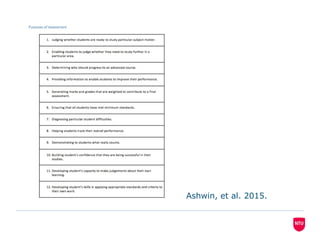
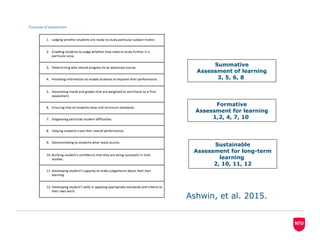
Ashwin, et al. 2015.
Summative
Assessment of learning
3, 5, 6, 8
Formative
Assessment for learning
1,2, 4, 7, 10
Sustainable
Assessment for long-term
learning
2, 10, 11, 12
Session Aims:
1. To introduce you to the principles and practices of formative
assessment, feedback and feedforward
2. To help you to evaluate and develop your current practice in using
formative assessment and feedback/feedforward to support
student progress
November 6, 2017
Session Learning Outcomes:
By completing this session, you should be able to:
LO1 Evaluate your current practice in using formative assessment, feedback
and feedforward
LO2 Identify methods to enable your learners to engage more effectively with
feedback
November 6, 2017
Your practice
What formative assessment methods do you use already?
•Individually: Describe current practices THINK
•In pairs: PAIR
•As a group: SHARE
FORMATIVE ASSESSMENT
AND FEEDBACK
6 November 2017 9
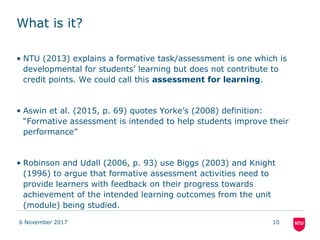
What is it?
• NTU (2013) explains a formative task/assessment is one which is
developmental for students’ learning but does not contribute to
credit points. We could call this assessment for learning.
• Aswin et al. (2015, p. 69) quotes Yorke’s (2008) definition:
“Formative assessment is intended to help students improve their
performance”
• Robinson and Udall (2006, p. 93) use Biggs (2003) and Knight
(1996) to argue that formative assessment activities need to
provide learners with feedback on their progress towards
achievement of the intended learning outcomes from the unit
(module) being studied.
6 November 2017 10
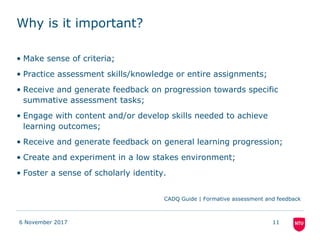
Why is it important?
• Make sense of criteria;
• Practice assessment skills/knowledge or entire assignments;
• Receive and generate feedback on progression towards specific
summative assessment tasks;
• Engage with content and/or develop skills needed to achieve
learning outcomes;
• Receive and generate feedback on general learning progression;
• Create and experiment in a low stakes environment;
• Foster a sense of scholarly identity.
CADQ Guide | Formative assessment and feedback
6 November 2017 11
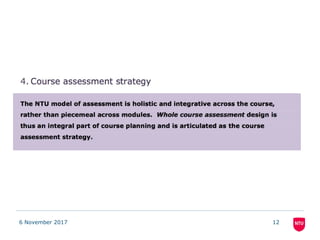
6 November 2017 12
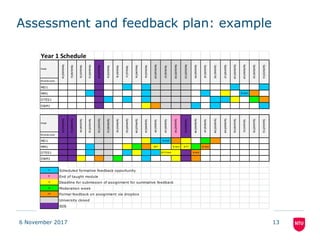
Assessment and feedback plan: example
6 November 2017 13
student-centred learning process
Without information about their work being taken up and used by
students, it is hard to justify the use of the word feedback at all. Boud
and Molloy (2013a) call this ‘hopefully useful information.
Ashwin et al, 2015, p.265.
6 November 2017 14
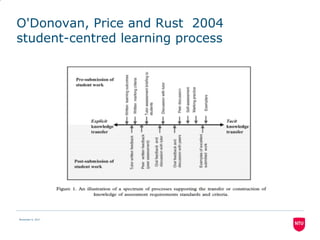
O'Donovan, Price and Rust 2004
student-centred learning process
November 6, 2017
5
6 November 2017 16
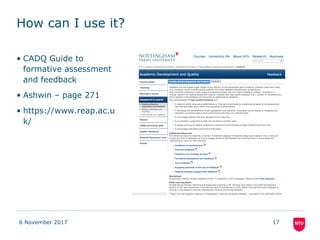
How can I use it?
• CADQ Guide to
formative assessment
and feedback
• Ashwin – page 271
• https://www.reap.ac.u
k/
6 November 2017 17
What have I learnt?
• One-minute paper
• Write for one-minute on the topic of formative assessment, what
have you learned or what do you need to do to develop your
understanding and skills next.
6 November 2017 18
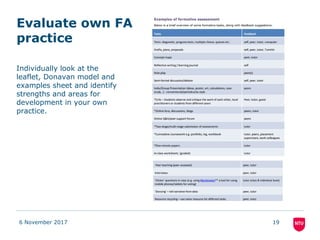
Evaluate own FA
practice
6 November 2017 19
Individually look at the
leaflet, Donavan model and
examples sheet and identify
strengths and areas for
development in your own
practice.
• Share findings across your table and: Determine explicit and tacit
knowledge transference.
BREAK
November 6, 2017 21
Summative Assessment – PGCAP
module 1
Assessment Brief
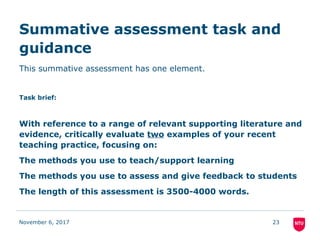
Summative assessment task and
guidance
This summative assessment has one element.
Task brief:
With reference to a range of relevant supporting literature and
evidence, critically evaluate two examples of your recent
teaching practice, focusing on:
The methods you use to teach/support learning
The methods you use to assess and give feedback to students
The length of this assessment is 3500-4000 words.
November 6, 2017 23
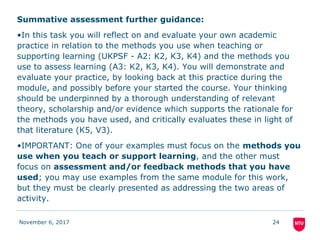
Summative assessment further guidance:
•In this task you will reflect on and evaluate your own academic
practice in relation to the methods you use when teaching or
supporting learning (UKPSF - A2: K2, K3, K4) and the methods you
use to assess learning (A3: K2, K3, K4). You will demonstrate and
evaluate your practice, by looking back at this practice during the
module, and possibly before your started the course. Your thinking
should be underpinned by a thorough understanding of relevant
theory, scholarship and/or evidence which supports the rationale for
the methods you have used, and critically evaluates these in light of
that literature (K5, V3).
•IMPORTANT: One of your examples must focus on the methods you
use when you teach or support learning, and the other must
focus on assessment and/or feedback methods that you have
used; you may use examples from the same module for this work,
but they must be clearly presented as addressing the two areas of
activity.
November 6, 2017 24
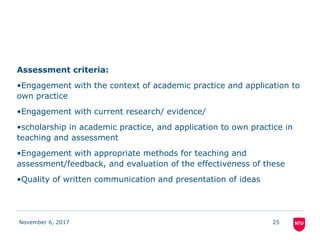
Assessment criteria:
•Engagement with the context of academic practice and application to
own practice
•Engagement with current research/ evidence/
•scholarship in academic practice, and application to own practice in
teaching and assessment
•Engagement with appropriate methods for teaching and
assessment/feedback, and evaluation of the effectiveness of these
•Quality of written communication and presentation of ideas
November 6, 2017 25
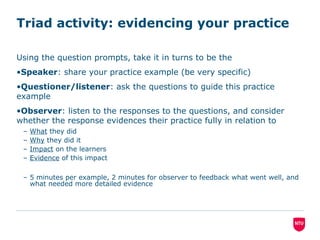
Triad activity: evidencing your practice
Using the question prompts, take it in turns to be the
•Speaker: share your practice example (be very specific)
•Questioner/listener: ask the questions to guide this practice
example
•Observer: listen to the responses to the questions, and consider
whether the response evidences their practice fully in relation to
– What they did
– Why they did it
– Impact on the learners
– Evidence of this impact
– 5 minutes per example, 2 minutes for observer to feedback what went well, and
what needed more detailed evidence
What are the challenges of evidencing
your practice?
Session Learning Outcomes:
By completing this session, you should be able to:
LO1 Evaluate your current practice in using formative assessment,
feedback and feedforward
LO2 Identify methods to enable your learners to engage more
effectively with feedback
November 6, 2017
In the critical reflection you should:
– identify the context in which you teach/support learning and the impact of this
on your practice
– apply and explore the impact of relevant theories /research/
– scholarship on your practice
– demonstrate the currency of your subject knowledge and how this impacts on
your practice
– explore your use of appropriate digital technologies to support teaching and/or
assessment practices
– evaluate the effectiveness of your practice to date, including the identification of
areas for your ongoing CPD in teaching and supporting learning
– The two examples can be from the same module or area of practice.
– Remember that you should use evidence from your Professional Portfolio to
support the choice of materials you reflect on in this task.
November 6, 2017 29

Pgcap session 5 module 1 session ppt nov 2017 (1)

  • 1.
    Principles of ActiveLearning 2: formative assessment, feedback and feedforward
  • 2.
    Why is assessmentuseful? On tables, in small groups: list all the reasons for assessing learners’ progress. November 6, 2017
  • 3.
    Formative and Summativeassessments Assessment – if a student does something and then reveals what they have done, this can be assessed. Ashwin et al. 2015, p.250
  • 4.
  • 5.
    Ashwin, et al.2015. Summative Assessment of learning 3, 5, 6, 8 Formative Assessment for learning 1,2, 4, 7, 10 Sustainable Assessment for long-term learning 2, 10, 11, 12
  • 6.
    Session Aims: 1. Tointroduce you to the principles and practices of formative assessment, feedback and feedforward 2. To help you to evaluate and develop your current practice in using formative assessment and feedback/feedforward to support student progress November 6, 2017
  • 7.
    Session Learning Outcomes: Bycompleting this session, you should be able to: LO1 Evaluate your current practice in using formative assessment, feedback and feedforward LO2 Identify methods to enable your learners to engage more effectively with feedback November 6, 2017
  • 8.
    Your practice What formativeassessment methods do you use already? •Individually: Describe current practices THINK •In pairs: PAIR •As a group: SHARE
  • 9.
  • 10.
    What is it? •NTU (2013) explains a formative task/assessment is one which is developmental for students’ learning but does not contribute to credit points. We could call this assessment for learning. • Aswin et al. (2015, p. 69) quotes Yorke’s (2008) definition: “Formative assessment is intended to help students improve their performance” • Robinson and Udall (2006, p. 93) use Biggs (2003) and Knight (1996) to argue that formative assessment activities need to provide learners with feedback on their progress towards achievement of the intended learning outcomes from the unit (module) being studied. 6 November 2017 10
  • 11.
    Why is itimportant? • Make sense of criteria; • Practice assessment skills/knowledge or entire assignments; • Receive and generate feedback on progression towards specific summative assessment tasks; • Engage with content and/or develop skills needed to achieve learning outcomes; • Receive and generate feedback on general learning progression; • Create and experiment in a low stakes environment; • Foster a sense of scholarly identity. CADQ Guide | Formative assessment and feedback 6 November 2017 11
  • 12.
  • 13.
    Assessment and feedbackplan: example 6 November 2017 13
  • 14.
    student-centred learning process Withoutinformation about their work being taken up and used by students, it is hard to justify the use of the word feedback at all. Boud and Molloy (2013a) call this ‘hopefully useful information. Ashwin et al, 2015, p.265. 6 November 2017 14
  • 15.
    O'Donovan, Price andRust 2004 student-centred learning process November 6, 2017 5
  • 16.
  • 17.
    How can Iuse it? • CADQ Guide to formative assessment and feedback • Ashwin – page 271 • https://www.reap.ac.u k/ 6 November 2017 17
  • 18.
    What have Ilearnt? • One-minute paper • Write for one-minute on the topic of formative assessment, what have you learned or what do you need to do to develop your understanding and skills next. 6 November 2017 18
  • 19.
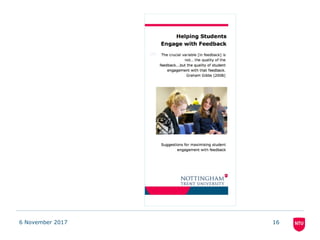
    Evaluate own FA practice 6November 2017 19 Individually look at the leaflet, Donavan model and examples sheet and identify strengths and areas for development in your own practice.
  • 20.
    • Share findingsacross your table and: Determine explicit and tacit knowledge transference.
  • 21.
  • 22.
    Summative Assessment –PGCAP module 1 Assessment Brief
  • 23.
    Summative assessment taskand guidance This summative assessment has one element. Task brief: With reference to a range of relevant supporting literature and evidence, critically evaluate two examples of your recent teaching practice, focusing on: The methods you use to teach/support learning The methods you use to assess and give feedback to students The length of this assessment is 3500-4000 words. November 6, 2017 23
  • 24.
    Summative assessment furtherguidance: •In this task you will reflect on and evaluate your own academic practice in relation to the methods you use when teaching or supporting learning (UKPSF - A2: K2, K3, K4) and the methods you use to assess learning (A3: K2, K3, K4). You will demonstrate and evaluate your practice, by looking back at this practice during the module, and possibly before your started the course. Your thinking should be underpinned by a thorough understanding of relevant theory, scholarship and/or evidence which supports the rationale for the methods you have used, and critically evaluates these in light of that literature (K5, V3). •IMPORTANT: One of your examples must focus on the methods you use when you teach or support learning, and the other must focus on assessment and/or feedback methods that you have used; you may use examples from the same module for this work, but they must be clearly presented as addressing the two areas of activity. November 6, 2017 24
  • 25.
    Assessment criteria: •Engagement withthe context of academic practice and application to own practice •Engagement with current research/ evidence/ •scholarship in academic practice, and application to own practice in teaching and assessment •Engagement with appropriate methods for teaching and assessment/feedback, and evaluation of the effectiveness of these •Quality of written communication and presentation of ideas November 6, 2017 25
  • 26.
    Triad activity: evidencingyour practice Using the question prompts, take it in turns to be the •Speaker: share your practice example (be very specific) •Questioner/listener: ask the questions to guide this practice example •Observer: listen to the responses to the questions, and consider whether the response evidences their practice fully in relation to – What they did – Why they did it – Impact on the learners – Evidence of this impact – 5 minutes per example, 2 minutes for observer to feedback what went well, and what needed more detailed evidence
  • 27.
    What are thechallenges of evidencing your practice?
  • 28.
    Session Learning Outcomes: Bycompleting this session, you should be able to: LO1 Evaluate your current practice in using formative assessment, feedback and feedforward LO2 Identify methods to enable your learners to engage more effectively with feedback November 6, 2017
  • 29.
    In the criticalreflection you should: – identify the context in which you teach/support learning and the impact of this on your practice – apply and explore the impact of relevant theories /research/ – scholarship on your practice – demonstrate the currency of your subject knowledge and how this impacts on your practice – explore your use of appropriate digital technologies to support teaching and/or assessment practices – evaluate the effectiveness of your practice to date, including the identification of areas for your ongoing CPD in teaching and supporting learning – The two examples can be from the same module or area of practice. – Remember that you should use evidence from your Professional Portfolio to support the choice of materials you reflect on in this task. November 6, 2017 29

Editor's Notes

  • #7 Tell/introduce session - SD/DE
  • #24 Pasted from handbook
  • #25 Pasted from handbook
  • #26 Pasted from handbook – complete missing sections of mark sheet activity
  • #30 Pasted from handbook – additional guidance