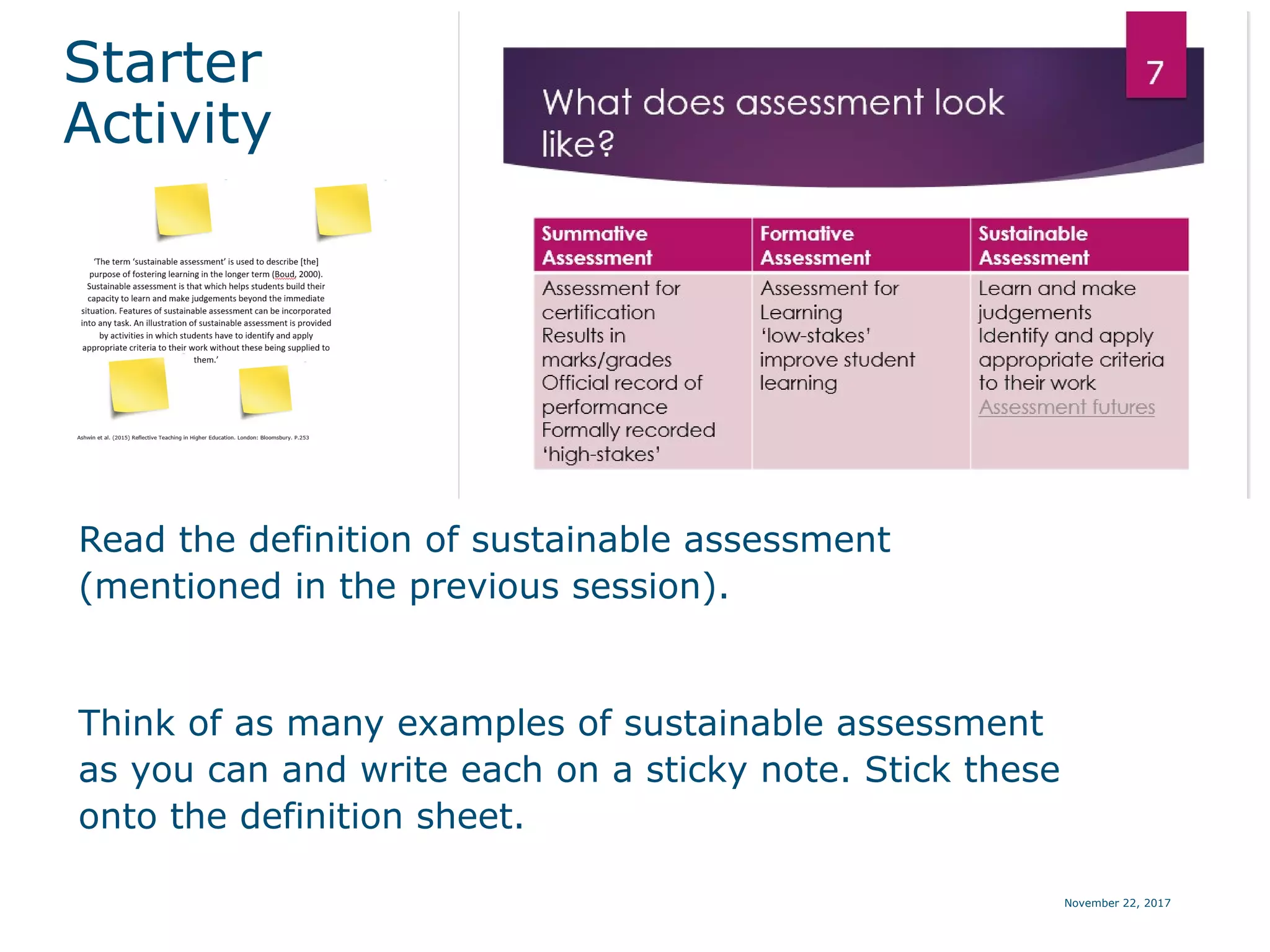
Starter
Activity
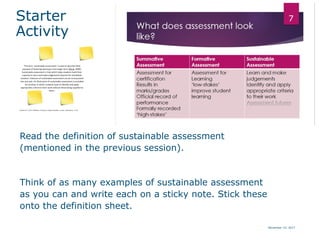
Read the definition of sustainable assessment
(mentioned in the previous session).
Think of as many examples of sustainable assessment
as you can and write each on a sticky note. Stick these
onto the definition sheet.
November 22, 2017
1
Planning for learning: putting it
all together
Session Learning Outcomes
By the end of this session you should be able to:
LO1 Identify elements to consider when planning teaching sessions
LO2 Evaluate your current session-planning practice
LO3 Apply the principles of Sustainable Development when resourcing
your academic practice
November 22, 2017 3
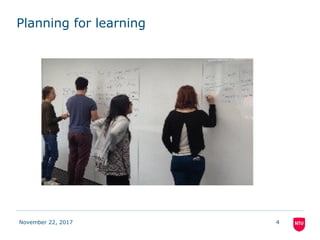
Planning for learning
November 22, 2017 4
PUTTING IT ALL
TOGETHER
November 22, 2017 5
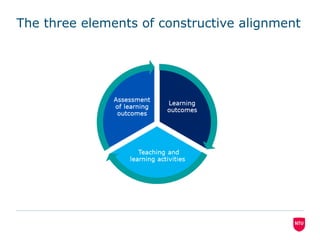
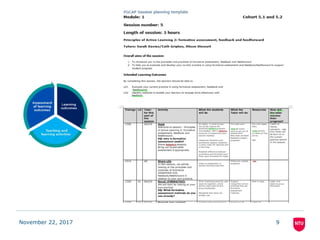
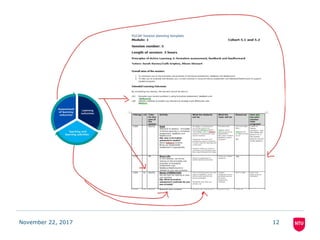
The three elements of constructive alignment
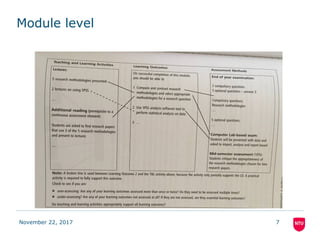
Module level
November 22, 2017 7
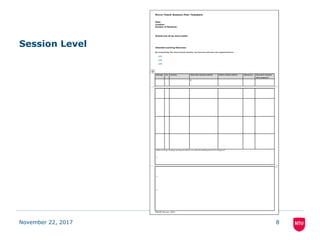
Session Level
November 22, 2017 8
November 22, 2017 9
November 22, 2017 10
November 22, 2017 11
November 22, 2017 12
WHAT ABOUT THEORY?
November 22, 2017 13
November 22, 2017 14
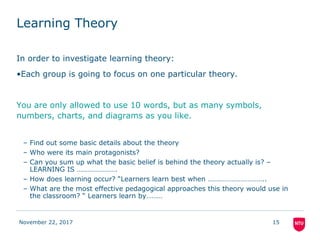
Learning Theory
In order to investigate learning theory:
•Each group is going to focus on one particular theory.
You are only allowed to use 10 words, but as many symbols,
numbers, charts, and diagrams as you like.
– Find out some basic details about the theory
– Who were its main protagonists?
– Can you sum up what the basic belief is behind the theory actually is? –
LEARNING IS ………………….
– How does learning occur? “Learners learn best when …………………………..
– What are the most effective pedagogical approaches this theory would use in
the classroom? “ Learners learn by………
November 22, 2017 15
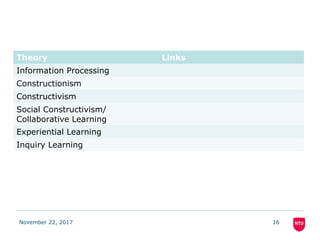
Theory Links
Information Processing
Constructionism
Constructivism
Social Constructivism/
Collaborative Learning
Experiential Learning
Inquiry Learning
November 22, 2017 16
Market Place
• Teach your colleagues and learn from you colleagues
November 22, 2017 17
SUSTAINABLE
DEVELOPMENT
November 22, 2017 18
19
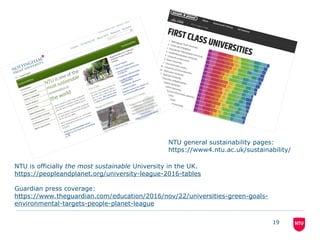
NTU is officially the most sustainable University in the UK.
https://peopleandplanet.org/university-league-2016-tables
Guardian press coverage:
https://www.theguardian.com/education/2016/nov/22/universities-green-goals-
environmental-targets-people-planet-league
NTU general sustainability pages:
https://www4.ntu.ac.uk/sustainability/
20
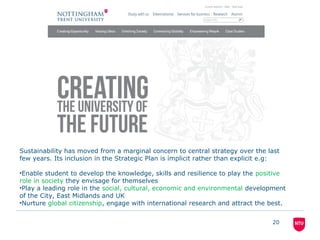
Sustainability has moved from a marginal concern to central strategy over the last
few years. Its inclusion in the Strategic Plan is implicit rather than explicit e.g:
•Enable student to develop the knowledge, skills and resilience to play the positive
role in society they envisage for themselves
•Play a leading role in the social, cultural, economic and environmental development
of the City, East Midlands and UK
•Nurture global citizenship, engage with international research and attract the best.
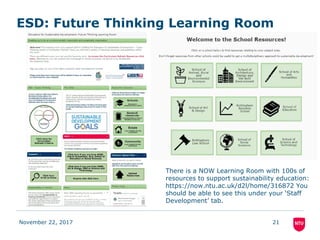
ESD: Future Thinking Learning Room
November 22, 2017 21
There is a NOW Learning Room with 100s of
resources to support sustainability education:
https://now.ntu.ac.uk/d2l/home/316872 You
should be able to see this under your ‘Staff
Development’ tab.
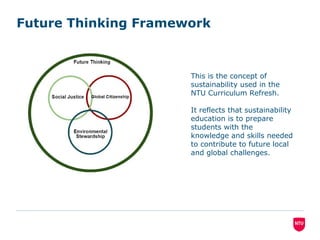
Future Thinking Framework
This is the concept of
sustainability used in the
NTU Curriculum Refresh.
It reflects that sustainability
education is to prepare
students with the
knowledge and skills needed
to contribute to future local
and global challenges.
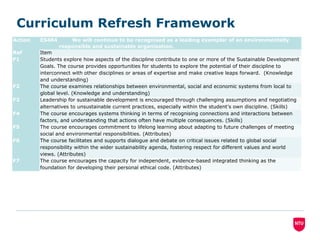
Curriculum Refresh Framework
Action ES404 We will continue to be recognised as a leading exemplar of an environmentally
responsible and sustainable organisation.
Ref Item
F1 Students explore how aspects of the discipline contribute to one or more of the Sustainable Development
Goals. The course provides opportunities for students to explore the potential of their discipline to
interconnect with other disciplines or areas of expertise and make creative leaps forward. (Knowledge
and understanding)
F2 The course examines relationships between environmental, social and economic systems from local to
global level. (Knowledge and understanding)
F3 Leadership for sustainable development is encouraged through challenging assumptions and negotiating
alternatives to unsustainable current practices, especially within the student’s own discipline. (Skills)
F4 The course encourages systems thinking in terms of recognising connections and interactions between
factors, and understanding that actions often have multiple consequences. (Skills)
F5 The course encourages commitment to lifelong learning about adapting to future challenges of meeting
social and environmental responsibilities. (Attributes)
F6 The course facilitates and supports dialogue and debate on critical issues related to global social
responsibility within the wider sustainability agenda, fostering respect for different values and world
views. (Attributes)
F7 The course encourages the capacity for independent, evidence-based integrated thinking as the
foundation for developing their personal ethical code. (Attributes)
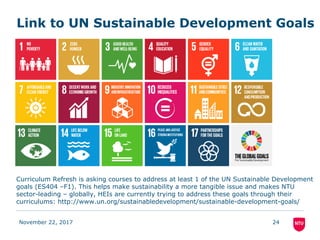
Link to UN Sustainable Development Goals
November 22, 2017 24
Curriculum Refresh is asking courses to address at least 1 of the UN Sustainable Development
goals (ES404 –F1). This helps make sustainability a more tangible issue and makes NTU
sector-leading – globally, HEIs are currently trying to address these goals through their
curriculums: http://www.un.org/sustainabledevelopment/sustainable-development-goals/
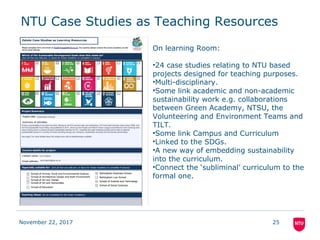
NTU Case Studies as Teaching Resources
November 22, 2017 25
On learning Room:
•24 case studies relating to NTU based
projects designed for teaching purposes.
•Multi-disciplinary.
•Some link academic and non-academic
sustainability work e.g. collaborations
between Green Academy, NTSU, the
Volunteering and Environment Teams and
TILT.
•Some link Campus and Curriculum
•Linked to the SDGs.
•A new way of embedding sustainability
into the curriculum.
•Connect the ‘subliminal’ curriculum to the
formal one.
The term ‘sustainable assessment’ is used to describe [the] purpose of fostering
learning in the longer term (Boud, 2000). Sustainable assessment is that which
helps students build their capacity to learn and make judgements beyond the
immediate situation. Features of sustainable assessment can be incorporated into
any task. An illustration of sustainable assessment is provided by activities in
which students have to identify and apply appropriate criteria to their work
without these being supplied to them.’
Ashwin et al. (2015) Reflective Teaching in Higher Education. London: Bloomsbury. P.253
November 22, 2017 26
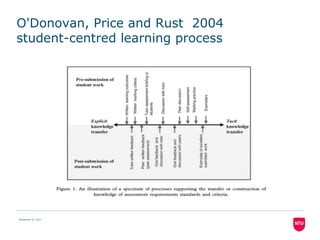
O'Donovan, Price and Rust 2004
student-centred learning process
November 22, 2017
7
PGCAP module 1 - Assignment
Summative assessment task and
guidance
This summative assessment has one element.
Task brief:
With reference to a range of relevant supporting literature and
evidence, critically evaluate two examples of your recent
teaching practice, focusing on:
The methods you use to teach/support learning
The methods you use to assess and give feedback to students
The length of this assessment is 3500-4000 words.
November 22, 2017 29
Summative assessment further guidance:
•In this task you will reflect on and evaluate your own academic
practice in relation to the methods you use when teaching or
supporting learning (UKPSF - A2: K2, K3, K4) and the methods you
use to assess learning (A3: K2, K3, K4). You will demonstrate and
evaluate your practice, by looking back at this practice during the
module, and possibly before your started the course. Your thinking
should be underpinned by a thorough understanding of relevant
theory, scholarship and/or evidence which supports the rationale for
the methods you have used, and critically evaluates these in light of
that literature (K5, V3).
•IMPORTANT: One of your examples must focus on the methods you
use when you teach or support learning, and the other must
focus on assessment and/or feedback methods that you have
used; you may use examples from the same module for this work,
but they must be clearly presented as addressing the two areas of
activity.
November 22, 2017 30
Triad activity: evidencing your practice
Using the question prompts, take it in turns to be the
•Speaker: share your practice example (be very specific)
•Questioner/listener: ask the questions to guide this practice
example
•Observer: listen to the responses to the questions, and consider
whether the response evidences their practice fully in relation to
– What they did
– Why they did it
– Impact on the learners
– Evidence of this impact
– 5 minutes per example, 2 minutes for observer to feedback what went well, and
what needed more detailed evidence
PGCAP module 1 – assignment
Exemplars
Assessment criteria
•Engagement with the context of academic practice and application to
own practice in teaching/ supporting learning and assessment and
feedback
•Engagement with current research/ evidence/
•scholarship in academic practice in teaching/ supporting learning and
assessment and feedback
•Evaluation of your own academic practice in teaching/ supporting
learning and assessment and feedback
•Quality of written communication and presentation of ideas
November 22, 2017 32
Session Learning Outcomes
By the end of this session you should be able to:
LO1 Identify elements to consider when planning teaching sessions
LO2 Evaluate your current session-planning practice
LO3 Apply the principles of Sustainable Development when resourcing
your academic practice
November 22, 2017 33
Session Reflection
November 22, 2017 34

Pgcap session 6 2017

  • 1.
    Starter Activity Read the definitionof sustainable assessment (mentioned in the previous session). Think of as many examples of sustainable assessment as you can and write each on a sticky note. Stick these onto the definition sheet. November 22, 2017 1
  • 2.
    Planning for learning:putting it all together
  • 3.
    Session Learning Outcomes Bythe end of this session you should be able to: LO1 Identify elements to consider when planning teaching sessions LO2 Evaluate your current session-planning practice LO3 Apply the principles of Sustainable Development when resourcing your academic practice November 22, 2017 3
  • 4.
  • 5.
  • 6.
    The three elementsof constructive alignment
  • 7.
  • 8.
  • 9.
  • 10.
  • 11.
  • 12.
  • 13.
  • 14.
  • 15.
    Learning Theory In orderto investigate learning theory: •Each group is going to focus on one particular theory. You are only allowed to use 10 words, but as many symbols, numbers, charts, and diagrams as you like. – Find out some basic details about the theory – Who were its main protagonists? – Can you sum up what the basic belief is behind the theory actually is? – LEARNING IS …………………. – How does learning occur? “Learners learn best when ………………………….. – What are the most effective pedagogical approaches this theory would use in the classroom? “ Learners learn by……… November 22, 2017 15
  • 16.
    Theory Links Information Processing Constructionism Constructivism SocialConstructivism/ Collaborative Learning Experiential Learning Inquiry Learning November 22, 2017 16
  • 17.
    Market Place • Teachyour colleagues and learn from you colleagues November 22, 2017 17
  • 18.
  • 19.
    19 NTU is officiallythe most sustainable University in the UK. https://peopleandplanet.org/university-league-2016-tables Guardian press coverage: https://www.theguardian.com/education/2016/nov/22/universities-green-goals- environmental-targets-people-planet-league NTU general sustainability pages: https://www4.ntu.ac.uk/sustainability/
  • 20.
    20 Sustainability has movedfrom a marginal concern to central strategy over the last few years. Its inclusion in the Strategic Plan is implicit rather than explicit e.g: •Enable student to develop the knowledge, skills and resilience to play the positive role in society they envisage for themselves •Play a leading role in the social, cultural, economic and environmental development of the City, East Midlands and UK •Nurture global citizenship, engage with international research and attract the best.
  • 21.
    ESD: Future ThinkingLearning Room November 22, 2017 21 There is a NOW Learning Room with 100s of resources to support sustainability education: https://now.ntu.ac.uk/d2l/home/316872 You should be able to see this under your ‘Staff Development’ tab.
  • 22.
    Future Thinking Framework Thisis the concept of sustainability used in the NTU Curriculum Refresh. It reflects that sustainability education is to prepare students with the knowledge and skills needed to contribute to future local and global challenges.
  • 23.
    Curriculum Refresh Framework ActionES404 We will continue to be recognised as a leading exemplar of an environmentally responsible and sustainable organisation. Ref Item F1 Students explore how aspects of the discipline contribute to one or more of the Sustainable Development Goals. The course provides opportunities for students to explore the potential of their discipline to interconnect with other disciplines or areas of expertise and make creative leaps forward. (Knowledge and understanding) F2 The course examines relationships between environmental, social and economic systems from local to global level. (Knowledge and understanding) F3 Leadership for sustainable development is encouraged through challenging assumptions and negotiating alternatives to unsustainable current practices, especially within the student’s own discipline. (Skills) F4 The course encourages systems thinking in terms of recognising connections and interactions between factors, and understanding that actions often have multiple consequences. (Skills) F5 The course encourages commitment to lifelong learning about adapting to future challenges of meeting social and environmental responsibilities. (Attributes) F6 The course facilitates and supports dialogue and debate on critical issues related to global social responsibility within the wider sustainability agenda, fostering respect for different values and world views. (Attributes) F7 The course encourages the capacity for independent, evidence-based integrated thinking as the foundation for developing their personal ethical code. (Attributes)
  • 24.
    Link to UNSustainable Development Goals November 22, 2017 24 Curriculum Refresh is asking courses to address at least 1 of the UN Sustainable Development goals (ES404 –F1). This helps make sustainability a more tangible issue and makes NTU sector-leading – globally, HEIs are currently trying to address these goals through their curriculums: http://www.un.org/sustainabledevelopment/sustainable-development-goals/
  • 25.
    NTU Case Studiesas Teaching Resources November 22, 2017 25 On learning Room: •24 case studies relating to NTU based projects designed for teaching purposes. •Multi-disciplinary. •Some link academic and non-academic sustainability work e.g. collaborations between Green Academy, NTSU, the Volunteering and Environment Teams and TILT. •Some link Campus and Curriculum •Linked to the SDGs. •A new way of embedding sustainability into the curriculum. •Connect the ‘subliminal’ curriculum to the formal one.
  • 26.
    The term ‘sustainableassessment’ is used to describe [the] purpose of fostering learning in the longer term (Boud, 2000). Sustainable assessment is that which helps students build their capacity to learn and make judgements beyond the immediate situation. Features of sustainable assessment can be incorporated into any task. An illustration of sustainable assessment is provided by activities in which students have to identify and apply appropriate criteria to their work without these being supplied to them.’ Ashwin et al. (2015) Reflective Teaching in Higher Education. London: Bloomsbury. P.253 November 22, 2017 26
  • 27.
    O'Donovan, Price andRust 2004 student-centred learning process November 22, 2017 7
  • 28.
    PGCAP module 1- Assignment
  • 29.
    Summative assessment taskand guidance This summative assessment has one element. Task brief: With reference to a range of relevant supporting literature and evidence, critically evaluate two examples of your recent teaching practice, focusing on: The methods you use to teach/support learning The methods you use to assess and give feedback to students The length of this assessment is 3500-4000 words. November 22, 2017 29
  • 30.
    Summative assessment furtherguidance: •In this task you will reflect on and evaluate your own academic practice in relation to the methods you use when teaching or supporting learning (UKPSF - A2: K2, K3, K4) and the methods you use to assess learning (A3: K2, K3, K4). You will demonstrate and evaluate your practice, by looking back at this practice during the module, and possibly before your started the course. Your thinking should be underpinned by a thorough understanding of relevant theory, scholarship and/or evidence which supports the rationale for the methods you have used, and critically evaluates these in light of that literature (K5, V3). •IMPORTANT: One of your examples must focus on the methods you use when you teach or support learning, and the other must focus on assessment and/or feedback methods that you have used; you may use examples from the same module for this work, but they must be clearly presented as addressing the two areas of activity. November 22, 2017 30
  • 31.
    Triad activity: evidencingyour practice Using the question prompts, take it in turns to be the •Speaker: share your practice example (be very specific) •Questioner/listener: ask the questions to guide this practice example •Observer: listen to the responses to the questions, and consider whether the response evidences their practice fully in relation to – What they did – Why they did it – Impact on the learners – Evidence of this impact – 5 minutes per example, 2 minutes for observer to feedback what went well, and what needed more detailed evidence
  • 32.
    PGCAP module 1– assignment Exemplars Assessment criteria •Engagement with the context of academic practice and application to own practice in teaching/ supporting learning and assessment and feedback •Engagement with current research/ evidence/ •scholarship in academic practice in teaching/ supporting learning and assessment and feedback •Evaluation of your own academic practice in teaching/ supporting learning and assessment and feedback •Quality of written communication and presentation of ideas November 22, 2017 32
  • 33.
    Session Learning Outcomes Bythe end of this session you should be able to: LO1 Identify elements to consider when planning teaching sessions LO2 Evaluate your current session-planning practice LO3 Apply the principles of Sustainable Development when resourcing your academic practice November 22, 2017 33
  • 34.

Editor's Notes

  • #3 Tell 1305 - 1310   SD Introduce aims of the session and intended outcomes (above)
  • #4 Tell 1305 - 1310   SD Introduce aims of the session and intended outcomes (above)
  • #5 Recall 1310 – 1315 LO1 SD Ask the group: what they know about the concepts and principles associated with learning, teaching, assessment and tutor identity? Brainstorm ideas onto flip chart paper. Share feedback – 2 ideas from each group
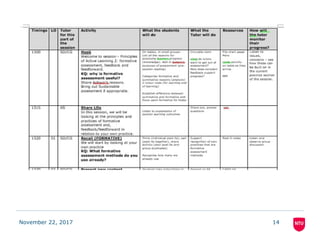
  • #7 Present 1315 – 1330 LO1 LO3 SD/CG Present content on how all the aspects learnt so far come together in the design of learning, e.g. session planning. Explain how the aspects link together: constructive alignment and figure 9.1 from Ashwin Individual note making
  • #8 Present 1315 – 1330 LO1 LO3 SD/CG Present content on how all the aspects learnt so far come together in the design of learning, e.g. session planning. Explain how the aspects link together: constructive alignment and figure 9.1 from Ashwin Individual note making
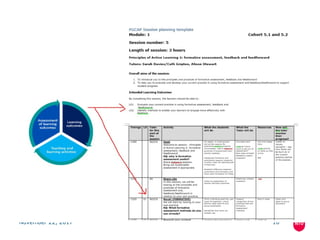
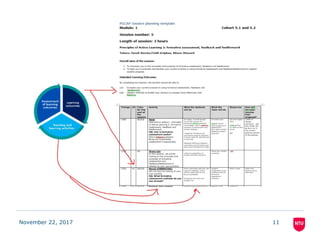
  • #9 Model session planning using p184 and/or PGCAP session. Link T&L strategies to theories in Ashwin book – teaching Individual note making
  • #10 Model session planning using p184 and/or PGCAP session. Link T&L strategies to theories in Ashwin book – teaching Individual note making
  • #11 Model session planning using p184 and/or PGCAP session. Link T&L strategies to theories in Ashwin book – teaching Individual note making
  • #12 Model session planning using p184 and/or PGCAP session. Link T&L strategies to theories in Ashwin book – teaching Individual note making
  • #13 Model session planning using p184 and/or PGCAP session. Link T&L strategies to theories in Ashwin book – teaching Individual note making
  • #15 Active Learning 1325 - 1345 LO1 SD/CG What about the theory? How can we make theory explicit within our session plans? Do we want to make theory explicit?   Guide colleagues to use page 209 – 221 of the Ashwin book to identify the teaching strategies (what) within our session plan or their own.   Acknowledge that this activity can be used to explain decisions and/or how they might enhance their session plan   This is theory about ‘what we do’ next we will look at theory about ‘why’ we choose those strategies. In pairs map the different teaching strategies to the actions we do in out sessions: referred to as what we did in session 4.   using examples brought to session – have our session plan available as back up Slide …   Model session plan
  • #16 Half stay and half visit and report back
  • #18 Feedback 1450 - 1515 LO2 SD/CG Apply theory to example of practice Use peers to support activity Using the example of your practice that you have bought to the session – evaluate/enhance using theory. Pro-forma?
  • #19 Assessment  1515 - 1545     CG Present content about education for sustainable development.
  • #20 High priority for NTU
  • #26 Also sustainability in practice
  • #27 Return to initial task Explain how the activity they have just done links to the assignment. (Link to O’Donavan chart and question about feedforward)   Introduce assignment exemplars and the next activity which will allow them to evaluate how someone else has evidenced the assessment criteria   Slide …   Exemplar assignments   Feedback sheet
  • #30 1430 CG/SD Assignment Brief Listen to explanations and read ppt. Connect to own reading of module handbook. Engage with mark sheet by discussing missing areas and what they must say.   Marksheet with some blanks   Mark sheet copies Pasted from handbook
  • #31 Pasted from handbook 1430 CG/SD Assignment Brief Listen to explanations and read ppt. Connect to own reading of module handbook. Engage with mark sheet by discussing missing areas and what they must say.   Marksheet with some blanks   Mark sheet copies Pasted from handbook
  • #32 Optional – if needed to repeat or if missed in session 5 Student centred activity with Feedback   Evaluate and develop current practice in relation to patchwork task 10: evaluating formative assessment methods. You will need to use the resources brought to session – example of formative assessment used by yourself or your department. Using Scale-up setup of threes working on a problem to evaluate formative assessment method against Ashwin et al. good features, checklist (patchwork 10) Triad activity: in threes (may need a tutor to support depending on numbers) they take it in turns to ask the checklist questions, answer questions, or listen in and consider quality of responses in relation to providing an example of their practice in A3 Assessment, focusing on K2 and K3 in particular. 5 minutes per example, 2 minutes for observer to ask questions or feedback. Use the wider room to disperse the noise! 10-15 minutes to write up example of their practice. This should be put into their pebblepad and share with their mentor for feedback. Intro to activity, Scale-up principles, and what AoA A3 requires, and K2 & K3. 10 mins Facilitate and monitor activity, asking questions of the questioner and observer where useful.   Indicate where on NOW they can find an example to support.   Question prompts for activity. Sheet to capture their thoughts before and after the activity. All tutors: ask questions of the questioner and observer where useful. Listen to responses, feedback generic observations
  • #33 Assessment  1515 - 1545 CG Explain how the activity they have just done links to the assignment. (Link to O’Donavan chart and question about feedforward)   Introduce assignment exemplars and the next activity which will allow them to evaluate how someone else has evidenced the assessment criteria   Slide …   Exemplar assignments   Feedback sheet
  • #34 Transfer to other contexts 1545 - 1600   CG Reflect on the session and identify what they need to do next. Refer to Post-session work on NOW/pebble pad
  • #35 Transfer to other contexts 1545 - 1600   CG Reflect on the session and identify what they need to do next. Refer to Post-session work on NOW/pebble pad