A Study in
… Lesson Study
Workshop Maths and CPD for Subject Advisors
Kroonstad, March 24-26, 2015
Outline
• What is lesson study?
• What are typical steps in a lesson study?
• How does lesson study look like in action?
In-School Teacher Professional Development
“Countries that wish to improve the effectiveness of professional
development provided to teachers should increase the amount and
variation of school embedded offerings such as mentoring and
coaching, creating networks of teachers who learn together, and
supporting collaborative research and instructional problem solving by
teachers.
Non-school embedded professional development such as conferences,
seminars, courses and workshops, especially those that take place
outside of the school where teachers are employed, should be limited as
they are associated with low levels of reported impact on
instruction.”
http://bit.ly/1GsYqdz
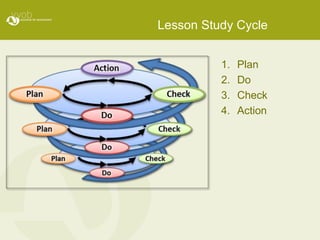
Lesson Study Cycle
1. Plan
2. Do
3. Check
4. Action
Lesson Study in 10 Steps
1. Identify
teacher &
topic
2. Plan
next
steps
3.
Research
on topic
4.
Lesson
plan
prepar
ation
5. Lesson
Plan
Discussion
6. “Mock” lesson
& feedback
7. Lesson plan
adapted
8. Implement
Lesson in Class
& collect data
9. Discuss
data
10. Adapt
Lesson
Plan
Steps 1 & 2: Planning & Preparation
• Collaborative
• Learner reactions
• Expectations for lesson
• Rationale for questions
• Teachers as professionals
• Needs-based
• Facilitator (subject advisor)
Step 3: Observation & Data Analysis
• Observation tool
• Focus on learner behaviour
– Many eyes
– Intermingle with pairs
– Facilitator participates
• Decide on focus
– Bloom’s taxonomy
– Questioning
– Motivation
– Learner activities
Step 4: Discussion & Adapting Lesson
• Reflection
• Data-driven
• Questions for
improvement
• Different perspective
• Tacit knowledge made
explicit
• Lesson can always be
improved
Lesson Study and PLCs
• Underlying vision on CPD is similar
– Collaborative, data driven, needs-based, continuous, school-
based…
– Teachers take responsibility for own professional learning
• Lesson study can be framework for PLC
• Link with other activities
– Bring in external expertise in planning phase.
– Discuss how to use manipulatives, ICT…
– Integrate innovative teaching and learning strategies
• Subject advisor
– Participant or facilitator
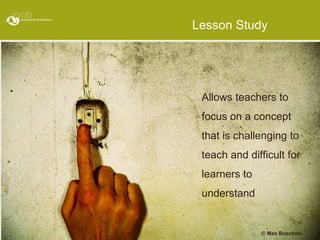
Lesson Study
Allows teachers to
focus on a concept
that is challenging to
teach and difficult for
learners to
understand
© Max Boschini
Potential for ICT
• Using low cost video equipment to record lesson parts
for peer learning
• Share lesson plans digitally
• Store final lesson plans in central (online) location
• Use ICT to arrange & communicate venue & data
• Attach digital artefacts to digital portfolio

A study of... Lesson Study

  • 1.
    A Study in …Lesson Study Workshop Maths and CPD for Subject Advisors Kroonstad, March 24-26, 2015
  • 2.
    Outline • What islesson study? • What are typical steps in a lesson study? • How does lesson study look like in action?
  • 3.
    In-School Teacher ProfessionalDevelopment “Countries that wish to improve the effectiveness of professional development provided to teachers should increase the amount and variation of school embedded offerings such as mentoring and coaching, creating networks of teachers who learn together, and supporting collaborative research and instructional problem solving by teachers. Non-school embedded professional development such as conferences, seminars, courses and workshops, especially those that take place outside of the school where teachers are employed, should be limited as they are associated with low levels of reported impact on instruction.” http://bit.ly/1GsYqdz
  • 4.
    Lesson Study Cycle 1.Plan 2. Do 3. Check 4. Action
  • 5.
    Lesson Study in10 Steps 1. Identify teacher & topic 2. Plan next steps 3. Research on topic 4. Lesson plan prepar ation 5. Lesson Plan Discussion 6. “Mock” lesson & feedback 7. Lesson plan adapted 8. Implement Lesson in Class & collect data 9. Discuss data 10. Adapt Lesson Plan
  • 6.
    Steps 1 &2: Planning & Preparation • Collaborative • Learner reactions • Expectations for lesson • Rationale for questions • Teachers as professionals • Needs-based • Facilitator (subject advisor)
  • 7.
    Step 3: Observation& Data Analysis • Observation tool • Focus on learner behaviour – Many eyes – Intermingle with pairs – Facilitator participates • Decide on focus – Bloom’s taxonomy – Questioning – Motivation – Learner activities
  • 8.
    Step 4: Discussion& Adapting Lesson • Reflection • Data-driven • Questions for improvement • Different perspective • Tacit knowledge made explicit • Lesson can always be improved
  • 9.
    Lesson Study andPLCs • Underlying vision on CPD is similar – Collaborative, data driven, needs-based, continuous, school- based… – Teachers take responsibility for own professional learning • Lesson study can be framework for PLC • Link with other activities – Bring in external expertise in planning phase. – Discuss how to use manipulatives, ICT… – Integrate innovative teaching and learning strategies • Subject advisor – Participant or facilitator
  • 10.
    Lesson Study Allows teachersto focus on a concept that is challenging to teach and difficult for learners to understand © Max Boschini
  • 11.
    Potential for ICT •Using low cost video equipment to record lesson parts for peer learning • Share lesson plans digitally • Store final lesson plans in central (online) location • Use ICT to arrange & communicate venue & data • Attach digital artefacts to digital portfolio