Changing the culture of
assessment and feedback
through TESTA
Tansy Jessop
@tansyjtweets @TESTAwin
13 May 2016
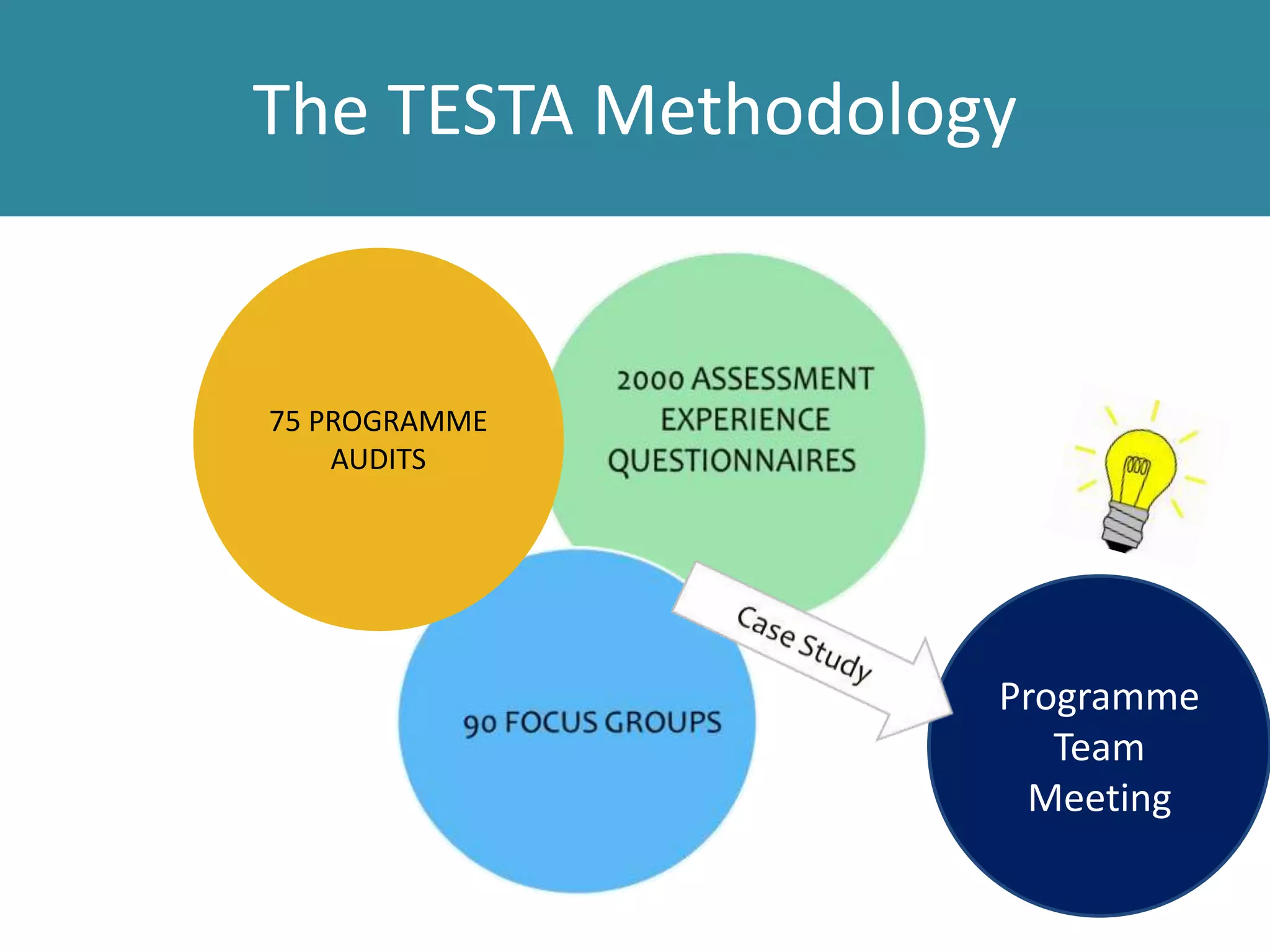
The TESTA Methodology
75 PROGRAMME
AUDITS
Programme
Team
Meeting
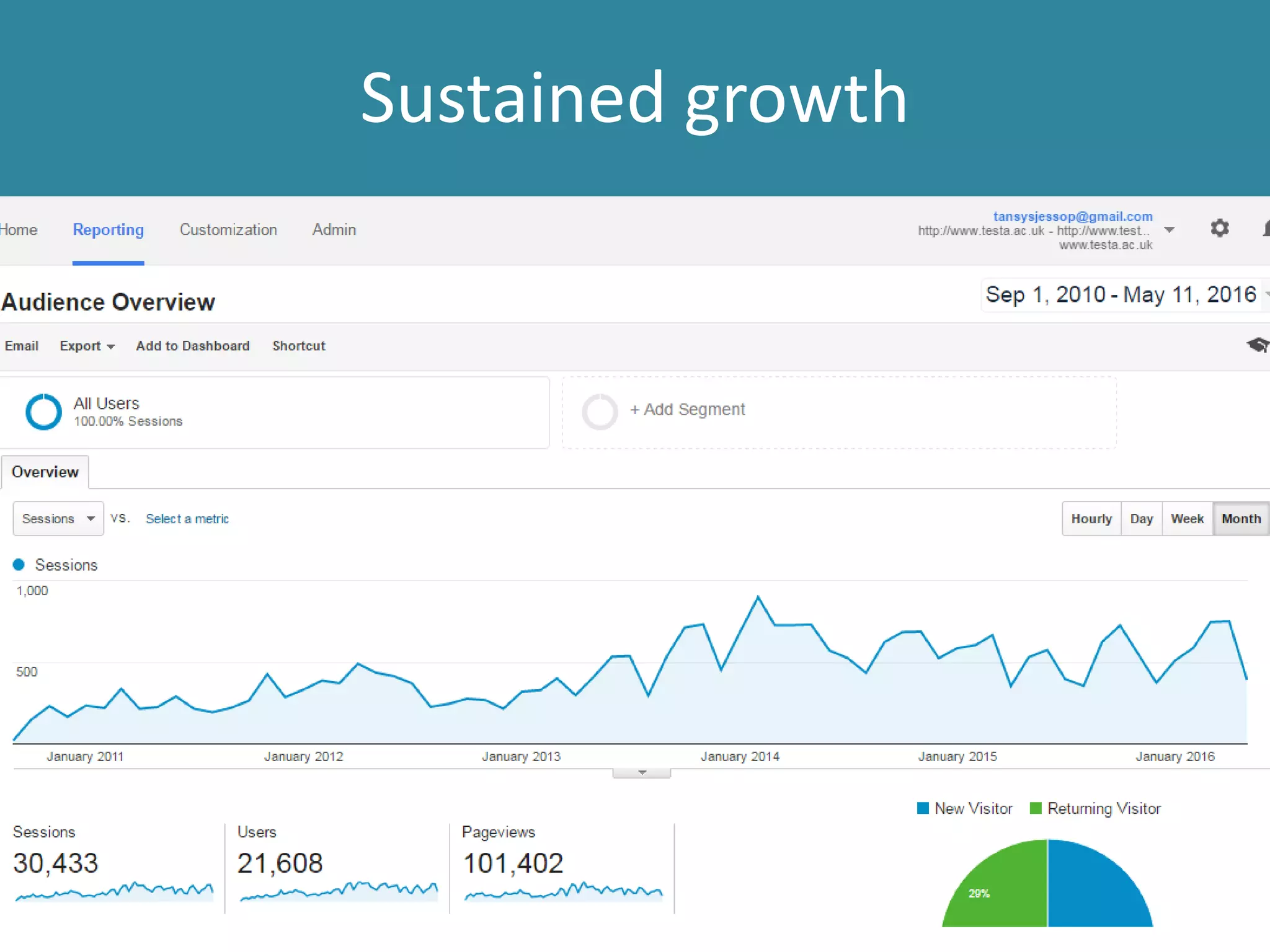
Sustained growth
TESTA….
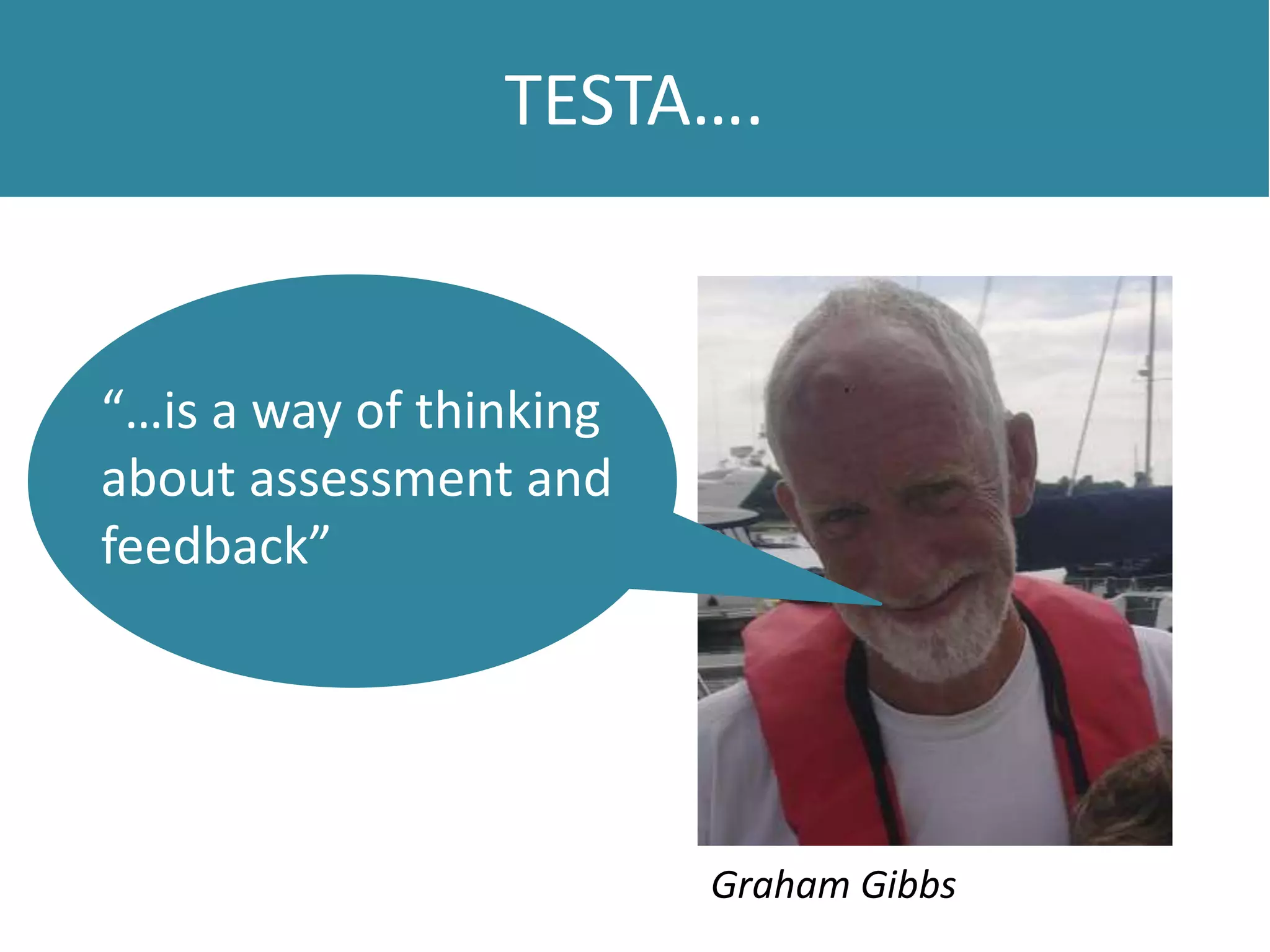
“…is a way of thinking
about assessment and
feedback”
Graham Gibbs
TESTA shifts in perspective from…
• ‘my’ module to ‘our’ programme
• from teacher-focused on module delivery to
student experience of whole programme
• from individualistic modular design to coherent
team design
• from the NSS to enhancement strategies
TESTA addresses three problems
Problem 1: Knee-jerk problem
Problem 2: Curriculum design problem
Problem 3: Evidence to action problem
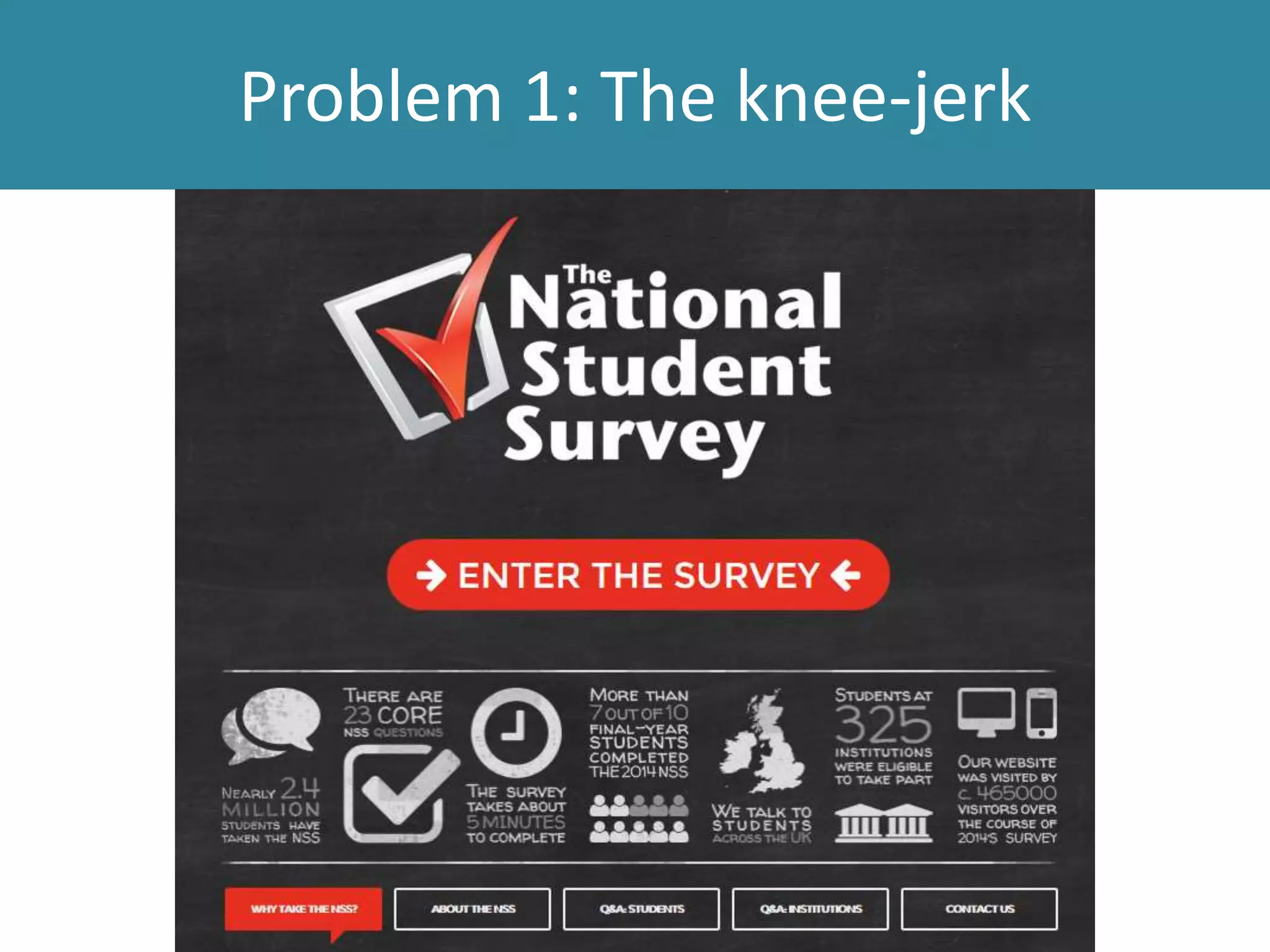
Problem 1: The knee-jerk
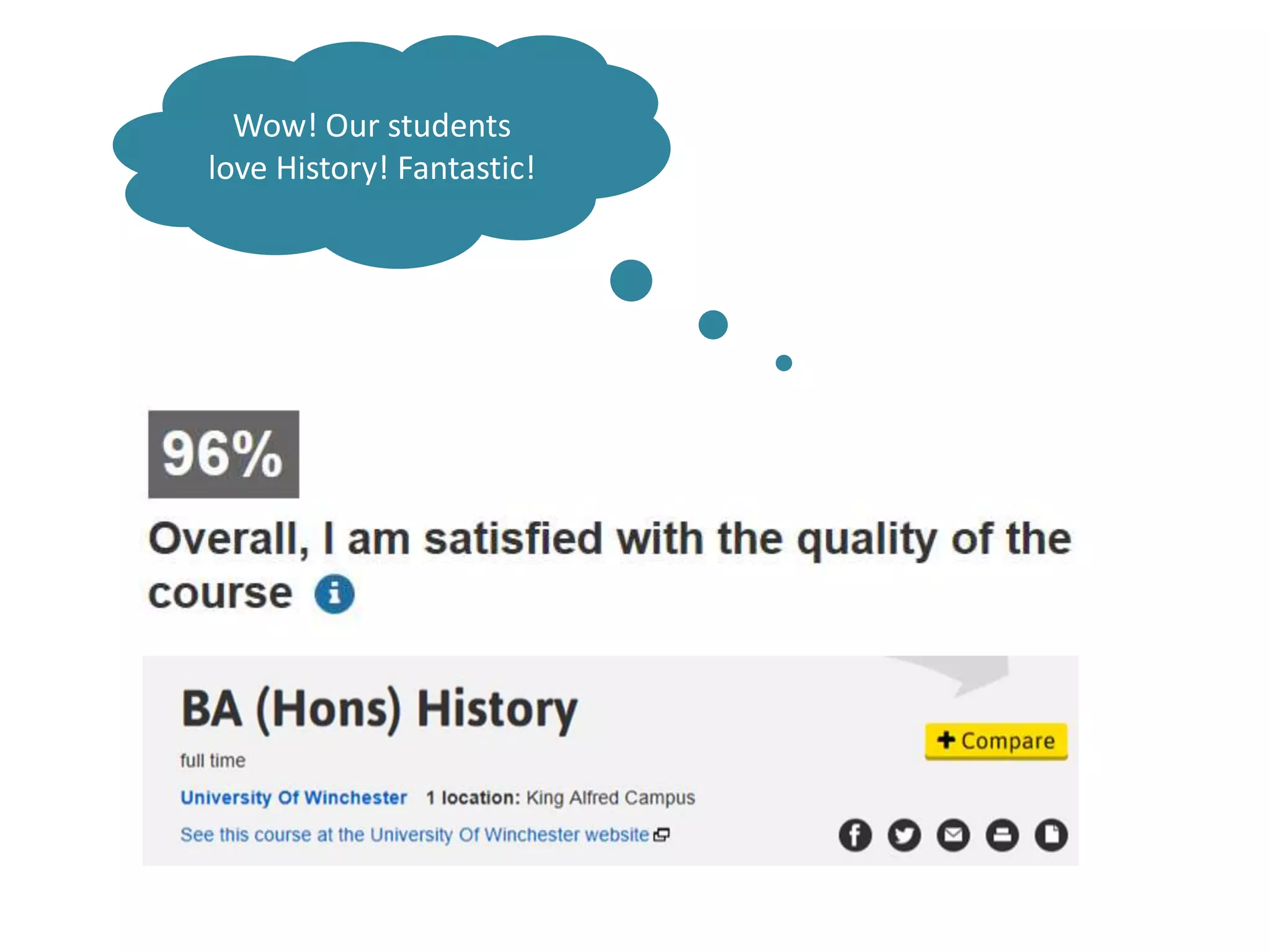
Wow! Our students
love History! Fantastic!
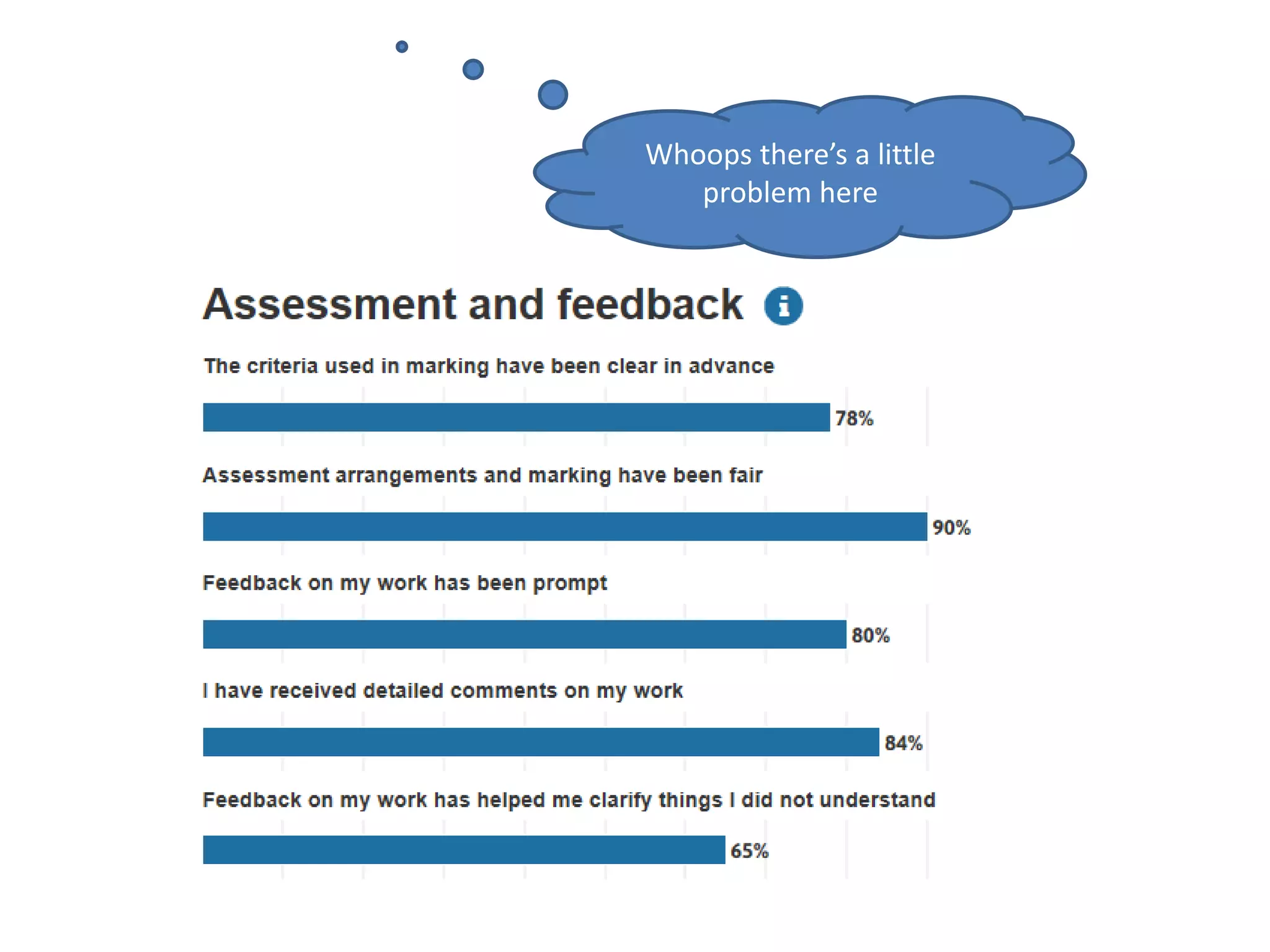
Whoops there’s a little
problem here
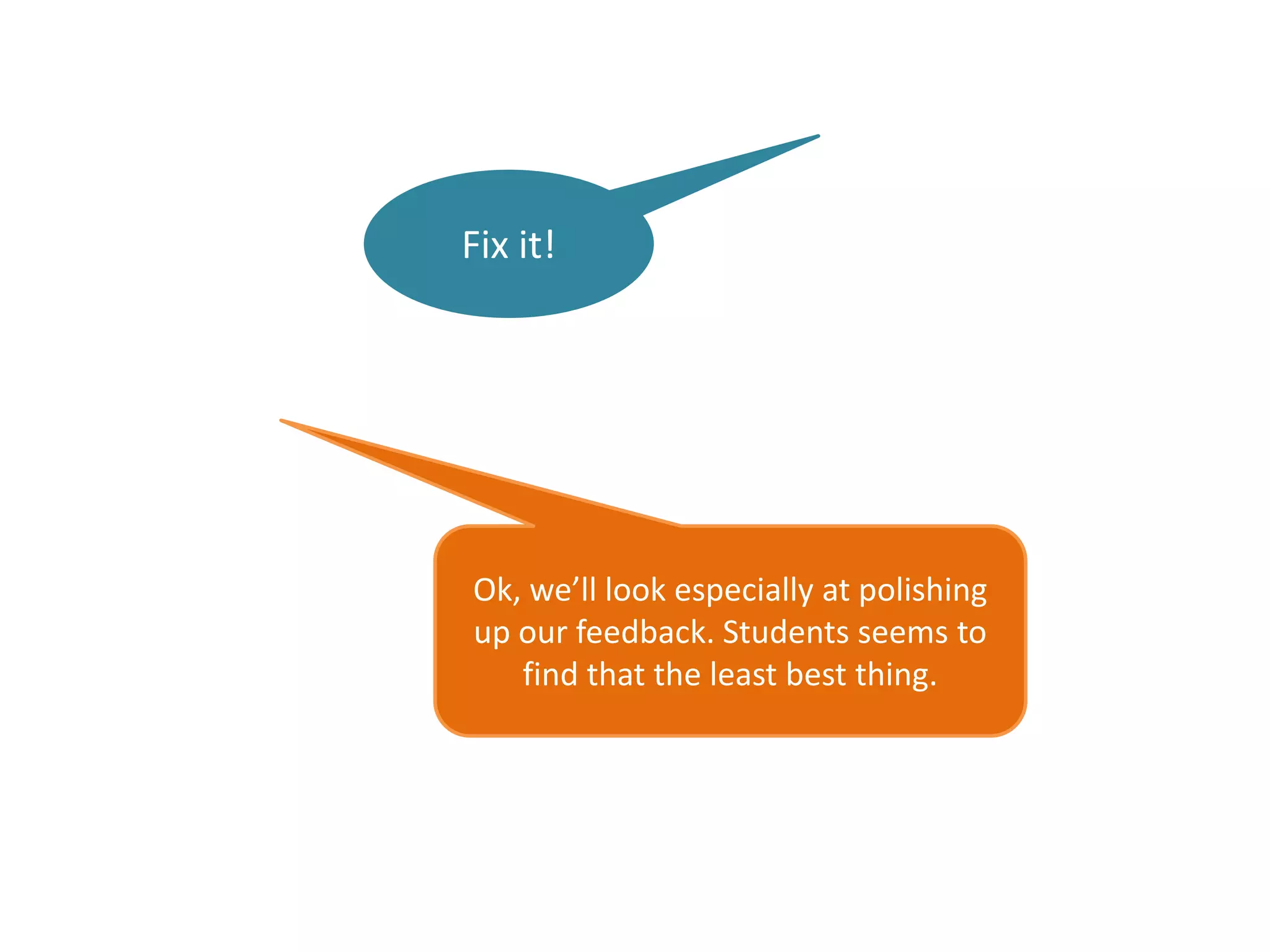
Fix it!
Ok, we’ll look especially at polishing
up our feedback. Students seems to
find that the least best thing.
Apply spit and polish
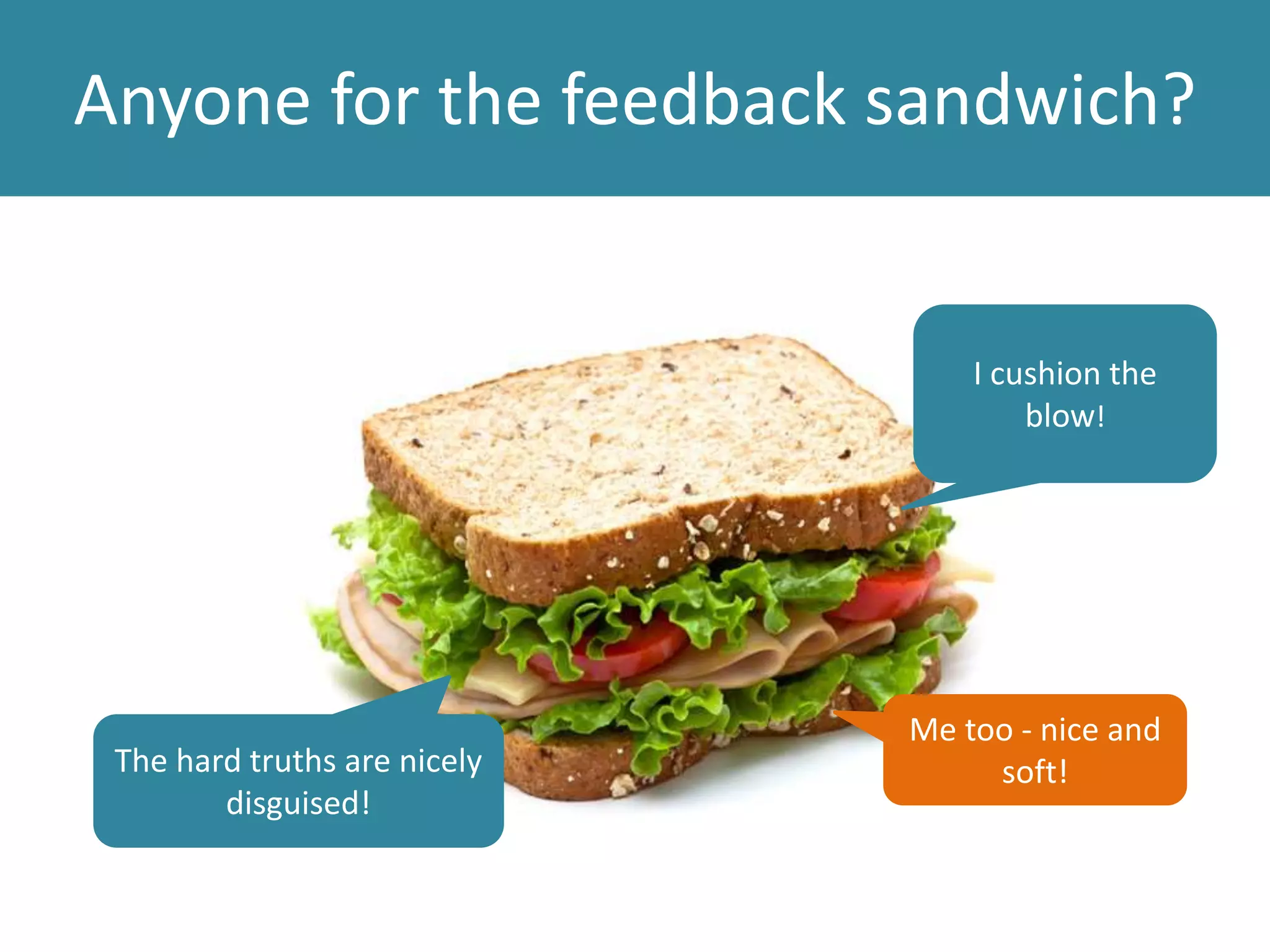
Anyone for the feedback sandwich?
I cushion the
blow!
The hard truths are nicely
disguised!
Me too - nice and
soft!
Problem 2: Curriculum design problem
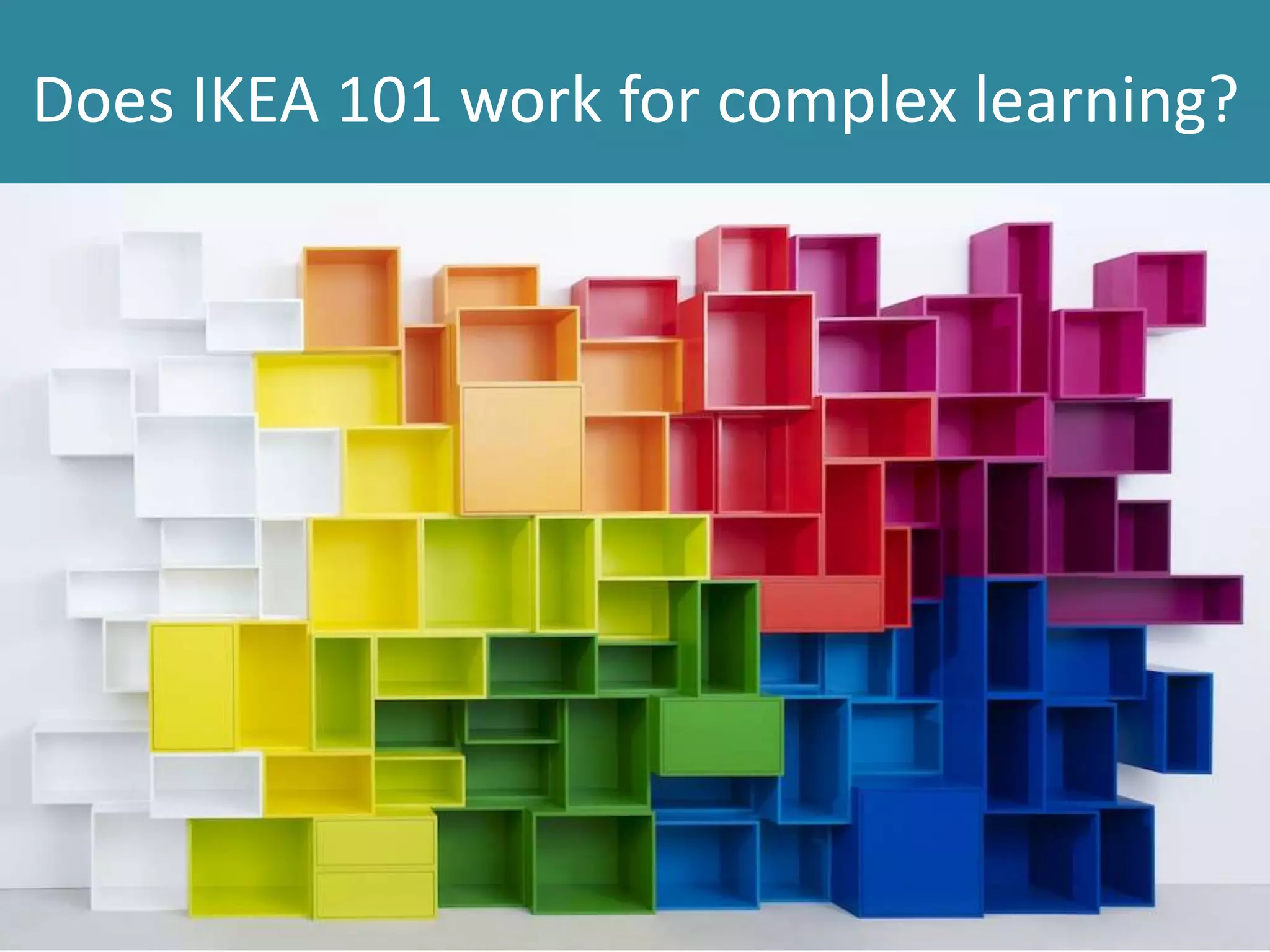
Does IKEA 101 work for complex learning?
Curriculum privileges ‘knowing’ stuff
“Content is often the most visible aspect
for students, the control of which is
frequently devolved to individual
academics, who receive little or no training
in curriculum design and planning”
(Blackmore and Kandiko 2014, 7).
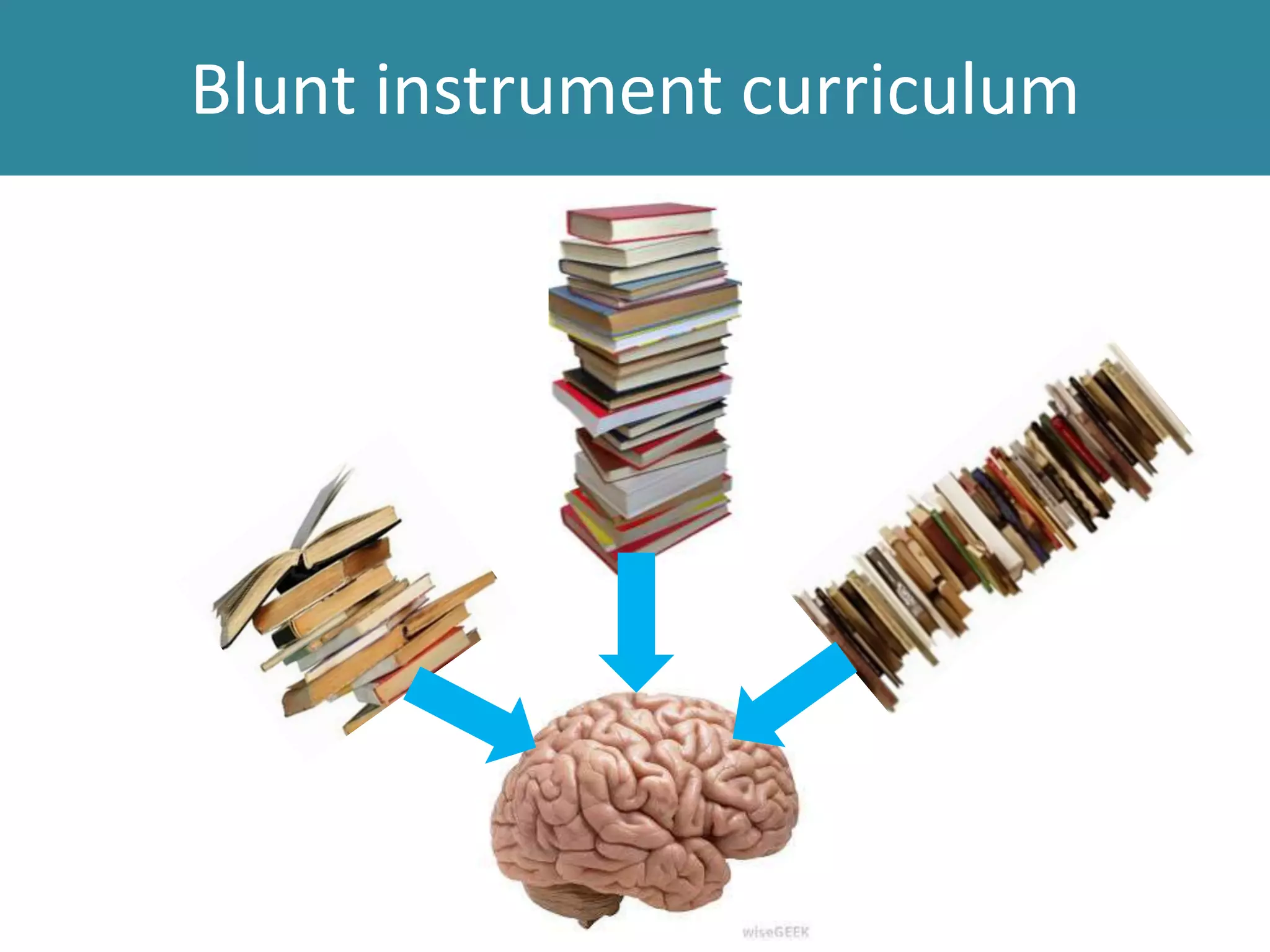
Blunt instrument curriculum
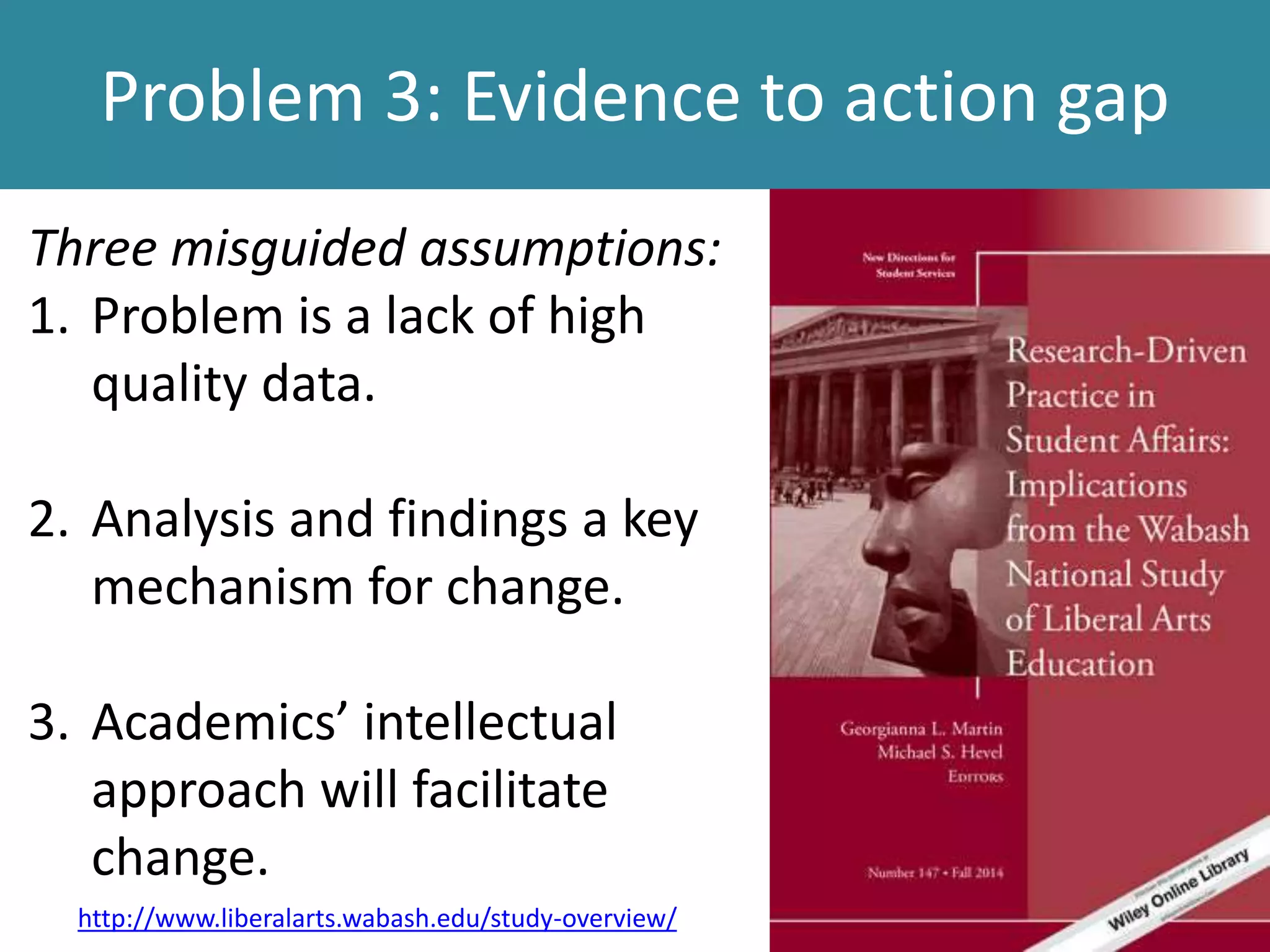
Problem 3: Evidence to action gap
Three misguided assumptions:
1. Problem is a lack of high
quality data.
2. Analysis and findings a key
mechanism for change.
3. Academics’ intellectual
approach will facilitate
change.
http://www.liberalarts.wabash.edu/study-overview/
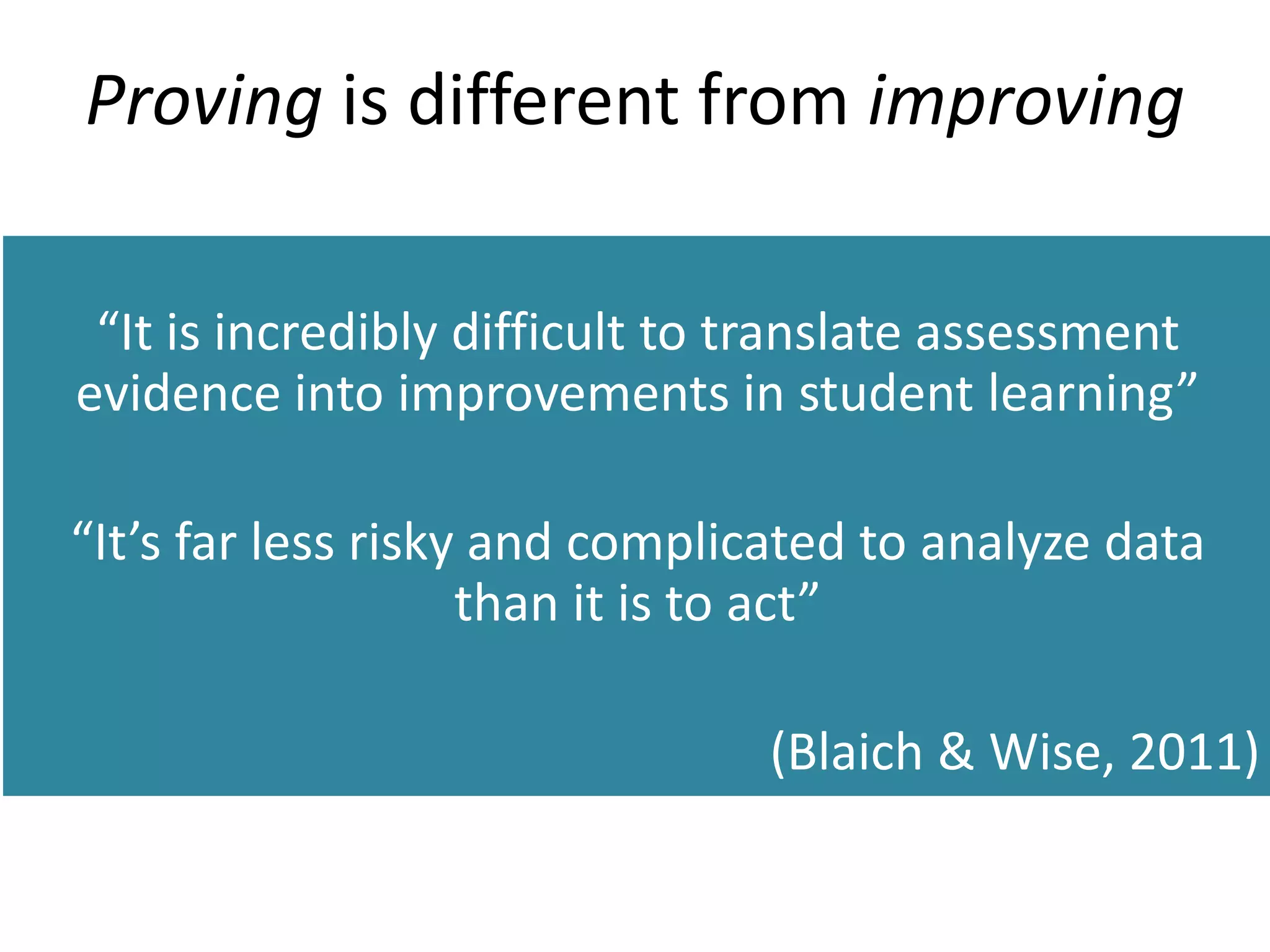
Proving is different from improving
“It is incredibly difficult to translate assessment
evidence into improvements in student learning”
“It’s far less risky and complicated to analyze data
than it is to act”
(Blaich & Wise, 2011)
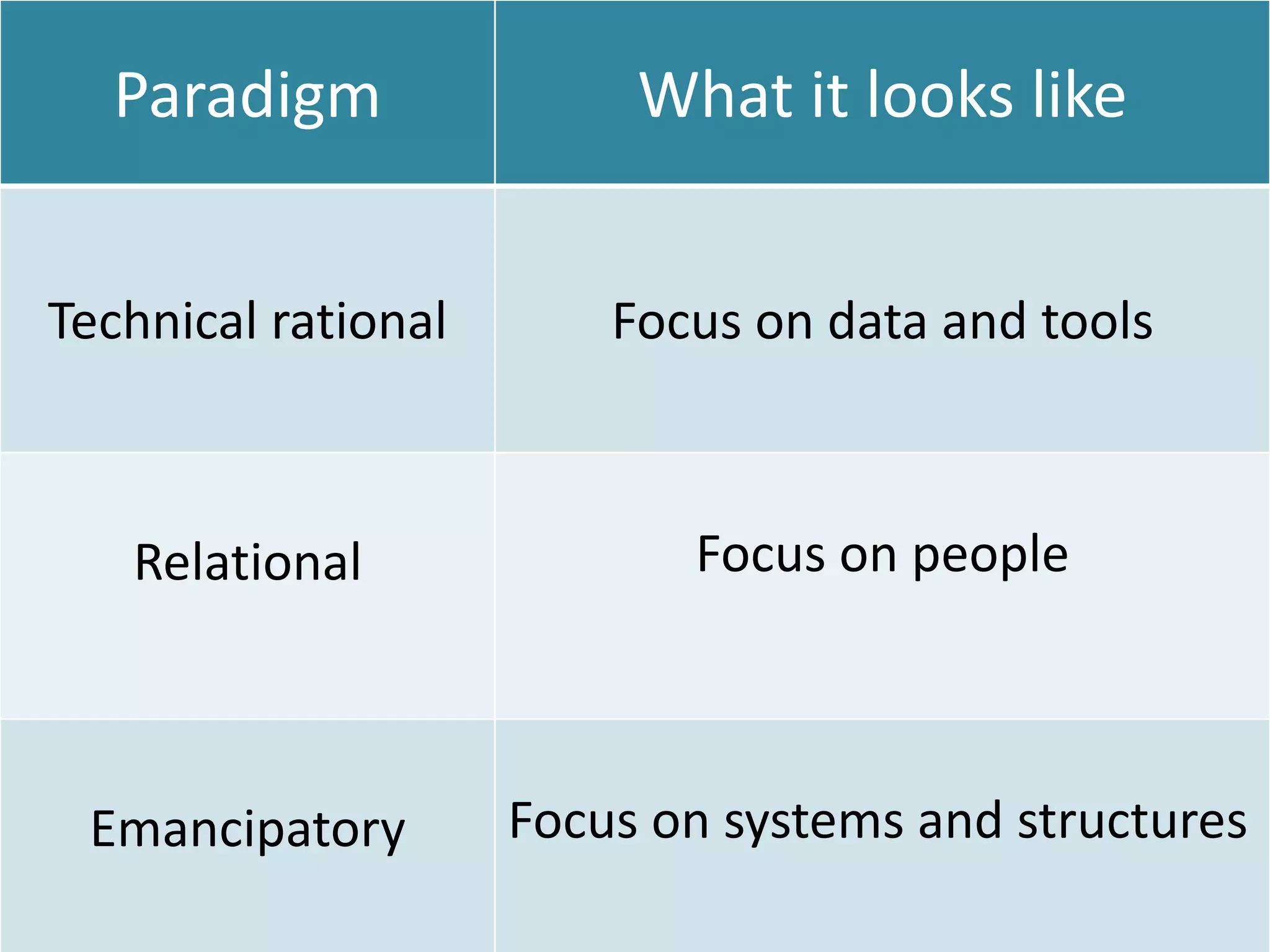
Paradigm What it looks like
Technical rational Focus on data and tools
Relational Focus on people
Emancipatory Focus on systems and structures
TESTA themes and impacts
1. Variations in assessment patterns
2. High summative: low formative
3. Disconnected feedback
4. Lack of clarity about goals and standards
1. Huge variations
• What is striking for
you about this data?
• How does it compare
with your context?
• Does variation
matter?
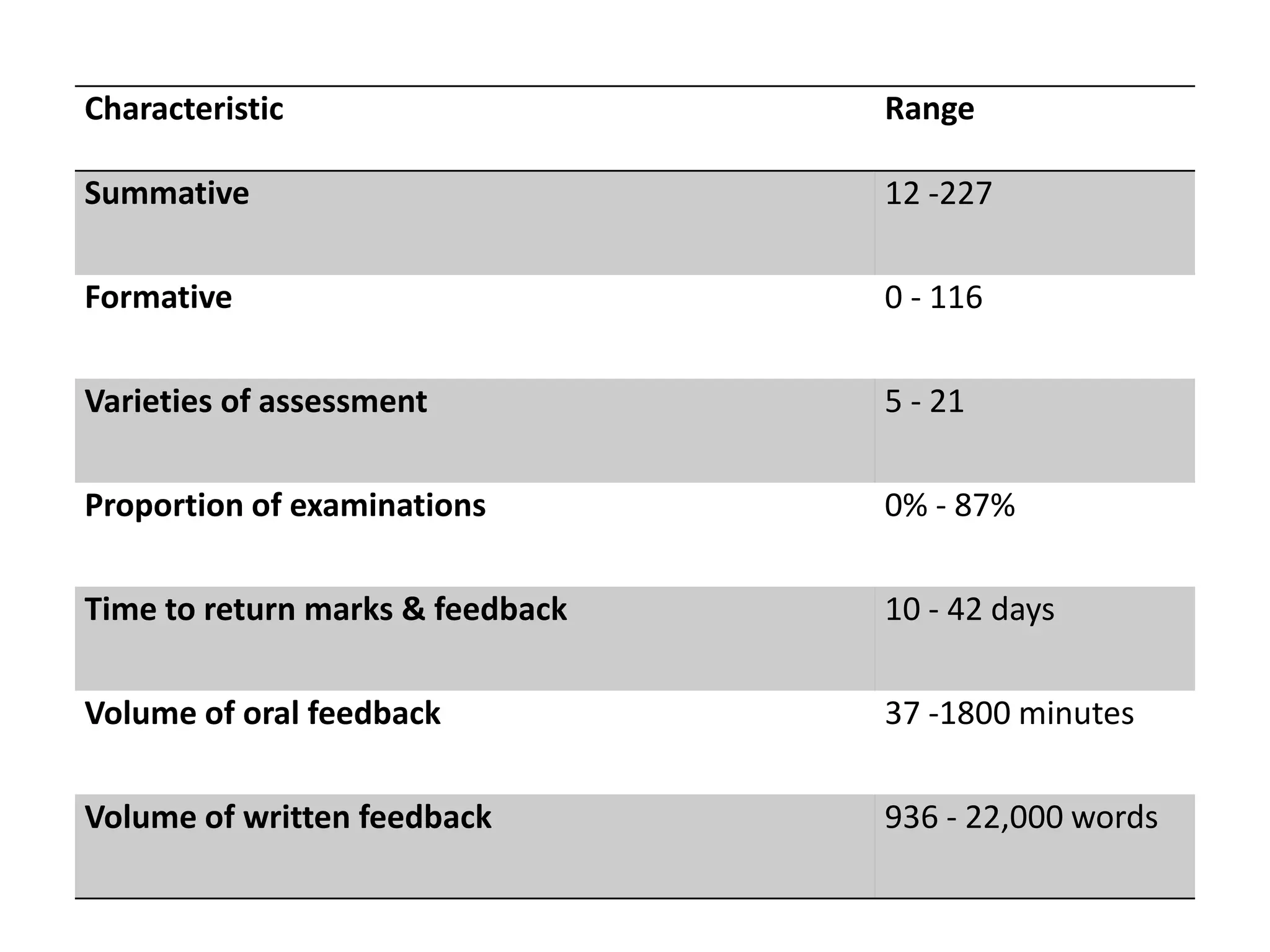
Characteristic Range
Summative 12 -227
Formative 0 - 116
Varieties of assessment 5 - 21
Proportion of examinations 0% - 87%
Time to return marks & feedback 10 - 42 days
Volume of oral feedback 37 -1800 minutes
Volume of written feedback 936 - 22,000 words
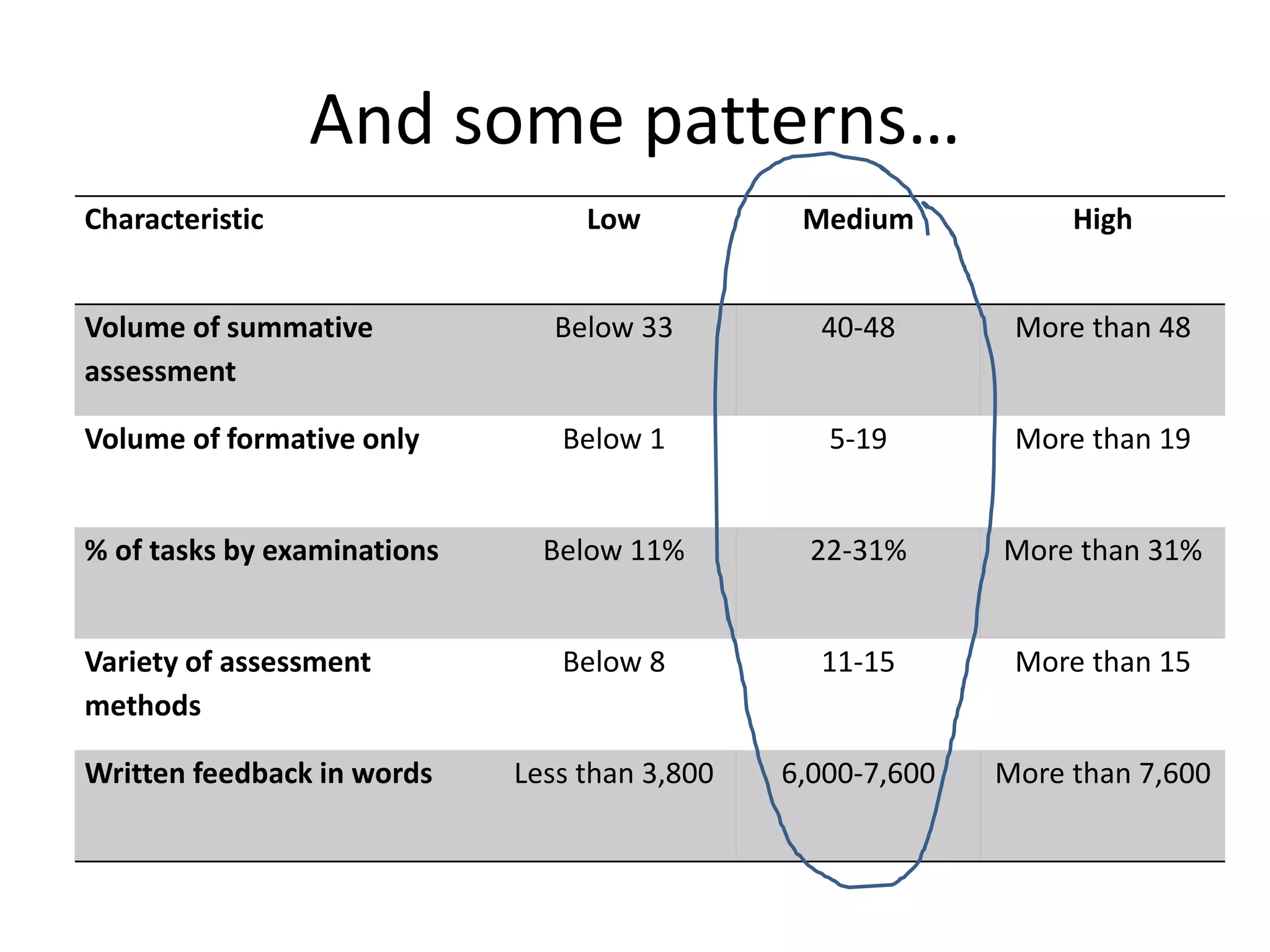
And some patterns…
Characteristic Low Medium High
Volume of summative
assessment
Below 33 40-48 More than 48
Volume of formative only Below 1 5-19 More than 19
% of tasks by examinations Below 11% 22-31% More than 31%
Variety of assessment
methods
Below 8 11-15 More than 15
Written feedback in words Less than 3,800 6,000-7,600 More than 7,600
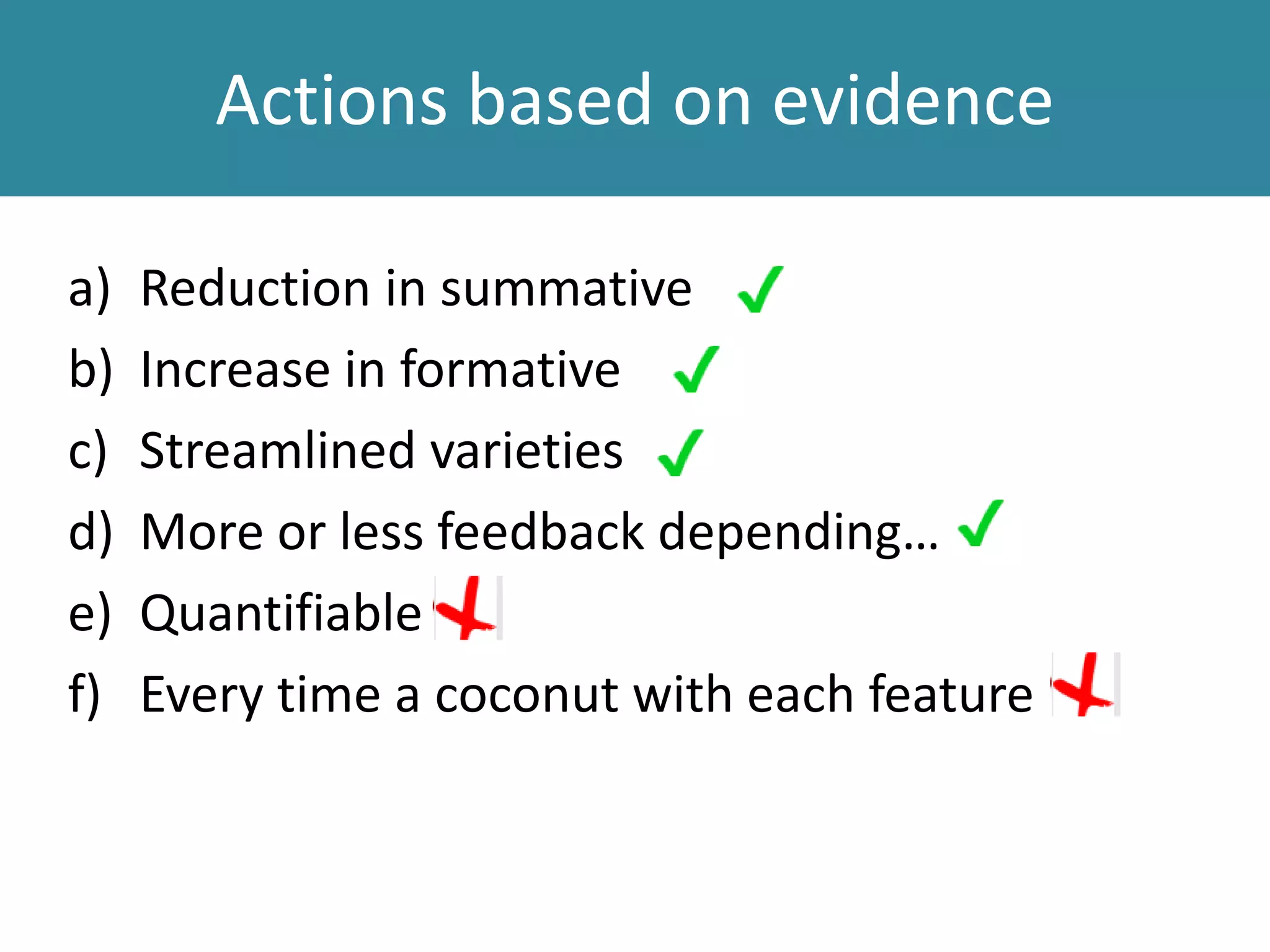
Actions based on evidence
a) Reduction in summative
b) Increase in formative
c) Streamlined varieties
d) More or less feedback depending…
e) Quantifiable
f) Every time a coconut with each feature
Theme 2: High summative: low formative
• Summative ‘pedagogies of control’
• Circa 2 per module in UK
• Ratio of 1:8 of formative to summative
• Formative weakly understood and practised
What students say…
• A lot of people don’t do wider reading. You just focus
on your essay question.
• In Weeks 9 to 12 there is hardly anyone in our
lectures. I'd rather use those two hours of lectures to
get the assignment done.
• It’s been non-stop assignments, and I’m now free of
assignments until the exams – I’ve had to rush every
piece of work I’ve done.
What students say: the barriers
• If there weren’t loads of other assessments, I’d do
it.
• If there are no actual consequences of not doing it,
most students are going to sit in the bar.
• It’s good to know you’re being graded because you
take it more seriously.
• The lecturers do formative assessment but we
don’t get any feedback on it.
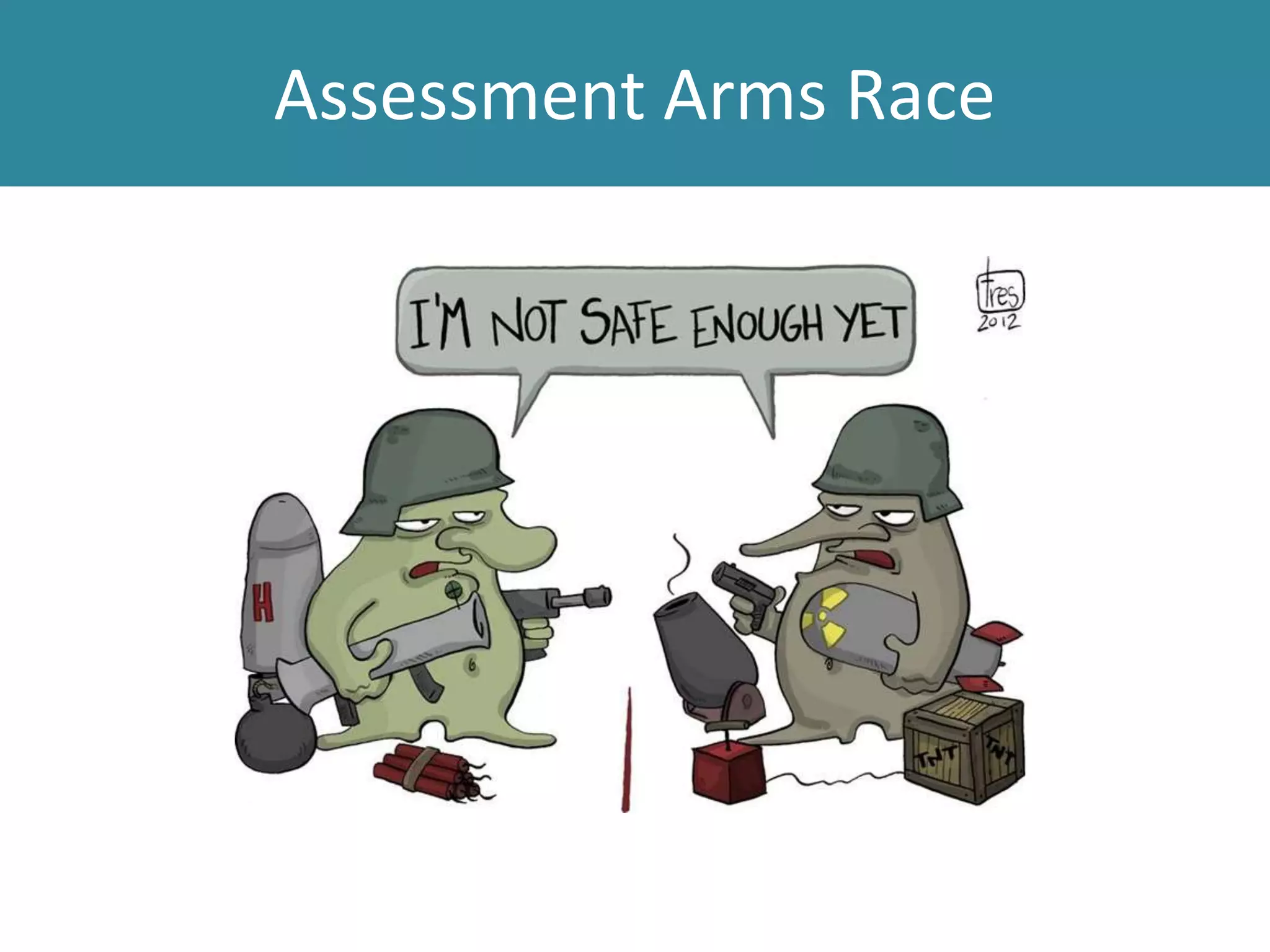
Assessment Arms Race
Actions based on evidence
1. Rebalance summative and formative
2. Shared language: programme approach
3. Formative in the public domain
4. Linking formative and summative
5. Risky, creative, challenging tasks
6. Students reading and producing more
7. Deeper understanding of value of formative
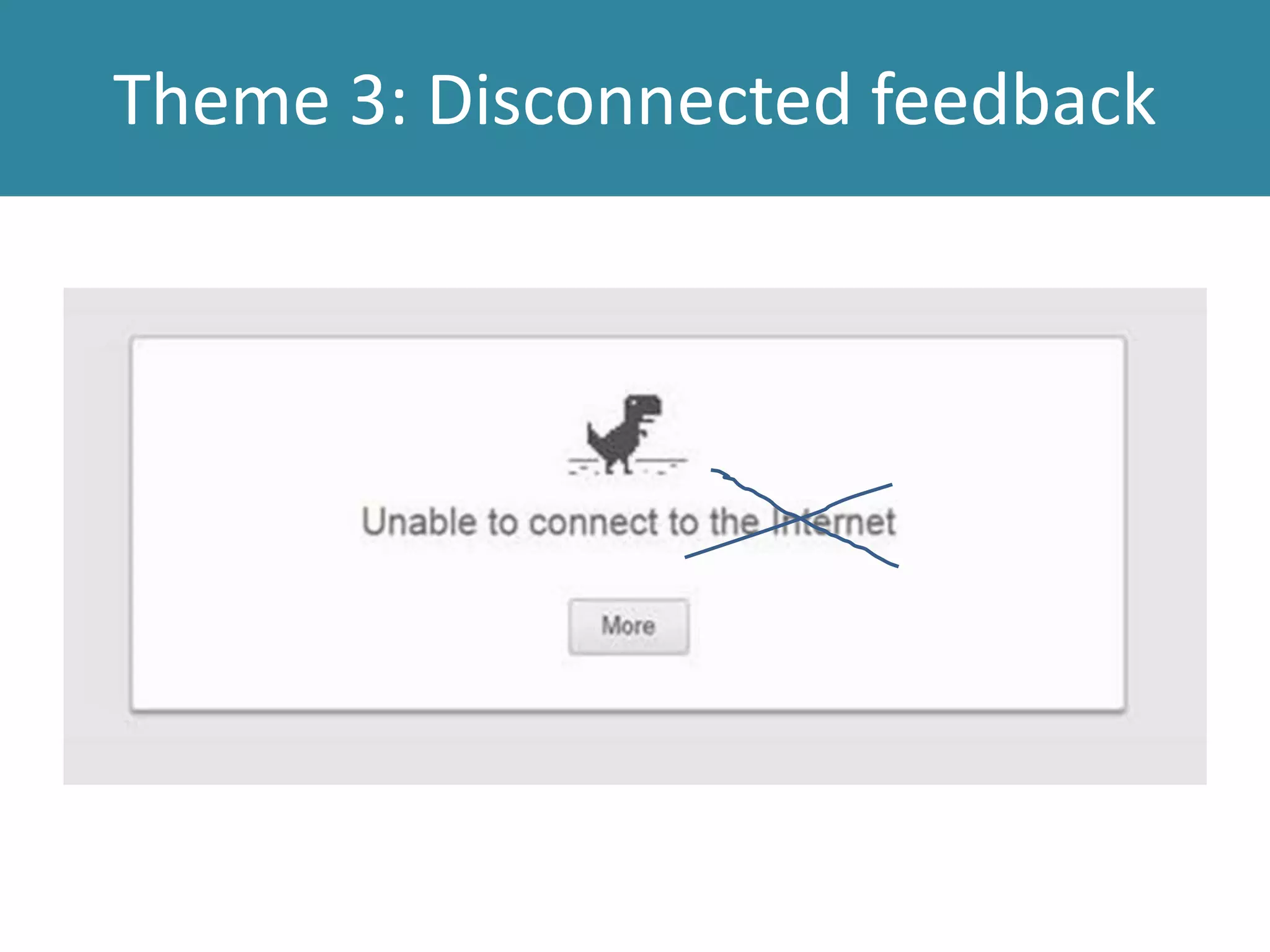
Theme 3: Disconnected feedback
Take five
• Choose a quote that
strikes you.
• What is the key issue?
• What strategies might
address this issue?
What students say…
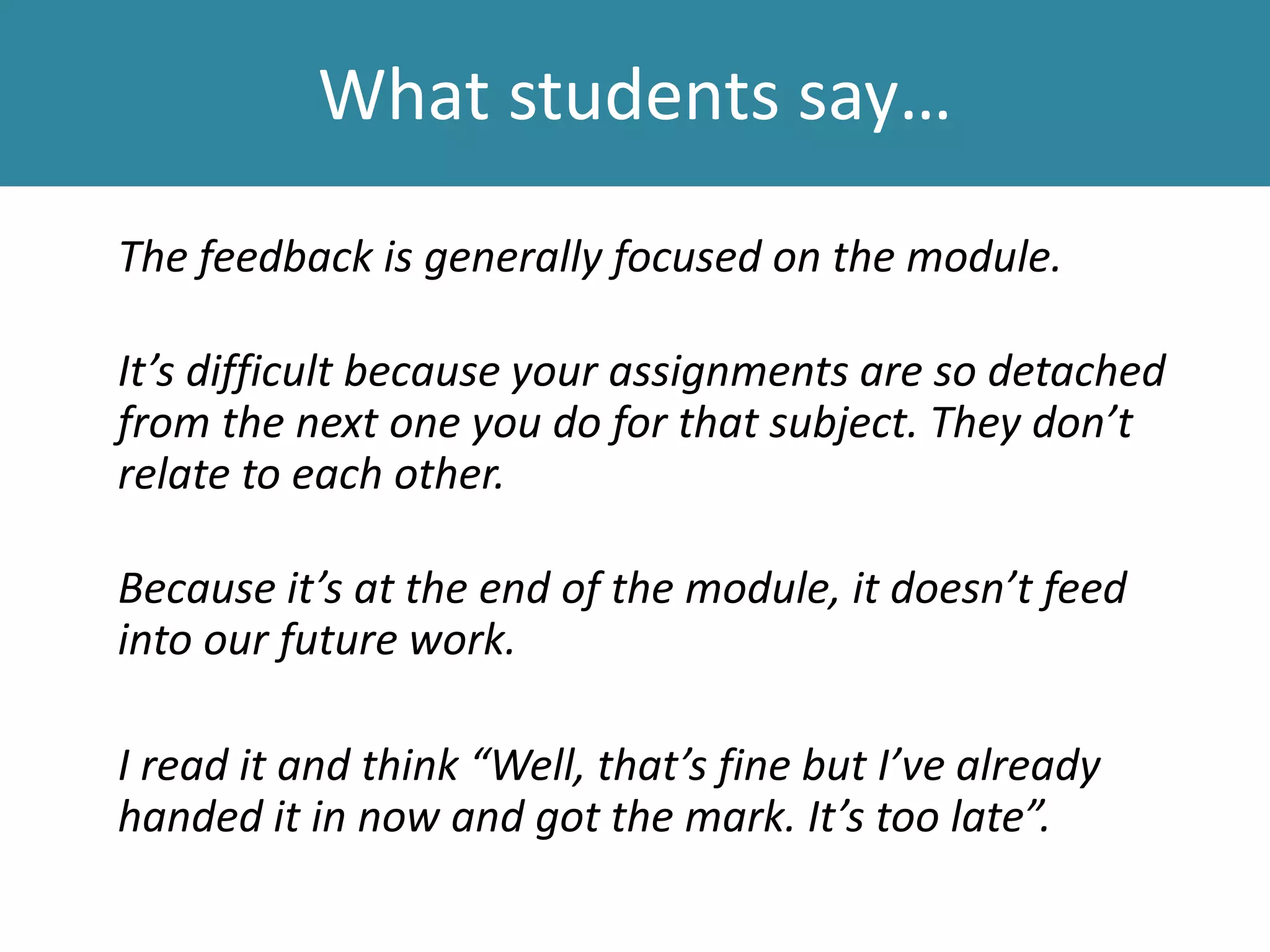
The feedback is generally focused on the module.
It’s difficult because your assignments are so detached
from the next one you do for that subject. They don’t
relate to each other.
Because it’s at the end of the module, it doesn’t feed
into our future work.
I read it and think “Well, that’s fine but I’ve already
handed it in now and got the mark. It’s too late”.
Students say the feedback relationship is
broken…
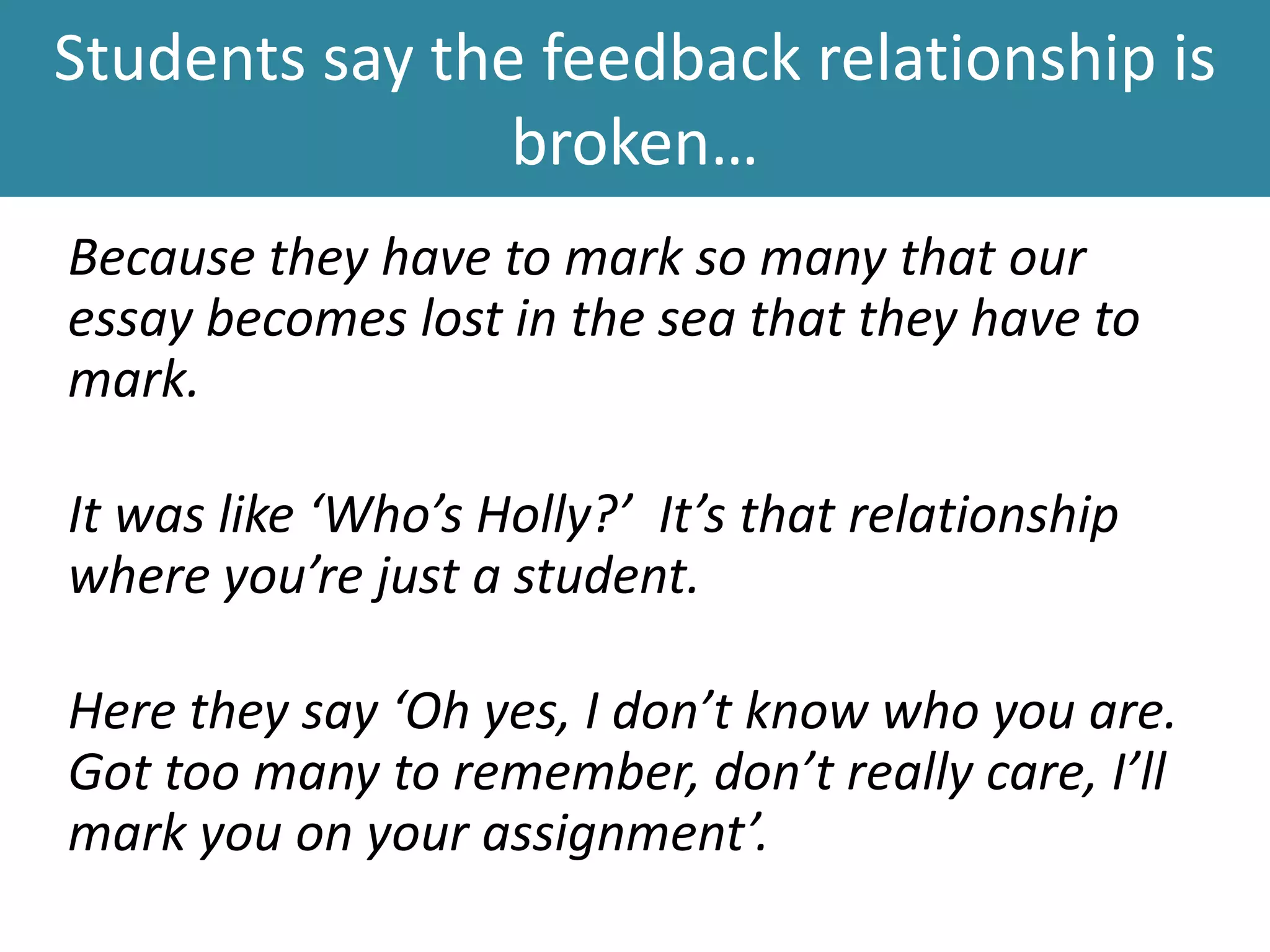
Because they have to mark so many that our
essay becomes lost in the sea that they have to
mark.
It was like ‘Who’s Holly?’ It’s that relationship
where you’re just a student.
Here they say ‘Oh yes, I don’t know who you are.
Got too many to remember, don’t really care, I’ll
mark you on your assignment’.
Actions based on evidence
• Conversation: who starts the dialogue?
• Iterative cycles of reflection across modules
• Quick generic feedback: the ‘Sherlock’ factor
• Feedback synthesis tasks
• Technology: audio, screencast and blogging
• From feedback as ‘telling’…
• … to feedback as asking questions
Theme 4: Confusion about goals and
standards
• Consistently low scores on the AEQ for clear
goals and standards
• Alienation from the tools, especially criteria
and guidelines
• Symptoms: perceptions of marker variation,
unfair standards and inconsistencies in practice
What students say…
We’ve got two tutors- one marks completely differently
to the other and it’s pot luck which one you get.
They have different criteria, they build up their own
criteria.
It’s such a guessing game.... You don’t know what they
expect from you.
What students say…
There are criteria, but I find them really strange.
There’s “writing coherently, making sure the
argument that you present is backed up with
evidence”.
I get the impression that they don't even look at the
marking criteria. They read the essay and then they
get a general impression, then they pluck a mark
from the air.
I don’t have any idea of why it got that mark
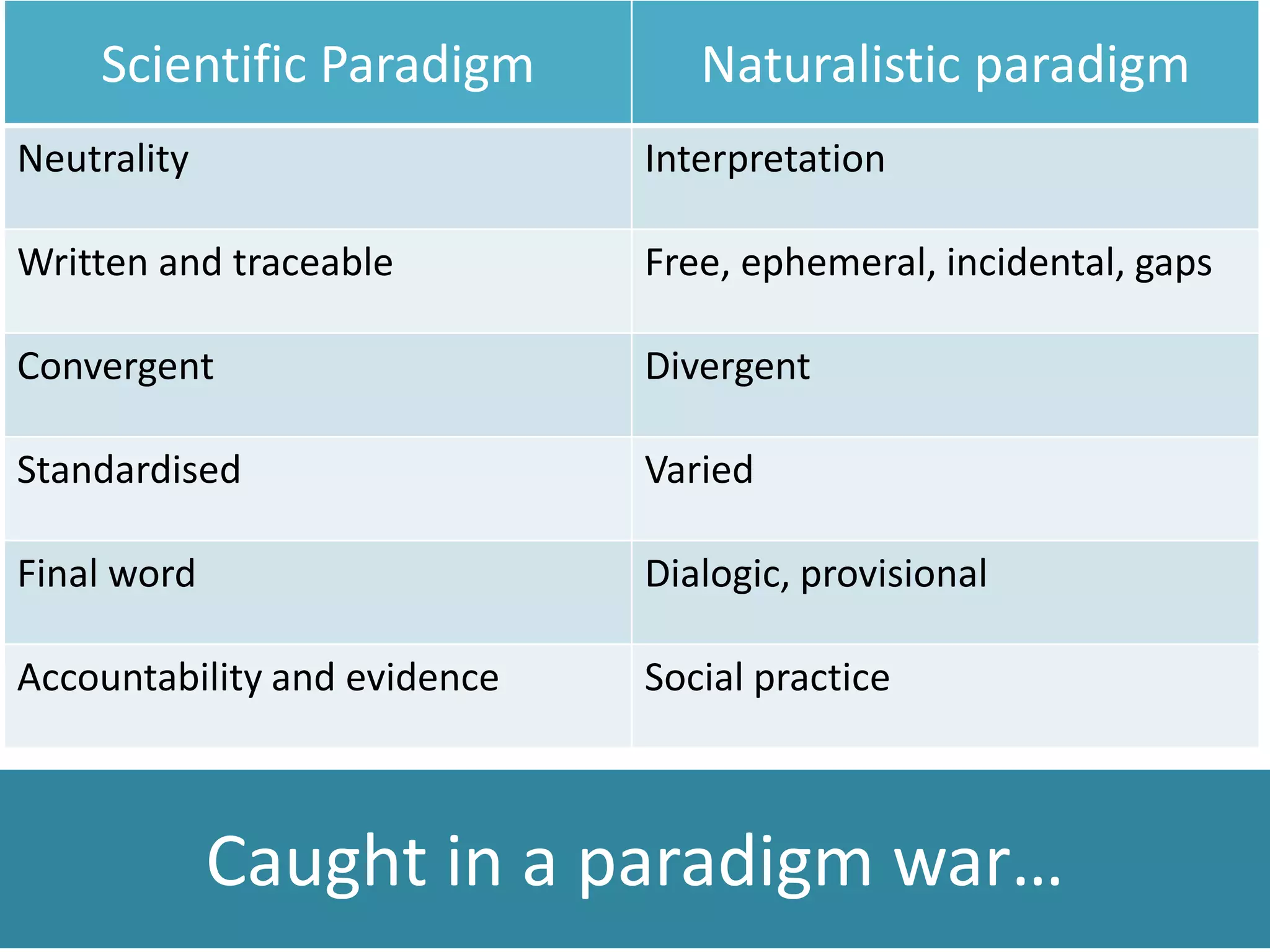
Caught in a paradigm war…
Scientific Paradigm Naturalistic paradigm
Neutrality Interpretation
Written and traceable Free, ephemeral, incidental, gaps
Convergent Divergent
Standardised Varied
Final word Dialogic, provisional
Accountability and evidence Social practice
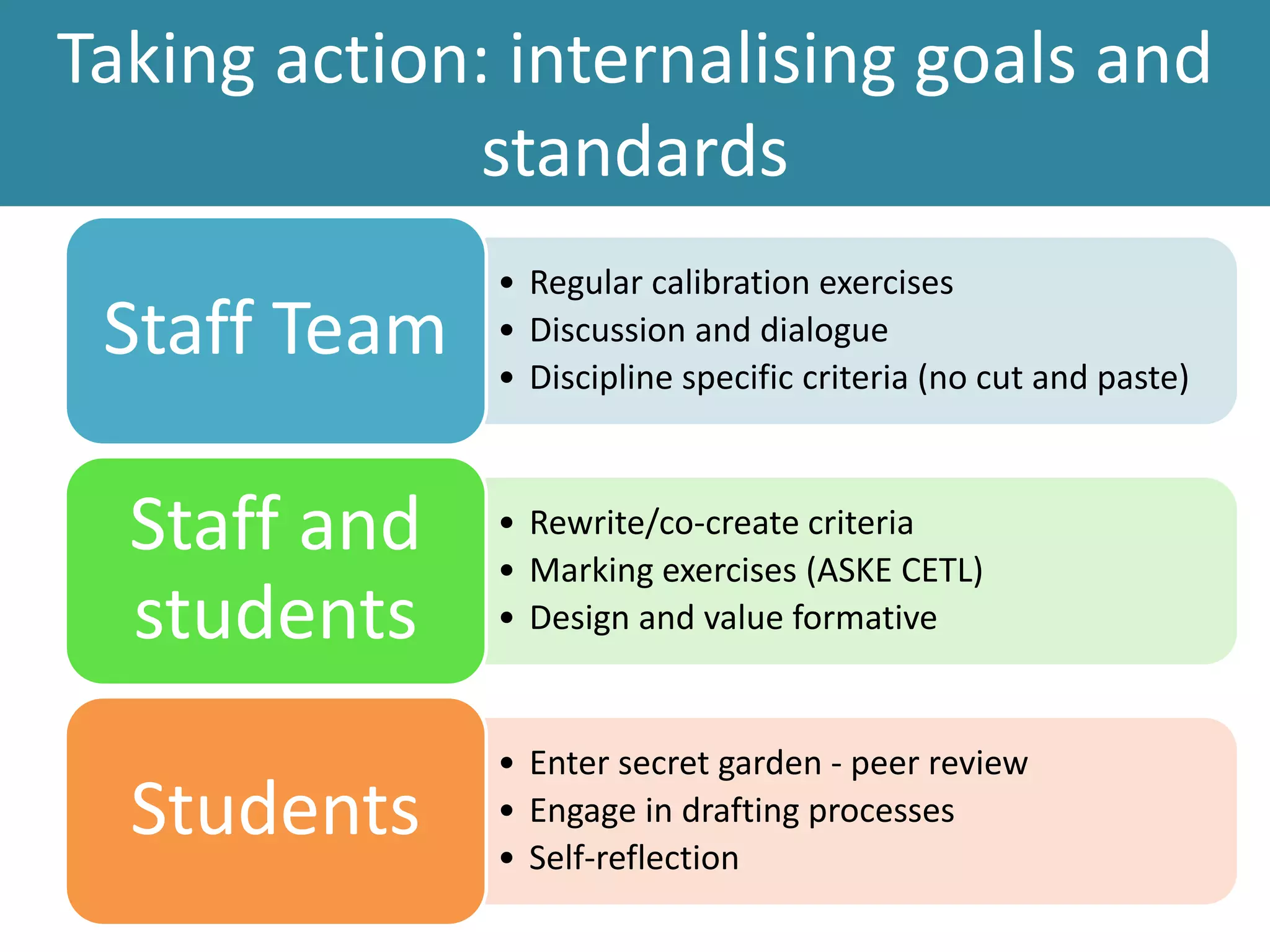
Taking action: internalising goals and
standards
• Regular calibration exercises
• Discussion and dialogue
• Discipline specific criteria (no cut and paste)
Staff Team
• Rewrite/co-create criteria
• Marking exercises (ASKE CETL)
• Design and value formative
Staff and
students
• Enter secret garden - peer review
• Engage in drafting processes
• Self-reflection
Students
It’s about educational paradigms…
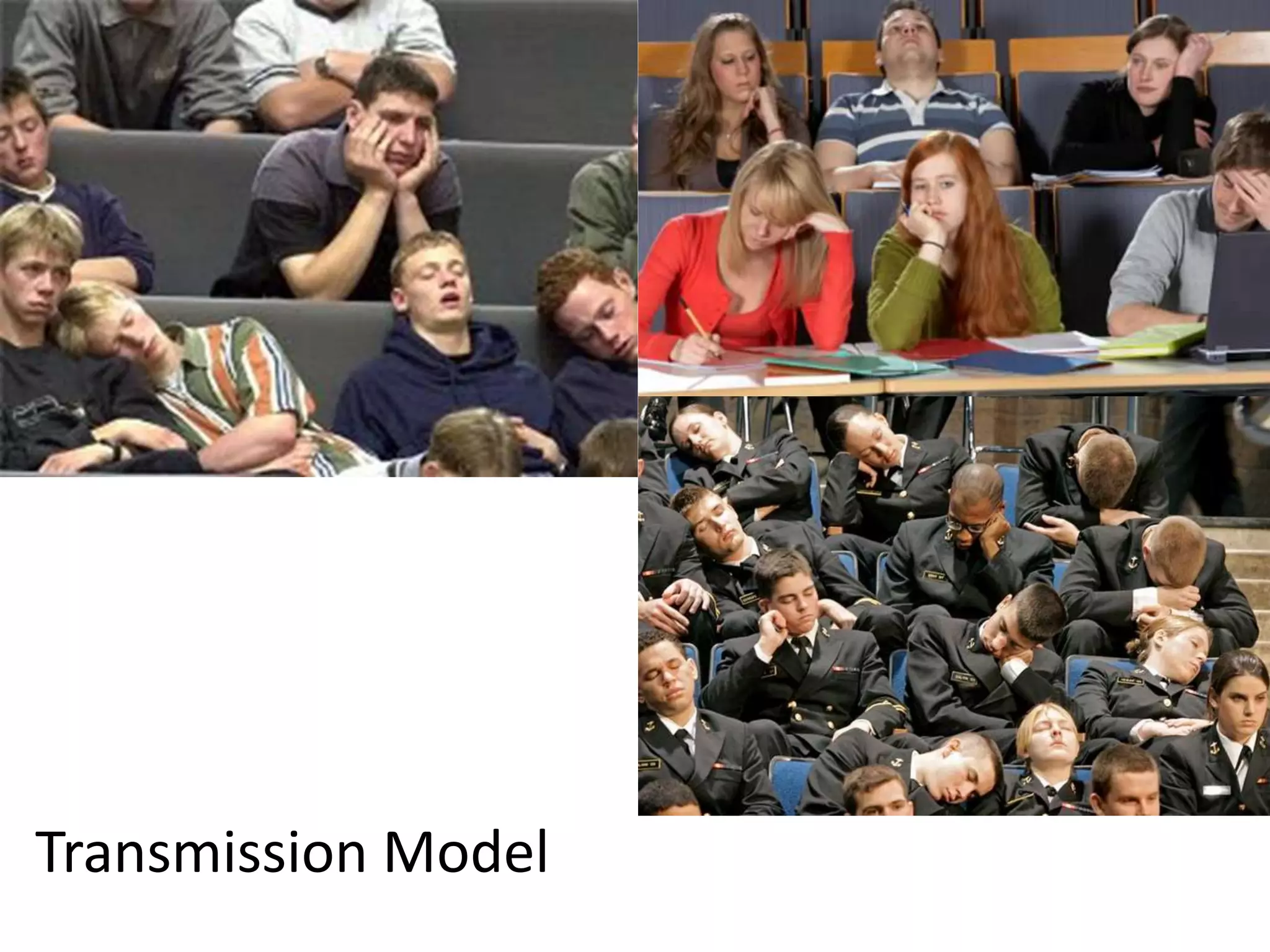
Transmission Model
Social Constructivist Model
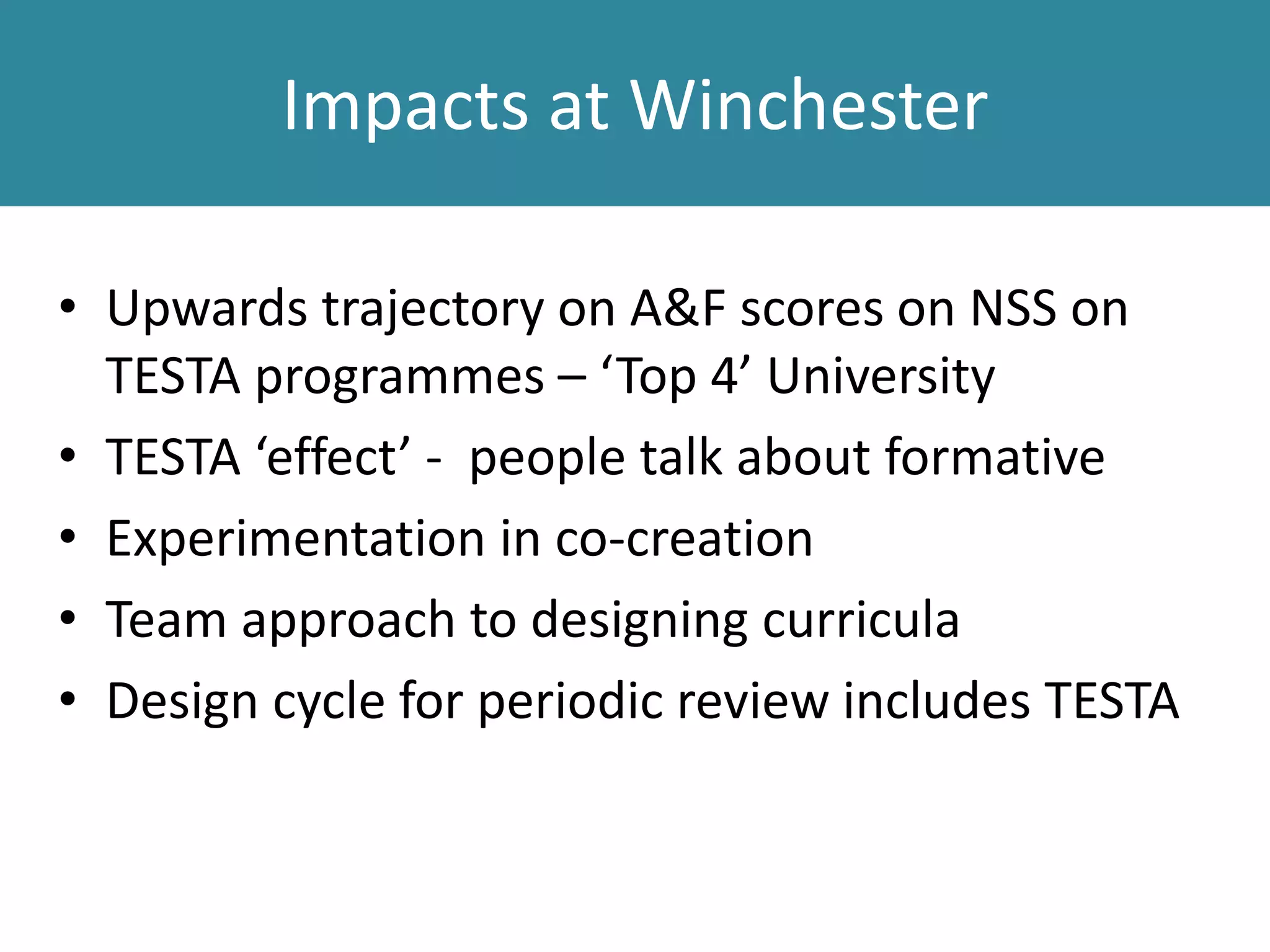
Impacts at Winchester
• Upwards trajectory on A&F scores on NSS on
TESTA programmes – ‘Top 4’ University
• TESTA ‘effect’ - people talk about formative
• Experimentation in co-creation
• Team approach to designing curricula
• Design cycle for periodic review includes TESTA
References
Blaich, C., & Wise, K. (2011). From Gathering to Using Assessment Results: Lessons from the Wabash
National Study. Occasional Paper #8. University of Illinois: National Institution for Learning Outcomes
Assessment.
Boud, D. and Molloy, E. (2013) ‘Rethinking models of feedback for learning: The challenge of
design’, Assessment & Evaluation in Higher Education, 38(6), pp. 698–712. doi:
10.1080/02602938.2012.691462.
Gibbs, G. & Simpson, C. (2004) Conditions r which assessment supports students' learning. Learning and
Teaching in Higher Education. 1(1): 3-31.
Harland, T., McLean, A., Wass, R., Miller, E. and Sim, K. N. (2014) ‘An assessment arms race and its
fallout: High-stakes grading and the case for slow scholarship’, Assessment & Evaluation in Higher
Education, 40(4), pp. 528–541. doi: 10.1080/02602938.2014.931927.
Hughes, G. (2014) Ipsative Assessment. Basingstoke. Palgrave MacMillan.
Jessop, T. and Maleckar, B. (2014). The Influence of disciplinary assessment patterns on student
learning: a comparative study. Studies in Higher Education. Published Online 27 August 2014
http://www.tandfonline.com/doi/abs/10.1080/03075079.2014.943170
Jessop, T. , El Hakim, Y. and Gibbs, G. (2014) The whole is greater than the sum of its parts: a large-scale
study of students’ learning in response to different assessment patterns. Assessment and Evaluation in
Higher Education. 39(1) 73-88.
Nicol, D. (2010) From monologue to dialogue: improving written feedback processes in mass higher
education, Assessment & Evaluation in Higher Education, 35: 5, 501 – 517.
O'Donovan, B , Price, M. and Rust, C. (2008) 'Developing student understanding of assessment
standards: a nested hierarchy of approaches', Teaching in Higher Education, 13: 2, 205 — 217
Sadler, D. R. (1989) ‘Formative assessment and the design of instructional systems’, Instructional
Science, 18(2), pp. 119–144. doi: 10.1007/bf00117714.

TESTA SEDA Keynote Spring 2016

  • 1.
    Changing the cultureof assessment and feedback through TESTA Tansy Jessop @tansyjtweets @TESTAwin 13 May 2016
  • 3.
    The TESTA Methodology 75PROGRAMME AUDITS Programme Team Meeting
  • 4.
  • 5.
    TESTA…. “…is a wayof thinking about assessment and feedback” Graham Gibbs
  • 6.
    TESTA shifts inperspective from… • ‘my’ module to ‘our’ programme • from teacher-focused on module delivery to student experience of whole programme • from individualistic modular design to coherent team design • from the NSS to enhancement strategies
  • 7.
    TESTA addresses threeproblems Problem 1: Knee-jerk problem Problem 2: Curriculum design problem Problem 3: Evidence to action problem
  • 8.
    Problem 1: Theknee-jerk
  • 9.
    Wow! Our students loveHistory! Fantastic!
  • 10.
    Whoops there’s alittle problem here
  • 11.
    Fix it! Ok, we’lllook especially at polishing up our feedback. Students seems to find that the least best thing.
  • 12.
  • 13.
    Anyone for thefeedback sandwich? I cushion the blow! The hard truths are nicely disguised! Me too - nice and soft!
  • 14.
    Problem 2: Curriculumdesign problem
  • 15.
    Does IKEA 101work for complex learning?
  • 16.
    Curriculum privileges ‘knowing’stuff “Content is often the most visible aspect for students, the control of which is frequently devolved to individual academics, who receive little or no training in curriculum design and planning” (Blackmore and Kandiko 2014, 7).
  • 17.
  • 18.
    Problem 3: Evidenceto action gap
  • 19.
    Problem 3: Evidenceto action gap Three misguided assumptions: 1. Problem is a lack of high quality data. 2. Analysis and findings a key mechanism for change. 3. Academics’ intellectual approach will facilitate change. http://www.liberalarts.wabash.edu/study-overview/
  • 20.
    Proving is differentfrom improving “It is incredibly difficult to translate assessment evidence into improvements in student learning” “It’s far less risky and complicated to analyze data than it is to act” (Blaich & Wise, 2011)
  • 21.
    Paradigm What itlooks like Technical rational Focus on data and tools Relational Focus on people Emancipatory Focus on systems and structures
  • 22.
    TESTA themes andimpacts 1. Variations in assessment patterns 2. High summative: low formative 3. Disconnected feedback 4. Lack of clarity about goals and standards
  • 23.
    1. Huge variations •What is striking for you about this data? • How does it compare with your context? • Does variation matter?
  • 24.
    Characteristic Range Summative 12-227 Formative 0 - 116 Varieties of assessment 5 - 21 Proportion of examinations 0% - 87% Time to return marks & feedback 10 - 42 days Volume of oral feedback 37 -1800 minutes Volume of written feedback 936 - 22,000 words
  • 25.
    And some patterns… CharacteristicLow Medium High Volume of summative assessment Below 33 40-48 More than 48 Volume of formative only Below 1 5-19 More than 19 % of tasks by examinations Below 11% 22-31% More than 31% Variety of assessment methods Below 8 11-15 More than 15 Written feedback in words Less than 3,800 6,000-7,600 More than 7,600
  • 26.
    Actions based onevidence a) Reduction in summative b) Increase in formative c) Streamlined varieties d) More or less feedback depending… e) Quantifiable f) Every time a coconut with each feature
  • 27.
    Theme 2: Highsummative: low formative • Summative ‘pedagogies of control’ • Circa 2 per module in UK • Ratio of 1:8 of formative to summative • Formative weakly understood and practised
  • 28.
    What students say… •A lot of people don’t do wider reading. You just focus on your essay question. • In Weeks 9 to 12 there is hardly anyone in our lectures. I'd rather use those two hours of lectures to get the assignment done. • It’s been non-stop assignments, and I’m now free of assignments until the exams – I’ve had to rush every piece of work I’ve done.
  • 29.
    What students say:the barriers • If there weren’t loads of other assessments, I’d do it. • If there are no actual consequences of not doing it, most students are going to sit in the bar. • It’s good to know you’re being graded because you take it more seriously. • The lecturers do formative assessment but we don’t get any feedback on it.
  • 30.
  • 31.
    Actions based onevidence 1. Rebalance summative and formative 2. Shared language: programme approach 3. Formative in the public domain 4. Linking formative and summative 5. Risky, creative, challenging tasks 6. Students reading and producing more 7. Deeper understanding of value of formative
  • 32.
  • 33.
    Take five • Choosea quote that strikes you. • What is the key issue? • What strategies might address this issue?
  • 34.
    What students say… Thefeedback is generally focused on the module. It’s difficult because your assignments are so detached from the next one you do for that subject. They don’t relate to each other. Because it’s at the end of the module, it doesn’t feed into our future work. I read it and think “Well, that’s fine but I’ve already handed it in now and got the mark. It’s too late”.
  • 35.
    Students say thefeedback relationship is broken… Because they have to mark so many that our essay becomes lost in the sea that they have to mark. It was like ‘Who’s Holly?’ It’s that relationship where you’re just a student. Here they say ‘Oh yes, I don’t know who you are. Got too many to remember, don’t really care, I’ll mark you on your assignment’.
  • 36.
    Actions based onevidence • Conversation: who starts the dialogue? • Iterative cycles of reflection across modules • Quick generic feedback: the ‘Sherlock’ factor • Feedback synthesis tasks • Technology: audio, screencast and blogging • From feedback as ‘telling’… • … to feedback as asking questions
  • 37.
    Theme 4: Confusionabout goals and standards • Consistently low scores on the AEQ for clear goals and standards • Alienation from the tools, especially criteria and guidelines • Symptoms: perceptions of marker variation, unfair standards and inconsistencies in practice
  • 38.
    What students say… We’vegot two tutors- one marks completely differently to the other and it’s pot luck which one you get. They have different criteria, they build up their own criteria. It’s such a guessing game.... You don’t know what they expect from you.
  • 39.
    What students say… Thereare criteria, but I find them really strange. There’s “writing coherently, making sure the argument that you present is backed up with evidence”. I get the impression that they don't even look at the marking criteria. They read the essay and then they get a general impression, then they pluck a mark from the air. I don’t have any idea of why it got that mark
  • 40.
    Caught in aparadigm war… Scientific Paradigm Naturalistic paradigm Neutrality Interpretation Written and traceable Free, ephemeral, incidental, gaps Convergent Divergent Standardised Varied Final word Dialogic, provisional Accountability and evidence Social practice
  • 41.
    Taking action: internalisinggoals and standards • Regular calibration exercises • Discussion and dialogue • Discipline specific criteria (no cut and paste) Staff Team • Rewrite/co-create criteria • Marking exercises (ASKE CETL) • Design and value formative Staff and students • Enter secret garden - peer review • Engage in drafting processes • Self-reflection Students
  • 42.
  • 43.
  • 44.
  • 45.
    Impacts at Winchester •Upwards trajectory on A&F scores on NSS on TESTA programmes – ‘Top 4’ University • TESTA ‘effect’ - people talk about formative • Experimentation in co-creation • Team approach to designing curricula • Design cycle for periodic review includes TESTA
  • 46.
    References Blaich, C., &Wise, K. (2011). From Gathering to Using Assessment Results: Lessons from the Wabash National Study. Occasional Paper #8. University of Illinois: National Institution for Learning Outcomes Assessment. Boud, D. and Molloy, E. (2013) ‘Rethinking models of feedback for learning: The challenge of design’, Assessment & Evaluation in Higher Education, 38(6), pp. 698–712. doi: 10.1080/02602938.2012.691462. Gibbs, G. & Simpson, C. (2004) Conditions r which assessment supports students' learning. Learning and Teaching in Higher Education. 1(1): 3-31. Harland, T., McLean, A., Wass, R., Miller, E. and Sim, K. N. (2014) ‘An assessment arms race and its fallout: High-stakes grading and the case for slow scholarship’, Assessment & Evaluation in Higher Education, 40(4), pp. 528–541. doi: 10.1080/02602938.2014.931927. Hughes, G. (2014) Ipsative Assessment. Basingstoke. Palgrave MacMillan. Jessop, T. and Maleckar, B. (2014). The Influence of disciplinary assessment patterns on student learning: a comparative study. Studies in Higher Education. Published Online 27 August 2014 http://www.tandfonline.com/doi/abs/10.1080/03075079.2014.943170 Jessop, T. , El Hakim, Y. and Gibbs, G. (2014) The whole is greater than the sum of its parts: a large-scale study of students’ learning in response to different assessment patterns. Assessment and Evaluation in Higher Education. 39(1) 73-88. Nicol, D. (2010) From monologue to dialogue: improving written feedback processes in mass higher education, Assessment & Evaluation in Higher Education, 35: 5, 501 – 517. O'Donovan, B , Price, M. and Rust, C. (2008) 'Developing student understanding of assessment standards: a nested hierarchy of approaches', Teaching in Higher Education, 13: 2, 205 — 217 Sadler, D. R. (1989) ‘Formative assessment and the design of instructional systems’, Instructional Science, 18(2), pp. 119–144. doi: 10.1007/bf00117714.

Editor's Notes

  • #5 How do you measure soft stuff? 5 day cricket match versus 20/20
  • #6 What started as a research methodology has become a way of thinking. David Nicol – changing the discourse, the way we think about assessment and feedback; not only technical, research, mapping, also shaping our thinking. Evidence, assessment principles. Habermas framework.
  • #7 Dominos fast food to Raymond Blanc slow learning
  • #14 Honest dialogue vs tricks of dialogue to minimise damage
  • #16 Hard to make connections, difficult to see the joins between assessments, much more assessment, much more assessment to accredit each little box. Multiplier effect. Less challenge, less integration. Lots of little neo-liberal tasks. The Assessment Arms Race.
  • #18 Language of ‘covering material’ Should we be surprised?
  • #19 Wabash study – 2005-2011, 17,000 students in 49 American colleges. 60-70 publications Critical thinking, moral reasoning, leadership towards social justice, engagement in diversity, deep intellectual work.
  • #20 Wabash study – 2005-2011, 17,000 students in 49 American colleges. 60-70 publications Critical thinking, moral reasoning, leadership towards social justice, engagement in diversity, deep intellectual work.
  • #22 TESTA has done the data and that’s been useful. Ideological compromises. Mixed methods approaches. Critical pedagogy sleeping with the enemy. Democratic, participatory, liberating curriculum and pedagogy. Teachers and students shape and change education. Resist managerialism and the market. Risky pedagogies.
  • #31 Teach Less, learn more. Assess less, learn more.
  • #36 Impoverished dialogue Nicol, Mass Higher Education; Relationship
  • #41 Reliability at the expense of learning?
  • #42 Students can increase their understanding of the language of assessment through their active engagement in: ‘observation, imitation, dialogue and practice’ (Rust, Price, and O’Donovan 2003, 152), Dialogue, clever strategies, social practice, relationship building, relinquishing power.