

PRESENTED BY : Mrs. DIVYA PD
MSc Nsg
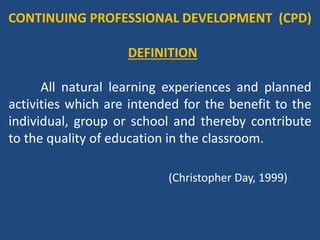
CONTINUING PROFESSIONAL DEVELOPMENT (CPD)
All natural learning experiences and planned
activities which are intended for the benefit to the
individual, group or school and thereby contribute
to the quality of education in the classroom.
(Christopher Day, 1999)
DEFINITION
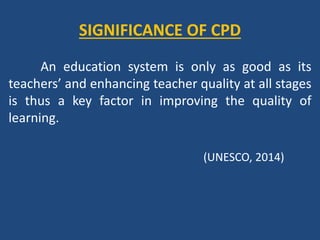
SIGNIFICANCE OF CPD
An education system is only as good as its
teachers’ and enhancing teacher quality at all stages
is thus a key factor in improving the quality of
learning.
(UNESCO, 2014)
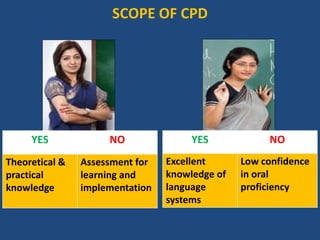
SCOPE OF CPD
YES NO
Excellent
knowledge of
language
systems
Low confidence
in oral
proficiency
YES NO
Theoretical &
practical
knowledge
Assessment for
learning and
implementation
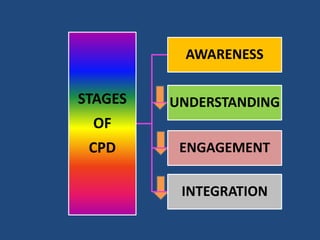
STAGES
OF
CPD
AWARENESS
UNDERSTANDING
ENGAGEMENT
INTEGRATION
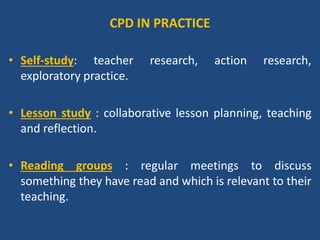
CPD IN PRACTICE
• Self-study: teacher research, action research,
exploratory practice.
• Lesson study : collaborative lesson planning, teaching
and reflection.
• Reading groups : regular meetings to discuss
something they have read and which is relevant to their
teaching.
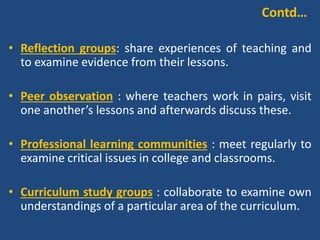
Contd…
• Reflection groups: share experiences of teaching and
to examine evidence from their lessons.
• Peer observation : where teachers work in pairs, visit
one another’s lessons and afterwards discuss these.
• Professional learning communities : meet regularly to
examine critical issues in college and classrooms.
• Curriculum study groups : collaborate to examine own
understandings of a particular area of the curriculum.
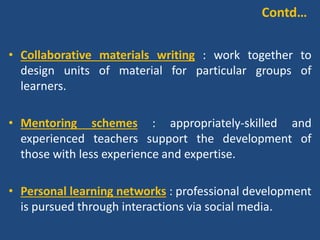
• Collaborative materials writing : work together to
design units of material for particular groups of
learners.
• Mentoring schemes : appropriately-skilled and
experienced teachers support the development of
those with less experience and expertise.
• Personal learning networks : professional development
is pursued through interactions via social media.
Contd…
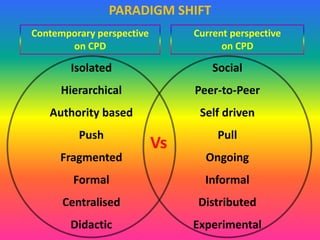
PARADIGM SHIFT
Isolated
Hierarchical
Authority based
Push
Fragmented
Formal
Centralised
Didactic
Social
Peer-to-Peer
Self driven
Pull
Ongoing
Informal
Distributed
Experimental
Vs
Contemporary perspective
on CPD
Current perspective
on CPD
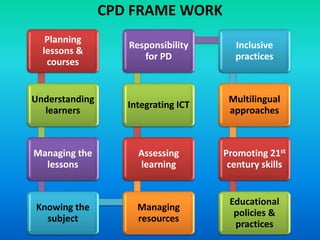
Planning
lessons &
courses
Understanding
learners
Managing the
lessons
Knowing the
subject
Managing
resources
Assessing
learning
Integrating ICT
Responsibility
for PD
Inclusive
practices
Multilingual
approaches
Promoting 21st
century skills
Educational
policies &
practices
CPD FRAME WORK
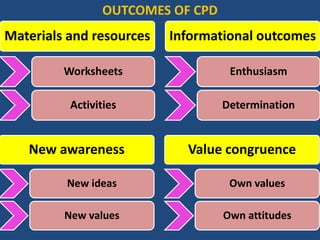
Materials and resources
Worksheets
Activities
OUTCOMES OF CPD
Informational outcomes
Enthusiasm
Determination
New awareness
New ideas
New values
Value congruence
Own values
Own attitudes
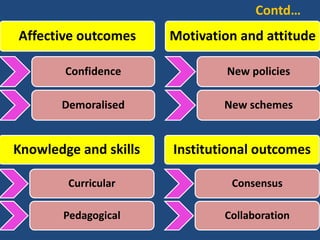
Affective outcomes
Confidence
Demoralised
Contd…
Motivation and attitude
New policies
New schemes
Knowledge and skills
Curricular
Pedagogical
Institutional outcomes
Consensus
Collaboration
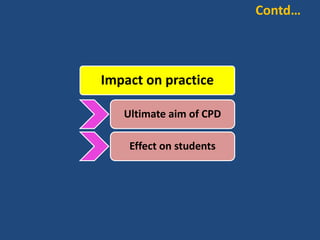
Impact on practice
Ultimate aim of CPD
Effect on students
Contd…
REFERENCES
• UNESCO (2014) Teaching and learning: Achieving equality
for all. 11th EFA global monitoring report. Paris: UNESCO.
• British Council, institution for international cultural and
educational opportunities.
• 20th Annual World International Congress for
Effectiveness and Improvement on Teachers’ CPD.
Bottom Line…
Our ability to learn what we
need for tomorrow is more important
than what we know today…
Continuing Professional Development

Continuing Professional Development

  • 1.
    PRESENTED BY :Mrs. DIVYA PD MSc Nsg CONTINUING PROFESSIONAL DEVELOPMENT (CPD)
  • 2.
    CONTINUING PROFESSIONAL DEVELOPMENT(CPD) All natural learning experiences and planned activities which are intended for the benefit to the individual, group or school and thereby contribute to the quality of education in the classroom. (Christopher Day, 1999) DEFINITION
  • 3.
    SIGNIFICANCE OF CPD Aneducation system is only as good as its teachers’ and enhancing teacher quality at all stages is thus a key factor in improving the quality of learning. (UNESCO, 2014)
  • 4.
    SCOPE OF CPD YESNO Excellent knowledge of language systems Low confidence in oral proficiency YES NO Theoretical & practical knowledge Assessment for learning and implementation
  • 5.
  • 6.
    CPD IN PRACTICE •Self-study: teacher research, action research, exploratory practice. • Lesson study : collaborative lesson planning, teaching and reflection. • Reading groups : regular meetings to discuss something they have read and which is relevant to their teaching.
  • 7.
    Contd… • Reflection groups:share experiences of teaching and to examine evidence from their lessons. • Peer observation : where teachers work in pairs, visit one another’s lessons and afterwards discuss these. • Professional learning communities : meet regularly to examine critical issues in college and classrooms. • Curriculum study groups : collaborate to examine own understandings of a particular area of the curriculum.
  • 8.
    • Collaborative materialswriting : work together to design units of material for particular groups of learners. • Mentoring schemes : appropriately-skilled and experienced teachers support the development of those with less experience and expertise. • Personal learning networks : professional development is pursued through interactions via social media. Contd…
  • 9.
    PARADIGM SHIFT Isolated Hierarchical Authority based Push Fragmented Formal Centralised Didactic Social Peer-to-Peer Selfdriven Pull Ongoing Informal Distributed Experimental Vs Contemporary perspective on CPD Current perspective on CPD
  • 10.
    Planning lessons & courses Understanding learners Managing the lessons Knowingthe subject Managing resources Assessing learning Integrating ICT Responsibility for PD Inclusive practices Multilingual approaches Promoting 21st century skills Educational policies & practices CPD FRAME WORK
  • 11.
    Materials and resources Worksheets Activities OUTCOMESOF CPD Informational outcomes Enthusiasm Determination New awareness New ideas New values Value congruence Own values Own attitudes
  • 12.
    Affective outcomes Confidence Demoralised Contd… Motivation andattitude New policies New schemes Knowledge and skills Curricular Pedagogical Institutional outcomes Consensus Collaboration
  • 13.
    Impact on practice Ultimateaim of CPD Effect on students Contd…
  • 14.
    REFERENCES • UNESCO (2014)Teaching and learning: Achieving equality for all. 11th EFA global monitoring report. Paris: UNESCO. • British Council, institution for international cultural and educational opportunities. • 20th Annual World International Congress for Effectiveness and Improvement on Teachers’ CPD.
  • 15.
    Bottom Line… Our abilityto learn what we need for tomorrow is more important than what we know today…