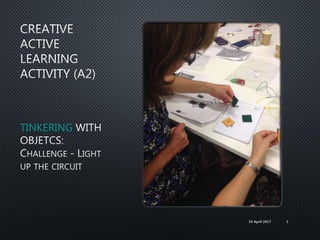
TINKERING
19 April 2017 2
SESSION AIM:
•
•
•
19 April 2017 3
19 April 2017 4
•
•
19 April 2017 5
19 April 2017 6
19 April 2017 7
•
•
•
•
•
19 April 2017 8
19 April 2017 9
April 19, 2017 10
19 April 2017 11
•
•
•
19 April 2017 12
•
•
19 April 2017 13
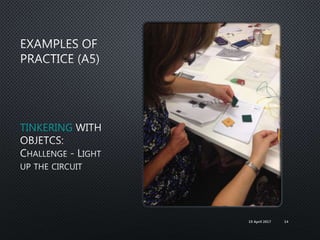
TINKERING
19 April 2017 14
TINKERING
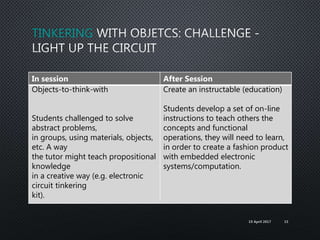
In session After Session
Objects-to-think-with
Students challenged to solve
abstract problems,
in groups, using materials, objects,
etc. A way
the tutor might teach propositional
knowledge
in a creative way (e.g. electronic
circuit tinkering
kit).
Create an instructable (education)
Students develop a set of on-line
instructions to teach others the
concepts and functional
operations, they will need to learn,
in order to create a fashion product
with embedded electronic
systems/computation.
19 April 2017 15
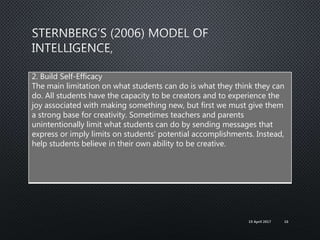
2. Build Self-Efficacy
The main limitation on what students can do is what they think they can
do. All students have the capacity to be creators and to experience the
joy associated with making something new, but first we must give them
a strong base for creativity. Sometimes teachers and parents
unintentionally limit what students can do by sending messages that
express or imply limits on students’ potential accomplishments. Instead,
help students believe in their own ability to be creative.
19 April 2017 16
19 April 2017 17
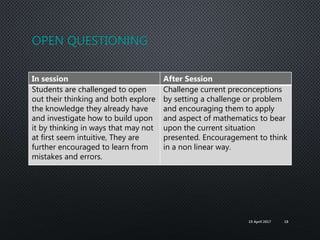
OPEN QUESTIONING
In session After Session
Students are challenged to open
out their thinking and both explore
the knowledge they already have
and investigate how to build upon
it by thinking in ways that may not
at first seem intuitive, They are
further encouraged to learn from
mistakes and errors.
Challenge current preconceptions
by setting a challenge or problem
and encouraging them to apply
and aspect of mathematics to bear
upon the current situation
presented. Encouragement to think
in a non linear way.
19 April 2017 18
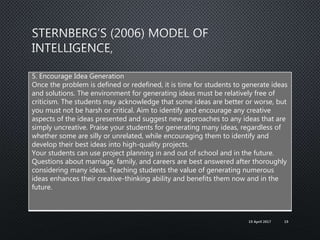
5. Encourage Idea Generation
Once the problem is defined or redefined, it is time for students to generate ideas
and solutions. The environment for generating ideas must be relatively free of
criticism. The students may acknowledge that some ideas are better or worse, but
you must not be harsh or critical. Aim to identify and encourage any creative
aspects of the ideas presented and suggest new approaches to any ideas that are
simply uncreative. Praise your students for generating many ideas, regardless of
whether some are silly or unrelated, while encouraging them to identify and
develop their best ideas into high-quality projects.
Your students can use project planning in and out of school and in the future.
Questions about marriage, family, and careers are best answered after thoroughly
considering many ideas. Teaching students the value of generating numerous
ideas enhances their creative-thinking ability and benefits them now and in the
future.
19 April 2017 19
19 April 2017 20
April 19, 2017 21
19 April 2017 22

Teaching for Creativity

  • 2.
  • 3.
  • 4.
  • 5.
  • 6.
  • 7.
  • 8.
  • 9.
  • 10.
  • 11.
  • 12.
  • 13.
  • 14.
  • 15.
    TINKERING In session AfterSession Objects-to-think-with Students challenged to solve abstract problems, in groups, using materials, objects, etc. A way the tutor might teach propositional knowledge in a creative way (e.g. electronic circuit tinkering kit). Create an instructable (education) Students develop a set of on-line instructions to teach others the concepts and functional operations, they will need to learn, in order to create a fashion product with embedded electronic systems/computation. 19 April 2017 15
  • 16.
    2. Build Self-Efficacy Themain limitation on what students can do is what they think they can do. All students have the capacity to be creators and to experience the joy associated with making something new, but first we must give them a strong base for creativity. Sometimes teachers and parents unintentionally limit what students can do by sending messages that express or imply limits on students’ potential accomplishments. Instead, help students believe in their own ability to be creative. 19 April 2017 16
  • 17.
  • 18.
    OPEN QUESTIONING In sessionAfter Session Students are challenged to open out their thinking and both explore the knowledge they already have and investigate how to build upon it by thinking in ways that may not at first seem intuitive, They are further encouraged to learn from mistakes and errors. Challenge current preconceptions by setting a challenge or problem and encouraging them to apply and aspect of mathematics to bear upon the current situation presented. Encouragement to think in a non linear way. 19 April 2017 18
  • 19.
    5. Encourage IdeaGeneration Once the problem is defined or redefined, it is time for students to generate ideas and solutions. The environment for generating ideas must be relatively free of criticism. The students may acknowledge that some ideas are better or worse, but you must not be harsh or critical. Aim to identify and encourage any creative aspects of the ideas presented and suggest new approaches to any ideas that are simply uncreative. Praise your students for generating many ideas, regardless of whether some are silly or unrelated, while encouraging them to identify and develop their best ideas into high-quality projects. Your students can use project planning in and out of school and in the future. Questions about marriage, family, and careers are best answered after thoroughly considering many ideas. Teaching students the value of generating numerous ideas enhances their creative-thinking ability and benefits them now and in the future. 19 April 2017 19
  • 20.
  • 21.
  • 22.

Editor's Notes

  • #3 Write down as a group about your learning experince
  • #4 To introduce the principles and practices of teaching for creativity, allow time to evaluate and develop current teaching practice, in relation to the principles of teaching for creativity and to evaluate your own personal capacity to be creative and use creative approaches that develop creativity in others
  • #7 Individually write down what creativity means to you and why it might be a good thing to support students with
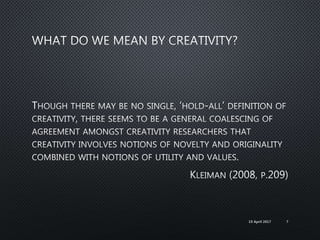
  • #8 Kleiman writes about creativity within the HE sector – when he states that university lecturers across a range of disciplines (arts, humanities and science) conceptualise creativity in different ways, p.209 In Kleiman’s view, “there is much more to the experience of creativity in learning and teaching than simply ‘being creative’”, p.216. Kleiman warns that “The transformational power of creativity poses a clear challenge to organisational systems and institutional frameworks that rely, often necessarily, on compliance and constraint, and it also poses a challenge to approaches to learning, teaching and assessment that promote or pander to strategic or surface approaches to learning”, p.216 In Kleiman’s view, creativity for the teacher is about transformation and fulfilment, p.216.
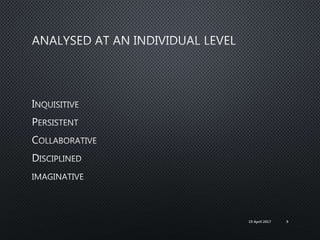
  • #9 SPENCER, E., LUCAS, B. and CLAXTON, G., 2014. Progression in Student Creativity in School First Steps Towards New Forms of Formative Assessments  Report for OECD Focused on schooling.
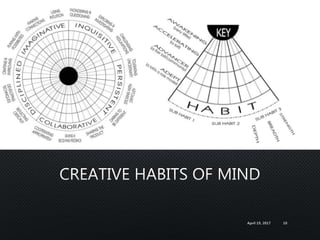
  • #10 Spencer, Lucas and Claxton (2014, p.4) state that “learners can display the full range of their creative dispositions in a wide variety of contexts”, if “(1) teachers are able to be more precise and confident in the development of creativity, and (2) learners are better able to understand what it is to be creative (and to use this understanding to record evidence of their progress). In other words progress is made if practical steps are taken to develop creativity in leaners and to to make that learning explicit so the learners can become autonomous in their development Building blocks to teach creativity.
  • #12 Why do it? Gibson (2010) states that “creativity per se has been heralded as a means with which to solve a plethora of social, political and economic problems facing the twenty-first centaury”, p.609. Gibson explore the “subversive nature of creativity, the value of creative teaching and proposes a number of strategies higher education should consider if they hope to graduate the future leaders of twenty-first centaury society”, p. 607 In Gibson’s view, that “by fostering creativity in our students, we learn about our own teaching and ultimately become more creative teachers”, p.612 Part of module 2 is for you to contextualise the influence of different drivers in HE.
  • #13 Sternberg et al. state that successful intelligence tests which include tasks for testing analysis, practical and creative intelligence ought to be used for entrance prediction validity for college success that has the potential to increase diversity. P.321 In other words, regular tests are limited in their capacity to predict college success and the broadening of tests that include analytic, practical and creative elements might also identify groups of learners that don’t typically pass the current tests.
  • #14 Has this made you think again about your current practice? Add opportunities and threats to your SWOT
  • #18 SPENCER, E., LUCAS, B. and CLAXTON, G., 2014.