Integrative Learning at the
     University of Oregon
                 Amber Garrison Duncan
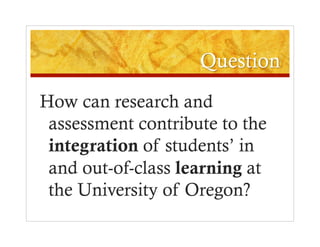
How can research and
 assessment contribute to the
 integration of students’ in
 and out-of-class learning at
 the University of Oregon?
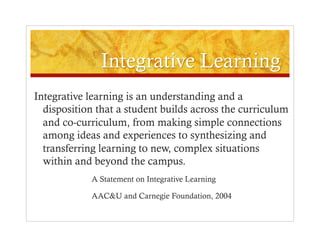
Integrative learning is an understanding and a
  disposition that a student builds across the curriculum
  and co-curriculum, from making simple connections
  among ideas and experiences to synthesizing and
  transferring learning to new, complex situations
  within and beyond the campus.
            A Statement on Integrative Learning

            AAC&U and Carnegie Foundation, 2004
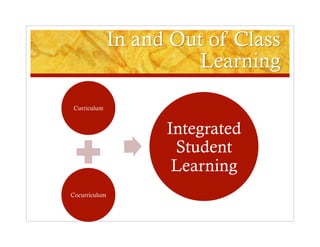
Curriculum


               Integrated
                Student
                Learning
Cocurriculum
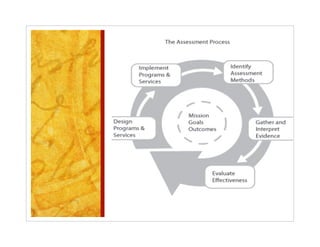
    Assessment – The ongoing, systematic process of collecting,
     analyzing, and using information about divisional,
     departmental, and programmatic effectiveness, in order to
     improve student learning (Upcraft & Schuh, 1996; Anderson,
     Bresciani, & Zelna, 2004).
    Research – In contrast to assessment, which “guides good
     practice,” research “guides theory development and tests
     concepts” and has “broader implication for student affairs and
     higher education” (Upcraft & Schuh, 2001, p. 5).
Student Learning – “Learning is a complex, holistic,
multi-centric activity that occurs throughout and across
the college experience. Student development, and the
adaptation of learning to students’ lives and needs, are
fundamental parts of engaged learning and liberal
education. True liberal education requires the engagement
of the whole student – and the deployment of every
resource in higher education” (Learning Reconsidered,
2004, p. 6).
    Requires more collaboration among faculty and staff to identify
     shared learning outcomes.

    Alignment of curricular and cocurricular learning opportunities to
     create coherent or holistic student learning experience.

    Acknowledges strengths of multiple pedagogies and learning contexts,
     resulting in a comprehensive approach to teaching and learning.
    Concentrate limited resources on high impact practices that foster
     integrative learning.

    Fosters a dynamic academic environment as everyone is a part of
     building the learning community.

    Provides comprehensive data about student learning at the institution.

    Greater ability to communicate the institutions impact on student
     learning.

    Facilitates more student self assessment.
    Communicate

    Collaborate

    Shared Vision and Learning Outcomes

    New Partnerships

    Capacity Building

    Strategic Planning

    Assessment of Current Practices and Culture
    Cocurricular learning domains aligned with general education
     outcomes and UO Mission.
    Student Affairs Strategic Plan aligned with Academic Plan, UO
     Mission.
    Implement infrastructure and decision making processes that support
     culture of evidence based practice through assessment and evaluation.

    Capacity building through professional development.
    Research agenda focused on integrative learning.
    Faculty collaborations and key partnerships.
    Telling the story.
Questions?

Integrative Learning

  • 1.
    Integrative Learning atthe University of Oregon Amber Garrison Duncan
  • 2.
    How can researchand assessment contribute to the integration of students’ in and out-of-class learning at the University of Oregon?
  • 3.
    Integrative learning isan understanding and a disposition that a student builds across the curriculum and co-curriculum, from making simple connections among ideas and experiences to synthesizing and transferring learning to new, complex situations within and beyond the campus. A Statement on Integrative Learning AAC&U and Carnegie Foundation, 2004
  • 5.
    Curriculum Integrated Student Learning Cocurriculum
  • 6.
      Assessment – The ongoing, systematic process of collecting, analyzing, and using information about divisional, departmental, and programmatic effectiveness, in order to improve student learning (Upcraft & Schuh, 1996; Anderson, Bresciani, & Zelna, 2004).   Research – In contrast to assessment, which “guides good practice,” research “guides theory development and tests concepts” and has “broader implication for student affairs and higher education” (Upcraft & Schuh, 2001, p. 5).
  • 7.
    Student Learning –“Learning is a complex, holistic, multi-centric activity that occurs throughout and across the college experience. Student development, and the adaptation of learning to students’ lives and needs, are fundamental parts of engaged learning and liberal education. True liberal education requires the engagement of the whole student – and the deployment of every resource in higher education” (Learning Reconsidered, 2004, p. 6).
  • 9.
      Requires more collaboration among faculty and staff to identify shared learning outcomes.   Alignment of curricular and cocurricular learning opportunities to create coherent or holistic student learning experience.   Acknowledges strengths of multiple pedagogies and learning contexts, resulting in a comprehensive approach to teaching and learning.
  • 10.
      Concentrate limited resources on high impact practices that foster integrative learning.   Fosters a dynamic academic environment as everyone is a part of building the learning community.   Provides comprehensive data about student learning at the institution.   Greater ability to communicate the institutions impact on student learning.   Facilitates more student self assessment.
  • 11.
      Communicate   Collaborate   Shared Vision and Learning Outcomes   New Partnerships   Capacity Building   Strategic Planning   Assessment of Current Practices and Culture
  • 12.
      Cocurricular learning domains aligned with general education outcomes and UO Mission.   Student Affairs Strategic Plan aligned with Academic Plan, UO Mission.   Implement infrastructure and decision making processes that support culture of evidence based practice through assessment and evaluation.   Capacity building through professional development.   Research agenda focused on integrative learning.   Faculty collaborations and key partnerships.   Telling the story.
  • 13.