Assessment in Higher Education
Webinar 5
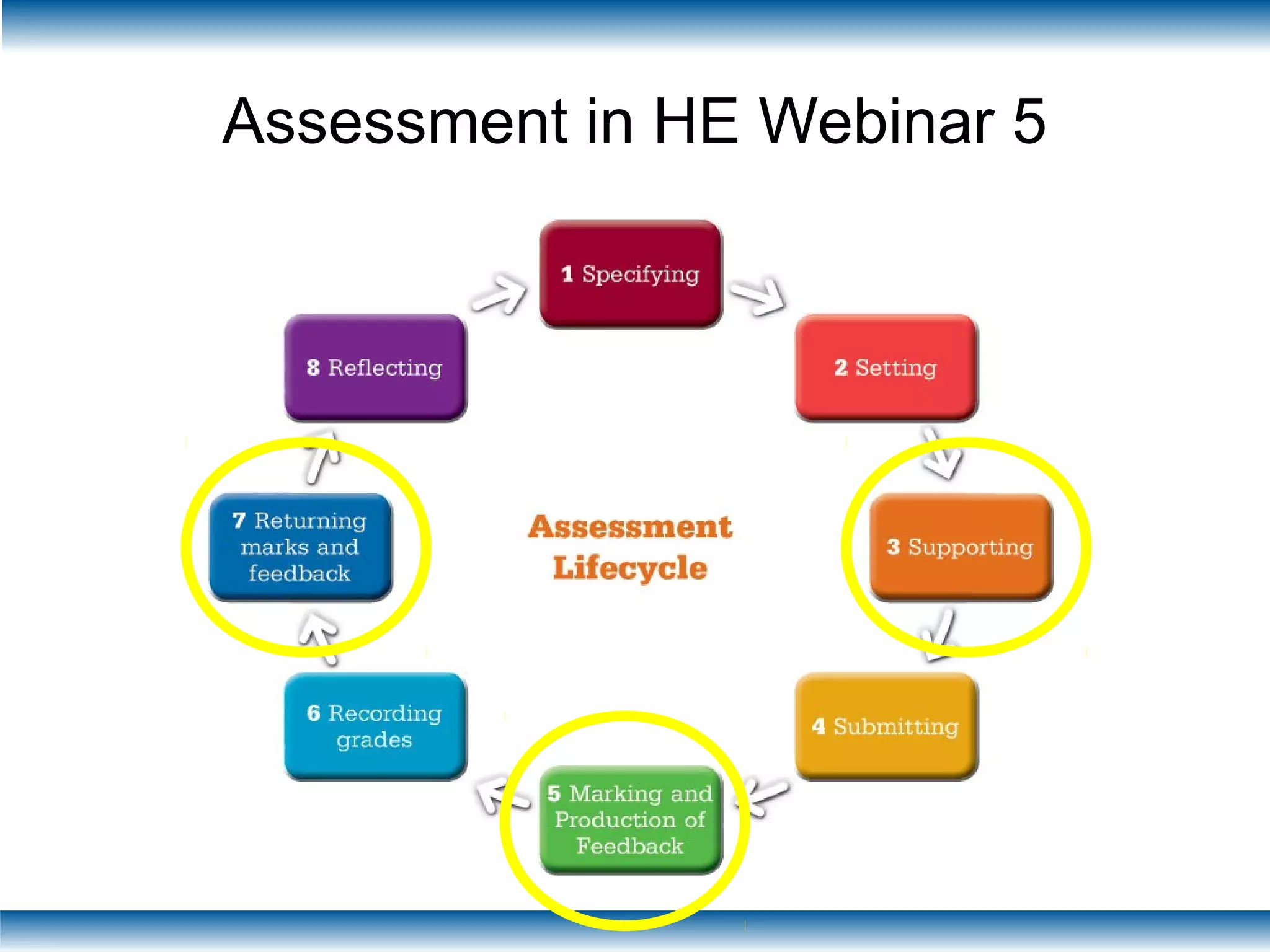
What is Feedback for?
“the effects of bad [assessment] practice are far more potent than they
are for any aspect of teaching. Students can, with difficulty, escape
from the effects of poor teaching, they cannot (by definition if they want
to graduate) escape the effects of poor assessment.” (Boud, 1995)
Assessment in HE Webinar 5
A bit of revision
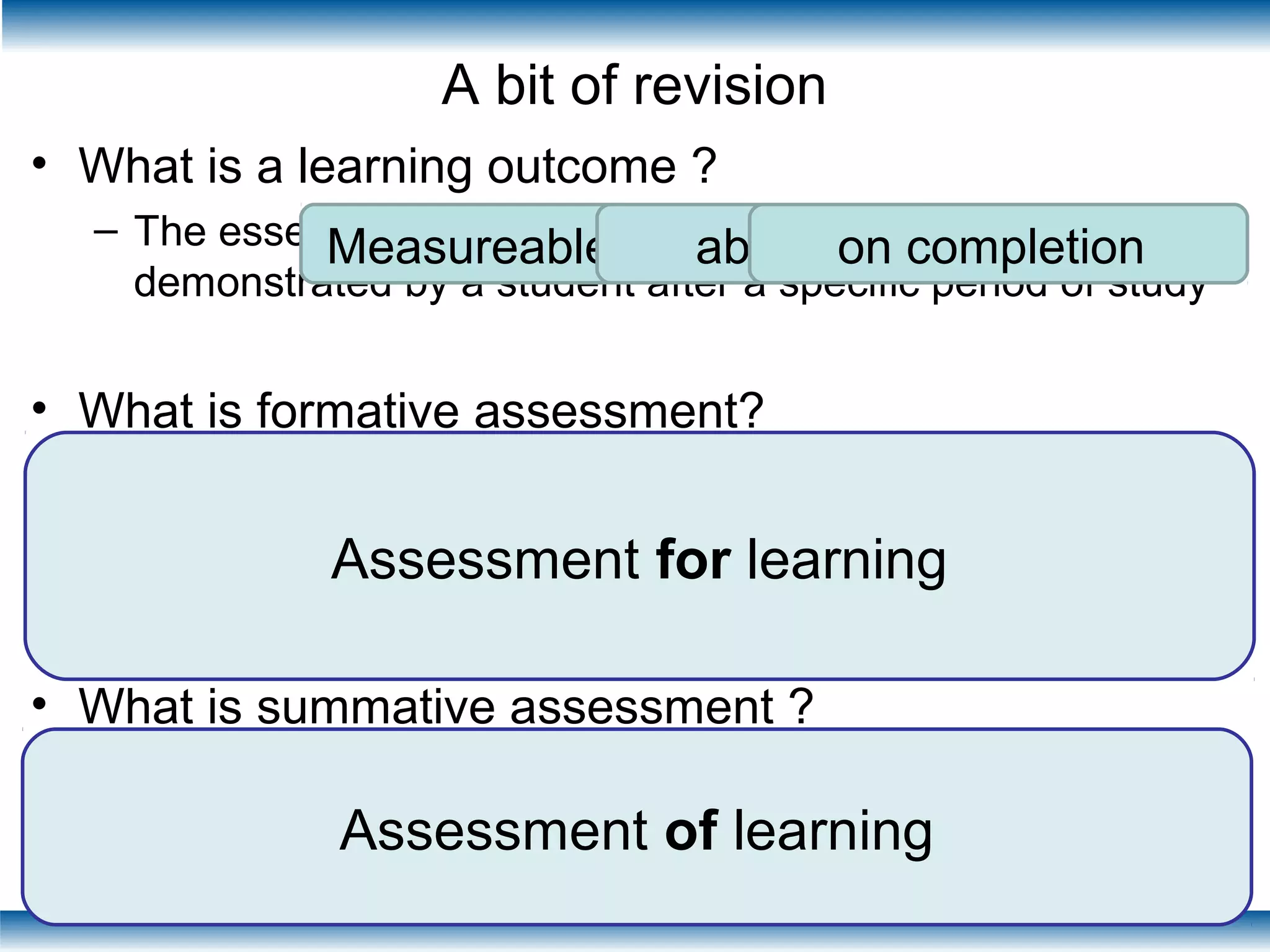
• What is a learning outcome ?
– The essential measurable learning or behaviour
demonstrated by a student after a specific period of study
• What is formative assessment?
– “Formative assessment is designed to provide learners
with feedback on progress and inform development, but
does not contribute to the overall assessment.”
QAA 2000
• What is summative assessment ?
– The process by which we measure the extent to which a
student can demonstrate specific learning outcomes
designed
feedback developmental
non-counting
Process measurement
learning outcomes
Measureable ability on completion
Assessment of learning
Assessment for learning
Impact of feedback
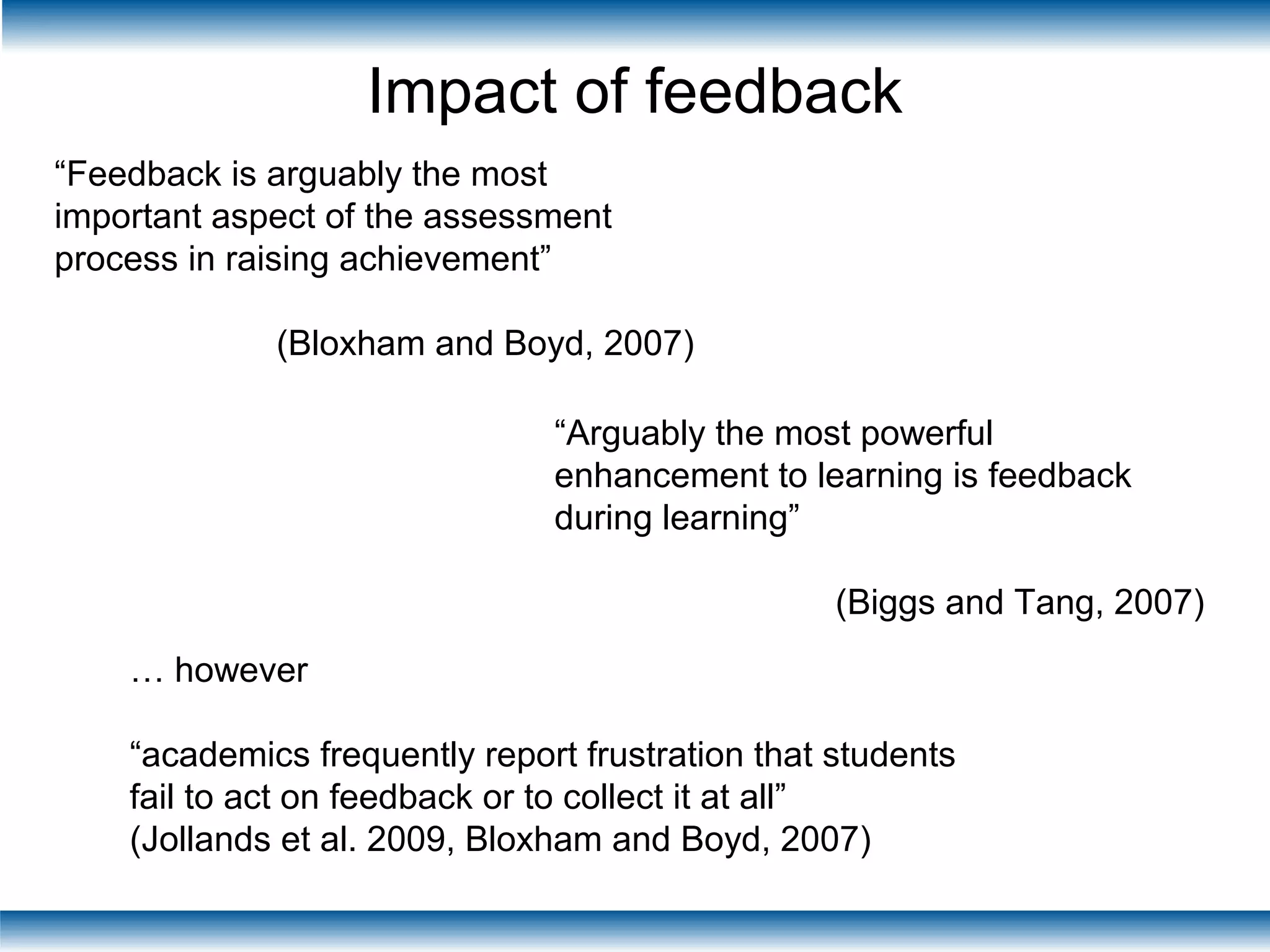
“Feedback is arguably the most
important aspect of the assessment
process in raising achievement”
(Bloxham and Boyd, 2007)
“Arguably the most powerful
enhancement to learning is feedback
during learning”
(Biggs and Tang, 2007)
… however
“academics frequently report frustration that students
fail to act on feedback or to collect it at all”
(Jollands et al. 2009, Bloxham and Boyd, 2007)
In the final year of his Business Management degree George is set the
task of producing an individual 1500 word management report based on
case study materials that he has been studying with his tutorial group.
The report constitutes 50% of the final unit grade the other 50% is
assessed by a 3 hour examination at the end of the semester.
The hand in date for the essay is 6 weeks before the examination. The
work is marked within 3 weeks and returned to George with his mark
and a detailed written feedback proforma. The assignment is also
discussed in a feedback tutorial during the week the work is returned.
The report tests two of the 5 learning outcomes for the unit. These
learning outcomes are therefore not tested in examination (which tests
the remaining three learning outcomes).
George sits the examination for the unit which is marked in time for
exam board. George is given the mark awarded for the examination but
receives no verbal or written feedback on his performance in the exam.
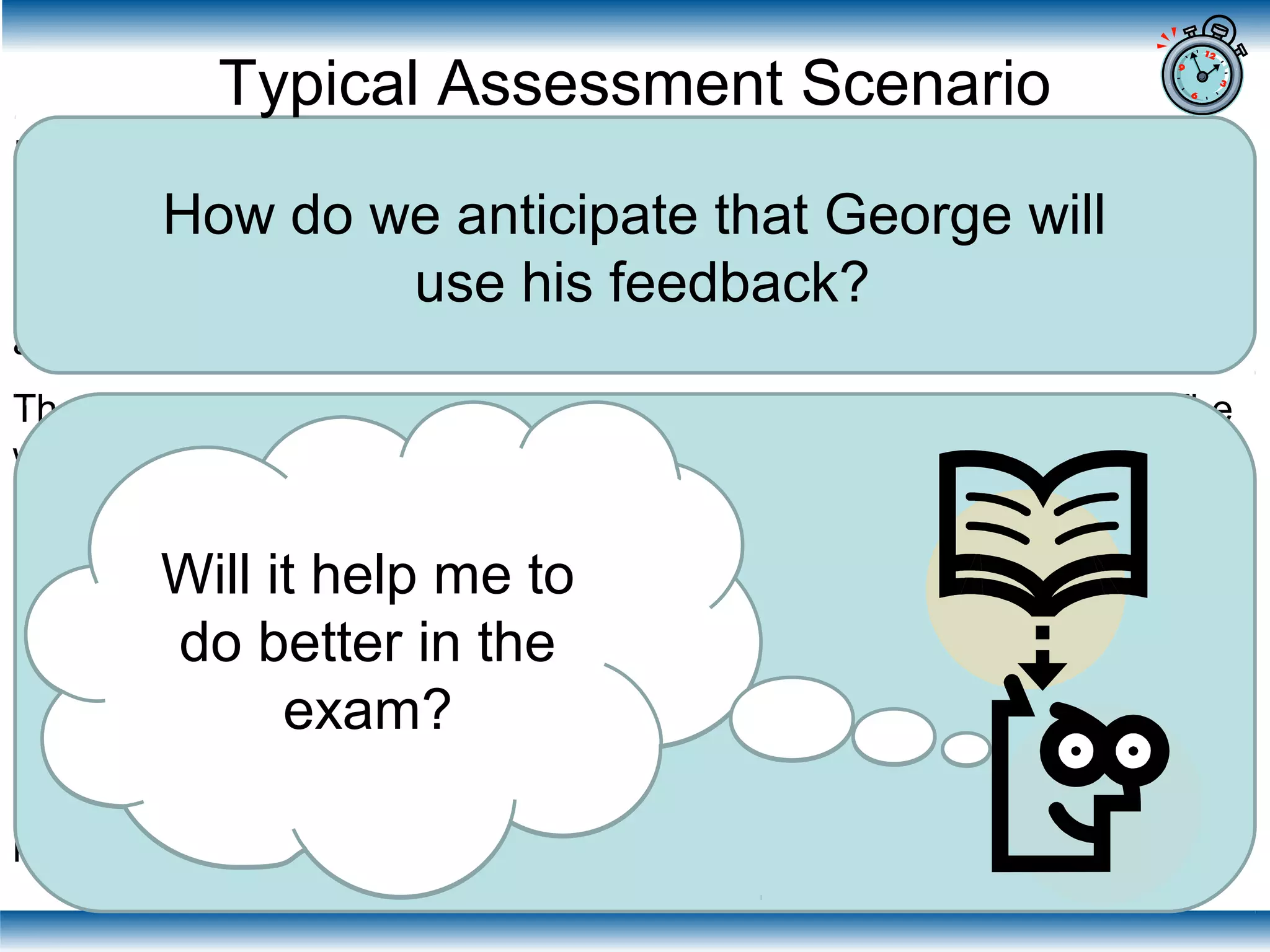
How do we anticipate that George will
use his feedback?
Typical Assessment Scenario
Will this feedback
help me get a
better mark for
the report?
Will it help me to
do better in the
exam?
Characteristics of feedback
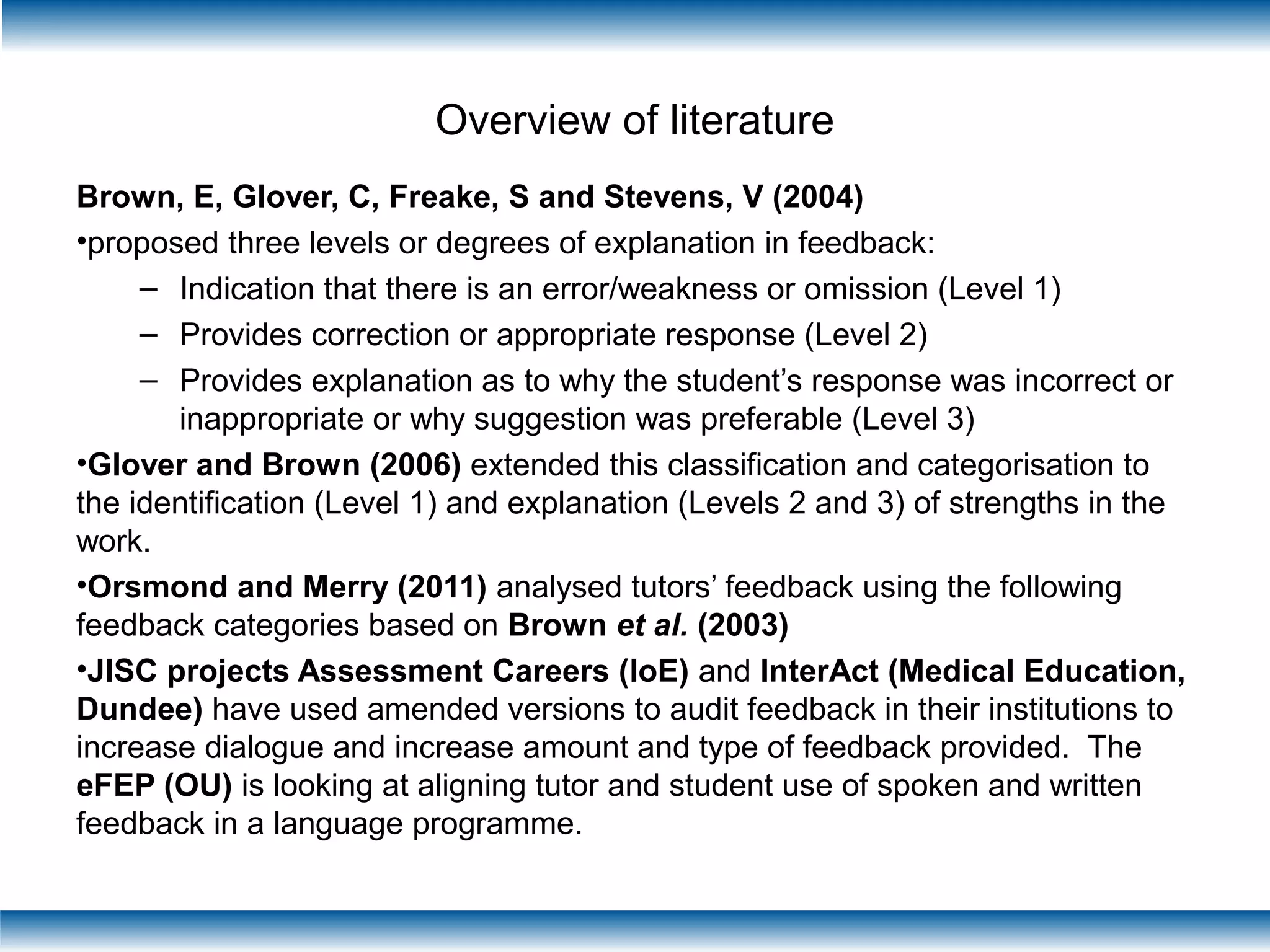
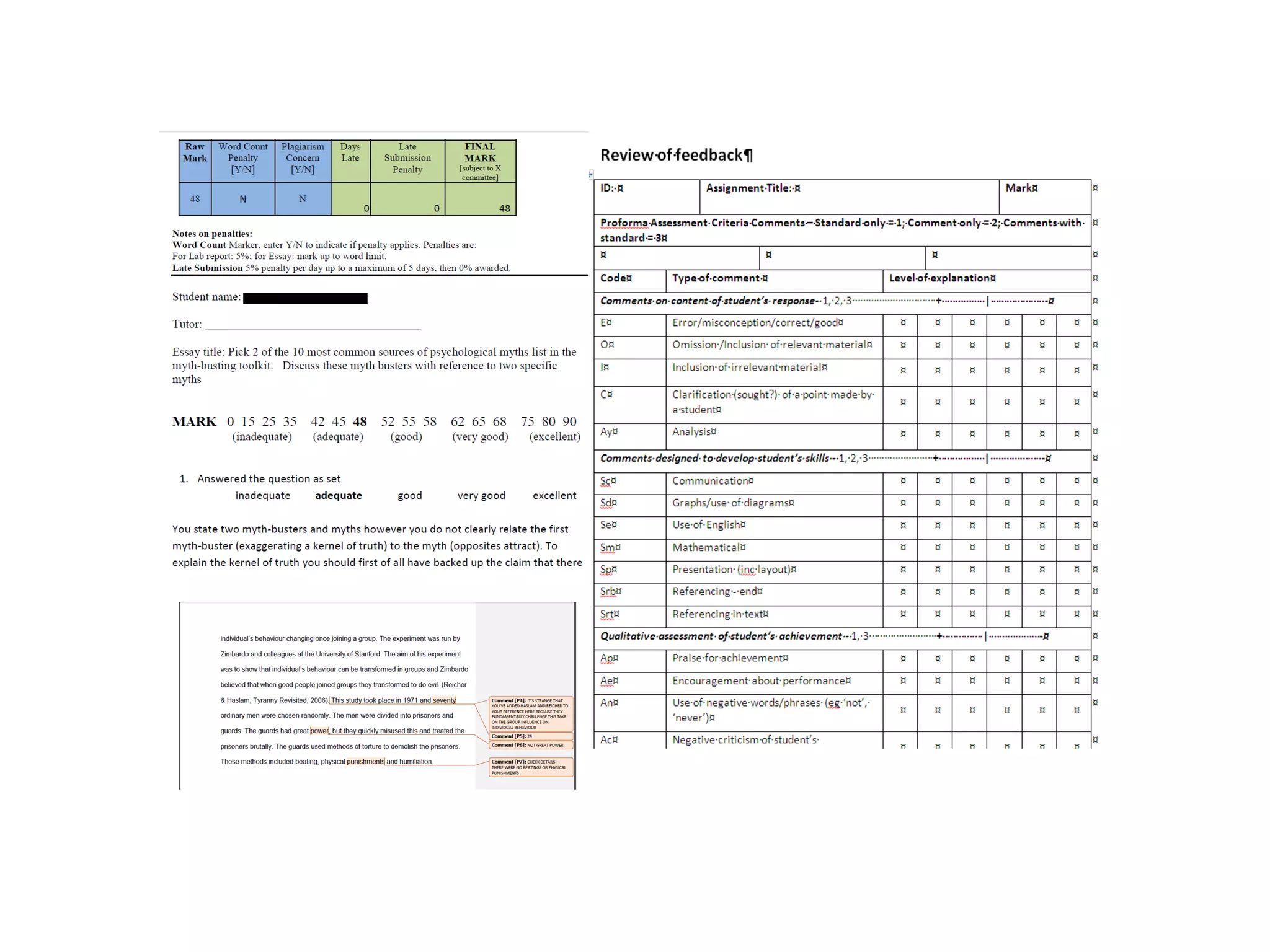
Overview of literature
Brown, E, Glover, C, Freake, S and Stevens, V (2004)
•proposed three levels or degrees of explanation in feedback:
– Indication that there is an error/weakness or omission (Level 1)
– Provides correction or appropriate response (Level 2)
– Provides explanation as to why the student’s response was incorrect or
inappropriate or why suggestion was preferable (Level 3)
•Glover and Brown (2006) extended this classification and categorisation to
the identification (Level 1) and explanation (Levels 2 and 3) of strengths in the
work.
•Orsmond and Merry (2011) analysed tutors’ feedback using the following
feedback categories based on Brown et al. (2003)
•JISC projects Assessment Careers (IoE) and InterAct (Medical Education,
Dundee) have used amended versions to audit feedback in their institutions to
increase dialogue and increase amount and type of feedback provided. The
eFEP (OU) is looking at aligning tutor and student use of spoken and written
feedback in a language programme.
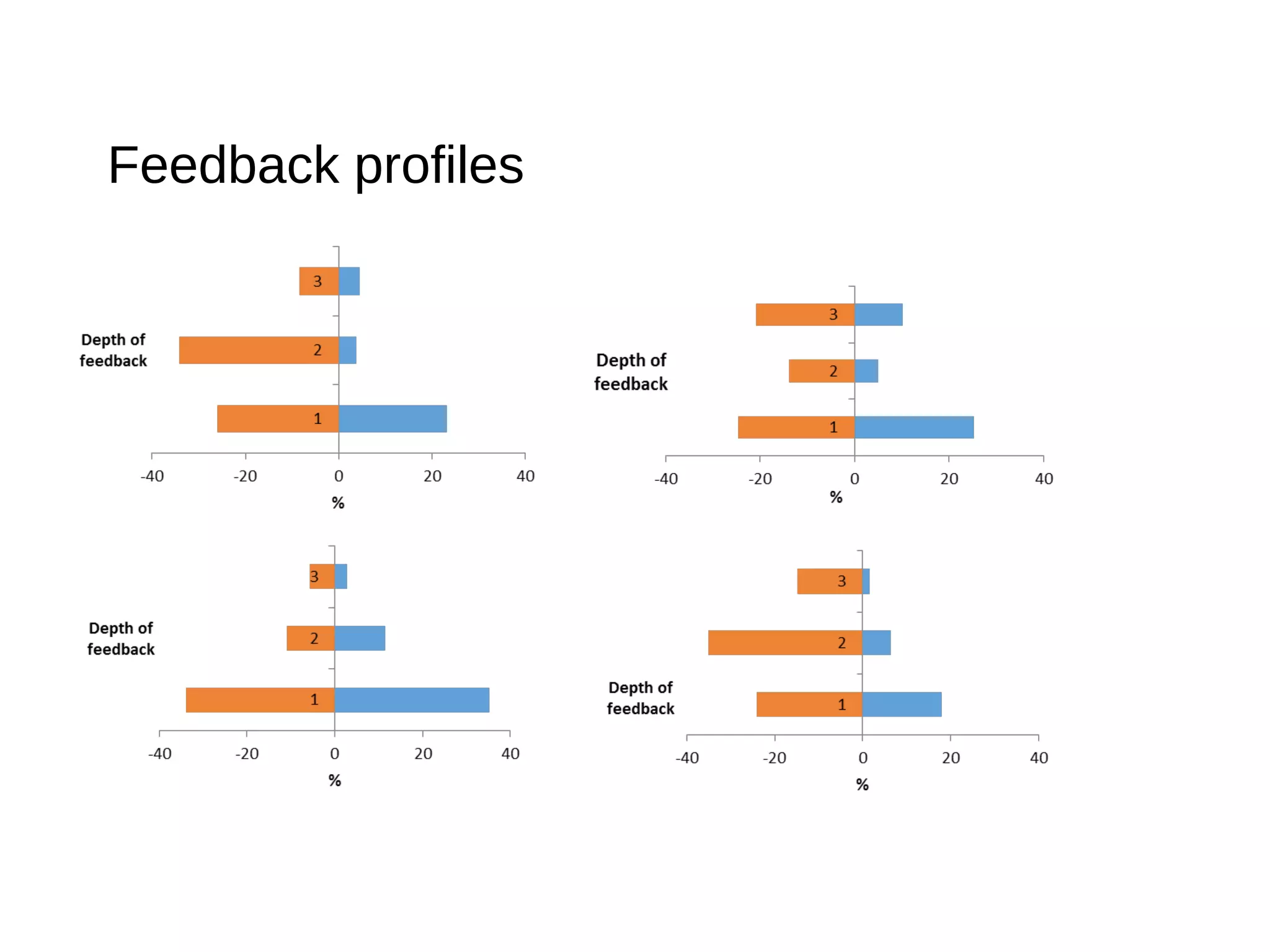
Feedback profiles
Timing of feedback?
Formative assessment model
Online
Preparation
In Class
Session 1
Online
formative
activity
Online
Preparation
In Class
Session 2
Online
formative
activity
Week 1 Week 2
Feedback Feedback
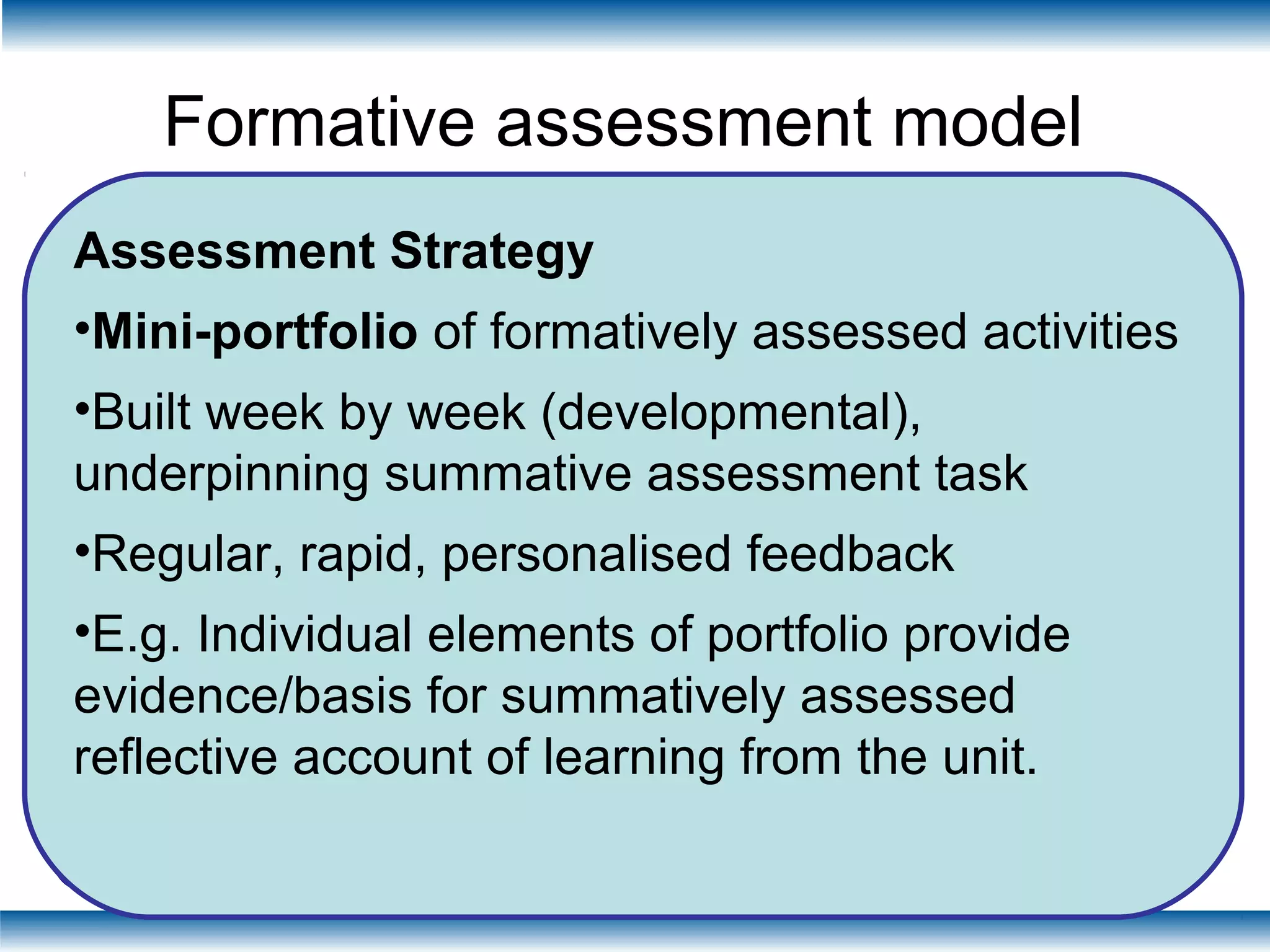
Assessment Strategy
•Mini-portfolio of formatively assessed activities
•Built week by week (developmental),
underpinning summative assessment task
•Regular, rapid, personalised feedback
•E.g. Individual elements of portfolio provide
evidence/basis for summatively assessed
reflective account of learning from the unit.
Targeted Approach to provision of
feedback
1. Set
Assignment
2. Draft
Submission
3. Formative
Assessment
4. Reflection
and
Reworking
5. Complete
Submission
6. Summative
Assessment
“Formative
Feedback”
directly linked
to current task
“Summative
Feedback”
Feed forward
to inform future
work
Via eMail
Via eMail
In-class
Optional
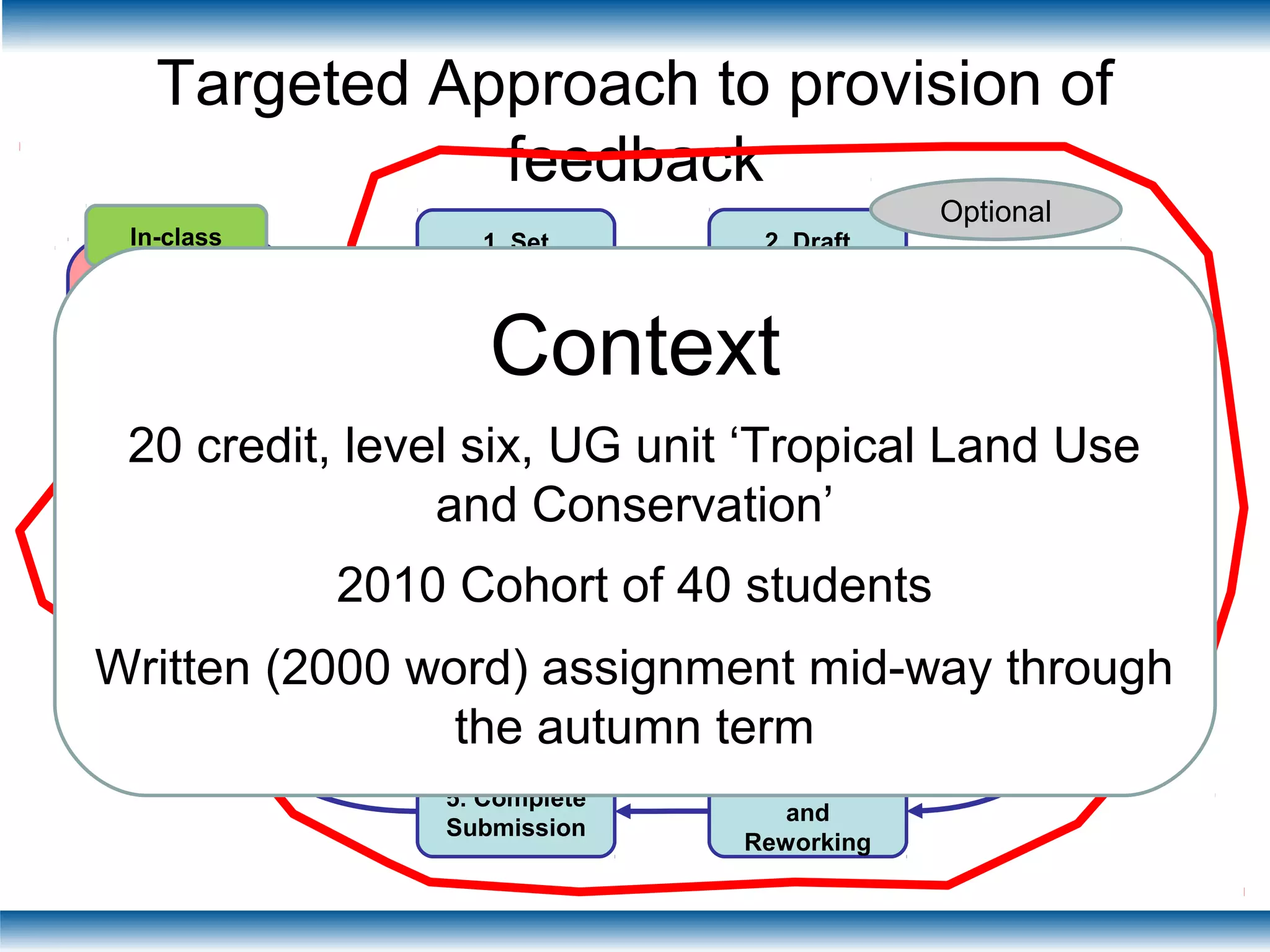
Context
20 credit, level six, UG unit ‘Tropical Land Use
and Conservation’
2010 Cohort of 40 students
Written (2000 word) assignment mid-way through
the autumn term
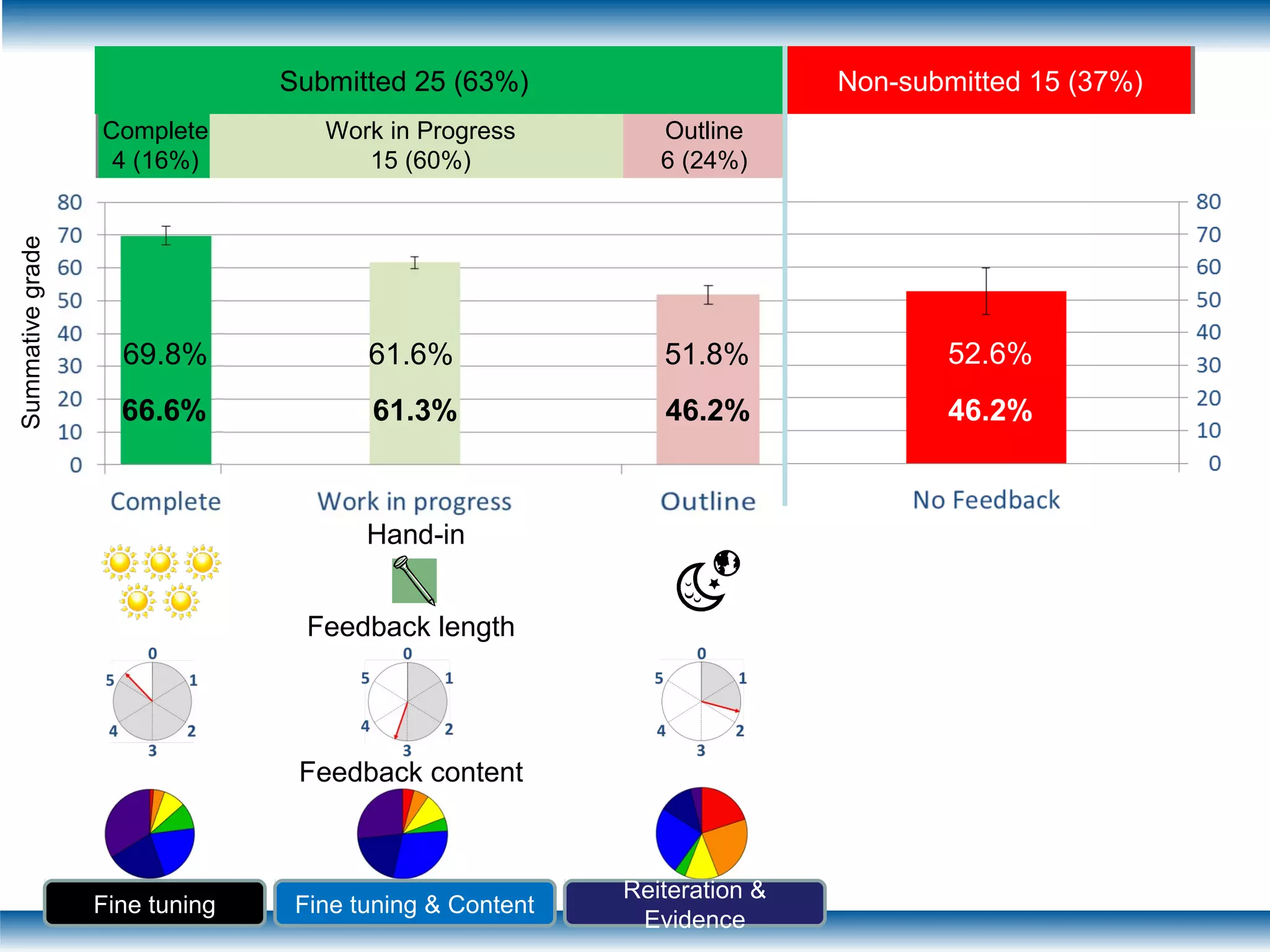
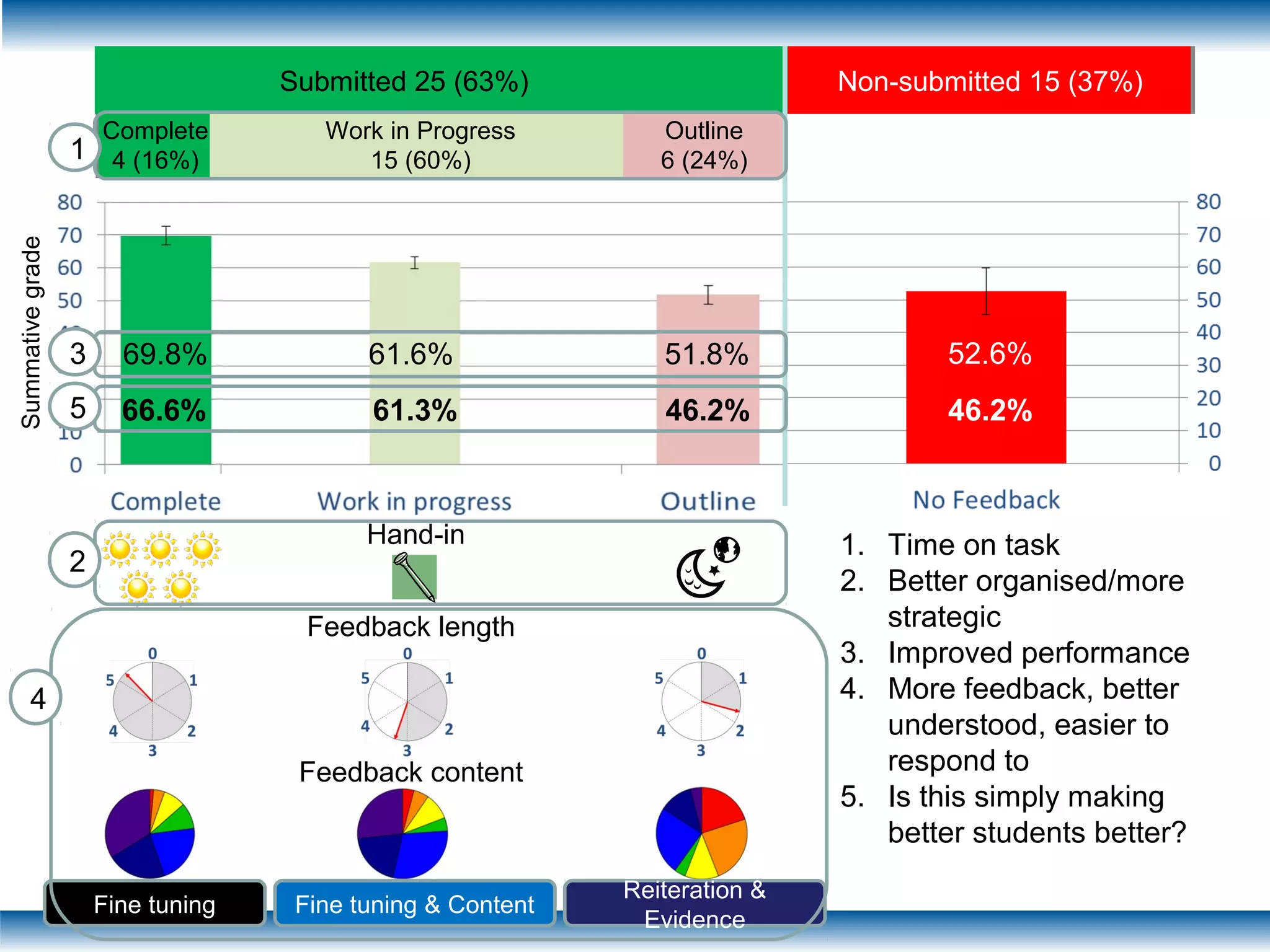
FindingsComplete
4 (16%)
Work in Progress
15 (60%)
Outline
6 (24%)
Submitted 25 (63%) Non-submitted 15 (37%)
60.8% 52.6%
Summativegrade
69.8% 61.6% 51.8%
Fine tuning
Reiteration &
Evidence
Fine tuning & Content
Hand-in
Feedback length
Feedback content
66.6% 61.3% 46.2% 46.2%
Complete
4 (16%)
Work in Progress
15 (60%)
Outline
6 (24%)
Submitted 25 (63%) Non-submitted 15 (37%)
60.8% 52.6%
Summativegrade
69.8% 61.6% 51.8%
Fine tuning
Reiteration &
Evidence
Fine tuning & Content
Hand-in
Feedback length
Feedback content
66.6% 61.3% 46.2% 46.2%
1. Time on task
2. Better organised/more
strategic
3. Improved performance
4. More feedback, better
understood, easier to
respond to
5. Is this simply making
better students better?
1
2
4
3
5
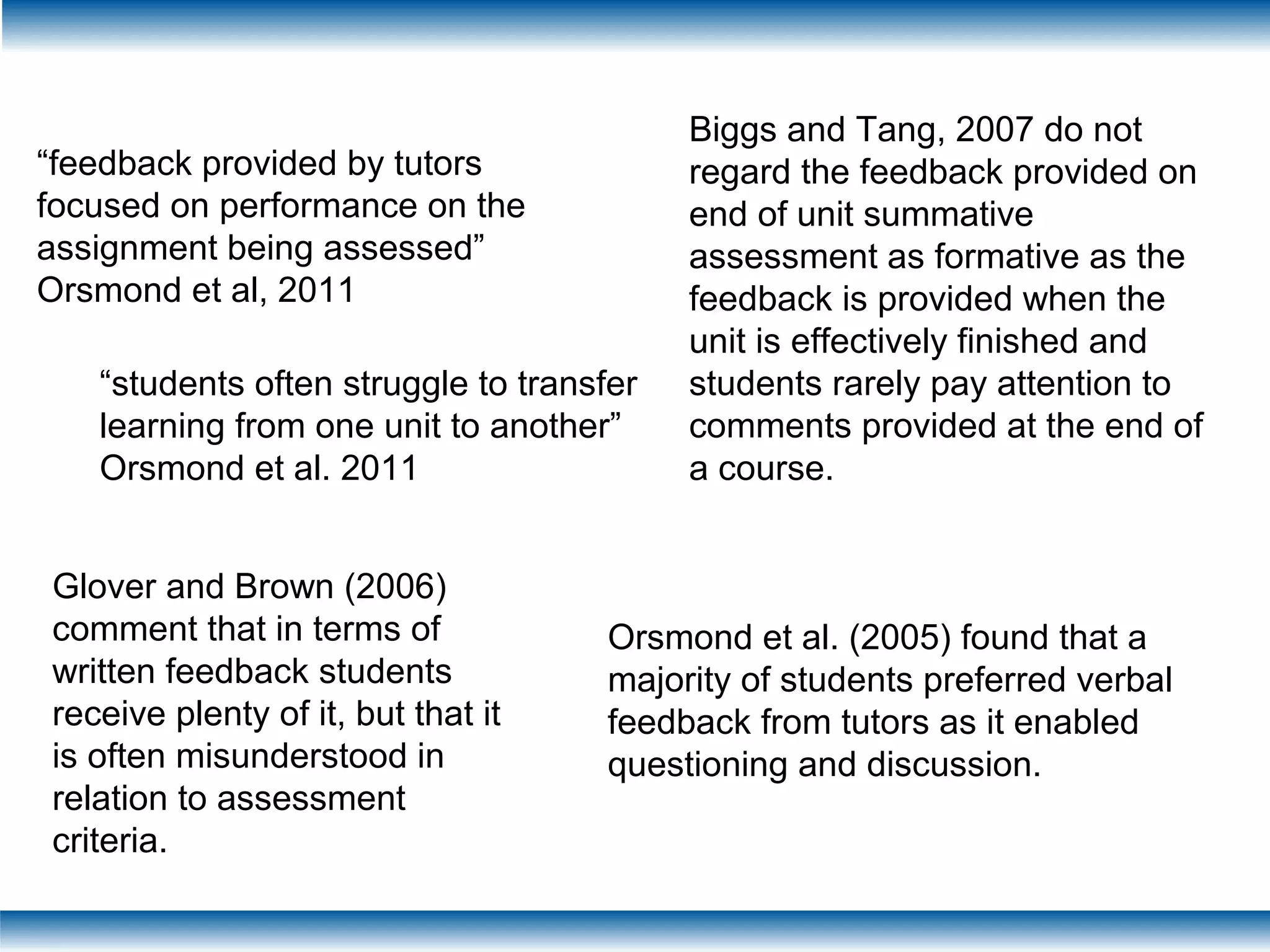
“feedback provided by tutors
focused on performance on the
assignment being assessed”
Orsmond et al, 2011
“students often struggle to transfer
learning from one unit to another”
Orsmond et al. 2011
Biggs and Tang, 2007 do not
regard the feedback provided on
end of unit summative
assessment as formative as the
feedback is provided when the
unit is effectively finished and
students rarely pay attention to
comments provided at the end of
a course.
Glover and Brown (2006)
comment that in terms of
written feedback students
receive plenty of it, but that it
is often misunderstood in
relation to assessment
criteria.
Orsmond et al. (2005) found that a
majority of students preferred verbal
feedback from tutors as it enabled
questioning and discussion.
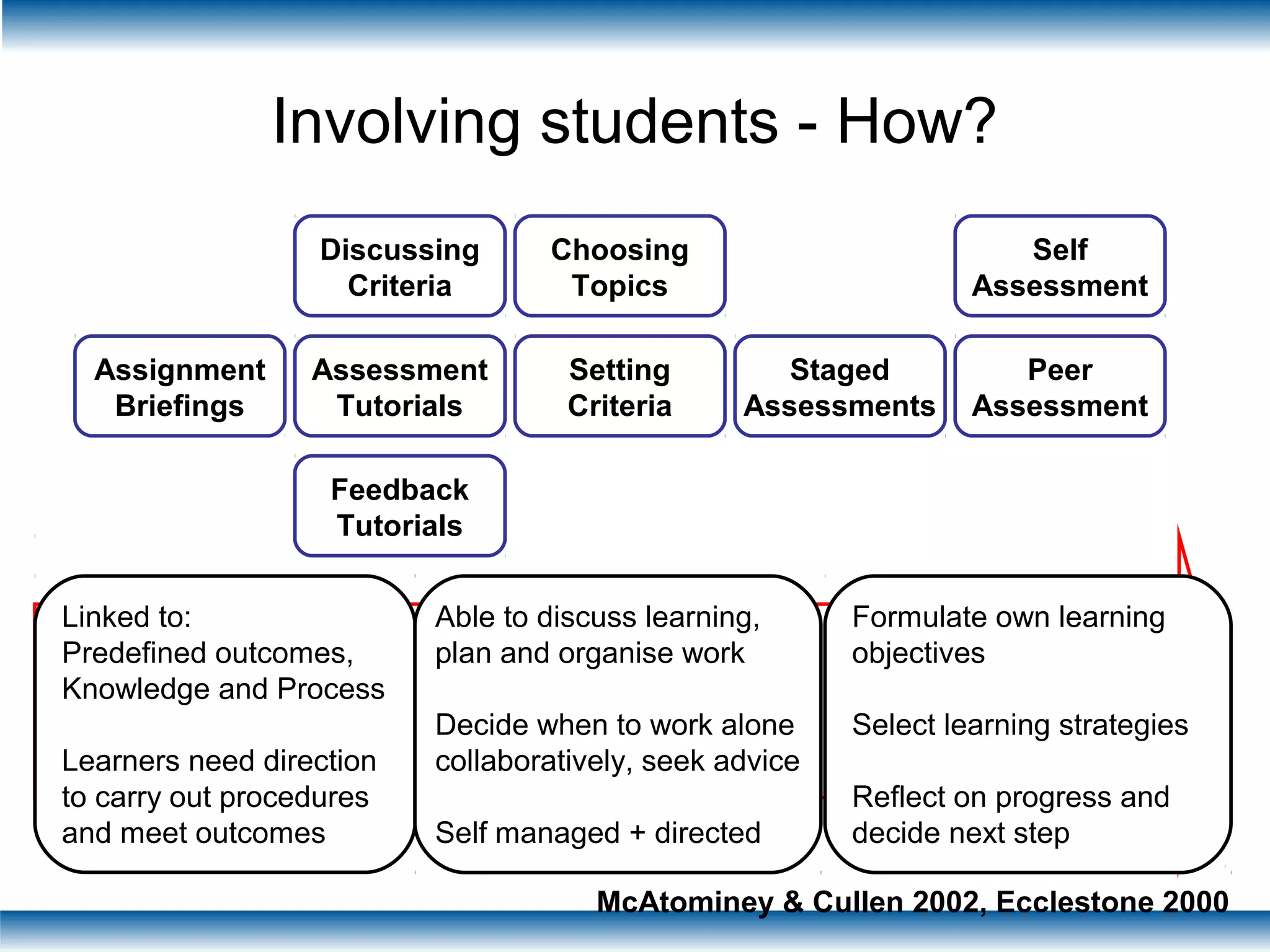
Engaging Students in Assessment
• What approaches would you suggest to
involve students more directly in the
assessment process?
Thoughts? Comments? Questions?
Acceptable assignments?
Essay
Newsletter
Magazine article
Written Report
Data Analysis
Event
Oral presentation
Artefact
Web site
Audio report
Video report
Competition entry Problems to solve
Job Application
Critique
Case Study
Poster
Unseen Written
exam
Photo Essay
“Dragon’s Den™”
Seen written
exam
“The Apprentice”
MCQs
Computer based assessment
Practice Observation
Wiki contribution Blogg/learning log
Research Article
Lab Practical
Reflective account
Annotated Map
Annotated Reference List
Portfilio
Translation
Dissertation
Group work
Interview
Work based assessment
A Performance Roll play
References
Boud, D. (1995). Assessment and Learning: contradictory or complementary? Assessment for Learning in
Higher Education. P. Knight. London, Kogan Page: 35-48.
Biggs, J. B. and Tang, C. (2007). Teaching for quality learning at university. Open University Press/Mc Graw-
Hill Education.
Bloxham, S. and Boyd, P. (2007). Developing Effective Assessment in Higher Education: A Practical Guide.
Berkshire, UK. Open University Press.
Cullen W. R., (2011) A multi-technology formative assessment strategy, Media-Enhanced Feedback case
studies and methods, Proceedings of the Media-Enhanced Feedback event, Sheffield, 27 October 2010
pp 28-33
Ecclestone, K. (2000) Assessment and Critical Autonomy in Post Compulsory Education in the UK, in,
Journal of Education and Work, Vol. 13, No. 2.
Glover, C. and Brown, E. (2006) Written Feedback for Students: too much, too detailed or too
incomprehensible to be effective? Bioscience Education Journal (7)
Jollands, M., McCallum, N., Bondy, J. (2009) If students want feedback why don’t they collect their
assignments? Proceedings of 20th Australasian Association for Engineering Education Conference
University of Adelaide, 6-9th December 2009
McAtominey, D. & Cullen, W.R. (2002) Effective e-Learning with VLE’s, Netskills Workshop Materials
Orsmond, Paul , Merry, Stephen and Reiling, Kevin(2005) 'Biology students' utilization of tutors' formative
feedback: a qualitative interview study', Assessment & Evaluation in Higher Education, 30: 4, pp 369 -
386
Orsmond, Paul and Merry, Stephen(2011) 'Feedback alignment: effective and ineffective links between tutors'
and students' understanding of coursework feedback', Assessment & Evaluation in Higher Education, 36:
2, pp 125-136.

Assessment in he 2014 webinar 5

  • 1.
    Assessment in HigherEducation Webinar 5 What is Feedback for? “the effects of bad [assessment] practice are far more potent than they are for any aspect of teaching. Students can, with difficulty, escape from the effects of poor teaching, they cannot (by definition if they want to graduate) escape the effects of poor assessment.” (Boud, 1995)
  • 2.
  • 3.
    A bit ofrevision • What is a learning outcome ? – The essential measurable learning or behaviour demonstrated by a student after a specific period of study • What is formative assessment? – “Formative assessment is designed to provide learners with feedback on progress and inform development, but does not contribute to the overall assessment.” QAA 2000 • What is summative assessment ? – The process by which we measure the extent to which a student can demonstrate specific learning outcomes designed feedback developmental non-counting Process measurement learning outcomes Measureable ability on completion Assessment of learning Assessment for learning
  • 4.
    Impact of feedback “Feedbackis arguably the most important aspect of the assessment process in raising achievement” (Bloxham and Boyd, 2007) “Arguably the most powerful enhancement to learning is feedback during learning” (Biggs and Tang, 2007) … however “academics frequently report frustration that students fail to act on feedback or to collect it at all” (Jollands et al. 2009, Bloxham and Boyd, 2007)
  • 5.
    In the finalyear of his Business Management degree George is set the task of producing an individual 1500 word management report based on case study materials that he has been studying with his tutorial group. The report constitutes 50% of the final unit grade the other 50% is assessed by a 3 hour examination at the end of the semester. The hand in date for the essay is 6 weeks before the examination. The work is marked within 3 weeks and returned to George with his mark and a detailed written feedback proforma. The assignment is also discussed in a feedback tutorial during the week the work is returned. The report tests two of the 5 learning outcomes for the unit. These learning outcomes are therefore not tested in examination (which tests the remaining three learning outcomes). George sits the examination for the unit which is marked in time for exam board. George is given the mark awarded for the examination but receives no verbal or written feedback on his performance in the exam. How do we anticipate that George will use his feedback? Typical Assessment Scenario Will this feedback help me get a better mark for the report? Will it help me to do better in the exam?
  • 6.
  • 7.
    Overview of literature Brown,E, Glover, C, Freake, S and Stevens, V (2004) •proposed three levels or degrees of explanation in feedback: – Indication that there is an error/weakness or omission (Level 1) – Provides correction or appropriate response (Level 2) – Provides explanation as to why the student’s response was incorrect or inappropriate or why suggestion was preferable (Level 3) •Glover and Brown (2006) extended this classification and categorisation to the identification (Level 1) and explanation (Levels 2 and 3) of strengths in the work. •Orsmond and Merry (2011) analysed tutors’ feedback using the following feedback categories based on Brown et al. (2003) •JISC projects Assessment Careers (IoE) and InterAct (Medical Education, Dundee) have used amended versions to audit feedback in their institutions to increase dialogue and increase amount and type of feedback provided. The eFEP (OU) is looking at aligning tutor and student use of spoken and written feedback in a language programme.
  • 9.
  • 10.
  • 11.
    Formative assessment model Online Preparation InClass Session 1 Online formative activity Online Preparation In Class Session 2 Online formative activity Week 1 Week 2 Feedback Feedback Assessment Strategy •Mini-portfolio of formatively assessed activities •Built week by week (developmental), underpinning summative assessment task •Regular, rapid, personalised feedback •E.g. Individual elements of portfolio provide evidence/basis for summatively assessed reflective account of learning from the unit.
  • 12.
    Targeted Approach toprovision of feedback 1. Set Assignment 2. Draft Submission 3. Formative Assessment 4. Reflection and Reworking 5. Complete Submission 6. Summative Assessment “Formative Feedback” directly linked to current task “Summative Feedback” Feed forward to inform future work Via eMail Via eMail In-class Optional Context 20 credit, level six, UG unit ‘Tropical Land Use and Conservation’ 2010 Cohort of 40 students Written (2000 word) assignment mid-way through the autumn term
  • 13.
    FindingsComplete 4 (16%) Work inProgress 15 (60%) Outline 6 (24%) Submitted 25 (63%) Non-submitted 15 (37%) 60.8% 52.6% Summativegrade 69.8% 61.6% 51.8% Fine tuning Reiteration & Evidence Fine tuning & Content Hand-in Feedback length Feedback content 66.6% 61.3% 46.2% 46.2%
  • 14.
    Complete 4 (16%) Work inProgress 15 (60%) Outline 6 (24%) Submitted 25 (63%) Non-submitted 15 (37%) 60.8% 52.6% Summativegrade 69.8% 61.6% 51.8% Fine tuning Reiteration & Evidence Fine tuning & Content Hand-in Feedback length Feedback content 66.6% 61.3% 46.2% 46.2% 1. Time on task 2. Better organised/more strategic 3. Improved performance 4. More feedback, better understood, easier to respond to 5. Is this simply making better students better? 1 2 4 3 5
  • 15.
    “feedback provided bytutors focused on performance on the assignment being assessed” Orsmond et al, 2011 “students often struggle to transfer learning from one unit to another” Orsmond et al. 2011 Biggs and Tang, 2007 do not regard the feedback provided on end of unit summative assessment as formative as the feedback is provided when the unit is effectively finished and students rarely pay attention to comments provided at the end of a course. Glover and Brown (2006) comment that in terms of written feedback students receive plenty of it, but that it is often misunderstood in relation to assessment criteria. Orsmond et al. (2005) found that a majority of students preferred verbal feedback from tutors as it enabled questioning and discussion.
  • 16.
    Engaging Students inAssessment • What approaches would you suggest to involve students more directly in the assessment process?
  • 17.
  • 18.
    Acceptable assignments? Essay Newsletter Magazine article WrittenReport Data Analysis Event Oral presentation Artefact Web site Audio report Video report Competition entry Problems to solve Job Application Critique Case Study Poster Unseen Written exam Photo Essay “Dragon’s Den™” Seen written exam “The Apprentice” MCQs Computer based assessment Practice Observation Wiki contribution Blogg/learning log Research Article Lab Practical Reflective account Annotated Map Annotated Reference List Portfilio Translation Dissertation Group work Interview Work based assessment A Performance Roll play
  • 19.
    References Boud, D. (1995).Assessment and Learning: contradictory or complementary? Assessment for Learning in Higher Education. P. Knight. London, Kogan Page: 35-48. Biggs, J. B. and Tang, C. (2007). Teaching for quality learning at university. Open University Press/Mc Graw- Hill Education. Bloxham, S. and Boyd, P. (2007). Developing Effective Assessment in Higher Education: A Practical Guide. Berkshire, UK. Open University Press. Cullen W. R., (2011) A multi-technology formative assessment strategy, Media-Enhanced Feedback case studies and methods, Proceedings of the Media-Enhanced Feedback event, Sheffield, 27 October 2010 pp 28-33 Ecclestone, K. (2000) Assessment and Critical Autonomy in Post Compulsory Education in the UK, in, Journal of Education and Work, Vol. 13, No. 2. Glover, C. and Brown, E. (2006) Written Feedback for Students: too much, too detailed or too incomprehensible to be effective? Bioscience Education Journal (7) Jollands, M., McCallum, N., Bondy, J. (2009) If students want feedback why don’t they collect their assignments? Proceedings of 20th Australasian Association for Engineering Education Conference University of Adelaide, 6-9th December 2009 McAtominey, D. & Cullen, W.R. (2002) Effective e-Learning with VLE’s, Netskills Workshop Materials Orsmond, Paul , Merry, Stephen and Reiling, Kevin(2005) 'Biology students' utilization of tutors' formative feedback: a qualitative interview study', Assessment & Evaluation in Higher Education, 30: 4, pp 369 - 386 Orsmond, Paul and Merry, Stephen(2011) 'Feedback alignment: effective and ineffective links between tutors' and students' understanding of coursework feedback', Assessment & Evaluation in Higher Education, 36: 2, pp 125-136.

Editor's Notes

  • #8 The e-Feedback Evaluation Project (eFEP) to examine the ways in which students and tutors actually use spoken and written e‑feedback when these have become standard practice across an entire programme; to evaluate the perceptions and preferences of tutors and students in relation to spoken and written e‑feedback in those learning contexts; to investigate the ways in which students engage with the written and spoken e‑feedback that they receive; to evaluate the extent to which the findings from the above evaluations apply to non‑distance learning institutions in which e-feedback is an emerging practice; to identify the areas in which further support is needed in order to maximise the benefits of spoken and written e-feedback; to produce a set of training and support tools for students and tutors
  • #13 The study was undertaken within a 20 credit, third-year (level six) undergraduate unit, ‘Tropical Land Use and Conservation’, taught in the School of Science and the Environment at Manchester Metropolitan University (2010/2011 cohort). The 2010 unit had a cohort of 40 students who were invited to participate in the study. In brief, students were set a written assignment mid-way through the autumn term and encouraged to submit a draft on which audio feedback was provided two weeks before the final submission deadline near the end of term. A full overview of the assessment strategy, including the formative and summative feedback elements, employed in the study is provided in Table 1.
  • #19 Well with those rules in mind, I’ve made a list of the different types of assignment that might be acceptable at MMU. Do you need me to explain any of these cursory headings? An attempt at brevity may have led to loss of clarity so shout out if anything is unclear. Are all of these allowed? What are the barriers to implementing any of these? Just in your head, count up the number of different types of assignment you currently use, either formatively or summatively. Whisper the number to your neighbour. Does anyone here use more than 10 different types of assignment? (if so…well done, special prize coming your way) 6? 3? Don’t you get bored? Do you think that your students might get bored? Are the assignments that you use really the best ways for students to demonstrate their achievements? You may have noticed the inspiration of a couple of TV programmes there. You do need to be careful. Would the X factor be appropriate?