Teaching electronic wearables as part of
the D&T curriculum: a STEAM approach
Sarah Davies
Nottingham Trent University | email sarah.davies@ntu.ac.uk | twitter #sdsdavies
2
20/02/2017 4
February 1, 2018 5
February 1, 2018 6
Teaching Electronics
• how can we develop research informed teaching resources that
engage young people in multi-disciplinary learning?
February 1, 2018 7
February 1, 2018 8
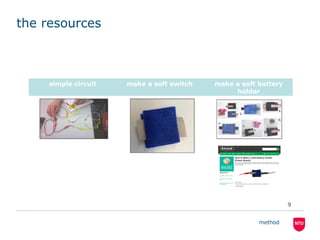
the resources
simple circuit make a soft switch make a soft battery
holder
method
9
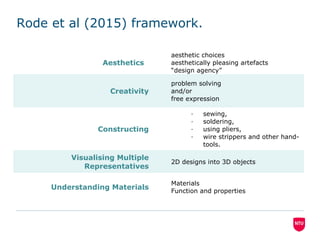
Rode et al (2015) framework.
Aesthetics
aesthetic choices
aesthetically pleasing artefacts
“design agency”
Creativity
problem solving
and/or
free expression
Constructing
- sewing,
- soldering,
- using pliers,
- wire strippers and other hand-
tools.
Visualising Multiple
Representatives
2D designs into 3D objects
Understanding Materials
Materials
Function and properties
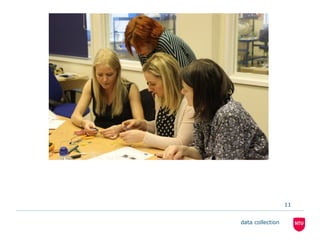
data collection
11
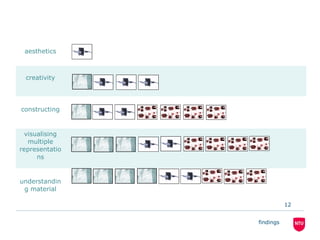
aesthetics
creativity
constructing
visualising
multiple
representatio
ns
understandin
g material
findings
12
Opportunities: teacher interviews
• Understanding Materials
 They talked about how the coin cell differed from their tradition counterpart
(pen cell) ; positive side “curled around the edge” (Teacher A Line 180)
• Creativity - abstract problem solving
 working in teams was good for “sharing ideas and working together as a
team” (Line 169) to solve abstract problems.
 early sequence of activity “built my confidence up straight away”
• Visualising multiple representations
 The teachers talk about “undoing” (Teacher C, line 69) and re-doing the
circuit through the clipping and “quick to unclip” nature of the crocodile
clips (Teacher E, line 31).
 Teacher A discusses how the LED gives her instant feedback when she says
that “it is easy to see if you are doing it right or wrong because the end
objective, the goal, to get the LED to light up isn’t working” (Line 168).
13 findings
•Constructing
 helpful for developing the construction skills (required to make Smart Fashion)
 thread was “not easy to work with” (Teacher D Line 231).
Aesthetic
 “it’s always nice, isn’t it, to have something physical especially when you
have done it yourself” (Line 240).
findings and analysis
14
What have we found out?
• Opportunities for:
• Problem solving – creativity
• 2D/3D – visualising multi representations
• conductive/non-conductive properties - material (and component) understanding,
• Team working
Need to build on:
• experiences with conductive thread (hand and machine) - constructing
• Aesthetics
• Free expression – creativity
15 conclusion
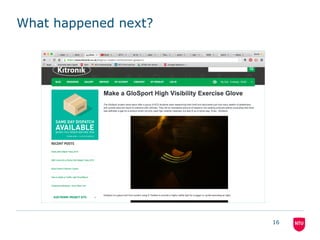
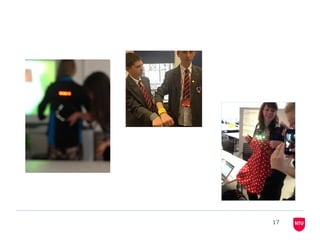
What happened next?
16
17
Further reading
• Alden, P., 2016. Can tinkering benefit pupils’ learning?. The STeP Journal:
Student Teacher Perspectives, 3(2), pp.3-13.
• DAVIES, S. and HARDY, A. , 2016. How to teach 'Smart Fashion' within the
D&T curriculum: have we got it right? In: PATT2016: Technology Education for
21st Century Skills Conference, Hogeschool Utrecht, Utrecht, Netherlands,
23-26 August 2016.
• Letting pupils ‘tinker’ is the way to teach electronics
18 references
THANK YOU FOR
LISTENING
Sarah Davies
Nottingham Trent University | email
sarah.davies@ntu.ac.uk | twitter #sdsdavies
February 1, 2018 19
• Buechley, L. (2006). A construction kit for electronic textiles. Wearable Computers, 2006 10th IEEE International Symposium on, 83-90.
• Kafai, Y. B., Fields, D. A., & Searle, K. A. (2014). Electronic textiles as disruptive designs: Supporting and challenging maker activities in
schools. Harvard Educational Review, 84(4), 532-556. Kettley, S. (2016). Designing with smart textiles. London: Fairchild Books.
• Ngai, G., Chan, S. C. F., Cheung, J. C. Y., & Lau, W. W. Y. (2010). Deploying a wearable computing platform for computer education.
IEEE Transactions in Learning Technologies, 3(1), 45-55.
• Papert, S., & Harel, I. (1991). Situating constructionism. In S. Papert, & I. Harel (Eds.), Constructionism (pp. 1-11) Ablex Publishing
Corporation. Peppler, K., Gresalfi, M., Tekinbas, K. S., & Santo, R. (2014). Soft circuits: Crafting E-fashion with DIY electronics MIT
Press.
• Perner-Wilson, H., & Buechley, L. (2013). Handcrafting textile sensors. In L. Buechley, K. Peppler, M. Eisenberg & Y. Kafai (Eds.), Textile
messages: Dispatches from the world of e-textiles and education (pp. 55-65). Oxford: Peter Lang Publishing Incorporated.
• Pulé, S., & McCardle, J. (2010). Developing novel explanatory models for electronics education. Design and Technology Education: An
International Journal, 15(2)
• Resnick, M., & Rosenbaum, E. (2013). Designing for tinkerability. Design, make, Play: Growing the Next Generation of STEM Innovators,
163-181.
• Rode, J. A., Weibert, A., Marshall, A., Aal, K., von Rekowski, T., el Mimoni, H., & Booker, J. (2015). From computational thinking to
computational making. Proceedings of the 2015 ACM International Joint Conference on Pervasive and Ubiquitous Computing, 239-250.
• Seymour, S. (2008). Fashionable technology. DE: Springer
• Verlag. Schepens, A., Aelterman, A., & Van Keer, H. (2007). Studying learning processes of student teachers with stimulated recall
interviews through changes in interactive cognitions. Teaching and Teacher Education, 23(4), 457-472.
• Wilkinson, K., & Petrich, M. (2013). The art of tinkering: Meet 150 makers working at the intersection of art, science & technology
Wilson, E. (2012). School-based research: A guide for education students. London: Sage.
February 1, 2018 20

Warwick conference teaching electronic wearables

  • 1.
    Teaching electronic wearablesas part of the D&T curriculum: a STEAM approach Sarah Davies Nottingham Trent University | email sarah.davies@ntu.ac.uk | twitter #sdsdavies
  • 2.
  • 4.
  • 5.
  • 6.
  • 7.
    Teaching Electronics • howcan we develop research informed teaching resources that engage young people in multi-disciplinary learning? February 1, 2018 7
  • 8.
  • 9.
    the resources simple circuitmake a soft switch make a soft battery holder method 9
  • 10.
    Rode et al(2015) framework. Aesthetics aesthetic choices aesthetically pleasing artefacts “design agency” Creativity problem solving and/or free expression Constructing - sewing, - soldering, - using pliers, - wire strippers and other hand- tools. Visualising Multiple Representatives 2D designs into 3D objects Understanding Materials Materials Function and properties
  • 11.
  • 12.
  • 13.
    Opportunities: teacher interviews •Understanding Materials  They talked about how the coin cell differed from their tradition counterpart (pen cell) ; positive side “curled around the edge” (Teacher A Line 180) • Creativity - abstract problem solving  working in teams was good for “sharing ideas and working together as a team” (Line 169) to solve abstract problems.  early sequence of activity “built my confidence up straight away” • Visualising multiple representations  The teachers talk about “undoing” (Teacher C, line 69) and re-doing the circuit through the clipping and “quick to unclip” nature of the crocodile clips (Teacher E, line 31).  Teacher A discusses how the LED gives her instant feedback when she says that “it is easy to see if you are doing it right or wrong because the end objective, the goal, to get the LED to light up isn’t working” (Line 168). 13 findings
  • 14.
    •Constructing  helpful fordeveloping the construction skills (required to make Smart Fashion)  thread was “not easy to work with” (Teacher D Line 231). Aesthetic  “it’s always nice, isn’t it, to have something physical especially when you have done it yourself” (Line 240). findings and analysis 14
  • 15.
    What have wefound out? • Opportunities for: • Problem solving – creativity • 2D/3D – visualising multi representations • conductive/non-conductive properties - material (and component) understanding, • Team working Need to build on: • experiences with conductive thread (hand and machine) - constructing • Aesthetics • Free expression – creativity 15 conclusion
  • 16.
  • 17.
  • 18.
    Further reading • Alden,P., 2016. Can tinkering benefit pupils’ learning?. The STeP Journal: Student Teacher Perspectives, 3(2), pp.3-13. • DAVIES, S. and HARDY, A. , 2016. How to teach 'Smart Fashion' within the D&T curriculum: have we got it right? In: PATT2016: Technology Education for 21st Century Skills Conference, Hogeschool Utrecht, Utrecht, Netherlands, 23-26 August 2016. • Letting pupils ‘tinker’ is the way to teach electronics 18 references
  • 19.
    THANK YOU FOR LISTENING SarahDavies Nottingham Trent University | email sarah.davies@ntu.ac.uk | twitter #sdsdavies February 1, 2018 19
  • 20.
    • Buechley, L.(2006). A construction kit for electronic textiles. Wearable Computers, 2006 10th IEEE International Symposium on, 83-90. • Kafai, Y. B., Fields, D. A., & Searle, K. A. (2014). Electronic textiles as disruptive designs: Supporting and challenging maker activities in schools. Harvard Educational Review, 84(4), 532-556. Kettley, S. (2016). Designing with smart textiles. London: Fairchild Books. • Ngai, G., Chan, S. C. F., Cheung, J. C. Y., & Lau, W. W. Y. (2010). Deploying a wearable computing platform for computer education. IEEE Transactions in Learning Technologies, 3(1), 45-55. • Papert, S., & Harel, I. (1991). Situating constructionism. In S. Papert, & I. Harel (Eds.), Constructionism (pp. 1-11) Ablex Publishing Corporation. Peppler, K., Gresalfi, M., Tekinbas, K. S., & Santo, R. (2014). Soft circuits: Crafting E-fashion with DIY electronics MIT Press. • Perner-Wilson, H., & Buechley, L. (2013). Handcrafting textile sensors. In L. Buechley, K. Peppler, M. Eisenberg & Y. Kafai (Eds.), Textile messages: Dispatches from the world of e-textiles and education (pp. 55-65). Oxford: Peter Lang Publishing Incorporated. • Pulé, S., & McCardle, J. (2010). Developing novel explanatory models for electronics education. Design and Technology Education: An International Journal, 15(2) • Resnick, M., & Rosenbaum, E. (2013). Designing for tinkerability. Design, make, Play: Growing the Next Generation of STEM Innovators, 163-181. • Rode, J. A., Weibert, A., Marshall, A., Aal, K., von Rekowski, T., el Mimoni, H., & Booker, J. (2015). From computational thinking to computational making. Proceedings of the 2015 ACM International Joint Conference on Pervasive and Ubiquitous Computing, 239-250. • Seymour, S. (2008). Fashionable technology. DE: Springer • Verlag. Schepens, A., Aelterman, A., & Van Keer, H. (2007). Studying learning processes of student teachers with stimulated recall interviews through changes in interactive cognitions. Teaching and Teacher Education, 23(4), 457-472. • Wilkinson, K., & Petrich, M. (2013). The art of tinkering: Meet 150 makers working at the intersection of art, science & technology Wilson, E. (2012). School-based research: A guide for education students. London: Sage. February 1, 2018 20

Editor's Notes

  • #2 Introduction Alison Hardy and myself, designed and tested a set of ‘teaching resources’ that aimed to make teaching electronics engaging, fun and inclusive for KS3 D&T pupils.
  • #3 Why did we do this research? The simple reason was to improve the teaching of electronics at KS3 in English schools.   2015 National Curriculum interdisciplinary materials and technologies.  
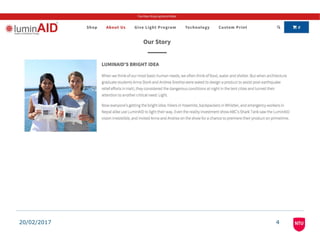
  • #4 Why did we do this research? Sarah Kettley designing with smart textiles: https://sarahkettleydesign.co.uk/2015/08/19/designing-with-smart-textiles/ In Smart Fashion, electronics and computation are integrated into garments that can be worn on the body. In other words, if we substitute traditional components, like printed circuit boards (PCBs), ... battery holders and LED displays, with flexible conductive thread and sewable versions of the hard components a wearable garment might offer the same functionality as your smartphone, mood lighting or house security systems.
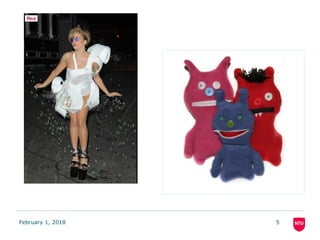
  • #5 Potential and Challenges of developing STEAM education – BERA Report: https://www.bera.ac.uk/project/bera-research-commissions/reviewing-the-potential-and-challenges-of-developing-steam-education-2 The natural world (electricity) can be understood through technology and engineering (electronic systems)  Technology and engineering (electronic textiles) build on art (creativity and language of fashion design) and mathematics (Ohms law)  Therefore,  Learning about technology and engineering requires a multi-disciplinary approach  called STEAM. 
  • #6 Explain issues with teaching this stuff - previous research - DAVIES, S.  and RUTLAND, M., 2013. Did the UK Digital Design and Technology (DD&T) programme lead to innovative curriculum change within secondary schools? http://irep.ntu.ac.uk/id/eprint/12335/ - current trend to bolt on electronics
  • #7 Resnick and Rosenbaum (2013) write about e-textile teaching in the States. They urge teachers to consider problem solving activities that rely on tangible objects, which allow learners to ‘tinker’ with electronic components and construct their own understanding of the concepts that govern how various components function, within a soft (textile) or traditional (resistant materials) circuit.  Seymore Papert has written about learning computation. Constructionism and the idea of using objects to make abstract knowledge concrete. Perner-Wilson and Buecheley (2013) refer to these as ‘a kit of no parts’ encouraging adult and teenage makers to construct switches and battery holders that expose the functionality of the materials – striping it back, so to say. This type of technology ‘laid bare’ enables learners to see what might be inside the black box, giving textile electronics an edge over traditional components.
  • #9 How did we do the research? European Regional Development Fund local SME – Kitronik : https://www.kitronik.co.uk/blog/lighting-simple-e-textiles-circuit-tinkering-activity/ Rode, J. A., Weibert, A., Marshall, A., Aal, K., von Rekowski, T., el Mimoni, H., & Booker, J. (2015). From computational thinking to computational making. Proceedings of the 2015 ACM International Joint Conference on Pervasive and Ubiquitous Computing, 239-250. Verlag. Schepens, A., Aelterman, A., & Van Keer, H. (2007). Studying learning processes of student teachers with stimulated recall interviews through changes in interactive cognitions. Teaching and Teacher Education, 23(4), 457-472.
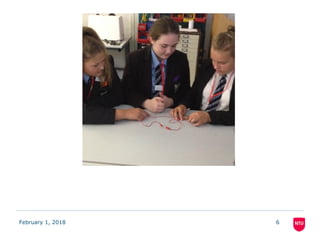
  • #10 Set of resources: a simple circuit tinkering kit: Tinkering kits are bags of components: crocodile clips, cell coins, LED lights that come with no instructions and challenge pupils to use all the components in the bag to make the LED light up. a multimetre activity a soft switch kit a battery holder kit a set of exemplar Smart Fashion products
  • #11 Rode, J. A., Weibert, A., Marshall, A., Aal, K., von Rekowski, T., el Mimoni, H., & Booker, J. (2015). From computational thinking to computational making. Proceedings of the 2015 ACM International Joint Conference on Pervasive and Ubiquitous Computing, 239-250. Aesthetics young people desire to make aesthetically pleasing artefacts, however, these complex decisions can hinder a participant’s creativity; sometimes aesthetic choices override decisions about the right solution ; these aesthetic choices give young people “design agency” Creativity creativity can be a factor in problem solving within e-textiles – ‘an abstract problem solving mechanism’ and/or creativity can support free expression within e-textiles – ‘concrete and tangible skill building’ Constructing young people need the skills to be able to produce tangible objects this includes physical skills: sewing, soldering, using pliers, wire strippers and other hand-tools. acquisition of skills, impact on the young person’s realisation of artefacts from preparation to final outcome weak execution of stitching can lead to short circuits Visualising Multiple Representatives visualising 2D designs into 3D objects can be a challenge there is a need for young people to understand why they have to follow the 2D representations into real world 3D representations Understanding Materials young people need to understand how different materials operate that objects, for example crocodile clips, have the same properties as conductive thread issues associated with short circuiting
  • #13 We recorded instances of themes within each resource and then compared these to the teacher interviews to see how the teachers had responded to the activity. We are aware that our sample is small and so far we have only tested with teachers and not the pupils.
  • #14 From this data we can see how the activities might provide opportunities for learners to experience and potentially understand Smart Fashion materials and components. This extends the Rode et al (2015) framework to include component understanding alongside materials. The teachers understood how the components interconnected and impacted on the circuit functionality (Peppler et al, 2013) this is essential knowledge for the types of design decisions that are required to design and make flexible Smart Fashion objects that will ultimately be worn next to the body.
  • #15 From the data we can see that through the range of making skills, including the construction of pockets and encasing conductive fabric within pouches, the resources provide opportunities to support learners with the skills they need to house electronic circuit within Smart Fashion objects. However, opportunities to practice skills related to using conductive thread on the sewing machine are limited. Teacher D, identifies potential barriers to using the thread which supports the concern Ngai et al. (2010) pinpointed when describing the need to remove sewing from the initial stage of making.
  • #16 How is it relevant to you? From this study we can start to see that these teaching resources have the potential to support learners in developing an understanding of what e-textiles are and how they can be made. This understanding can then be applied, at a later date, through the designing and making of Smart Fashion products. For these teaching resources to be of quality they need to include opportunities for: abstract problem solving, the development of material and component understanding, experiences in construction techniques required for this kind of hybrid activity (integrated electronics and textiles), the visualisation of circuits, simple and advanced and group work to support competition and team work.   The next steps in the research project will involve testing the remaining resources with teachers and conducting further enquiry into the social, creative and aesthetic aspects of e-textile learning.