Observing Student Teachers: How can we utilise
'IRIS Connect' to enhance our work at NTU?
Sarah Davies
Observation
Observing the behaviour of our fellow humans is something we all start in
babyhood and never finish until they finally screw the lid down on us. It is one of
those taken-for-granted activities that occurs every day of our lives, in work, in
the family, and in social situation. Much of what we see is repeated versions, with
variations, of what we have observed many times before. It is because we have
crossed the road thousands of times that we know what to look for, though the
context will be different on each new occasion. We have the means of recognising
what is familiar and what is novel, and this puts us in a position to make decisions
rapidly about the speed of vehicles, their distance away, likely position in a few
seconds, our capability of walking or running at a certain pace and in a particular
direction. Without the powers of observation and deduction most of us would
have been dead years ago.
Wragg (2013, p. vii)
25 January 2018 2
Student teacher observation
25 January 2018 3
Lunchtime Recipe:
• Introduction to student teacher observation
• Explaining how student teacher observation works at NTU
• Considering alternatives
• Conclusion and Recommendations
25 January 2018 4
25 January 2018 5
25 January 2018 6
NTU student observation
• Observations should be spread evenly across trainees’ Professional
Practice Placements.
• NTU Course guide for secondary ITE
25 January 2018 7
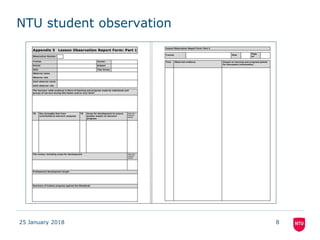
NTU student observation
25 January 2018 8
NTU Observation process (secondary)
• describe precisely what they observe, giving specific examples,
evaluating the trainee’s intentions and judging their effectiveness on
pupils’ learning
• develop questions about the choices made by the trainee, prompts
for further reflection and strategies/ideas that the trainee might
consider in order to improve
• suggest particular areas for development that arise from the
observation; these should be limited in number, achievable within a
given time-frame and prioritised to have the greatest impact on the
trainee’s progress
• relate all information to the progress made by the trainee against
the Teachers’ Standards
25 January 2018 9
NTU student observation
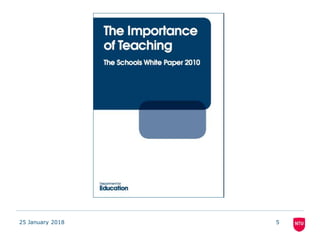
In The Importance of Teaching (DfE 2010), classroom observation is
identified as a key tool in the improvement of practice and is
considered the principle means of re-instating what is regarded as
‘core’ in education”,
O'Leary (2013, p. 26)
25 January 2018 10
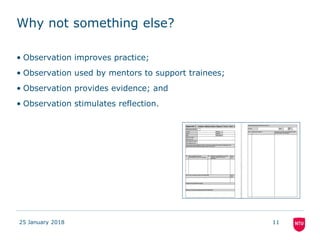
Why not something else?
• Observation improves practice;
• Observation used by mentors to support trainees;
• Observation provides evidence; and
• Observation stimulates reflection.
25 January 2018 11
What if the current system was wrong?
• Observation improves practice – debates about power relations
• Observation used by mentors to support trainees – debates about
power relations
• Observation stimulates reflection – debates about power relations
• Observation provides evidence – debates about graded observation
reliability
25 January 2018 12
Considering alternatives
25 January 2018 13
Ownership of observation needs to be devolved down as much as
possible to the participants in the teaching process. The closer the
ownership of the process is located to the actual participants, the
more likely it is that the aims will be achieved and the outcomes
accepted by all concerned
Brown et al. 1993, p. 10
Considering alternatives
argue that teacher education is moving to a more collaborative
direction through learning communities that connect experienced and
pre-service teachers (less individualistic)
Barnett (2006)
argue that video viewing can be a tool in bridging the sharing of
learning experiences between university and school
YOUENS et al. (2014)
25 January 2018 14
Considering alternatives
25 January 2018 15
• The access to the classroom that video provides;
• The way technical progress has facilitated the use of video in the
classroom;
• And the way video is used as a way to implement institutional
reforms
Gaudin and Chaliès (2015)
Considering alternatives
25 January 2018 16
Considering alternatives
25 January 2018 17
• Objectives of video viewing in teacher education?
– improve practice;
– Support mentors/subject tutors in the support of trainees;
– Provide evidence to stimulate student teacher reflection.
Conclusion: What does this mean?
• Shared ownership of professional development
• Reflexivity
• Relationship between mentor/student
25 January 2018 18
Conclusion and Recommendations
• Why Is this significant?
• Is this convincing? Why/why not?
• What are the implications?
• Is it successful?
• How does it meet the criteria?
• Is it transferable?
• How and where else can it be applied?
• What needs doing now?
25 January 2018 19
References
– Barnett, M., 2006. Using a web-based professional development system to
support preservice teachers in examining authentic classroom practice. Journal
of Technology and Teacher Education, 14 (4), pp.701.
– Gaudin, C., and Chaliès, S., 2015. Video viewing in teacher education and
professional development: A literature review. Educational Research
Review, 16, 41-67.
– O'Leary, M., 2013. Classroom observation: A guide to the effective observation
of teaching and learning. Routledge.
– Wragg, T., 2013. An Introduction to Classroom Observation (Classic
Edition). Routledge.
– Youens, B., Smethem, L. and Sullivan, S., 2014. Promoting collaborative
practice and reciprocity in initial teacher education: realising a ‘dialogic
space’through video capture analysis. Journal of Education for Teaching, 40 (2),
pp.101-113.
25 January 2018 20

Student observation

  • 1.
    Observing Student Teachers:How can we utilise 'IRIS Connect' to enhance our work at NTU? Sarah Davies
  • 2.
    Observation Observing the behaviourof our fellow humans is something we all start in babyhood and never finish until they finally screw the lid down on us. It is one of those taken-for-granted activities that occurs every day of our lives, in work, in the family, and in social situation. Much of what we see is repeated versions, with variations, of what we have observed many times before. It is because we have crossed the road thousands of times that we know what to look for, though the context will be different on each new occasion. We have the means of recognising what is familiar and what is novel, and this puts us in a position to make decisions rapidly about the speed of vehicles, their distance away, likely position in a few seconds, our capability of walking or running at a certain pace and in a particular direction. Without the powers of observation and deduction most of us would have been dead years ago. Wragg (2013, p. vii) 25 January 2018 2
  • 3.
  • 4.
    Lunchtime Recipe: • Introductionto student teacher observation • Explaining how student teacher observation works at NTU • Considering alternatives • Conclusion and Recommendations 25 January 2018 4
  • 5.
  • 6.
  • 7.
    NTU student observation •Observations should be spread evenly across trainees’ Professional Practice Placements. • NTU Course guide for secondary ITE 25 January 2018 7
  • 8.
  • 9.
    NTU Observation process(secondary) • describe precisely what they observe, giving specific examples, evaluating the trainee’s intentions and judging their effectiveness on pupils’ learning • develop questions about the choices made by the trainee, prompts for further reflection and strategies/ideas that the trainee might consider in order to improve • suggest particular areas for development that arise from the observation; these should be limited in number, achievable within a given time-frame and prioritised to have the greatest impact on the trainee’s progress • relate all information to the progress made by the trainee against the Teachers’ Standards 25 January 2018 9
  • 10.
    NTU student observation InThe Importance of Teaching (DfE 2010), classroom observation is identified as a key tool in the improvement of practice and is considered the principle means of re-instating what is regarded as ‘core’ in education”, O'Leary (2013, p. 26) 25 January 2018 10
  • 11.
    Why not somethingelse? • Observation improves practice; • Observation used by mentors to support trainees; • Observation provides evidence; and • Observation stimulates reflection. 25 January 2018 11
  • 12.
    What if thecurrent system was wrong? • Observation improves practice – debates about power relations • Observation used by mentors to support trainees – debates about power relations • Observation stimulates reflection – debates about power relations • Observation provides evidence – debates about graded observation reliability 25 January 2018 12
  • 13.
    Considering alternatives 25 January2018 13 Ownership of observation needs to be devolved down as much as possible to the participants in the teaching process. The closer the ownership of the process is located to the actual participants, the more likely it is that the aims will be achieved and the outcomes accepted by all concerned Brown et al. 1993, p. 10
  • 14.
    Considering alternatives argue thatteacher education is moving to a more collaborative direction through learning communities that connect experienced and pre-service teachers (less individualistic) Barnett (2006) argue that video viewing can be a tool in bridging the sharing of learning experiences between university and school YOUENS et al. (2014) 25 January 2018 14
  • 15.
    Considering alternatives 25 January2018 15 • The access to the classroom that video provides; • The way technical progress has facilitated the use of video in the classroom; • And the way video is used as a way to implement institutional reforms Gaudin and Chaliès (2015)
  • 16.
  • 17.
    Considering alternatives 25 January2018 17 • Objectives of video viewing in teacher education? – improve practice; – Support mentors/subject tutors in the support of trainees; – Provide evidence to stimulate student teacher reflection.
  • 18.
    Conclusion: What doesthis mean? • Shared ownership of professional development • Reflexivity • Relationship between mentor/student 25 January 2018 18
  • 19.
    Conclusion and Recommendations •Why Is this significant? • Is this convincing? Why/why not? • What are the implications? • Is it successful? • How does it meet the criteria? • Is it transferable? • How and where else can it be applied? • What needs doing now? 25 January 2018 19
  • 20.
    References – Barnett, M.,2006. Using a web-based professional development system to support preservice teachers in examining authentic classroom practice. Journal of Technology and Teacher Education, 14 (4), pp.701. – Gaudin, C., and Chaliès, S., 2015. Video viewing in teacher education and professional development: A literature review. Educational Research Review, 16, 41-67. – O'Leary, M., 2013. Classroom observation: A guide to the effective observation of teaching and learning. Routledge. – Wragg, T., 2013. An Introduction to Classroom Observation (Classic Edition). Routledge. – Youens, B., Smethem, L. and Sullivan, S., 2014. Promoting collaborative practice and reciprocity in initial teacher education: realising a ‘dialogic space’through video capture analysis. Journal of Education for Teaching, 40 (2), pp.101-113. 25 January 2018 20

Editor's Notes

  • #3 What is it about?
  • #4 What is the context/situation? The origins of classroom observation in England can be traced back to the middle of the 19th century where its emergence in state schools coincided with government’s introduction of Her Majesty’s Inspectorate (HMI), whose remit was to assess whether public money was being well spent in the newly created ‘schools for the poor’ and to identify ways in which the then government office of education could help to further improvement provision (Grubb 2000) , p. 10 “ [Oleary] Today it has become a tool for: - Measuring - Assuring - Improving Teachers
  • #5 What is the main point/problem to be explored? This chapter collects together the best parts of this advice on general classroom observation and puts them together in a series of sections which look at beginning design and technology teachers’ lessons, including tools for observation and analysis. This chapter will support mentors working across a range of contexts to make decisions about the best tools to use to meet the different purposes of observation within the mentor and mentee process, rather than a one-size fits all approach to observation. I am using this session to articulate my thinking for the chapter
  • #6 Where does it take place? In the schools sector, for example, the white paper, The importance of teaching (DfE 2010) , promises greater use of observation and increased powers for head teachers in school to ‘sit in on as many lessons as necessary to root out under-performing teachers’. , p. 25 Who is this by? Expert teachers observe teachers in their subject department; – Goslings model of teacher observation Who is affected? Observer has power over observee – if observation is for measuring teaching Observer has expertise over/novice relationship – if developmental equality/mutuality – if used for peer review;, Who might be interested? Ofsted; ITE provider; colleagues When does this occur?
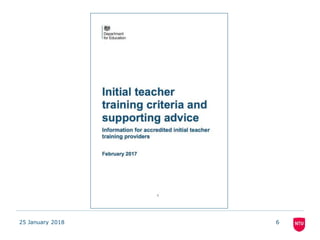
  • #7 Training may be delivered in schools or other settings (subject to C2.3) and is likely to include a combination of unobserved and observed teaching, taught sessions, seminars, workshops, tasks and assignments, and engagement with academic/professional research. The content of professional programmes might include, for example: § the role of the teacher § planning and assessment to ensure pupil progress § national assessments and examinations  child development and learning § priorities, such as managing pupils’ behaviour, early reading, and special educational needs and disability § assessing and evaluating teaching § the use of evidence and research to inform teaching.
  • #8 The NTU Course guide for secondary ITE states that “Observations should be spread evenly across trainees’ Professional Practice Placements. The tables below indicate the expected number and spread of observations and includes a suggestion of when during each Professional Practice Placement these should occur.”, p. ...
  • #9 In theory this means in school and tutor are given guidance on how to conduct the preparation, observation feedback afterwards. Published protocols on what to do before, during and after the observation. Assessment guidance through the NASBTT “Training and Assessment Toolkit” (2015).
  • #10 In their commentary Observers should: Describe ... In practice: the observation records are used to report; set actions and grade student teachers – developmental? Evaluative? tension completed but interpretations of the assessment criteria are subjective – moderation is difficult to implement. and little evidence of NASBTT “Training and Assessment Toolkit” (2015). How does one factor affect another or how do the parts fit into the whole? – trainee might miss the development target due to feelings of not making the grade
  • #11 Why did it occur? Expectation to base training in school settings and make judgements through observed teaching. Lofthouse (2010) Claims that observation is used by mentors to support student teachers during practice; Why was that done? Because NTU training year graded through partnership between school and university – common pro-forma and system of reporting competencies - We combine the both in teacher education because as gosling acknowledges observation is used in ITE to demonstrate the teachers developing competency and at the same time improve those competencies. The observation become the product of the student teachers training in that they evidence the teachers ...repot on the teacher and help to set actions for development. EVIDENCE and Why this argument/theory/suggestion/solution? Observation stimulates reflection on practice by engaging in professional dialogue with colleagues, who act as “critical mirrors” Brookfield 1995 – can’t argue with that Observation improves practice, used by mentors to support trainees, provides evidence and stimulates reflection
  • #12 Why not something else? How can we improve the engagement in professional dialogue with colleagues, about practice through additional/better delivered Observation? STIMULATING REFLECTION
  • #13 What if this were wrong? Wragg argues that graded observation is less reliable Oleary says that p42 – examination is a form of power and can stop risk taking and creativity However, video might offer an alternative view
  • #14 POWER RELATIONSHIP What are the alternatives? In order to shift the power we need to make the process collaborative and give ownership, equality and autonomy, trust to the participant
  • #15 Communities of practice and video might offer a solution
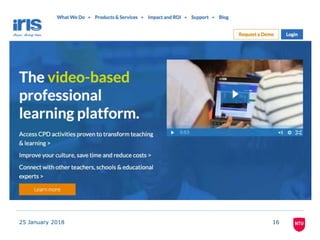
  • #16 Gaudin, C., and Chaliès, S., 2015. Video viewing in teacher education and professional development: A literature review. Educational Research Review, 16, 41-67. Gaudin and Chaliès discuss how the literature “presents three main reasons for the growing reliance on video in teacher education and professional development”, p.42, which are: The access to the classroom that video provides; The way technical progress has facilitated the use of video in the classroom; And the way video is used as a way to implement institutional reforms, p.42. From the review Gaudin and Chaliès identify four interrelated aspects to video viewing:
  • #17 The access to the classroom that video provides; - we can now video record lesson observation as a record of the teaching experience The way technical progress has facilitated the use of video in the classroom; student teachers can have access to the kit and record their own teaching on a more regular basis And the way video is used as a way to implement institutional reforms – video viewing can be used to exemplify teaching and learning theory – or competencies – e.g. technician view of education – what to do.
  • #18 What if there was a problem? Bocquillon, M. and Derobertmasure, A., 2017 The paper claims that trainee teachers need to reflect on practice which they find difficult. Lofthouse, R. and Birmingham, P., 2010. The paper reports on the use of video to make these professional dialogues authentic and facilitating of reflection What if this or that factor were – added? Removed? Altered? More opportunities to improve practice Dialogue about teaching might be more authentic – through video exemplification Student find reflection difficult and again video might offer concrete examples which scaffold reflection
  • #19 What does this mean? Perceived benefits of using video to develop student teachers ownership of PD through peer on peer dialogue
  • #20 Why Is this significant? Lofthouse argues that video intervention may foster a more critical reflective approach enhancing placement and mentoring opportunities Is this convincing? Why/why not? But time is needed to develop skills in reflection and dialogue about practice What are the implications? If these goes well we will have student teachers with strong skills in reflection and improved practice? Is it successful? It has been with others – but dialogue comes up again and again and the use of video viewing within university How does it meet the criteria? Is it transferable? How and where else can it be applied? What needs doing now?
  • #21 Gaudin, C., and Chaliès, S., 2015. Video viewing in teacher education and professional development: A literature review. Educational Research Review, 16, 41-67.