Session 3: The Learning Universe
Sarah Davies
Designing Spaces for Learning
14 February 2018 2
hook
Intended Learning Outcomes
By completing this session, learners should be able to:
– Explain key terminology/factors in relation to ‘learning spaces’;
– Identify and categorise the different concepts associated with spaces; and
– Explain the historical developments of learning spaces in relation to educational
and architectural factors.
14 February 2018 3
What do we know already?
• Think about which seat you prefer and explain to your table why
that is.
• List the reasons.
14 February 2018 4
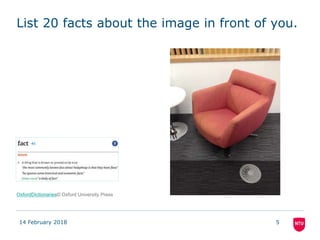
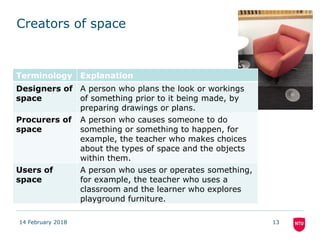
List 20 facts about the image in front of you.
14 February 2018 5
OxfordDictionaries© Oxford University Press
Key Terminology
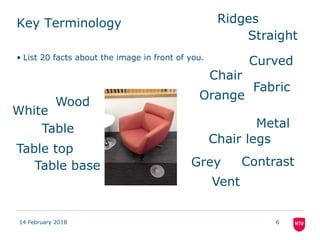
• List 20 facts about the image in front of you.
14 February 2018 6
Orange
Grey
Curved
Straight
Chair
Chair legs
MetalTable
Table top
Table base
Vent
Ridges
Contrast
Fabric
Wood
White
What have we been doing?
• Describing what furniture looks like using key terminology
• Appraising how we feel about the seat
• Explaining why that is
14 February 2018 7
KEY
TERMINOLOGY/FACTORS
14 February 2018 8
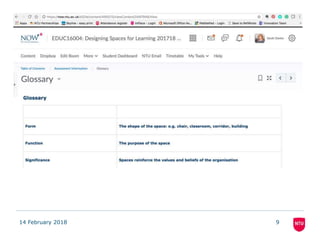
glossary
14 February 2018 9
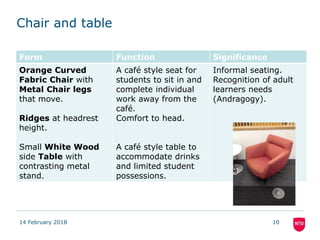
Chair and table
Form Function Significance
Orange Curved
Fabric Chair with
Metal Chair legs
that move.
Ridges at headrest
height.
Small White Wood
side Table with
contrasting metal
stand.
A café style seat for
students to sit in and
complete individual
work away from the
café.
Comfort to head.
A café style table to
accommodate drinks
and limited student
possessions.
Informal seating.
Recognition of adult
learners needs
(Andragogy).
14 February 2018 10
Form, function and significance.
• Go back to your original favorite seat and
• Start to interpret the Form, Function and Significance.
14 February 2018 11
CONCEPTS
14 February 2018 12
Creators of space
Terminology Explanation
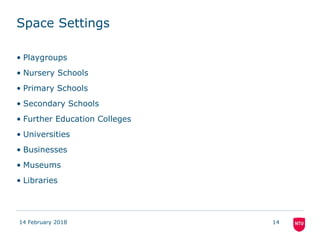
Designers of
space
A person who plans the look or workings
of something prior to it being made, by
preparing drawings or plans.
Procurers of
space
A person who causes someone to do
something or something to happen, for
example, the teacher who makes choices
about the types of space and the objects
within them.
Users of
space
A person who uses or operates something,
for example, the teacher who uses a
classroom and the learner who explores
playground furniture.
14 February 2018 13
Space Settings
• Playgroups
• Nursery Schools
• Primary Schools
• Secondary Schools
• Further Education Colleges
• Universities
• Businesses
• Museums
• Libraries
14 February 2018 14
Ask questions:
• Who uses the space?
• Who is designing the space?
• Are the designers talking to the users?
• Are the educators talking to the users?
14 February 2018 15
HISTORICAL
DEVELOPMENTS
14 February 2018 16
Blog Post
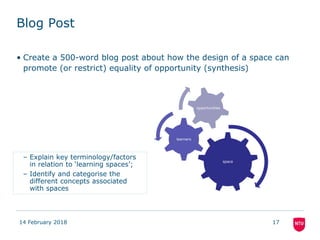
• Create a 500-word blog post about how the design of a space can
promote (or restrict) equality of opportunity (synthesis)
14 February 2018 17
space
learners
opportunities
– Explain key terminology/factors
in relation to ‘learning spaces’;
– Identify and categorise the
different concepts associated
with spaces
Independent learning
– Explain key terminology/factors in relation to ‘learning spaces’;
– Identify and categorise the different concepts associated with spaces
14 February 2018 18
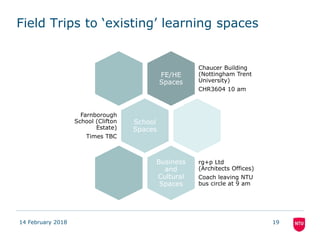
Field Trips to ‘existing’ learning spaces
FE/HE
Spaces
Chaucer Building
(Nottingham Trent
University)
CHR3604 10 am
School
Spaces
Farnborough
School (Clifton
Estate)
Times TBC
Business
and
Cultural
Spaces
rg+p Ltd
(Architects Offices)
Coach leaving NTU
bus circle at 9 am
14 February 2018 19
Intended Learning Outcomes
By completing this session, learners should be able to:
– Explain key terminology/factors in relation to ‘learning spaces’;
– Identify and categorise the different concepts associated with spaces; and
– Explain the historical developments of learning spaces in relation to educational
and architectural factors.
14 February 2018 20

Learning universe

  • 1.
    Session 3: TheLearning Universe Sarah Davies Designing Spaces for Learning
  • 2.
  • 3.
    Intended Learning Outcomes Bycompleting this session, learners should be able to: – Explain key terminology/factors in relation to ‘learning spaces’; – Identify and categorise the different concepts associated with spaces; and – Explain the historical developments of learning spaces in relation to educational and architectural factors. 14 February 2018 3
  • 4.
    What do weknow already? • Think about which seat you prefer and explain to your table why that is. • List the reasons. 14 February 2018 4
  • 5.
    List 20 factsabout the image in front of you. 14 February 2018 5 OxfordDictionaries© Oxford University Press
  • 6.
    Key Terminology • List20 facts about the image in front of you. 14 February 2018 6 Orange Grey Curved Straight Chair Chair legs MetalTable Table top Table base Vent Ridges Contrast Fabric Wood White
  • 7.
    What have webeen doing? • Describing what furniture looks like using key terminology • Appraising how we feel about the seat • Explaining why that is 14 February 2018 7
  • 8.
  • 9.
  • 10.
    Chair and table FormFunction Significance Orange Curved Fabric Chair with Metal Chair legs that move. Ridges at headrest height. Small White Wood side Table with contrasting metal stand. A café style seat for students to sit in and complete individual work away from the café. Comfort to head. A café style table to accommodate drinks and limited student possessions. Informal seating. Recognition of adult learners needs (Andragogy). 14 February 2018 10
  • 11.
    Form, function andsignificance. • Go back to your original favorite seat and • Start to interpret the Form, Function and Significance. 14 February 2018 11
  • 12.
  • 13.
    Creators of space TerminologyExplanation Designers of space A person who plans the look or workings of something prior to it being made, by preparing drawings or plans. Procurers of space A person who causes someone to do something or something to happen, for example, the teacher who makes choices about the types of space and the objects within them. Users of space A person who uses or operates something, for example, the teacher who uses a classroom and the learner who explores playground furniture. 14 February 2018 13
  • 14.
    Space Settings • Playgroups •Nursery Schools • Primary Schools • Secondary Schools • Further Education Colleges • Universities • Businesses • Museums • Libraries 14 February 2018 14
  • 15.
    Ask questions: • Whouses the space? • Who is designing the space? • Are the designers talking to the users? • Are the educators talking to the users? 14 February 2018 15
  • 16.
  • 17.
    Blog Post • Createa 500-word blog post about how the design of a space can promote (or restrict) equality of opportunity (synthesis) 14 February 2018 17 space learners opportunities – Explain key terminology/factors in relation to ‘learning spaces’; – Identify and categorise the different concepts associated with spaces
  • 18.
    Independent learning – Explainkey terminology/factors in relation to ‘learning spaces’; – Identify and categorise the different concepts associated with spaces 14 February 2018 18
  • 19.
    Field Trips to‘existing’ learning spaces FE/HE Spaces Chaucer Building (Nottingham Trent University) CHR3604 10 am School Spaces Farnborough School (Clifton Estate) Times TBC Business and Cultural Spaces rg+p Ltd (Architects Offices) Coach leaving NTU bus circle at 9 am 14 February 2018 19
  • 20.
    Intended Learning Outcomes Bycompleting this session, learners should be able to: – Explain key terminology/factors in relation to ‘learning spaces’; – Identify and categorise the different concepts associated with spaces; and – Explain the historical developments of learning spaces in relation to educational and architectural factors. 14 February 2018 20

Editor's Notes

  • #2 Session 3 Overall aims of the session: In this session, we will start to think about the concepts associated with ‘learning space’ and educational inequalities.
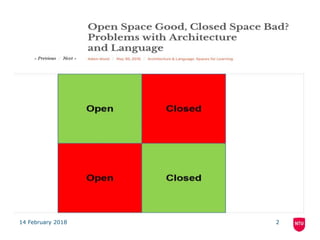
  • #3 https://architectureandeducation.org/2015/05/30/open-space-good-closed-space-bad-problems-with-architecture-and-language/ The ideological baggage words carry help to shape how we understand school learning spaces. Because I spend a lot of time in classrooms and open learning spaces and I’m trying to work out what these things mean, I end up thinking a lot about the role of language in communicating and selling architectural and educational ideas. So it strikes me that in the case of Open Learning Spaces or Flexible Learning Spaces, say, we have already moved beyond mere description. These are value statements – think about what it would mean to talk about Closed Learning Spaces or Inflexible Learning Spaces. “Open” belongs to a semantic web that speaks of good things: freedom; transparency; innovation; of the future and perhaps even democracy. A closed space seems squalid and dark, stale of air and of ideas in comparison. The past is closed; the future is open. Sometimes these words are worked into extended metaphors that tie together individual ideas into ideological knots. In his autobiography, Frank Lloyd Wright expressed his desire for doing away with walls and creating larger, open spaces: I could see little sense in this inhibition, this cellular sequestration that implied ancestors familiar with penal institutions… ([1943] 2005:142) Prisons, sequestration, cellular-ness, inhibition – these existed with rooms and can be deleted – ping! – by a wave of the openness wand. “Cells and bells” is a similar construction that I often hear, one that attempts metonymically to reduce a vast and broad range of school styles (architecture and system organisation) and social relationships to a figurative world of the time-ordered prison. But a twelve-year-old girl reminded me recently that things can be very different. She taught me two lessons: firstly to get off my high horse and stop assuming that as an adult, the way I see things is always the right way and secondly to be wary of the language of architecture. I was sitting in her science lesson, a large and truly open space and keen to hear what students felt about the different kinds of classroom / learning space in the school. (Built in 2009-10, this school has a range of spaces where lessons happen, from this larger, wall-less one to more traditional classrooms and on to “break out areas”.) I’ll call this student Marie, we’ve already been talking for a minute or two and she’s keener on the classrooms than the more open spaces: Me:           So you prefer the classrooms then. What is it about these open spaces you’re less keen on? Marie:      I feel claustrophobic in them. Me:           Do you mean “claustrophobic”? Marie:      Yeah, yeah, all the people, it’s all ehhhh [waves hands close to face]. In my arrogance, I assumed she’d used the wrong word: how could an open space be claustrophobic? Forgetting that for a 12-year-old girl the experience of space might be very different from my own (a late 30s male) and that what is open might not necessarily suggest freedom and lightness for someone else. She reminded me that if I am to understand people’s experiences of space, I need to find ways beyond my own.   Note: I don’t know what explains her reaction or if it can be explained. It may be a feeling particular to her and a personal reaction to these kinds of spaces. It could be her age, her (relatively) small size, her gender…it could be any, all or none of these. I don’t think much has been done on open spaces and student characteristics, has it? The gender aspect is curious – I wonder if the generally larger numbers in open plan have different effects for students of different genders. It wasn’t the main focus of my research but I’m curious now. If anybody knows of any studies, I’d be grateful, thanks.
  • #4 In this session, we will start to think about the concepts associated with ‘learning space’ and educational inequalities. This session will support your capacity to ‘Develop an overview of how learning spaces may alter pedagogical approaches across different age ranges’ and demonstrate your capacity to: Appraise and apply theories of learning to the design of a learning space Terminology in the ‘hook’ about users and space – remember who uses the space whilst developing a language to talk about it.
  • #7 Do you like this seat or not? List you reasons. Share your reasons with someone else.
  • #8 Describing what furniture looks like using key terminology (form) Appraising how we feel about the seat (significance/procurer) Explaining why that is (function/user) You are already using terminology
  • #10 Key terminology – NOW Glossary Form - The shape of the space: e.g. chair, classroom, corridor, building (facts about a space) - Describing what furniture looks like using key terminology (form) Function - The purpose of the space (what the space does – e.g. lecture theatre for teaching large groups of learners) - Explaining why that is (function/user) Significance - Spaces reinforce the values and beliefs of the organisation (what the space says – e.g. lecture theatre signifies scholarly learning) - Appraising how we feel about the seat (significance/procurer)
  • #11 Key terminology – NOW Glossary Form - The shape of the space: e.g. chair, classroom, corridor, building (facts about a space) - Describing what furniture looks like using key terminology (form) Function - The purpose of the space (what the space does – e.g. lecture theatre for teaching large groups of learners) - Explaining why that is (function/user) Significance - Spaces reinforce the values and beliefs of the organisation (what the space says – e.g. lecture theatre signifies scholarly learning) - Appraising how we feel about the seat (significance/procurer)
  • #14 Key terminology – NOW Glossary Form - The shape of the space: e.g. chair, classroom, corridor, building (facts about a space) - Describing what furniture looks like using key terminology (form) Function - The purpose of the space (what the space does – e.g. lecture theatre for teaching large groups of learners) - Explaining why that is (function/user) Significance - Spaces reinforce the values and beliefs of the organisation (what the space says – e.g. lecture theatre signifies scholarly learning) - Appraising how we feel about the seat (significance/procurer)
  • #20 Connect to the session: What questions do you want to ask during these visits about: form function and significance The designers The procurers The users The historical development of these spaces P.S. SDS to let Sarah know if not able to attend Chaucer and confirm attendance on the rg+p trip. Your professionalism in this will lead to choices for the 3rd trip.
  • #21 In this session, we will start to think about the concepts associated with ‘learning space’ and educational inequalities. This session will support your capacity to ‘Develop an overview of how learning spaces may alter pedagogical approaches across different age ranges’ and demonstrate your capacity to: Appraise and apply theories of learning to the design of a learning space Terminology in the ‘hook’ about users and space – remember who uses the space whilst developing a language to talk about it.