Introduction to Designing Spaces for Learning
(DS4L)
With Sarah Davies and Jamie Tinney
30 January 2018 2
Designing Spaces for Learning.
• What does it involve?
• What is the context?
• Who will deliver the module?
• When and where will the module take place?
• How will we be assessed?
• Why is this module relevant to me?
30 January 2018 3
Designing Spaces for Learning
30 January 2018 4
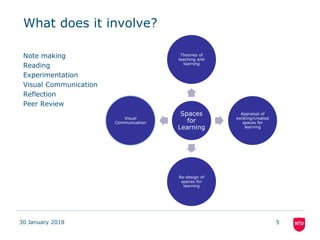
What does it involve?
Note making
Reading
Experimentation
Visual Communication
Reflection
Peer Review
30 January 2018 5
Spaces
for
Learning
Theories of
teaching and
learning
Appraisal of
existing/created
spaces for
learning
Re-design of
spaces for
learning
Visual
Communication
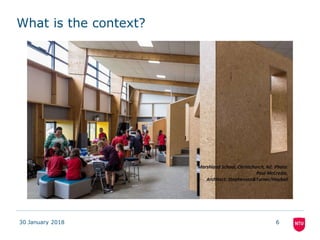
What is the context?
30 January 2018 6
Who?
30 January 2018 7
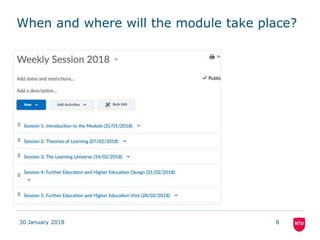
When and where will the module take place?
30 January 2018 8
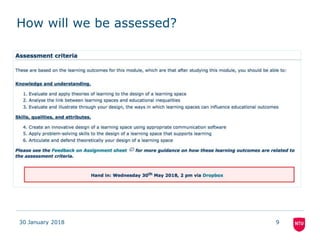
How will we be assessed?
30 January 2018 9
Why is this module relevant to me?
• Explore the link between learning spaces and educational
inequalities
• Investigate the tension between traditional and recent
developments in teaching and learning and how this applies to the
design of learning spaces
• Develop an overview of how learning spaces may alter pedagogical
approaches across different age ranges
30 January 2018 10
Who do I want to be?
• designers of space
• procurers of space
• users of space
30 January 2018 11
PRESENTATION
GUIDANCE
Re-design three identified ‘learning spaces’ for young
and/or adult learners, based on your initial analysis of
three existing ‘learning spaces’ in relation to how they
meet the inclusive educational needs of young and/or
adult learners.
Present your findings in visual form, including notes
(2000-word equivalent).
30 January 2018 12
Introduction: Research into what makes a
good ‘space for learning’
Use this part of the presentation to introduce:
• What is the presentation about?
• What is the context/setting?
• What is the main point/problem/topic to be explored?
• Where does it take place?
• Who is involved?
• Who is affected?
• Who might be interested?
• When does this occur?
30 January 2018 13
Appraise and Review three existing ‘spaces
for learning’ (minimum 3 slides)
Use this part of the presentation to appraise and review three
different ‘spaces for learning’
• How are they designed?
• How does the design relate to theories about teaching and learning?
• How do the different aspects of the design: form, function and
significance, relate to theories about teaching and learning?
• Why are they designed this way?
• Why have different aspects of the form, function and significance,
been designed that way?
• Why do these designs promote (or restrict) the inclusive educational
needs of young and/or adult learners?
30 January 2018 14
Re-designs (minimum 3 slides)
Use this part of the presentation to communicate your three
experiments into communicating effective ‘spaces for learning’
– What is the space?
– What is the context/setting of the space?
– What is the main point/problem/topic to be explored through the re-design?
– Where will the space be located?
– Who will use the space?
– How have you re-designed the space?
– How does the re-design relate to theories about teaching and learning?
– How do the different aspects of the design: form, function and significance,
relate to theories about teaching and learning?
– Why have you designed it this way?
30 January 2018 15
Appraise and Review re-designs through
reflection
Use feedback from peers (formative presentation) and architects and
tutors (summative assessment) to inform this section
• What has been successful and why?
• What has been less successful and why?
• What is it about these designs which promotes the inclusive
educational needs of young and/or adult learners?
30 January 2018 16
Conclusion: Your vision for inclusive future
‘spaces for learning’.
Use this section to iterate one of your designs based on reflection and
share your vision of inclusive design through ‘spaces for learning’ – or
good design!
Include a personal reflection on your learning process:
• How did you use the visits, lectures and workshops to develop your
thinking about ‘spaces for learning’?
• What did you do when things didn’t go to plan?
• What would you do next time?
30 January 2018 17

Introduction to the module

  • 1.
    Introduction to DesigningSpaces for Learning (DS4L) With Sarah Davies and Jamie Tinney
  • 2.
  • 3.
    Designing Spaces forLearning. • What does it involve? • What is the context? • Who will deliver the module? • When and where will the module take place? • How will we be assessed? • Why is this module relevant to me? 30 January 2018 3
  • 4.
    Designing Spaces forLearning 30 January 2018 4
  • 5.
    What does itinvolve? Note making Reading Experimentation Visual Communication Reflection Peer Review 30 January 2018 5 Spaces for Learning Theories of teaching and learning Appraisal of existing/created spaces for learning Re-design of spaces for learning Visual Communication
  • 6.
    What is thecontext? 30 January 2018 6
  • 7.
  • 8.
    When and wherewill the module take place? 30 January 2018 8
  • 9.
    How will webe assessed? 30 January 2018 9
  • 10.
    Why is thismodule relevant to me? • Explore the link between learning spaces and educational inequalities • Investigate the tension between traditional and recent developments in teaching and learning and how this applies to the design of learning spaces • Develop an overview of how learning spaces may alter pedagogical approaches across different age ranges 30 January 2018 10 Who do I want to be? • designers of space • procurers of space • users of space
  • 11.
  • 12.
    PRESENTATION GUIDANCE Re-design three identified‘learning spaces’ for young and/or adult learners, based on your initial analysis of three existing ‘learning spaces’ in relation to how they meet the inclusive educational needs of young and/or adult learners. Present your findings in visual form, including notes (2000-word equivalent). 30 January 2018 12
  • 13.
    Introduction: Research intowhat makes a good ‘space for learning’ Use this part of the presentation to introduce: • What is the presentation about? • What is the context/setting? • What is the main point/problem/topic to be explored? • Where does it take place? • Who is involved? • Who is affected? • Who might be interested? • When does this occur? 30 January 2018 13
  • 14.
    Appraise and Reviewthree existing ‘spaces for learning’ (minimum 3 slides) Use this part of the presentation to appraise and review three different ‘spaces for learning’ • How are they designed? • How does the design relate to theories about teaching and learning? • How do the different aspects of the design: form, function and significance, relate to theories about teaching and learning? • Why are they designed this way? • Why have different aspects of the form, function and significance, been designed that way? • Why do these designs promote (or restrict) the inclusive educational needs of young and/or adult learners? 30 January 2018 14
  • 15.
    Re-designs (minimum 3slides) Use this part of the presentation to communicate your three experiments into communicating effective ‘spaces for learning’ – What is the space? – What is the context/setting of the space? – What is the main point/problem/topic to be explored through the re-design? – Where will the space be located? – Who will use the space? – How have you re-designed the space? – How does the re-design relate to theories about teaching and learning? – How do the different aspects of the design: form, function and significance, relate to theories about teaching and learning? – Why have you designed it this way? 30 January 2018 15
  • 16.
    Appraise and Reviewre-designs through reflection Use feedback from peers (formative presentation) and architects and tutors (summative assessment) to inform this section • What has been successful and why? • What has been less successful and why? • What is it about these designs which promotes the inclusive educational needs of young and/or adult learners? 30 January 2018 16
  • 17.
    Conclusion: Your visionfor inclusive future ‘spaces for learning’. Use this section to iterate one of your designs based on reflection and share your vision of inclusive design through ‘spaces for learning’ – or good design! Include a personal reflection on your learning process: • How did you use the visits, lectures and workshops to develop your thinking about ‘spaces for learning’? • What did you do when things didn’t go to plan? • What would you do next time? 30 January 2018 17