Assessment for Learning I Rosalind Duhs Centre for the Advancement of Learning and Teaching (CALT) This document is licensed under the Attribution-NonCommercial-ShareAlike 2.0 UK: England & Wales license, available at http://creativecommons.org/licenses/by-nc-sa/2.0/uk/.
Introductions Name Role Discipline Interest in assessment Any concerns?
Workshop intended learning outcomes After the workshop, participants are expected to be able to: select appropriate ways of providing formative assessment (feedback) to foster higher order learning problematise the impact of different types of assessment on student learning
Summative assessment counts towards final results in relation to learning outcomes Formative assessment does not count towards final course grades, but measures progress and provides students with valuable feedback Summative assessment should also be formative Summative and Formative assessment
Being assessed as a learner Assessing learning as a teacher Think Pair Share Your experience of assessment
A student’s experience of assessment UCL Blogs (First year undergraduates) http://www.ucl.ac.uk/transition/blogs Anna (Linguistics) Handing in my first assessment was a nightmare. I didn't know what they expected and worried that I wouldn't be good enough. What strategies could help Anna?
Alverno: Assessment-as-learning must Judge performance in contexts related to life roles Include explicitness of expected outcomes, public criteria and student self assessment Include multiplicity and be cumulative and expansive Include feedback and external perspectives as well as performance Be multiple in mode and context (Mentkowski and Associates, 2000) Overview: assessment for learning
Assessment Why? Idea generation
Why? Motivation Learning Feedback (to students) on strengths and weaknesses Feedback (to teachers) on how well students are coping with the course Evaluate student performance (grade) Quality assurance – internal and external 1-4 require lots of assessment: self- and peer assessment 5 och 6 require rigorous, reliable assessment, but how often? Based on:  http://www.brookes.ac.uk/services/ocsd/2_learntch/aup14pr.html Formative and/or Summative Assessment
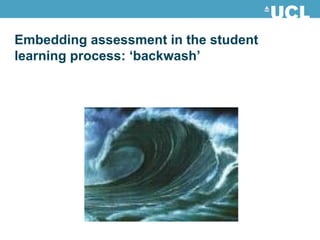
Embedding assessment in the student learning process: ‘backwash’
Select appropriate ways of providing formative assessment (feedback) to foster higher order learning Workshop outcome 1
Higher order learning (HOL) What is higher order learning? Work alone for a few minutes. How would you describe higher order learning? Generate some ideas and make a note of a few points. Compare your description with your neighbour’s description and agree on a definition of higher order learning from your perspective.
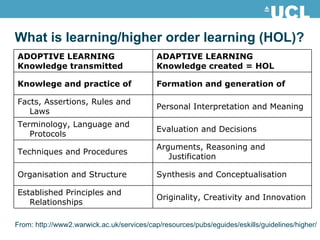
What is learning/higher order learning (HOL)? From: http://www2.warwick.ac.uk/services/cap/resources/pubs/eguides/eskills/guidelines/higher/ Originality, Creativity and Innovation Established Principles and Relationships  Synthesis and Conceptualisation  Organisation and Structure Arguments, Reasoning and Justification Techniques and Procedures Evaluation and Decisions  Terminology, Language and Protocols Personal Interpretation and Meaning  Facts, Assertions, Rules and Laws Formation and generation of Knowlege and practice of ADAPTIVE LEARNING Knowledge created = HOL ADOPTIVE LEARNING Knowledge transmitted
I forget what I was taught. I only remember what I’ve learnt.’ (White 1966) Knowledge transmission?
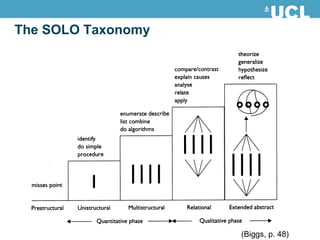
The SOLO Taxonomy (Biggs, p. 48)
Barriers to higher order learning
Strategic compliance Surface approaches to learning Focus on accreditation/qualification “ Will this be in the exam?” Extrinsic motivation
Intrinsic motivation -  a genuine interest in the subject How can it be achieved?
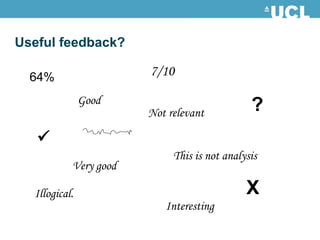
Useful feedback? Good This is not analysis Illogical. Interesting Not relevant ? X    Very good 64% 7/10
Writing a brief summary of your view of the assignment Balancing negative with positive comments Using constructive criticism to provide positive suggestions for improvement Asking questions which encourage reflection about the work Explaining all your comments Suggesting follow-up work and references Suggesting specific ways to improve the assignment Explaining the mark or the grade and explaining why it is not better or worse Offering help with specific problems Offering the opportunity to discuss the assignment and your comments. Feedback for higher order learning Gibbs, G, and Habeshaw, T,  Preparing to Teach: An introduction to effective teaching in higher education
Discussion Please study the texts on written work to prepare for our discussion. Setting and assessing written work
Decide on the  subject focus  you want to assess (content). Aim to assess understanding.  2. List the  skills  you would like students to use and show (essay or report planning/structure, argument, comparison, evaluation, economy of expression, relevance, checking spelling and grammar, etc.). Check against module learning outcomes. Decide on the appropriate format.  3. Write a  draft  choice of tasks/topics/essay questions and put them to one side for at least 24 hours. Check your tasks/questions and revise, then ask a colleague to read them and explain their understanding of the text. Revise again.  4. When you give the students the task/assignment, make sure they understand what is expected of them in general terms (grading criteria - check module criteria) and that they have been given the opportunity to learn the necessary skills. Use  exemplars  to illustrate what is expected. If possible, give students the chance to mark previous essays/reports, preferably one at pass and one at distinction level. Discuss how criteria are applied using examples.  Setting and Assessing written work 1
5.  Deadlines : explain that these are part of the university learning process = time management. Format/length: students can learn a lot from writing short essays which are quicker to assess.  6.  Self- and peer assessment : students should routinely self- and peer-assess against criteria and redraft their work. Give them an interim deadline for the draft and self- and peer-assessment. You could ask them to post feedback on the course Virtual Learning Environment (VLE egMoodle, Blackboard). Make this compulsory. You can choose if you want to grade this activity.  7.  Commenting : when you get the essays in, skim-read a selection, making a note of general tendencies. Prepare feedback comments which can be re-used. Reading on-line is usually quicker than reading printed texts. Marking electronically makes sense because it’s easy to adjust comments and easy for students to read. Marking in pencil is an alternative. Red pens can appear aggressive. Always skim-read the whole essay before you begin writing comments.  8.  Grading : Preparing a detailed marking grid can save time. Sometimes you can circle the appropriate grade descriptors to indicate student performance. Be sure to write individual comments as well, explaining why the work is good and how it could be further developed. Marking in relation to predetermined criteria is good practice. Setting and Assessing written work 2
1. Facilitates the development of  self assessment  (reflection) in learning. 2. Encourages  teacher and peer dialogue  around learning. 3. Helps  clarify  what good performance is (goals,  criteria , expected standards). 4. Provides opportunities to  close the gap  between current and desired performance. 5. Delivers  high quality information to students  about their learning. 6. Encourages  positive motivational beliefs and self-esteem. 7. Provides  information to teachers  that can be used to help shape teaching. (SENLEF) The seven principles of good feedback
Study and d iscuss one or two of the seven principles of good feedback described in your handout. Could they be used in your teaching? If so, how?   (15 minutes). Your perspective
Short cuts – written feedback Work electronically and ’paste’ in comments from a separate file Use a handout with numbered comments. Write the number where you want to comment. Differentiate between style- or method-related and content comments, eg use letters for style and re-use, including examples. Use numbers for comments on content. Sound-record comments. Learners have reacted positively to audio feedback See for example http://www.rsc-ne-scotland.org.uk/mashe/tag/audio-feedback/?order=ASC
Problematise the impact of different types of assessment on student learning  Workshop learning outcome 2
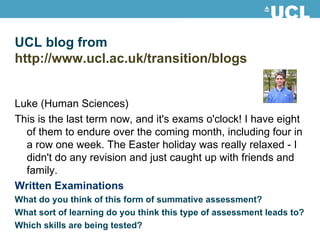
UCL blog from http://www.ucl.ac.uk/transition/blogs   Luke (Human Sciences) This is the last term now, and it's exams o'clock! I have eight of them to endure over the coming month, including four in a row one week. The Easter holiday was really relaxed - I didn't do any revision and just caught up with friends and family. Written Examinations What do you think of this form of summative assessment? What sort of learning do you think this type of assessment leads to? Which skills are being tested?
Marking traditional exams Criterion-referenced  The student’s performance is evaluated in relation to criteria formulated before the course of study begins and preferably communicated to the student Norm-referenced  Student’s performance is compared to the norm; grading is based on peer achievement in the cohort (measurement model)
What are we assessing apart from factual knowledge? Jigsaw: discuss  one  of the following Written field reports  ’ Take-home’ essays Formal written examinations Labwork and lab reports Written literature review presented orally in pairs Evaluating student performance
The student’s responsibilty and learning to learn Choice in learning: projects, enquiry-based learning, roleplay, debates ’ Ways of thinking and practising’ – becoming a biologist, historian, philosopher, engineer, etc. Learning outcomes, assessment and choice
Learning alone and with others Individually and in small and medium-sized groups  Vary learning activities snowball, triads, fishbowl, jigsaw, roleplay, debate Vary time-frames:  From short, snappy activities to longer projects Vary ways of showing that learning outcomes have been achieved:  Write and speak: sketch, draw mind maps, design models, diagrams, do presentations, speeches, chair debates, meetings, do practicals Variety in learning and assessment for learning
Biggs, J. (2003).  Teaching for Quality Learning at University.  2nd ed. Buckingham: The Society for Research into Higher Education & Open University Press. Mentowski, M. and Associates (2000).  Learning that lasts: integrating learning development, and performance in college and beyond .  San Francisco: Jossey-Bass. White, P. (1966).  The Solid Mandala . New York: Viking Press. References

Assessment for Learning I

  • 1.
    Assessment for LearningI Rosalind Duhs Centre for the Advancement of Learning and Teaching (CALT) This document is licensed under the Attribution-NonCommercial-ShareAlike 2.0 UK: England & Wales license, available at http://creativecommons.org/licenses/by-nc-sa/2.0/uk/.
  • 2.
    Introductions Name RoleDiscipline Interest in assessment Any concerns?
  • 3.
    Workshop intended learningoutcomes After the workshop, participants are expected to be able to: select appropriate ways of providing formative assessment (feedback) to foster higher order learning problematise the impact of different types of assessment on student learning
  • 4.
    Summative assessment countstowards final results in relation to learning outcomes Formative assessment does not count towards final course grades, but measures progress and provides students with valuable feedback Summative assessment should also be formative Summative and Formative assessment
  • 5.
    Being assessed asa learner Assessing learning as a teacher Think Pair Share Your experience of assessment
  • 6.
    A student’s experienceof assessment UCL Blogs (First year undergraduates) http://www.ucl.ac.uk/transition/blogs Anna (Linguistics) Handing in my first assessment was a nightmare. I didn't know what they expected and worried that I wouldn't be good enough. What strategies could help Anna?
  • 7.
    Alverno: Assessment-as-learning mustJudge performance in contexts related to life roles Include explicitness of expected outcomes, public criteria and student self assessment Include multiplicity and be cumulative and expansive Include feedback and external perspectives as well as performance Be multiple in mode and context (Mentkowski and Associates, 2000) Overview: assessment for learning
  • 8.
  • 9.
    Why? Motivation LearningFeedback (to students) on strengths and weaknesses Feedback (to teachers) on how well students are coping with the course Evaluate student performance (grade) Quality assurance – internal and external 1-4 require lots of assessment: self- and peer assessment 5 och 6 require rigorous, reliable assessment, but how often? Based on: http://www.brookes.ac.uk/services/ocsd/2_learntch/aup14pr.html Formative and/or Summative Assessment
  • 10.
    Embedding assessment inthe student learning process: ‘backwash’
  • 11.
    Select appropriate waysof providing formative assessment (feedback) to foster higher order learning Workshop outcome 1
  • 12.
    Higher order learning(HOL) What is higher order learning? Work alone for a few minutes. How would you describe higher order learning? Generate some ideas and make a note of a few points. Compare your description with your neighbour’s description and agree on a definition of higher order learning from your perspective.
  • 13.
    What is learning/higherorder learning (HOL)? From: http://www2.warwick.ac.uk/services/cap/resources/pubs/eguides/eskills/guidelines/higher/ Originality, Creativity and Innovation Established Principles and Relationships Synthesis and Conceptualisation Organisation and Structure Arguments, Reasoning and Justification Techniques and Procedures Evaluation and Decisions Terminology, Language and Protocols Personal Interpretation and Meaning Facts, Assertions, Rules and Laws Formation and generation of Knowlege and practice of ADAPTIVE LEARNING Knowledge created = HOL ADOPTIVE LEARNING Knowledge transmitted
  • 14.
    I forget whatI was taught. I only remember what I’ve learnt.’ (White 1966) Knowledge transmission?
  • 15.
    The SOLO Taxonomy(Biggs, p. 48)
  • 16.
    Barriers to higherorder learning
  • 17.
    Strategic compliance Surfaceapproaches to learning Focus on accreditation/qualification “ Will this be in the exam?” Extrinsic motivation
  • 18.
    Intrinsic motivation - a genuine interest in the subject How can it be achieved?
  • 19.
    Useful feedback? GoodThis is not analysis Illogical. Interesting Not relevant ? X  Very good 64% 7/10
  • 20.
    Writing a briefsummary of your view of the assignment Balancing negative with positive comments Using constructive criticism to provide positive suggestions for improvement Asking questions which encourage reflection about the work Explaining all your comments Suggesting follow-up work and references Suggesting specific ways to improve the assignment Explaining the mark or the grade and explaining why it is not better or worse Offering help with specific problems Offering the opportunity to discuss the assignment and your comments. Feedback for higher order learning Gibbs, G, and Habeshaw, T, Preparing to Teach: An introduction to effective teaching in higher education
  • 21.
    Discussion Please studythe texts on written work to prepare for our discussion. Setting and assessing written work
  • 22.
    Decide on the subject focus you want to assess (content). Aim to assess understanding. 2. List the skills you would like students to use and show (essay or report planning/structure, argument, comparison, evaluation, economy of expression, relevance, checking spelling and grammar, etc.). Check against module learning outcomes. Decide on the appropriate format. 3. Write a draft choice of tasks/topics/essay questions and put them to one side for at least 24 hours. Check your tasks/questions and revise, then ask a colleague to read them and explain their understanding of the text. Revise again. 4. When you give the students the task/assignment, make sure they understand what is expected of them in general terms (grading criteria - check module criteria) and that they have been given the opportunity to learn the necessary skills. Use exemplars to illustrate what is expected. If possible, give students the chance to mark previous essays/reports, preferably one at pass and one at distinction level. Discuss how criteria are applied using examples. Setting and Assessing written work 1
  • 23.
    5. Deadlines: explain that these are part of the university learning process = time management. Format/length: students can learn a lot from writing short essays which are quicker to assess. 6. Self- and peer assessment : students should routinely self- and peer-assess against criteria and redraft their work. Give them an interim deadline for the draft and self- and peer-assessment. You could ask them to post feedback on the course Virtual Learning Environment (VLE egMoodle, Blackboard). Make this compulsory. You can choose if you want to grade this activity. 7. Commenting : when you get the essays in, skim-read a selection, making a note of general tendencies. Prepare feedback comments which can be re-used. Reading on-line is usually quicker than reading printed texts. Marking electronically makes sense because it’s easy to adjust comments and easy for students to read. Marking in pencil is an alternative. Red pens can appear aggressive. Always skim-read the whole essay before you begin writing comments. 8. Grading : Preparing a detailed marking grid can save time. Sometimes you can circle the appropriate grade descriptors to indicate student performance. Be sure to write individual comments as well, explaining why the work is good and how it could be further developed. Marking in relation to predetermined criteria is good practice. Setting and Assessing written work 2
  • 24.
    1. Facilitates thedevelopment of self assessment (reflection) in learning. 2. Encourages teacher and peer dialogue around learning. 3. Helps clarify what good performance is (goals, criteria , expected standards). 4. Provides opportunities to close the gap between current and desired performance. 5. Delivers high quality information to students about their learning. 6. Encourages positive motivational beliefs and self-esteem. 7. Provides information to teachers that can be used to help shape teaching. (SENLEF) The seven principles of good feedback
  • 25.
    Study and discuss one or two of the seven principles of good feedback described in your handout. Could they be used in your teaching? If so, how? (15 minutes). Your perspective
  • 26.
    Short cuts –written feedback Work electronically and ’paste’ in comments from a separate file Use a handout with numbered comments. Write the number where you want to comment. Differentiate between style- or method-related and content comments, eg use letters for style and re-use, including examples. Use numbers for comments on content. Sound-record comments. Learners have reacted positively to audio feedback See for example http://www.rsc-ne-scotland.org.uk/mashe/tag/audio-feedback/?order=ASC
  • 27.
    Problematise the impactof different types of assessment on student learning Workshop learning outcome 2
  • 28.
    UCL blog fromhttp://www.ucl.ac.uk/transition/blogs Luke (Human Sciences) This is the last term now, and it's exams o'clock! I have eight of them to endure over the coming month, including four in a row one week. The Easter holiday was really relaxed - I didn't do any revision and just caught up with friends and family. Written Examinations What do you think of this form of summative assessment? What sort of learning do you think this type of assessment leads to? Which skills are being tested?
  • 29.
    Marking traditional examsCriterion-referenced The student’s performance is evaluated in relation to criteria formulated before the course of study begins and preferably communicated to the student Norm-referenced Student’s performance is compared to the norm; grading is based on peer achievement in the cohort (measurement model)
  • 30.
    What are weassessing apart from factual knowledge? Jigsaw: discuss one of the following Written field reports ’ Take-home’ essays Formal written examinations Labwork and lab reports Written literature review presented orally in pairs Evaluating student performance
  • 31.
    The student’s responsibiltyand learning to learn Choice in learning: projects, enquiry-based learning, roleplay, debates ’ Ways of thinking and practising’ – becoming a biologist, historian, philosopher, engineer, etc. Learning outcomes, assessment and choice
  • 32.
    Learning alone andwith others Individually and in small and medium-sized groups Vary learning activities snowball, triads, fishbowl, jigsaw, roleplay, debate Vary time-frames: From short, snappy activities to longer projects Vary ways of showing that learning outcomes have been achieved: Write and speak: sketch, draw mind maps, design models, diagrams, do presentations, speeches, chair debates, meetings, do practicals Variety in learning and assessment for learning
  • 33.
    Biggs, J. (2003). Teaching for Quality Learning at University. 2nd ed. Buckingham: The Society for Research into Higher Education & Open University Press. Mentowski, M. and Associates (2000). Learning that lasts: integrating learning development, and performance in college and beyond . San Francisco: Jossey-Bass. White, P. (1966). The Solid Mandala . New York: Viking Press. References

Editor's Notes