Why formative? What is it? Why 
doesn’t it work ? How can we do 
formative better? 
Dr Tansy Jessop 
Head of L&T, University of Winchester 
Programme Leaders’ Forum 
1 October 2014
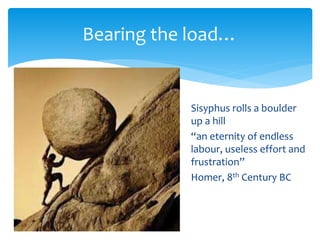
Bearing the load… 
Sisyphus rolls a boulder 
up a hill 
“an eternity of endless 
labour, useless effort and 
frustration” 
Homer, 8th Century BC
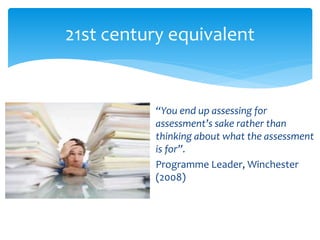
21st century equivalent 
“You end up assessing for 
assessment’s sake rather than 
thinking about what the assessment 
is for”. 
Programme Leader, Winchester 
(2008)
Why do formative assessment? 
“Feedback is the single most influential factor in 
student learning” (Hattie 2009). 
“Innovations that include strengthening the practice 
of formative assessment produce significant and 
often substantial learning gains” (Black and Wiliam, 
1998, p.40).
Why formative matters 
1) Because it provides low-risk, more frequent opportunities 
for students to learn from feedback (Sadler, 1989) 
2) Because it helps students to fine-tune and understand 
requirements and standards (Boud 2000, Nicol, 2006) 
3) Because feedback to lecturers from formative tasks helps 
to adapt teaching (Hattie, 2009) 
4) Because it engages students in cycles of reflection and 
collaboration (Biggs 2003; Nicol & McFarlane Dick 2006) 
5) Because it encourages and distributes student effort 
(Gibbs 2004).
Why students say it matters 
 It was really useful. We were assessed on it but we weren’t officially 
given a grade, but they did give us feedback on how we did. 
 It didn’t actually count so that helped quite a lot because it was just a 
practice and didn’t really matter what we did and we could learn from 
mistakes so that was quite useful. 
 Getting feedback from other students in my class helps. I can relate to 
what they’re saying and take it on board. I’d just shut down if I was 
getting constant feedback from my lecturer. 
 I find more helpful the feedback you get in informal ways week by 
week, but there are some people who just hammer on about what will 
get them a better mark.
Why it matters to students 
 He’s such a better essay writer because he’s constantly writing. 
And we don’t, especially in the first year when we really don’t have 
anything to do. The amount of times formative assignments could 
have taken place… 
 The more you write the better you become at it. It only comes 
through practice and in the end if we’ve only written 40 pieces 
over three years that’s not a lot. 
 So you could have a great time doing nothing until like a month 
before Christmas and you’d suddenly panic. I prefer steady 
deadlines, there’s a gradual move forward, rather than bam!
What is formative assessment?
Definitions of formative assessment 
 “Definitional fuzziness” Mantz Yorke (2003) 
 Basic idea is simple – to contribute to student learning 
through the provision of information about 
performance (Yorke, 2003). 
 A fine tuning mechanism for how and what we learn 
(Boud 2000)
Defining formative (2) 
 Formative assessment is concerned with how judgements 
about the quality of student responses can be used to 
shape and improve students’ competence by short-circuiting 
the randomness and inefficiency of trial-and-error 
learning” (Sadler, 1989, p.120). 
 TESTA – ungraded, required, eliciting feedback
Why we struggle to do formative
Theory 1: Content drives our view of 
curriculum
A student’s lecture to professors 
The best approach from the student’s perspective is to focus on 
concepts. I’m sorry to break it to you, but your students are not 
going to remember 90 per cent – possibly 99 per cent – of what 
you teach them unless it’s conceptual…. when broad, over-arching 
connections are made, education occurs. Most details 
are only a necessary means to that end. 
http://www.timeshighereducation.co.uk/features/a-students-lecture- 
to-professors/2013238.fullarticle#.U3orx_f9xWc.twitter
Theory 2: Summative competes for 
time and effort with formative
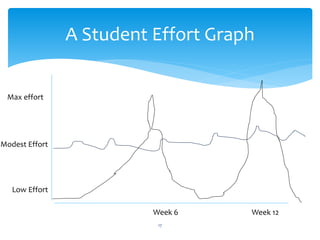
If there weren’t loads of other assessments, I’d do it. 
Unless I find it interesting I will rarely do anything else on it 
because I haven’t got the time. Even though I haven’t anything 
to do, I don’t have the time, I have jobs to do and I have to go to 
work and stuff. 
“I’m sorry, but we can’t afford to stay here. We’re off to do our 
assignment” (Harland, 2014).
A Student Effort Graph 
Week 6 Week 12 
Max effort 
Modest Effort 
Low Effort 
17
Theory 3: Students are grades-oriented
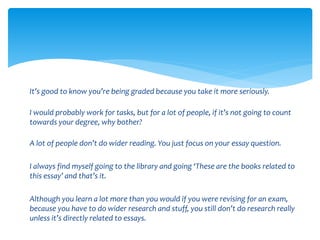
It’s good to know you’re being graded because you take it more seriously. 
I would probably work for tasks, but for a lot of people, if it’s not going to count 
towards your degree, why bother? 
A lot of people don’t do wider reading. You just focus on your essay question. 
I always find myself going to the library and going ‘These are the books related to 
this essay’ and that’s it. 
Although you learn a lot more than you would if you were revising for an exam, 
because you have to do wider research and stuff, you still don’t do research really 
unless it’s directly related to essays.
Theory 4: Academics have competing 
demands
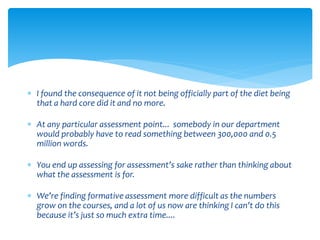
 I found the consequence of it not being officially part of the diet being 
that a hard core did it and no more. 
 At any particular assessment point... somebody in our department 
would probably have to read something between 300,000 and 0.5 
million words. 
 You end up assessing for assessment’s sake rather than thinking about 
what the assessment is for. 
 We’re finding formative assessment more difficult as the numbers 
grow on the courses, and a lot of us now are thinking I can’t do this 
because it’s just so much extra time....
Summary of TESTA evidence about 
missing formative assessment 
1) Competes for time and effort with summative 
assessment 
2) The volume of summative assessment squeezes out 
formative 
3) Modules and semesters 
4) Marks driven culture, weak theory and rationale for 
formative among students and lecturers 
5) It’s not required.
Why summative can’t do the 
same job as formative 
 Grades …the administrative device that actively diverted 
students from really learning anything (Becker, 1968). 
 Feedback on summative tasks is more readily dismissed 
when there is a grade (Black and William 1998, Orrell 2006, 
Taras 2002; 2008). 
 Timing of summative tasks, often too late to act on 
feedback.
Good cop, bad cop?
Good cop, bad cop? 
 Assessment of, for or as learning 
 Different functions, some overlaps 
 False dichotomy is unhelpful 
 Rebuilding formative-summative relationship 
 Linked, integrated, multi-stage assessment
Ten principles for making formative 
1) Align it with summative tasks – multi-stage, linked, 
integrated 
2) The value of feedback feeding forward 
3) Set formative tasks in the public domain 
4) Set the tone in first year 
5) Adopt a whole programme approach 
6) Habituate students to peer review 
7) Taking risks and providing rationale to students 
8) Real world tasks, authentic, linked to previous and own 
experience 
9) Research based tasks 
10) Group accountability 
work
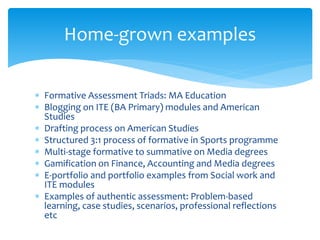
Home-grown examples 
 Formative Assessment Triads: MA Education 
 Blogging on ITE (BA Primary) modules and American 
Studies 
 Drafting process on American Studies 
 Structured 3:1 process of formative in Sports programme 
 Multi-stage formative to summative on Media degrees 
 Gamification on Finance, Accounting and Media degrees 
 E-portfolio and portfolio examples from Social work and 
ITE modules 
 Examples of authentic assessment: Problem-based 
learning, case studies, scenarios, professional reflections 
etc
References 
Becker, H. (1968) Making the grade: the academic side of college life. 
Boud, D. (2000) Sustainable Assessment: Rethinking assessment for the learning society, Studies in 
Continuing Education, 22: 2, 151 — 167. 
Gibbs, G. & Simpson, C. (2004) Conditions under which assessment supports students' learning. Learning 
and Teaching in Higher Education. 1(1): 3-31. 
Hattie, J. (2007) The Power of Feedback. Review of Educational Research. 77(1) 81-112. 
Harland, T. et al. (2014) An Assessment Arms Race and its fallout: high-stakes grading and the case for 
slow scholarship. Assessment and Evaluation inn Higher Education. 
http://www.tandfonline.com/doi/abs/10.1080/02602938.2014.931927 
Nicol, D. J. and McFarlane-Dick, D. (2006) Formative Assessment and Self-Regulated Learning: A Model 
and Seven Principles of Good Feedback Practice. Studies in Higher Education. 31(2): 199-218. 
Jessop, T. , El Hakim, Y. and Gibbs, G. (2013) The whole is greater than the sum of its parts: a large-scale 
study of students’ learning in response to different assessment patterns. Assessment and Evaluation in 
Higher Education. ifirst. 
Jessop, T, McNab, N and Gubby, L. (2012) Mind the gap: An analysis of how quality assurance processes 
influence programme assessment patterns. Active Learning in Higher Education. 13(3). 143-154. 
Sadler, D.R. (1989) Formative assessment and the design of instructional systems, Instructional Science, 
18, 119-144. 
Yorke, M. (2003) Formative assessment in higher education: Moves towards theory and the 
enhancement of pedagogic practice. Higher Education. 45

Why formative? What is it? Why doesn't it work? How can we do it better?

  • 1.
    Why formative? Whatis it? Why doesn’t it work ? How can we do formative better? Dr Tansy Jessop Head of L&T, University of Winchester Programme Leaders’ Forum 1 October 2014
  • 2.
    Bearing the load… Sisyphus rolls a boulder up a hill “an eternity of endless labour, useless effort and frustration” Homer, 8th Century BC
  • 3.
    21st century equivalent “You end up assessing for assessment’s sake rather than thinking about what the assessment is for”. Programme Leader, Winchester (2008)
  • 4.
    Why do formativeassessment? “Feedback is the single most influential factor in student learning” (Hattie 2009). “Innovations that include strengthening the practice of formative assessment produce significant and often substantial learning gains” (Black and Wiliam, 1998, p.40).
  • 5.
    Why formative matters 1) Because it provides low-risk, more frequent opportunities for students to learn from feedback (Sadler, 1989) 2) Because it helps students to fine-tune and understand requirements and standards (Boud 2000, Nicol, 2006) 3) Because feedback to lecturers from formative tasks helps to adapt teaching (Hattie, 2009) 4) Because it engages students in cycles of reflection and collaboration (Biggs 2003; Nicol & McFarlane Dick 2006) 5) Because it encourages and distributes student effort (Gibbs 2004).
  • 6.
    Why students sayit matters  It was really useful. We were assessed on it but we weren’t officially given a grade, but they did give us feedback on how we did.  It didn’t actually count so that helped quite a lot because it was just a practice and didn’t really matter what we did and we could learn from mistakes so that was quite useful.  Getting feedback from other students in my class helps. I can relate to what they’re saying and take it on board. I’d just shut down if I was getting constant feedback from my lecturer.  I find more helpful the feedback you get in informal ways week by week, but there are some people who just hammer on about what will get them a better mark.
  • 7.
    Why it mattersto students  He’s such a better essay writer because he’s constantly writing. And we don’t, especially in the first year when we really don’t have anything to do. The amount of times formative assignments could have taken place…  The more you write the better you become at it. It only comes through practice and in the end if we’ve only written 40 pieces over three years that’s not a lot.  So you could have a great time doing nothing until like a month before Christmas and you’d suddenly panic. I prefer steady deadlines, there’s a gradual move forward, rather than bam!
  • 8.
    What is formativeassessment?
  • 9.
    Definitions of formativeassessment  “Definitional fuzziness” Mantz Yorke (2003)  Basic idea is simple – to contribute to student learning through the provision of information about performance (Yorke, 2003).  A fine tuning mechanism for how and what we learn (Boud 2000)
  • 10.
    Defining formative (2)  Formative assessment is concerned with how judgements about the quality of student responses can be used to shape and improve students’ competence by short-circuiting the randomness and inefficiency of trial-and-error learning” (Sadler, 1989, p.120).  TESTA – ungraded, required, eliciting feedback
  • 11.
    Why we struggleto do formative
  • 12.
    Theory 1: Contentdrives our view of curriculum
  • 14.
    A student’s lectureto professors The best approach from the student’s perspective is to focus on concepts. I’m sorry to break it to you, but your students are not going to remember 90 per cent – possibly 99 per cent – of what you teach them unless it’s conceptual…. when broad, over-arching connections are made, education occurs. Most details are only a necessary means to that end. http://www.timeshighereducation.co.uk/features/a-students-lecture- to-professors/2013238.fullarticle#.U3orx_f9xWc.twitter
  • 15.
    Theory 2: Summativecompetes for time and effort with formative
  • 16.
    If there weren’tloads of other assessments, I’d do it. Unless I find it interesting I will rarely do anything else on it because I haven’t got the time. Even though I haven’t anything to do, I don’t have the time, I have jobs to do and I have to go to work and stuff. “I’m sorry, but we can’t afford to stay here. We’re off to do our assignment” (Harland, 2014).
  • 17.
    A Student EffortGraph Week 6 Week 12 Max effort Modest Effort Low Effort 17
  • 18.
    Theory 3: Studentsare grades-oriented
  • 19.
    It’s good toknow you’re being graded because you take it more seriously. I would probably work for tasks, but for a lot of people, if it’s not going to count towards your degree, why bother? A lot of people don’t do wider reading. You just focus on your essay question. I always find myself going to the library and going ‘These are the books related to this essay’ and that’s it. Although you learn a lot more than you would if you were revising for an exam, because you have to do wider research and stuff, you still don’t do research really unless it’s directly related to essays.
  • 20.
    Theory 4: Academicshave competing demands
  • 21.
     I foundthe consequence of it not being officially part of the diet being that a hard core did it and no more.  At any particular assessment point... somebody in our department would probably have to read something between 300,000 and 0.5 million words.  You end up assessing for assessment’s sake rather than thinking about what the assessment is for.  We’re finding formative assessment more difficult as the numbers grow on the courses, and a lot of us now are thinking I can’t do this because it’s just so much extra time....
  • 22.
    Summary of TESTAevidence about missing formative assessment 1) Competes for time and effort with summative assessment 2) The volume of summative assessment squeezes out formative 3) Modules and semesters 4) Marks driven culture, weak theory and rationale for formative among students and lecturers 5) It’s not required.
  • 23.
    Why summative can’tdo the same job as formative  Grades …the administrative device that actively diverted students from really learning anything (Becker, 1968).  Feedback on summative tasks is more readily dismissed when there is a grade (Black and William 1998, Orrell 2006, Taras 2002; 2008).  Timing of summative tasks, often too late to act on feedback.
  • 24.
  • 25.
    Good cop, badcop?  Assessment of, for or as learning  Different functions, some overlaps  False dichotomy is unhelpful  Rebuilding formative-summative relationship  Linked, integrated, multi-stage assessment
  • 26.
    Ten principles formaking formative 1) Align it with summative tasks – multi-stage, linked, integrated 2) The value of feedback feeding forward 3) Set formative tasks in the public domain 4) Set the tone in first year 5) Adopt a whole programme approach 6) Habituate students to peer review 7) Taking risks and providing rationale to students 8) Real world tasks, authentic, linked to previous and own experience 9) Research based tasks 10) Group accountability work
  • 27.
    Home-grown examples Formative Assessment Triads: MA Education  Blogging on ITE (BA Primary) modules and American Studies  Drafting process on American Studies  Structured 3:1 process of formative in Sports programme  Multi-stage formative to summative on Media degrees  Gamification on Finance, Accounting and Media degrees  E-portfolio and portfolio examples from Social work and ITE modules  Examples of authentic assessment: Problem-based learning, case studies, scenarios, professional reflections etc
  • 28.
    References Becker, H.(1968) Making the grade: the academic side of college life. Boud, D. (2000) Sustainable Assessment: Rethinking assessment for the learning society, Studies in Continuing Education, 22: 2, 151 — 167. Gibbs, G. & Simpson, C. (2004) Conditions under which assessment supports students' learning. Learning and Teaching in Higher Education. 1(1): 3-31. Hattie, J. (2007) The Power of Feedback. Review of Educational Research. 77(1) 81-112. Harland, T. et al. (2014) An Assessment Arms Race and its fallout: high-stakes grading and the case for slow scholarship. Assessment and Evaluation inn Higher Education. http://www.tandfonline.com/doi/abs/10.1080/02602938.2014.931927 Nicol, D. J. and McFarlane-Dick, D. (2006) Formative Assessment and Self-Regulated Learning: A Model and Seven Principles of Good Feedback Practice. Studies in Higher Education. 31(2): 199-218. Jessop, T. , El Hakim, Y. and Gibbs, G. (2013) The whole is greater than the sum of its parts: a large-scale study of students’ learning in response to different assessment patterns. Assessment and Evaluation in Higher Education. ifirst. Jessop, T, McNab, N and Gubby, L. (2012) Mind the gap: An analysis of how quality assurance processes influence programme assessment patterns. Active Learning in Higher Education. 13(3). 143-154. Sadler, D.R. (1989) Formative assessment and the design of instructional systems, Instructional Science, 18, 119-144. Yorke, M. (2003) Formative assessment in higher education: Moves towards theory and the enhancement of pedagogic practice. Higher Education. 45