


UNIVERSITY OF
THE EAST CALOOCAN
Bachelor of Science in Hotel and
Restaurant Management
PDR 101
(Personality Development)
The totality of
qualities and
traits, as of
character or
behavior, that
are peculiar to a
specific person.
PERSONALITY
Personality has two common
meanings:
• The first meaning refers to the
impression a person makes on
others.
• The second meaning refers to the
unseen structures and processes
inside a person that explain why
we behave the way we do.
PERSONALITY
DETERMINANTS OF
PERSONALITY
• Biological Factors
• Cultural Factors
• Family Factors
• Social Factors
• Situational Factors
BIOLOGICAL FACTORS
• Biological factors are a variety of
extracellular substances that are not
otherwise classified under
ENZYMES; HORMONES or
HORMONE ANTAGONISTS
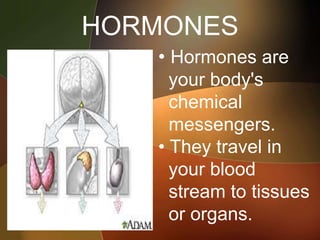
HORMONES
• Hormones are
your body's
chemical
messengers.
• They travel in
your blood
stream to tissues
or organs.
Cont. HORMONES
• They work slowly, over time, and
affect many different processes,
including:
1. Growth and Development
2. Metabolism - how your body gets
energy from the foods you eat
3. Sexual function
4. Reproduction
5. Mood
ENZYMES
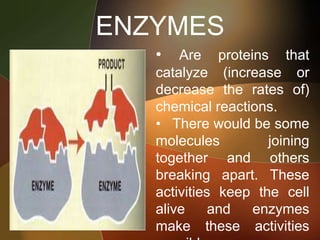
• Are proteins that
catalyze (increase or
decrease the rates of)
chemical reactions.
• There would be some
molecules joining
together and others
breaking apart. These
activities keep the cell
alive and enzymes
make these activities
BIOLOGICAL FACTORS
• HEREDITY
• BRAIN
• BIOFEEDBACK
• PHYSICAL FEATURES
HEREDITY
• It refers to physical
stature, facial
attractiveness, sex,
temperament, muscle
composition and
reflexes, energy level,
and biological rhythms
are characteristics that
are considered to be
inherent.
CHROMOSOMES
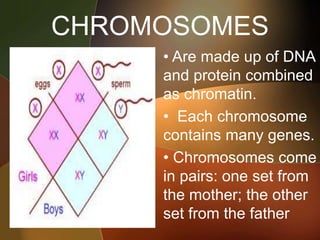
• Are made up of DNA
and protein combined
as chromatin.
• Each chromosome
contains many genes.
• Chromosomes come
in pairs: one set from
the mother; the other
set from the father
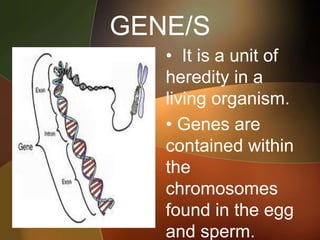
GENE/S
• It is a unit of
heredity in a
living organism.
• Genes are
contained within
the
chromosomes
found in the egg
and sperm.
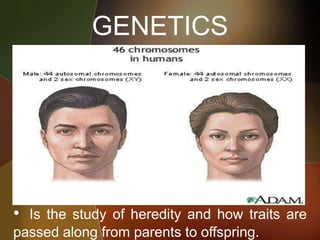
GENETICS
• Is the study of heredity and how traits are
passed along from parents to offspring.
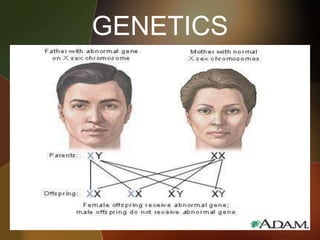
GENETICS
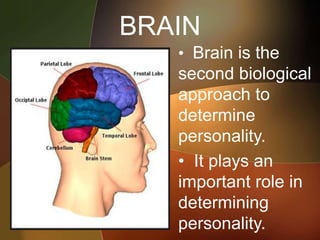
BRAIN
• Brain is the
second biological
approach to
determine
personality.
• It plays an
important role in
determining
personality.
Cont. BRAIN
• Electrical Stimulation of the Brain
(ESB) and Split brain psychology
results indicates that a better
understanding of human personality
and behavior might come from a
closer study of the brain.
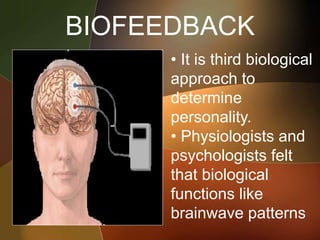
BIOFEEDBACK
• It is third biological
approach to
determine
personality.
• Physiologists and
psychologists felt
that biological
functions like
brainwave patterns
Cont. BIOFEEDBACK
gastric and hormonal secretions, and
fluctuations in blood pressure and
skin temperature were beyond conscious
control.
• For this purpose, individual can learns
the internal rhythms of a particular body
process through electronic signals that
are feedback from equipment which is
wired to body.
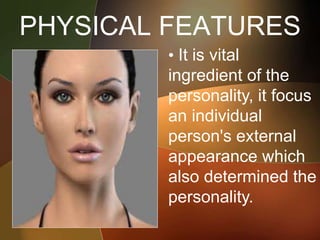
PHYSICAL FEATURES
• It is vital
ingredient of the
personality, it focus
an individual
person's external
appearance which
also determined the
personality.
Cont. PHYSICAL
FEATURES• Physical features like tall or short,
fat or skinny, black or white.
• These physical features will be
influenced the personal effect on
others and also affect self concept
of individual.
CULTURAL FACTORS
• It refers to traditional practice, customs,
procedure, norms and rules and
regulation followed by the society.
• Cultural factors determine attitudes
towards independence, aggression,
competition, cooperation, positive
thinking, team spirit, and a host of the
human being and discharge his/her
duties towards valuable responsibilities
to society.
FAMILY FACTORS
• Family factors are also major factors
which influence to determine individual
personality.
• Family consists of husband and wife and
their children's. Family role is very
important for nurturing and personality
development of their children.
• Family either directly or indirectly
influence to person for development of
individual personality.
SOCIAL FACTORS
• It refers to acquiring of wide range of
personality by acquiring and absorbed by
themselves in the society or an
organization. Socialization process is
starting from home and extending to work
environment in an organization or society.
• It focuses on good relationships,
cooperation, coordination and interaction
among the members in the society or an
organization or a family.
SITUATIONAL FACTORS
• Situational factors are very important to
change the individual behavior in a
different circumstance at different
situations, it also influence to personality
of individual person.
• In general term, personality is stable
and consistent and it does change in
different situations.
PERSONALITY TYPES
• Refers to the psychological
classification of different types of
individuals.
• Personality types are sometimes
distinguished from personality traits,
with the latter embodying a smaller
grouping of behavioral tendencies.
4 MAJOR PERSONALITY
TYPES
1. EXTRAVERTED
2. INTROVERTED
3. THINKERS
4. FEELERS
EXTRAVERTED
• Extraversion is a preference to focus on
the world outside the self. Extraverts enjoy
social interactions and tend to be
enthusiastic, verbal, assertive, and
animated.
• They enjoy large social gatherings, such
as parties and any kind of group activity.
Extraverts are likely to enjoy time spent
with people and find themselves energized
by social interaction.
EXTRAVERT
CHARACTERISTICS
• Sociable / Outgoing
• Confident
• Talkative
• Energized by interaction
• Expressive & enthusiastic
• Volunteers
• Has many friends
EXTRAVERTED
PERSONALITY TYPES
• Overseer
• Persuader
• Supporter
• Entertainer
• Chief
• Originator
• Mentor
• Advocate
INTROVERTED
• Introversion is a preference to focus
on the world inside the self. Introverts
tend to be quiet, peaceful and deliberate
and are not attracted to social
interactions.
• They prefer activities they can do
alone or with one other close friend,
activities such as reading, writing,
thinking, and inventing.
INTROVERT
CHARACTERISTICS
• Private
• Quiet
• Fewer friends
• Prefer smaller groups
• Independent
• Not socially inclined
• Enjoys solitude
• Thinks before speaking
INTROVERTED TYPE
• Examiner
• Craftsman
• Artist
• Strategist
• Engineer
• Confidant
• Dreamer
THINKER/S
• Thinking refers to how people
make decisions.
• Thinking people are objective and
make decisions based on facts.
• They are ruled by their head
instead of their heart. Thinking
people judge situations and others
based on logic.
THINKING
CHARACTERISTICS
• Logical
• Objective
• Wants truth
• Rational
• Impersonal
• Critical
• Thick-skinned
• Driven by thought
THINKING
PERSONALITY TYPES
• Overseer
• Persuader
• Supporter
• Entertainer
• Chief
• Originator
• Mentor
• Advocate
FEELER/S
• Feeling refers to how people make
decisions.
• Feeling people are subjective and
make decisions based on principles
and values. They are ruled by their
heart instead of their head.
• Feeling people judge situations
and others based on feelings and
extenuating circumstances
FEELING
CHARACTERISTICS
• Decides with heart
• Dislikes conflict
• Passionate
• Driven by emotion
• Gentle
• Easily hurt
• Empathetic
• Caring of others
• Warm
FEELING PERSONALITY
TYPES
• Supporter
• Entertainer
• Mentor
• Advocate
• Defender
• Artist
• Confidant
• Dreamer
TRAITS
• Traits refer to regularities or
trends in a person’s behavior.
• The trait approach to
personality maintains that people
behave the way they do because
of the strength of the traits they
possess.
PERSONA
• The persona is the public face
(mask) one presents to the world for
everyone else to see.
• Sometimes the persona is
referred to as the "social archetype"
since it involves all the compromises
appropriate to living in a community.
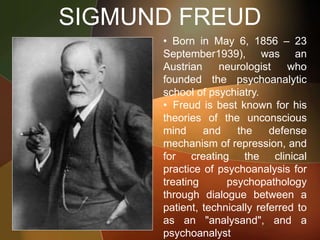
SIGMUND FREUD
• Born in May 6, 1856 – 23
September1939), was an
Austrian neurologist who
founded the psychoanalytic
school of psychiatry.
• Freud is best known for his
theories of the unconscious
mind and the defense
mechanism of repression, and
for creating the clinical
practice of psychoanalysis for
treating psychopathology
through dialogue between a
patient, technically referred to
as an "analysand", and a
psychoanalyst
ID
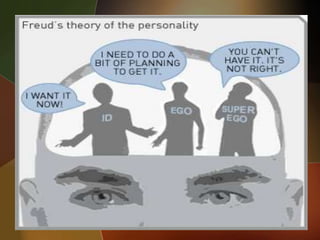
• The id represents a constant in
the personality as it is always
present.
• The id is governed by the
"pleasure principle". Early in the
development of his theory Freud
saw sexual energy as the only
source of energy for the id.
EGO
• The ego is the surface of the
personality, the part you show the
world. It is governed by the "reality
principle," or a pragmatic approach
to the world.
• Id desires are still present, but
the ego realizes the consequences
of committing a crime.
SUPER-EGO
• The superego consists of two parts,
the conscience and the ego-ideal.
• The conscience is the familiar
metaphor of angel and devil on each
shoulder. The conscience decides what
course of action one should take.
• The ego-ideal is an idealized view of
one's self. Comparisons are made
between the ego-ideal and one's actual
behavior.
6 FOUNDATIONS OF
PERSONALITY
1. Mental
2. Emotional
3. Social
4. Physical
5. Moral
6. Spiritual
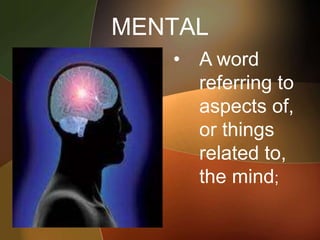
MENTAL
• A word
referring to
aspects of,
or things
related to,
the mind;
MENTAL
Mental mechanisms. Mental mechanisms
perform basic psychological functions
necessary to the operation of more complex
aspects of personality. They employ multiple
smaller operations, often at a psycho-
neurological level to perform their task.
Mental models. Mental models are
representations about a particular topic or
subject. The subject of mental models often
involves aspects of the self (e.g., self-
concept in regard to spelling), and aspects of
the world
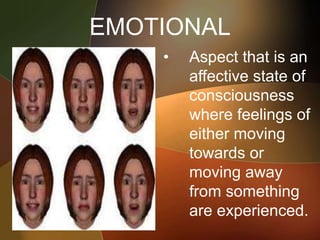
EMOTIONAL
• Aspect that is an
affective state of
consciousness
where feelings of
either moving
towards or
moving away
from something
are experienced.
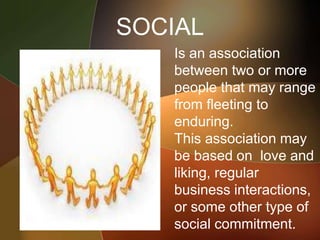
SOCIAL
• Is an association
between two or more
people that may range
from fleeting to
enduring.
• This association may
be based on love and
liking, regular
business interactions,
or some other type of
social commitment.
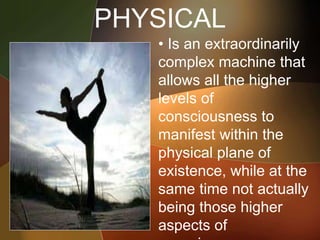
PHYSICAL
• Is an extraordinarily
complex machine that
allows all the higher
levels of
consciousness to
manifest within the
physical plane of
existence, while at the
same time not actually
being those higher
aspects of
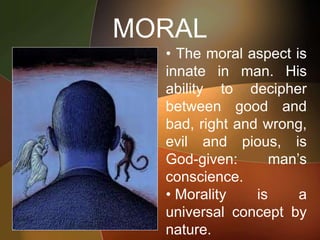
MORAL
• The moral aspect is
innate in man. His
ability to decipher
between good and
bad, right and wrong,
evil and pious, is
God-given: man’s
conscience.
• Morality is a
universal concept by
nature.
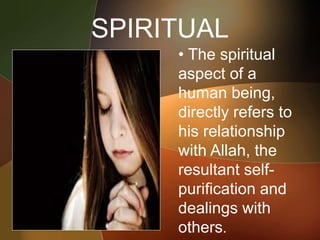
SPIRITUAL
• The spiritual
aspect of a
human being,
directly refers to
his relationship
with Allah, the
resultant self-
purification and
dealings with
others.
Cont. SPIRITUAL
• This is a constant, on-going
battle against Satan, in order to
protect oneself from the evil that
lurks around us, and remain
conscious of God Almighty at all
times and under all circumstances.

PERSONALITY

  • 1.
    UNIVERSITY OF THE EASTCALOOCAN Bachelor of Science in Hotel and Restaurant Management PDR 101 (Personality Development)
  • 4.
    The totality of qualitiesand traits, as of character or behavior, that are peculiar to a specific person. PERSONALITY
  • 5.
    Personality has twocommon meanings: • The first meaning refers to the impression a person makes on others. • The second meaning refers to the unseen structures and processes inside a person that explain why we behave the way we do. PERSONALITY
  • 6.
    DETERMINANTS OF PERSONALITY • BiologicalFactors • Cultural Factors • Family Factors • Social Factors • Situational Factors
  • 7.
    BIOLOGICAL FACTORS • Biologicalfactors are a variety of extracellular substances that are not otherwise classified under ENZYMES; HORMONES or HORMONE ANTAGONISTS
  • 8.
    HORMONES • Hormones are yourbody's chemical messengers. • They travel in your blood stream to tissues or organs.
  • 9.
    Cont. HORMONES • Theywork slowly, over time, and affect many different processes, including: 1. Growth and Development 2. Metabolism - how your body gets energy from the foods you eat 3. Sexual function 4. Reproduction 5. Mood
  • 10.
    ENZYMES • Are proteinsthat catalyze (increase or decrease the rates of) chemical reactions. • There would be some molecules joining together and others breaking apart. These activities keep the cell alive and enzymes make these activities
  • 11.
    BIOLOGICAL FACTORS • HEREDITY •BRAIN • BIOFEEDBACK • PHYSICAL FEATURES
  • 12.
    HEREDITY • It refersto physical stature, facial attractiveness, sex, temperament, muscle composition and reflexes, energy level, and biological rhythms are characteristics that are considered to be inherent.
  • 13.
    CHROMOSOMES • Are madeup of DNA and protein combined as chromatin. • Each chromosome contains many genes. • Chromosomes come in pairs: one set from the mother; the other set from the father
  • 14.
    GENE/S • It isa unit of heredity in a living organism. • Genes are contained within the chromosomes found in the egg and sperm.
  • 15.
    GENETICS • Is thestudy of heredity and how traits are passed along from parents to offspring.
  • 16.
  • 17.
    BRAIN • Brain isthe second biological approach to determine personality. • It plays an important role in determining personality.
  • 18.
    Cont. BRAIN • ElectricalStimulation of the Brain (ESB) and Split brain psychology results indicates that a better understanding of human personality and behavior might come from a closer study of the brain.
  • 19.
    BIOFEEDBACK • It isthird biological approach to determine personality. • Physiologists and psychologists felt that biological functions like brainwave patterns
  • 20.
    Cont. BIOFEEDBACK gastric andhormonal secretions, and fluctuations in blood pressure and skin temperature were beyond conscious control. • For this purpose, individual can learns the internal rhythms of a particular body process through electronic signals that are feedback from equipment which is wired to body.
  • 21.
    PHYSICAL FEATURES • Itis vital ingredient of the personality, it focus an individual person's external appearance which also determined the personality.
  • 22.
    Cont. PHYSICAL FEATURES• Physicalfeatures like tall or short, fat or skinny, black or white. • These physical features will be influenced the personal effect on others and also affect self concept of individual.
  • 23.
    CULTURAL FACTORS • Itrefers to traditional practice, customs, procedure, norms and rules and regulation followed by the society. • Cultural factors determine attitudes towards independence, aggression, competition, cooperation, positive thinking, team spirit, and a host of the human being and discharge his/her duties towards valuable responsibilities to society.
  • 24.
    FAMILY FACTORS • Familyfactors are also major factors which influence to determine individual personality. • Family consists of husband and wife and their children's. Family role is very important for nurturing and personality development of their children. • Family either directly or indirectly influence to person for development of individual personality.
  • 25.
    SOCIAL FACTORS • Itrefers to acquiring of wide range of personality by acquiring and absorbed by themselves in the society or an organization. Socialization process is starting from home and extending to work environment in an organization or society. • It focuses on good relationships, cooperation, coordination and interaction among the members in the society or an organization or a family.
  • 26.
    SITUATIONAL FACTORS • Situationalfactors are very important to change the individual behavior in a different circumstance at different situations, it also influence to personality of individual person. • In general term, personality is stable and consistent and it does change in different situations.
  • 28.
    PERSONALITY TYPES • Refersto the psychological classification of different types of individuals. • Personality types are sometimes distinguished from personality traits, with the latter embodying a smaller grouping of behavioral tendencies.
  • 29.
    4 MAJOR PERSONALITY TYPES 1.EXTRAVERTED 2. INTROVERTED 3. THINKERS 4. FEELERS
  • 30.
    EXTRAVERTED • Extraversion isa preference to focus on the world outside the self. Extraverts enjoy social interactions and tend to be enthusiastic, verbal, assertive, and animated. • They enjoy large social gatherings, such as parties and any kind of group activity. Extraverts are likely to enjoy time spent with people and find themselves energized by social interaction.
  • 31.
    EXTRAVERT CHARACTERISTICS • Sociable /Outgoing • Confident • Talkative • Energized by interaction • Expressive & enthusiastic • Volunteers • Has many friends
  • 32.
    EXTRAVERTED PERSONALITY TYPES • Overseer •Persuader • Supporter • Entertainer • Chief • Originator • Mentor • Advocate
  • 33.
    INTROVERTED • Introversion isa preference to focus on the world inside the self. Introverts tend to be quiet, peaceful and deliberate and are not attracted to social interactions. • They prefer activities they can do alone or with one other close friend, activities such as reading, writing, thinking, and inventing.
  • 34.
    INTROVERT CHARACTERISTICS • Private • Quiet •Fewer friends • Prefer smaller groups • Independent • Not socially inclined • Enjoys solitude • Thinks before speaking
  • 35.
    INTROVERTED TYPE • Examiner •Craftsman • Artist • Strategist • Engineer • Confidant • Dreamer
  • 36.
    THINKER/S • Thinking refersto how people make decisions. • Thinking people are objective and make decisions based on facts. • They are ruled by their head instead of their heart. Thinking people judge situations and others based on logic.
  • 37.
    THINKING CHARACTERISTICS • Logical • Objective •Wants truth • Rational • Impersonal • Critical • Thick-skinned • Driven by thought
  • 38.
    THINKING PERSONALITY TYPES • Overseer •Persuader • Supporter • Entertainer • Chief • Originator • Mentor • Advocate
  • 39.
    FEELER/S • Feeling refersto how people make decisions. • Feeling people are subjective and make decisions based on principles and values. They are ruled by their heart instead of their head. • Feeling people judge situations and others based on feelings and extenuating circumstances
  • 40.
    FEELING CHARACTERISTICS • Decides withheart • Dislikes conflict • Passionate • Driven by emotion • Gentle • Easily hurt • Empathetic • Caring of others • Warm
  • 41.
    FEELING PERSONALITY TYPES • Supporter •Entertainer • Mentor • Advocate • Defender • Artist • Confidant • Dreamer
  • 43.
    TRAITS • Traits referto regularities or trends in a person’s behavior. • The trait approach to personality maintains that people behave the way they do because of the strength of the traits they possess.
  • 44.
    PERSONA • The personais the public face (mask) one presents to the world for everyone else to see. • Sometimes the persona is referred to as the "social archetype" since it involves all the compromises appropriate to living in a community.
  • 47.
    SIGMUND FREUD • Bornin May 6, 1856 – 23 September1939), was an Austrian neurologist who founded the psychoanalytic school of psychiatry. • Freud is best known for his theories of the unconscious mind and the defense mechanism of repression, and for creating the clinical practice of psychoanalysis for treating psychopathology through dialogue between a patient, technically referred to as an "analysand", and a psychoanalyst
  • 48.
    ID • The idrepresents a constant in the personality as it is always present. • The id is governed by the "pleasure principle". Early in the development of his theory Freud saw sexual energy as the only source of energy for the id.
  • 49.
    EGO • The egois the surface of the personality, the part you show the world. It is governed by the "reality principle," or a pragmatic approach to the world. • Id desires are still present, but the ego realizes the consequences of committing a crime.
  • 50.
    SUPER-EGO • The superegoconsists of two parts, the conscience and the ego-ideal. • The conscience is the familiar metaphor of angel and devil on each shoulder. The conscience decides what course of action one should take. • The ego-ideal is an idealized view of one's self. Comparisons are made between the ego-ideal and one's actual behavior.
  • 52.
    6 FOUNDATIONS OF PERSONALITY 1.Mental 2. Emotional 3. Social 4. Physical 5. Moral 6. Spiritual
  • 53.
    MENTAL • A word referringto aspects of, or things related to, the mind;
  • 54.
    MENTAL Mental mechanisms. Mentalmechanisms perform basic psychological functions necessary to the operation of more complex aspects of personality. They employ multiple smaller operations, often at a psycho- neurological level to perform their task. Mental models. Mental models are representations about a particular topic or subject. The subject of mental models often involves aspects of the self (e.g., self- concept in regard to spelling), and aspects of the world
  • 55.
    EMOTIONAL • Aspect thatis an affective state of consciousness where feelings of either moving towards or moving away from something are experienced.
  • 56.
    SOCIAL • Is anassociation between two or more people that may range from fleeting to enduring. • This association may be based on love and liking, regular business interactions, or some other type of social commitment.
  • 57.
    PHYSICAL • Is anextraordinarily complex machine that allows all the higher levels of consciousness to manifest within the physical plane of existence, while at the same time not actually being those higher aspects of
  • 58.
    MORAL • The moralaspect is innate in man. His ability to decipher between good and bad, right and wrong, evil and pious, is God-given: man’s conscience. • Morality is a universal concept by nature.
  • 59.
    SPIRITUAL • The spiritual aspectof a human being, directly refers to his relationship with Allah, the resultant self- purification and dealings with others.
  • 60.
    Cont. SPIRITUAL • Thisis a constant, on-going battle against Satan, in order to protect oneself from the evil that lurks around us, and remain conscious of God Almighty at all times and under all circumstances.