PERSONALITY
Dr. S.Nangaiyarkarasi
Assistant professor in Education
VISTAS, Chennai
MEANING
Latin word ‘Persona’ – facial mask
“totality of what a person is “ (physical, psychological as
well as a variety of acquired habitual traits)
Stagnar & Korwaski (1952)
 Personality as a stimulus
 Personality as a response
 Personality as an intervening variable(integrative
approach / adjustment )
DEFINITIONS
Allport (1948)
Personality is a dynamic within the individual of
those psycho-physical systems that determine his
unique adjustment to his environment.
Cattell (1970)
personality is that which permits a prediction of
what a person will do in a given situation.
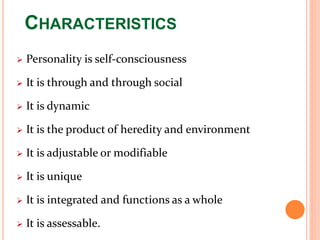
CHARACTERISTICS
 Personality is self-consciousness
 It is through and through social
 It is dynamic
 It is the product of heredity and environment
 It is adjustable or modifiable
 It is unique
 It is integrated and functions as a whole
 It is assessable.
PERSONALITY FACTORS
Biological
 Physique
 Chemique
 Nervous system
Sociological
 Home
 School
 Language
 Culture
Psychological
 Intelligence
 Motivation
 Emotion
 Attitude
 Interest
 sentiment
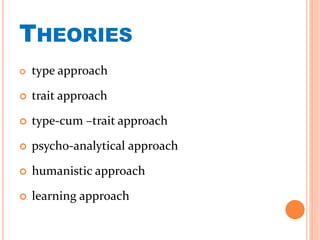
THEORIES
 type approach
 trait approach
 type-cum –trait approach
 psycho-analytical approach
 humanistic approach
 learning approach
THEORIES OF PERSONALITY
 Type Theory
 Trait Theory
 Type cum Trait Theory
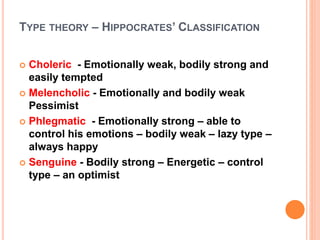
TYPE THEORY – HIPPOCRATES’ CLASSIFICATION
 Choleric - Emotionally weak, bodily strong and
easily tempted
 Melencholic - Emotionally and bodily weak
Pessimist
 Phlegmatic - Emotionally strong – able to
control his emotions – bodily weak – lazy type –
always happy
 Senguine - Bodily strong – Energetic – control
type – an optimist
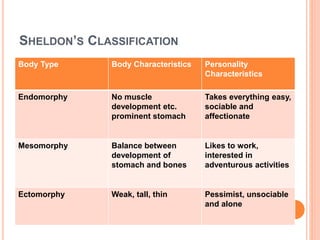
SHELDON’S CLASSIFICATION
Body Type Body Characteristics Personality
Characteristics
Endomorphy No muscle
development etc.
prominent stomach
Takes everything easy,
sociable and
affectionate
Mesomorphy Balance between
development of
stomach and bones
Likes to work,
interested in
adventurous activities
Ectomorphy Weak, tall, thin Pessimist, unsociable
and alone
KRETSCHMER’S CLASSIFICATION
Body Type Body Characteristics Personality
Characteristics
Pyknic Fat types, in whom
fat is more than
muscle
Social and helping to
others
Athletic Healthy, balance
between muscles
and bone
development
Energetic, optimist
can
adjust to any situation
Asthenic Thin, and lean tall,
no muscle, only
bone
Unsociable, shy,
pessimist and always
alone
Carl Jung‘s classification
2 distinct types of personality
 Introvert
 Extrovert
 Ambivert
TRAIT APPROACH
Defined as relatively permanent and
relatively consistent general
behaviour patterns that an individual
exhibits in most situations.
(intelligence, emotional sensitivity,
ascendance, submission, irritability,
warm etc., )
GORDON W. ALLPORT
 Allport & odbert’s (1936) analysis of personality
 Cardinal traits : basic that all of a person’s
activities can be traced back to the trait. pervasive
that virtually every act is traceable to its influence
 Central traits : express dispositions that cover a
more limited range of situations. Core qualities of a
personality
 Secondary dispositions : Inconsistent or
superficial aspects of a person . traits that are the
least conspicuous , generalized , and consistent
CARDINAL TRAIT
 The trait that dominates and shapes a person’s
behavior that they every aspect of one’s behavior.
These are also called primary traits.
 These are limited in number to just one or two.
For e.g : if a person is humorous in nature.
 ABRAHAM LINCOLN ( honest ),MOTHER
TERESA ( religious service )
CENTRAL TRAITS
 This is general characteristic found in some degree
in every person. These are the basic building
blocks that shape most of our behavior .
 FIVE TO TEN central traits in an individual’s
personality
 For e.g. : honesty, kindness etc.
SECONDARY TRAIT
 These are characteristics seen only in certain
circumstances .They must be included to provide a
complete picture of human complexity.
 These are not considered enough and not
dominant characteristics
 Preferences, attitudes, situational traits are all
secondary traits.
 For e.g. : stage fear before speaking at public
CATTELL’S TRAIT APPROACH
Four types of traits
 Common traits : widely distributed in general
population like honesty, aggression, &
cooperation.
 Unique traits : unique, to a person like
temperamental traits, emotional reactions.
 Surface traits : its recognized by manifestations
of behaviour like curiosity, dependability,
tactfulness.
 Source traits : underlying structures like
dominance, submission emotionality, etc.
16 SOURCE TRAITS
 Ability traits : traits that facilitate adaptive
functioning
 Temperament traits : traits that influence emotions
 Dynamic traits : traits that direct motivation
 L-DATA = life record data
Measures of behavior in everyday situations
(school performance)
May be actual counts of behavior or ratings based
on observations
 Q-DATA = self report or questionnaire data
 OT DATA = objective –test data
recording of behavior in situations where
participants are unaware of the relationship
between their responses and a certain trait
(experiment)
The trait of assertiveness can be expressed
behaviorally , such as fast tempo in arm
shoulder movements or fast speed of letter
comparisons
TYPE–CUM-TRAIT APPROACH : EYSENCK’S
THEORY
TRAIT LEVEL
INTROVERSION
PERSISTENCE RIGIDITY SUBJECTIVITY SHYNESS IRRITABILITY
Habitual response level
Specific response level
EYSENCK’S THEORY OF PERSONALITY
INTROVERT
Quiet, introspective, reserved, reflective,
disciplined,& well-ordered people.
EXTROVERT
Sociable, outgoing, impulsive, optimistic, &
jolly people
NEUROTICISM (EMOTIONAL
INSTABLITIY – EMOTIONAL STABILITY )
Emotional instability at the lower level-
Neurotic and moody, touchy, anxious, /
restless
Emotional stability at the upper level-
Not neurotic and stable, calm, carefree,
even-tempered , dependable.
PSYCHOTICISM
High in this dimension
Solitary, insensitive, egocentric, impersonal,
impulsive, opposed to accepted social norms
Low in this dimension
More empathic and less adventurous, bold.
EYSENCK’S CONTRIBUTION
Describing, explaining, and predicting one’s
behaviour and personality are notable.
It is biological-cum-hereditary base, so accepted the
role of environment influences.
Its close focus on individual differences and
principle of behaviour changes.
Contributed to the study of criminology, education,
aesthetics, genetics, psychopathology, & political
ideology.
PSYCHOANALYTICAL APPROACH
 Analysis of the psyche or mind by many new terms
and used psychoanalysis as a method for
understanding behaviour and for treating mental
illness.
 The approach its adopted for understanding
human behaviour and personality is known as the
psycho-analytical approach.
The human mind has three main divisions
namely
Conscious,
Semiconscious / Pre conscious
Unconscious.
Our personality is built round the three
unified and inter-relating systems , namely
Id,
Ego
Superego.
INSTINCTS
Libido – sexual energy – survival of the
individual and human race-oriented towards
growth, development & creativity – Pleasure
principle – goal of life gain pleasure and
avoid pain
Death instinct – accounts for aggressive
drive – to die or to hurt themselves or
others
Sex and aggressive drives-powerful
determinants of peoples actions
3 LEVELS OF AWARENESS
Conscious
Preconscious
Unconscious
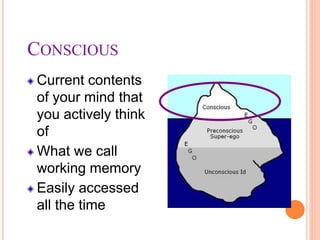
CONSCIOUS
Current contents
of your mind that
you actively think
of
What we call
working memory
Easily accessed
all the time
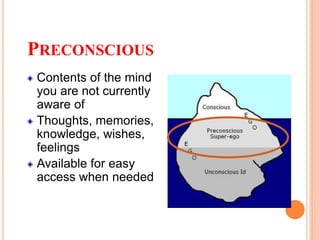
PRECONSCIOUS
Contents of the mind
you are not currently
aware of
Thoughts, memories,
knowledge, wishes,
feelings
Available for easy
access when needed
UNCONSCIOUS
Contents kept out of
conscious awareness
Not accessible at all
Processes that actively
keep these thoughts
from awareness
WHAT IS THE UNCONSCIOUS
 That portion of the mind inaccessible to usual,
conscious thought
 Get to unconscious through Free Association:
spontaneous free flowing associations of ideas
and feelings
FREUDIAN COMPONENTS OF
PERSONALITY
The Id
The Ego
The Superego
ID
Resides completely at the
unconscious level
Acts under the pleasure -seeking
principle
immediate gratification, not
willing to compromise
Generates all of the personality’s
energy
No values, know no laws, follows
no rules, does not recognize right/
wrong
SUPEREGO
 The moralist and idealistic part of the personality
 Resides in preconscious
 Operates on “ideal principle”
 Begins forming at 4-5 yrs of age
 initially formed from environment and others (society,
family etc)
 Internalized conventions and morals
 Essentially your “conscience”
 Perfection rather than pleasure is its goal.
 It is decision making entity which decides what is good /bad to
the social norms
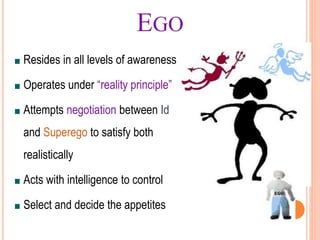
EGO
Resides in all levels of awareness
Operates under “reality principle”
Attempts negotiation between Id
and Superego to satisfy both
realistically
Acts with intelligence to control
Select and decide the appetites
PSYCHOSEXUAL THEORY OF
DEVELOPMENT
ORAL STAGE (First year)
Related to later mistrust and rejection issues
ANAL STAGE (Ages 2-4)
Related to later personal power issues
PHALLIC STAGE (Ages 4-6)
Related to later sexual attitudes
LATENCY STAGE (Ages 5-11)
A time of socialization
GENITAL STAGE (Ages 12-60)
Sexual energies are invested in life
ORAL STAGE: BIRTH TO 2 YEAR
Satisfy drive of hunger and thirst by
breast or bottle
Over Dependency
Over Attachment
“Intake” of interesting
substances/ideas
ANAL STAGE: 2- 4 YEARS
Id wants pleasure of reducing
tension by defecating & urinating
Toilet training – get superego to
impose societal norms
Self-control
Holding back
Freedom of action no control
PHALLIC STAGE: 4 – 6 YEARS
Sexual energy focused on genitals
Differences between boys and
girls
Emerging sexual gender identity
Personality fixed by end of this
stage
OEDIPUS /ELECTRA COMPLEX
A boy’s sexual feeling for his mother and
rivalries with his father
Psychological defenses against these
threatening thoughts and feelings
Form reaction pattern used throughout life
Form personality through identification with
father
Diminish fear of castration-vicariously obtain
mother through father
LATENCY PERIOD 5-11 YEARS OF
AGE
Time between resolution of Oedipus complex and
puberty
Usually not possible for sexual urges to be directly
expressed
Sexual energies are channeled into school and friends
GENITAL STAGE ADOLESCENCE -
ADULTHOOD
Normal sexual relations
Marriage
Child-rearing
Evaluating Freud’s Contributions
Good method for the study of human
behaviour
Highlighted the importance of earlier
childhood experiences.
Discovery of the unconscious & its
importance
To providing the education for mental health
Emphasis on sexual drives is inappropriate
ASSESSMENT OF PERSONALITY
Subjective methods
Objective methods
Projective methods
Perceptive
Apperceptive
Productive
SUBJECTIVE METHODS
 Autobiography
 Self-rating
 Interview
 Personality inventories
 Aptitude tests
 Interest inventories
 Attitude scales
OBJECTIVE METHODS
Observed in the laboratory/everyday situations
RORSCHACH INK-BLOT TEST
SCORING AND ANALYSIS OF RESPONSES
Rorschach Ink-Blot test
Location : it refers to the particular part a blot to which a
single response refers.
W,D, d, S
Determinants : is meant the particular aspect of the blot
which directs the perceptual activity.
M , F , C, K
Content : It refers to the actual meaning of the world.
H , A , Hd , obj , Pl , At
THEMATIC APPERCEPTION TEST
Uses “neutral pictures to elicit
stories “
Beginning, middle end
Look for common themes
Again, looking for normative
Reponses
Relationships/motivations
TAT (THEMATIC
APPERCEPTION TEST)
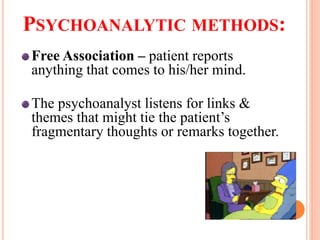
PSYCHOANALYTIC METHODS:
Free Association – patient reports
anything that comes to his/her mind.
The psychoanalyst listens for links &
themes that might tie the patient’s
fragmentary thoughts or remarks together.
SITUATIONAL TESTS
kind of performance test
The subjects are observed in situations
and they do not know that they are being
assessed.
Psychodrama – the individual has to play
a role spontaneously in a situation.
Sociodrama – portrays problems with
which the audience is concerned.
INTEGRATED PERSONALITY
Allport
Self extension
Self objectification
Skinner
Harmonious development of thoughts,
feelings, intention to activity, affection,
sympathy
Confidence in one’s abilities as well as
awareness of one’s weakness

Personality and its theories pptx

  • 1.
  • 2.
    MEANING Latin word ‘Persona’– facial mask “totality of what a person is “ (physical, psychological as well as a variety of acquired habitual traits) Stagnar & Korwaski (1952)  Personality as a stimulus  Personality as a response  Personality as an intervening variable(integrative approach / adjustment )
  • 3.
    DEFINITIONS Allport (1948) Personality isa dynamic within the individual of those psycho-physical systems that determine his unique adjustment to his environment. Cattell (1970) personality is that which permits a prediction of what a person will do in a given situation.
  • 4.
    CHARACTERISTICS  Personality isself-consciousness  It is through and through social  It is dynamic  It is the product of heredity and environment  It is adjustable or modifiable  It is unique  It is integrated and functions as a whole  It is assessable.
  • 5.
    PERSONALITY FACTORS Biological  Physique Chemique  Nervous system Sociological  Home  School  Language  Culture Psychological  Intelligence  Motivation  Emotion  Attitude  Interest  sentiment
  • 6.
    THEORIES  type approach trait approach  type-cum –trait approach  psycho-analytical approach  humanistic approach  learning approach
  • 7.
    THEORIES OF PERSONALITY Type Theory  Trait Theory  Type cum Trait Theory
  • 8.
    TYPE THEORY –HIPPOCRATES’ CLASSIFICATION  Choleric - Emotionally weak, bodily strong and easily tempted  Melencholic - Emotionally and bodily weak Pessimist  Phlegmatic - Emotionally strong – able to control his emotions – bodily weak – lazy type – always happy  Senguine - Bodily strong – Energetic – control type – an optimist
  • 9.
    SHELDON’S CLASSIFICATION Body TypeBody Characteristics Personality Characteristics Endomorphy No muscle development etc. prominent stomach Takes everything easy, sociable and affectionate Mesomorphy Balance between development of stomach and bones Likes to work, interested in adventurous activities Ectomorphy Weak, tall, thin Pessimist, unsociable and alone
  • 10.
    KRETSCHMER’S CLASSIFICATION Body TypeBody Characteristics Personality Characteristics Pyknic Fat types, in whom fat is more than muscle Social and helping to others Athletic Healthy, balance between muscles and bone development Energetic, optimist can adjust to any situation Asthenic Thin, and lean tall, no muscle, only bone Unsociable, shy, pessimist and always alone
  • 11.
    Carl Jung‘s classification 2distinct types of personality  Introvert  Extrovert  Ambivert
  • 12.
    TRAIT APPROACH Defined asrelatively permanent and relatively consistent general behaviour patterns that an individual exhibits in most situations. (intelligence, emotional sensitivity, ascendance, submission, irritability, warm etc., )
  • 13.
    GORDON W. ALLPORT Allport & odbert’s (1936) analysis of personality  Cardinal traits : basic that all of a person’s activities can be traced back to the trait. pervasive that virtually every act is traceable to its influence  Central traits : express dispositions that cover a more limited range of situations. Core qualities of a personality  Secondary dispositions : Inconsistent or superficial aspects of a person . traits that are the least conspicuous , generalized , and consistent
  • 14.
    CARDINAL TRAIT  Thetrait that dominates and shapes a person’s behavior that they every aspect of one’s behavior. These are also called primary traits.  These are limited in number to just one or two. For e.g : if a person is humorous in nature.  ABRAHAM LINCOLN ( honest ),MOTHER TERESA ( religious service )
  • 15.
    CENTRAL TRAITS  Thisis general characteristic found in some degree in every person. These are the basic building blocks that shape most of our behavior .  FIVE TO TEN central traits in an individual’s personality  For e.g. : honesty, kindness etc.
  • 16.
    SECONDARY TRAIT  Theseare characteristics seen only in certain circumstances .They must be included to provide a complete picture of human complexity.  These are not considered enough and not dominant characteristics  Preferences, attitudes, situational traits are all secondary traits.  For e.g. : stage fear before speaking at public
  • 17.
    CATTELL’S TRAIT APPROACH Fourtypes of traits  Common traits : widely distributed in general population like honesty, aggression, & cooperation.  Unique traits : unique, to a person like temperamental traits, emotional reactions.  Surface traits : its recognized by manifestations of behaviour like curiosity, dependability, tactfulness.  Source traits : underlying structures like dominance, submission emotionality, etc.
  • 18.
    16 SOURCE TRAITS Ability traits : traits that facilitate adaptive functioning  Temperament traits : traits that influence emotions  Dynamic traits : traits that direct motivation
  • 19.
     L-DATA =life record data Measures of behavior in everyday situations (school performance) May be actual counts of behavior or ratings based on observations  Q-DATA = self report or questionnaire data  OT DATA = objective –test data recording of behavior in situations where participants are unaware of the relationship between their responses and a certain trait (experiment) The trait of assertiveness can be expressed behaviorally , such as fast tempo in arm shoulder movements or fast speed of letter comparisons
  • 20.
    TYPE–CUM-TRAIT APPROACH :EYSENCK’S THEORY TRAIT LEVEL INTROVERSION PERSISTENCE RIGIDITY SUBJECTIVITY SHYNESS IRRITABILITY Habitual response level Specific response level
  • 21.
    EYSENCK’S THEORY OFPERSONALITY INTROVERT Quiet, introspective, reserved, reflective, disciplined,& well-ordered people. EXTROVERT Sociable, outgoing, impulsive, optimistic, & jolly people
  • 22.
    NEUROTICISM (EMOTIONAL INSTABLITIY –EMOTIONAL STABILITY ) Emotional instability at the lower level- Neurotic and moody, touchy, anxious, / restless Emotional stability at the upper level- Not neurotic and stable, calm, carefree, even-tempered , dependable.
  • 23.
    PSYCHOTICISM High in thisdimension Solitary, insensitive, egocentric, impersonal, impulsive, opposed to accepted social norms Low in this dimension More empathic and less adventurous, bold.
  • 24.
    EYSENCK’S CONTRIBUTION Describing, explaining,and predicting one’s behaviour and personality are notable. It is biological-cum-hereditary base, so accepted the role of environment influences. Its close focus on individual differences and principle of behaviour changes. Contributed to the study of criminology, education, aesthetics, genetics, psychopathology, & political ideology.
  • 25.
    PSYCHOANALYTICAL APPROACH  Analysisof the psyche or mind by many new terms and used psychoanalysis as a method for understanding behaviour and for treating mental illness.  The approach its adopted for understanding human behaviour and personality is known as the psycho-analytical approach.
  • 26.
    The human mindhas three main divisions namely Conscious, Semiconscious / Pre conscious Unconscious. Our personality is built round the three unified and inter-relating systems , namely Id, Ego Superego.
  • 27.
    INSTINCTS Libido – sexualenergy – survival of the individual and human race-oriented towards growth, development & creativity – Pleasure principle – goal of life gain pleasure and avoid pain Death instinct – accounts for aggressive drive – to die or to hurt themselves or others Sex and aggressive drives-powerful determinants of peoples actions
  • 28.
    3 LEVELS OFAWARENESS Conscious Preconscious Unconscious
  • 29.
    CONSCIOUS Current contents of yourmind that you actively think of What we call working memory Easily accessed all the time
  • 30.
    PRECONSCIOUS Contents of themind you are not currently aware of Thoughts, memories, knowledge, wishes, feelings Available for easy access when needed
  • 31.
    UNCONSCIOUS Contents kept outof conscious awareness Not accessible at all Processes that actively keep these thoughts from awareness
  • 32.
    WHAT IS THEUNCONSCIOUS  That portion of the mind inaccessible to usual, conscious thought  Get to unconscious through Free Association: spontaneous free flowing associations of ideas and feelings
  • 33.
  • 34.
    ID Resides completely atthe unconscious level Acts under the pleasure -seeking principle immediate gratification, not willing to compromise Generates all of the personality’s energy No values, know no laws, follows no rules, does not recognize right/ wrong
  • 35.
    SUPEREGO  The moralistand idealistic part of the personality  Resides in preconscious  Operates on “ideal principle”  Begins forming at 4-5 yrs of age  initially formed from environment and others (society, family etc)  Internalized conventions and morals  Essentially your “conscience”  Perfection rather than pleasure is its goal.  It is decision making entity which decides what is good /bad to the social norms
  • 36.
    EGO Resides in alllevels of awareness Operates under “reality principle” Attempts negotiation between Id and Superego to satisfy both realistically Acts with intelligence to control Select and decide the appetites
  • 37.
    PSYCHOSEXUAL THEORY OF DEVELOPMENT ORALSTAGE (First year) Related to later mistrust and rejection issues ANAL STAGE (Ages 2-4) Related to later personal power issues PHALLIC STAGE (Ages 4-6) Related to later sexual attitudes LATENCY STAGE (Ages 5-11) A time of socialization GENITAL STAGE (Ages 12-60) Sexual energies are invested in life
  • 38.
    ORAL STAGE: BIRTHTO 2 YEAR Satisfy drive of hunger and thirst by breast or bottle Over Dependency Over Attachment “Intake” of interesting substances/ideas
  • 39.
    ANAL STAGE: 2-4 YEARS Id wants pleasure of reducing tension by defecating & urinating Toilet training – get superego to impose societal norms Self-control Holding back Freedom of action no control
  • 40.
    PHALLIC STAGE: 4– 6 YEARS Sexual energy focused on genitals Differences between boys and girls Emerging sexual gender identity Personality fixed by end of this stage
  • 41.
    OEDIPUS /ELECTRA COMPLEX Aboy’s sexual feeling for his mother and rivalries with his father Psychological defenses against these threatening thoughts and feelings Form reaction pattern used throughout life Form personality through identification with father Diminish fear of castration-vicariously obtain mother through father
  • 42.
    LATENCY PERIOD 5-11YEARS OF AGE Time between resolution of Oedipus complex and puberty Usually not possible for sexual urges to be directly expressed Sexual energies are channeled into school and friends
  • 43.
    GENITAL STAGE ADOLESCENCE- ADULTHOOD Normal sexual relations Marriage Child-rearing
  • 44.
    Evaluating Freud’s Contributions Goodmethod for the study of human behaviour Highlighted the importance of earlier childhood experiences. Discovery of the unconscious & its importance To providing the education for mental health Emphasis on sexual drives is inappropriate
  • 45.
    ASSESSMENT OF PERSONALITY Subjectivemethods Objective methods Projective methods Perceptive Apperceptive Productive
  • 46.
    SUBJECTIVE METHODS  Autobiography Self-rating  Interview  Personality inventories  Aptitude tests  Interest inventories  Attitude scales OBJECTIVE METHODS Observed in the laboratory/everyday situations
  • 47.
  • 48.
    SCORING AND ANALYSISOF RESPONSES Rorschach Ink-Blot test Location : it refers to the particular part a blot to which a single response refers. W,D, d, S Determinants : is meant the particular aspect of the blot which directs the perceptual activity. M , F , C, K Content : It refers to the actual meaning of the world. H , A , Hd , obj , Pl , At
  • 49.
    THEMATIC APPERCEPTION TEST Uses“neutral pictures to elicit stories “ Beginning, middle end Look for common themes Again, looking for normative Reponses Relationships/motivations
  • 50.
  • 51.
    PSYCHOANALYTIC METHODS: Free Association– patient reports anything that comes to his/her mind. The psychoanalyst listens for links & themes that might tie the patient’s fragmentary thoughts or remarks together.
  • 52.
    SITUATIONAL TESTS kind ofperformance test The subjects are observed in situations and they do not know that they are being assessed. Psychodrama – the individual has to play a role spontaneously in a situation. Sociodrama – portrays problems with which the audience is concerned.
  • 53.
    INTEGRATED PERSONALITY Allport Self extension Selfobjectification Skinner Harmonious development of thoughts, feelings, intention to activity, affection, sympathy Confidence in one’s abilities as well as awareness of one’s weakness