Plasma
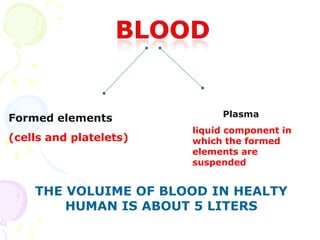
Formed elements
                        liquid component in
(cells and platelets)   which the formed
                        elements are
                        suspended


    THE VOLUIME OF BLOOD IN HEALTY
        HUMAN IS ABOUT 5 LITERS
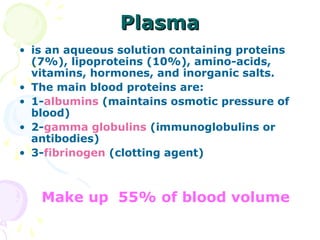
Plasma
• is an aqueous solution containing proteins
  (7%), lipoproteins (10%), amino-acids,
  vitamins, hormones, and inorganic salts.
• The main blood proteins are:
• 1-albumins (maintains osmotic pressure of
  blood)
• 2-gamma globulins (immunoglobulins or
  antibodies)
• 3-fibrinogen (clotting agent)


   Make up 55% of blood volume
• If blood is allowed to clot, the
  clot contains the formed
  elements, whereas the clear
  yellow liquid that separates is
  known as the serum. Serum is
  similar to plasma but lacks
  fibrinogen and other clotting
  agents
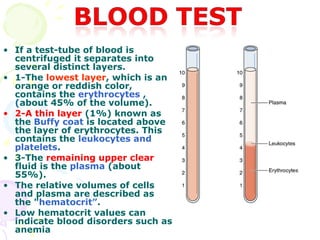
• If a test-tube of blood is
  centrifuged it separates into
  several distinct layers.
• 1-The lowest layer, which is an
  orange or reddish color,
  contains the erythrocytes ,
  (about 45% of the volume).
• 2-A thin layer (1%) known as
  the Buffy coat is located above
  the layer of erythrocytes. This
  contains the leukocytes and
  platelets.
• 3-The remaining upper clear
  fluid is the plasma (about
  55%).
• The relative volumes of cells
  and plasma are described as
  the "hematocrit”.
• Low hematocrit values can
  indicate blood disorders such as
  anemia
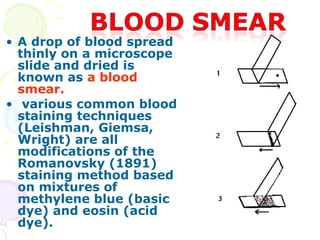
• A drop of blood spread
  thinly on a microscope
  slide and dried is
  known as a blood
  smear.
• various common blood
  staining techniques
  (Leishman, Giemsa,
  Wright) are all
  modifications of the
  Romanovsky (1891)
  staining method based
  on mixtures of
  methylene blue (basic
  dye) and eosin (acid
  dye).
1-Erythrocytes or red blood cells
5 to 5.5 millions per cubic millimeter.

2-Leukocytes or white blood cells
4000 to 11000 per cubic millimeter

3-Platelets or Thrompocytes
200, 000 to 400,000 per cubic millimeter
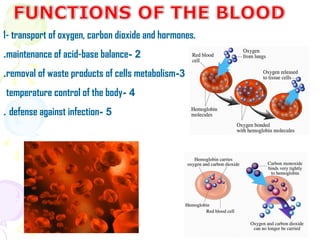
1- transport of oxygen, carbon dioxide and hormones.
.maintenance of acid-base balance- 2
.removal of waste products of cells metabolism-3
temperature control of the body- 4
. defense against infection- 5
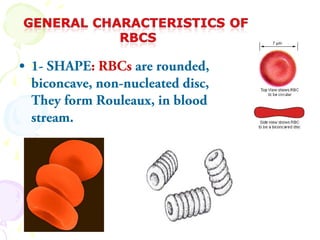
• 1- SHAPE: RBCs are rounded,
  biconcave, non-nucleated disc,
  They form Rouleaux, in blood
  stream.
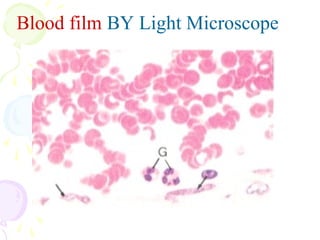
Blood film BY Light Microscope
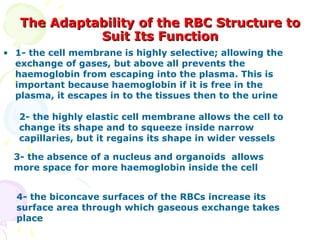
The Adaptability of the RBC Structure to
             Suit Its Function
• 1- the cell membrane is highly selective; allowing the
  exchange of gases, but above all prevents the
  haemoglobin from escaping into the plasma. This is
  important because haemoglobin if it is free in the
  plasma, it escapes in to the tissues then to the urine

   2- the highly elastic cell membrane allows the cell to
   change its shape and to squeeze inside narrow
   capillaries, but it regains its shape in wider vessels

  3- the absence of a nucleus and organoids allows
  more space for more haemoglobin inside the cell


  4- the biconcave surfaces of the RBCs increase its
  surface area through which gaseous exchange takes
  place
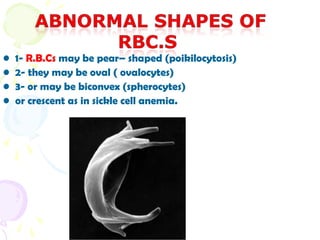
•   1- R.B.Cs may be pear– shaped (poikilocytosis)
•   2- they may be oval ( ovalocytes)
•   3- or may be biconvex (spherocytes)
•   or crescent as in sickle cell anemia.
In hypertonic solution( with high osmotic
  pressure ):
 the water draw out from the RBCs which become
  crenated (i.e. smaller, with notched outline).
• In hypotonic solution:
• Water is drawn inside the RBCs, and finally
  rupture ,leaving remnants of their cells membrane
  called “ghosts “. The rupture of RBCs and the
  discharge of their Hb content called hemolysis
The diameter of R.B.Cs varies between 7-8µm
(7.5 µm average)
• In Macrocytic Anemias there is increase in
  diameters of R.B.Cs
• In Mirocytic Anemias there is a decrease in
  diameters of R.B.Cs.
• In great variation in size of the R.B.Cs is
  called Anisocytosis.
• R.B.Cs are greenish –yellow in color,
  due to the presence of Haemoglobin (Hb
  %).
• A drop of blood appears red due to
  overlapping of RBCs .
• The normal blood corpuscles are called
  NORMOCHROMIC
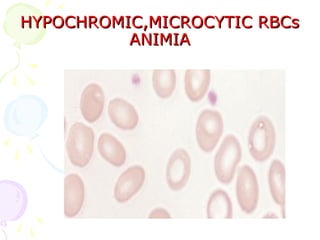
A- HYPOCHROMIC RBC (Contains
 less Hb% than usual). It has a
 larger pale central area, and
 poorly- stained periphery .
B- HYPERCHROMIC RBC (Contains
 more Hb% than usual) It has
 stained central area, and a deeply
 stained periphery.
HYPOCHROMIC,MICROCYTIC RBCs
          ANIMIA
In normal male the average number of RBCS is
about 5 million per cubic millimeter.

In female it is about 4.5 million per cmm.

The life span of the RBCS 4 months
abnormalities in The
      .Number of RBCs
  A- REDUCE THE AMOUNT OF RBCs
 1- Deficiency of iron, vitamin B12, proteins,vitamin
C, copper, calcium (i.e. deficiency anaemia).
2- haemorrhagic anaemia
3- Haemolysis or destruction of RBCs. e.g. in
increased fragility of RBCs or by bacterial toxins
(i.e. haemolytic anemia) erythrocytes have the
shape of elongated crescents (sickles) due to of
abnormal Hb.
4- Malfunction of bone marrow by various
exogenous or endogenous causes a plastic anaemia
B- increase the amount of
 :the RBCs Polycythaemia

 - Excessive production of RBCs from the
 bone marrow due to hypoxia which
 stimulates the bone marrow, as
 a- The foetus, due to intra-uterine anoxia
 e- Severe muscular exercise, due to
 excessive need of oxygen by the tissues
ORIGIN OF RBCS ,THEIR
LIFE SPAN AND FATE

 ORIGIN: BONE MARROW
 LIFE SPAN: 120 DAYS.

 Fate: destroyed and phagocytosed by
macrophages in spleen, bone marrow and
liver, to hemasiderin (iron-containing
pigment) and bilirubin
(Leukocytes (White blood cells

Leukocytes are colorless because they
contain no hemoglobin; however,
each cell has a nucleus. In blood
stream leukocytes are spherical in
shape and mobile.
IN NORMAL ADULT THE “TOTAL
  LEUKOCYTIC COUNT “IS BETWEEN
  4,000- 10,000 PER CUBIC MILLIMETER
According to type of cytoplasmic granules
  and the shape of nuclei leukocytes are
               classified into
•   A-Granular leukocytes
•   They contain specific granules and lobulated nuclei.
•   1- Neutrophils  60-75 %
•   2- Eosinphils   2-4     %
•   3- Basophils    0- 0.5 %

• B- Nongranular leukocytes
• They do not contain specific granules with non-lobulated
  nuclei.
• 1- Lymphocytes 20-40 %
• 2- monocytes      3- 8 %
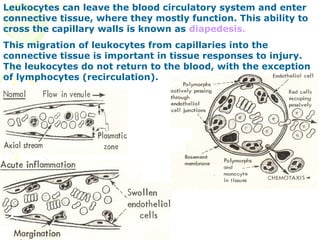
Leukocytes can leave the blood circulatory system and enter
connective tissue, where they mostly function. This ability to
cross the capillary walls is known as diapedesis.
This migration of leukocytes from capillaries into the
connective tissue is important in tissue responses to injury.
The leukocytes do not return to the blood, with the exception
of lymphocytes (recirculation).
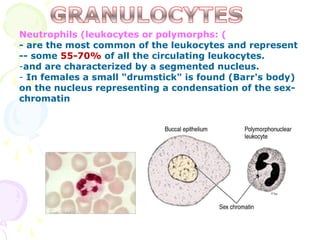
Neutrophils (leukocytes or polymorphs: (
- are the most common of the leukocytes and represent
-- some 55-70% of all the circulating leukocytes.
-and are characterized by a segmented nucleus.
- In females a small "drumstick" is found (Barr's body)
on the nucleus representing a condensation of the sex-
chromatin
Some specific granules contain phagocytins, which are
anti-bacterial substances involved intracellular
digestion.
The non-specific granules as azurophilic contain
lysosomal , enzymes (peroxidase).

 Neutrophils are phagocytic cells involved as a first line
 of defense against invading microorganisms.
 They are important in inflammation and at sites of
 injury or wounds
 Pus that develops in sites of infection is mainly
 composed of dead neutrophils and dead tissue
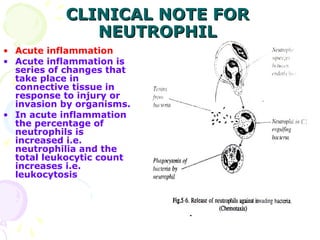
CLINICAL NOTE FOR
              NEUTROPHIL
• Acute inflammation
• Acute inflammation is
  series of changes that
  take place in
  connective tissue in
  response to injury or
  invasion by organisms.
• In acute inflammation
  the percentage of
  neutrophils is
  increased i.e.
  neutrophilia and the
  total leukocytic count
  increases i.e.
  leukocytosis
The clinical signs of
     acute inflammation
• 1- Swelling :This localized Odem or increase fluid in
  amorphous material of connective tissue is
  responsible for the swelling at site of acute
  inflammation.
• 2- Redness and hotness: histamine causes dilatation
  of arterioles and capillaries . this dilatation causes
  increased blood flow and is responsible for the
  redness and hotness.
• 3- Pain This is caused by the pressure of the
  increased amounts of the tissue fluid on the
  sensitive sensory nerve endings.
4- Loss of function : this is caused by
  pain
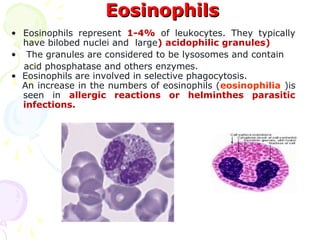
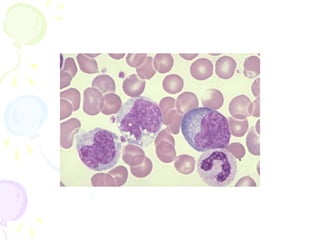
Eosinophils
• Eosinophils represent 1-4% of leukocytes. They typically
  have bilobed nuclei and large) acidophilic granules)
• The granules are considered to be lysosomes and contain
  acid phosphatase and others enzymes.
• Eosinophils are involved in selective phagocytosis.
  An increase in the numbers of eosinophils (eosinophilia )is
  seen in allergic reactions or helminthes parasitic
  infections.
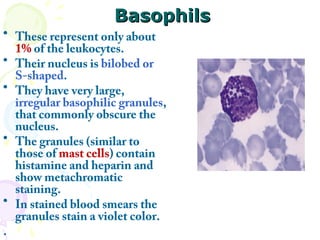
Basophils
• These represent only about
  1% of the leukocytes.
• Their nucleus is bilobed or
  S-shaped.
• They have very large,
  irregular basophilic granules,
  that commonly obscure the
  nucleus.
• The granules (similar to
  those of mast cells) contain
  histamine and heparin and
  show metachromatic
  staining.
• In stained blood smears the
  granules stain a violet color.
.
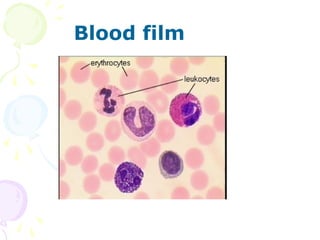
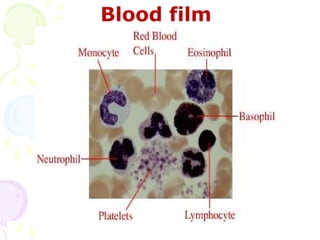
Blood film
AGRANULOCYTES
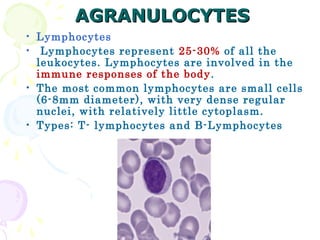
• Lymphocytes
• Lymphocytes represent 25-30% of all the
  leukocytes. Lymphocytes are involved in the
  immune responses of the body .
• The most common lymphocytes are small cells
  (6-8mm diameter), with very dense regular
  nuclei, with relatively little cytoplasm.
• Types: T- lymphocytes and B-Lymphocytes
Monocytes
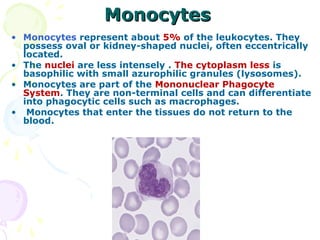
• Monocytes represent about 5% of the leukocytes. They
  possess oval or kidney-shaped nuclei, often eccentrically
  located.
• The nuclei are less intensely . The cytoplasm less is
  basophilic with small azurophilic granules (lysosomes).
• Monocytes are part of the Mononuclear Phagocyte
  System. They are non-terminal cells and can differentiate
  into phagocytic cells such as macrophages.
• Monocytes that enter the tissues do not return to the
  blood.
Blood platelets
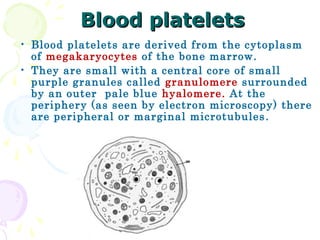
• Blood platelets are derived from the cytoplasm
  of megakaryocytes of the bone marrow.
• They are small with a central core of small
  purple granules called granulomere surrounded
  by an outer pale blue hyalomere. At the
  periphery (as seen by electron microscopy) there
  are peripheral or marginal microtubules .
(BLOOD PLATELET( THROMBOCYTES
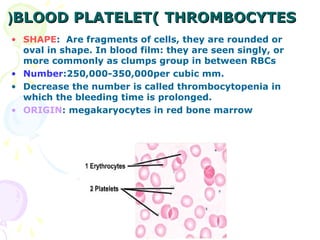
• SHAPE: Are fragments of cells, they are rounded or
  oval in shape. In blood film: they are seen singly, or
  more commonly as clumps group in between RBCs
• Number:250,000-350,000per cubic mm.
• Decrease the number is called thrombocytopenia in
  which the bleeding time is prolonged.
• ORIGIN: megakaryocytes in red bone marrow
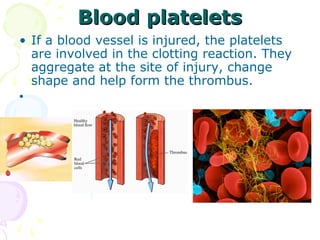
Blood platelets
• If a blood vessel is injured, the platelets
  are involved in the clotting reaction. They
  aggregate at the site of injury, change
  shape and help form the thrombus.
•
Blood film
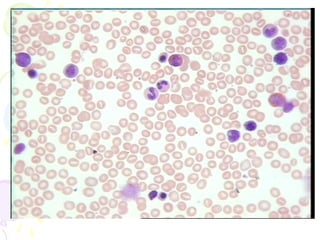
Peripheral blood
Peripheral blood

Peripheral blood

  • 2.
    Plasma Formed elements liquid component in (cells and platelets) which the formed elements are suspended THE VOLUIME OF BLOOD IN HEALTY HUMAN IS ABOUT 5 LITERS
  • 3.
    Plasma • is anaqueous solution containing proteins (7%), lipoproteins (10%), amino-acids, vitamins, hormones, and inorganic salts. • The main blood proteins are: • 1-albumins (maintains osmotic pressure of blood) • 2-gamma globulins (immunoglobulins or antibodies) • 3-fibrinogen (clotting agent) Make up 55% of blood volume
  • 4.
    • If bloodis allowed to clot, the clot contains the formed elements, whereas the clear yellow liquid that separates is known as the serum. Serum is similar to plasma but lacks fibrinogen and other clotting agents
  • 5.
    • If atest-tube of blood is centrifuged it separates into several distinct layers. • 1-The lowest layer, which is an orange or reddish color, contains the erythrocytes , (about 45% of the volume). • 2-A thin layer (1%) known as the Buffy coat is located above the layer of erythrocytes. This contains the leukocytes and platelets. • 3-The remaining upper clear fluid is the plasma (about 55%). • The relative volumes of cells and plasma are described as the "hematocrit”. • Low hematocrit values can indicate blood disorders such as anemia
  • 6.
    • A dropof blood spread thinly on a microscope slide and dried is known as a blood smear. • various common blood staining techniques (Leishman, Giemsa, Wright) are all modifications of the Romanovsky (1891) staining method based on mixtures of methylene blue (basic dye) and eosin (acid dye).
  • 7.
    1-Erythrocytes or redblood cells 5 to 5.5 millions per cubic millimeter. 2-Leukocytes or white blood cells 4000 to 11000 per cubic millimeter 3-Platelets or Thrompocytes 200, 000 to 400,000 per cubic millimeter
  • 8.
    1- transport ofoxygen, carbon dioxide and hormones. .maintenance of acid-base balance- 2 .removal of waste products of cells metabolism-3 temperature control of the body- 4 . defense against infection- 5
  • 9.
    • 1- SHAPE:RBCs are rounded, biconcave, non-nucleated disc, They form Rouleaux, in blood stream.
  • 10.
    Blood film BYLight Microscope
  • 12.
    The Adaptability ofthe RBC Structure to Suit Its Function • 1- the cell membrane is highly selective; allowing the exchange of gases, but above all prevents the haemoglobin from escaping into the plasma. This is important because haemoglobin if it is free in the plasma, it escapes in to the tissues then to the urine 2- the highly elastic cell membrane allows the cell to change its shape and to squeeze inside narrow capillaries, but it regains its shape in wider vessels 3- the absence of a nucleus and organoids allows more space for more haemoglobin inside the cell 4- the biconcave surfaces of the RBCs increase its surface area through which gaseous exchange takes place
  • 13.
    1- R.B.Cs may be pear– shaped (poikilocytosis) • 2- they may be oval ( ovalocytes) • 3- or may be biconvex (spherocytes) • or crescent as in sickle cell anemia.
  • 14.
    In hypertonic solution(with high osmotic pressure ): the water draw out from the RBCs which become crenated (i.e. smaller, with notched outline). • In hypotonic solution: • Water is drawn inside the RBCs, and finally rupture ,leaving remnants of their cells membrane called “ghosts “. The rupture of RBCs and the discharge of their Hb content called hemolysis
  • 15.
    The diameter ofR.B.Cs varies between 7-8µm (7.5 µm average) • In Macrocytic Anemias there is increase in diameters of R.B.Cs • In Mirocytic Anemias there is a decrease in diameters of R.B.Cs. • In great variation in size of the R.B.Cs is called Anisocytosis.
  • 16.
    • R.B.Cs aregreenish –yellow in color, due to the presence of Haemoglobin (Hb %). • A drop of blood appears red due to overlapping of RBCs . • The normal blood corpuscles are called NORMOCHROMIC
  • 17.
    A- HYPOCHROMIC RBC(Contains less Hb% than usual). It has a larger pale central area, and poorly- stained periphery . B- HYPERCHROMIC RBC (Contains more Hb% than usual) It has stained central area, and a deeply stained periphery.
  • 18.
  • 19.
    In normal malethe average number of RBCS is about 5 million per cubic millimeter. In female it is about 4.5 million per cmm. The life span of the RBCS 4 months
  • 20.
    abnormalities in The .Number of RBCs A- REDUCE THE AMOUNT OF RBCs 1- Deficiency of iron, vitamin B12, proteins,vitamin C, copper, calcium (i.e. deficiency anaemia). 2- haemorrhagic anaemia 3- Haemolysis or destruction of RBCs. e.g. in increased fragility of RBCs or by bacterial toxins (i.e. haemolytic anemia) erythrocytes have the shape of elongated crescents (sickles) due to of abnormal Hb. 4- Malfunction of bone marrow by various exogenous or endogenous causes a plastic anaemia
  • 21.
    B- increase theamount of :the RBCs Polycythaemia - Excessive production of RBCs from the bone marrow due to hypoxia which stimulates the bone marrow, as a- The foetus, due to intra-uterine anoxia e- Severe muscular exercise, due to excessive need of oxygen by the tissues
  • 22.
    ORIGIN OF RBCS,THEIR LIFE SPAN AND FATE ORIGIN: BONE MARROW LIFE SPAN: 120 DAYS. Fate: destroyed and phagocytosed by macrophages in spleen, bone marrow and liver, to hemasiderin (iron-containing pigment) and bilirubin
  • 23.
    (Leukocytes (White bloodcells Leukocytes are colorless because they contain no hemoglobin; however, each cell has a nucleus. In blood stream leukocytes are spherical in shape and mobile. IN NORMAL ADULT THE “TOTAL LEUKOCYTIC COUNT “IS BETWEEN 4,000- 10,000 PER CUBIC MILLIMETER
  • 24.
    According to typeof cytoplasmic granules and the shape of nuclei leukocytes are classified into • A-Granular leukocytes • They contain specific granules and lobulated nuclei. • 1- Neutrophils 60-75 % • 2- Eosinphils 2-4 % • 3- Basophils 0- 0.5 % • B- Nongranular leukocytes • They do not contain specific granules with non-lobulated nuclei. • 1- Lymphocytes 20-40 % • 2- monocytes 3- 8 %
  • 25.
    Leukocytes can leavethe blood circulatory system and enter connective tissue, where they mostly function. This ability to cross the capillary walls is known as diapedesis. This migration of leukocytes from capillaries into the connective tissue is important in tissue responses to injury. The leukocytes do not return to the blood, with the exception of lymphocytes (recirculation).
  • 26.
    Neutrophils (leukocytes orpolymorphs: ( - are the most common of the leukocytes and represent -- some 55-70% of all the circulating leukocytes. -and are characterized by a segmented nucleus. - In females a small "drumstick" is found (Barr's body) on the nucleus representing a condensation of the sex- chromatin
  • 27.
    Some specific granulescontain phagocytins, which are anti-bacterial substances involved intracellular digestion. The non-specific granules as azurophilic contain lysosomal , enzymes (peroxidase). Neutrophils are phagocytic cells involved as a first line of defense against invading microorganisms. They are important in inflammation and at sites of injury or wounds Pus that develops in sites of infection is mainly composed of dead neutrophils and dead tissue
  • 28.
    CLINICAL NOTE FOR NEUTROPHIL • Acute inflammation • Acute inflammation is series of changes that take place in connective tissue in response to injury or invasion by organisms. • In acute inflammation the percentage of neutrophils is increased i.e. neutrophilia and the total leukocytic count increases i.e. leukocytosis
  • 29.
    The clinical signsof acute inflammation • 1- Swelling :This localized Odem or increase fluid in amorphous material of connective tissue is responsible for the swelling at site of acute inflammation. • 2- Redness and hotness: histamine causes dilatation of arterioles and capillaries . this dilatation causes increased blood flow and is responsible for the redness and hotness. • 3- Pain This is caused by the pressure of the increased amounts of the tissue fluid on the sensitive sensory nerve endings. 4- Loss of function : this is caused by pain
  • 30.
    Eosinophils • Eosinophils represent1-4% of leukocytes. They typically have bilobed nuclei and large) acidophilic granules) • The granules are considered to be lysosomes and contain acid phosphatase and others enzymes. • Eosinophils are involved in selective phagocytosis. An increase in the numbers of eosinophils (eosinophilia )is seen in allergic reactions or helminthes parasitic infections.
  • 31.
    Basophils • These representonly about 1% of the leukocytes. • Their nucleus is bilobed or S-shaped. • They have very large, irregular basophilic granules, that commonly obscure the nucleus. • The granules (similar to those of mast cells) contain histamine and heparin and show metachromatic staining. • In stained blood smears the granules stain a violet color. .
  • 32.
  • 33.
    AGRANULOCYTES • Lymphocytes • Lymphocytesrepresent 25-30% of all the leukocytes. Lymphocytes are involved in the immune responses of the body . • The most common lymphocytes are small cells (6-8mm diameter), with very dense regular nuclei, with relatively little cytoplasm. • Types: T- lymphocytes and B-Lymphocytes
  • 34.
    Monocytes • Monocytes representabout 5% of the leukocytes. They possess oval or kidney-shaped nuclei, often eccentrically located. • The nuclei are less intensely . The cytoplasm less is basophilic with small azurophilic granules (lysosomes). • Monocytes are part of the Mononuclear Phagocyte System. They are non-terminal cells and can differentiate into phagocytic cells such as macrophages. • Monocytes that enter the tissues do not return to the blood.
  • 35.
    Blood platelets • Bloodplatelets are derived from the cytoplasm of megakaryocytes of the bone marrow. • They are small with a central core of small purple granules called granulomere surrounded by an outer pale blue hyalomere. At the periphery (as seen by electron microscopy) there are peripheral or marginal microtubules .
  • 36.
    (BLOOD PLATELET( THROMBOCYTES •SHAPE: Are fragments of cells, they are rounded or oval in shape. In blood film: they are seen singly, or more commonly as clumps group in between RBCs • Number:250,000-350,000per cubic mm. • Decrease the number is called thrombocytopenia in which the bleeding time is prolonged. • ORIGIN: megakaryocytes in red bone marrow
  • 37.
    Blood platelets • Ifa blood vessel is injured, the platelets are involved in the clotting reaction. They aggregate at the site of injury, change shape and help form the thrombus. •
  • 39.