Mbarara University of Science & Technology 1
Mbarara University of Science &
Technology
2
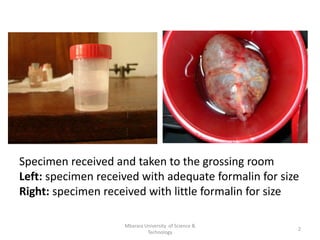
Specimen received and taken to the grossing room
Left: specimen received with adequate formalin for size
Right: specimen received with little formalin for size
Introduction
• Grossing is the macroscopic description
of tissue.
• Gross description provides information
that aides the pathologist in making a
diagnosis during microscopic evaluation
of the tissue.
• It includes cutting smaller pieces of
tissue from the entire gross specimen
submitted to the laboratory.
Mbarara University of Science & Technology 3
Cont’
• These pieces of tissue are likely to be more
diagnostically significant in relation to the
entire specimen, and are placed in tissue
processing cassettes for processing.
• An accurate diagnosis from the tissue is
dependent upon the correct identification
during grossing
Mbarara University of Science & Technology 4
Requirements for a grossing room
• Weighing scale
• Measuring cylinder
• Camera
• Pencil and pens for
labeling cassettes
• Tissue cassettes
• Grossing ink
Mbarara University of Science &
Technology
5
• Ruler with millimeter
scale
• Magnifying lens
• 10% Neutral buffered
formalin
• Waste bins, sharps
container.
• Disinfectant (70%
alcohol)
Requirements for a grossing room……
• Sink with running tape
water
• Fume extractor/ fume
hood
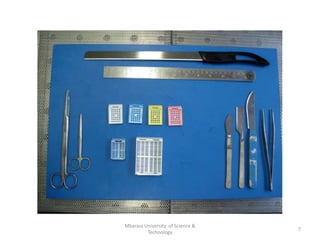
• Surgical blades and
scalpels
• Grossing knife, scissor
and forceps
• Formalin absorbent
padr
• Water proof apron
• Mask, Gloves
• Grossing board
Mbarara University of Science &
Technology
6
Mbarara University of Science &
Technology
7
.
Mbarara University of Science & Technology 8
.
Mbarara University of Science & Technology 9
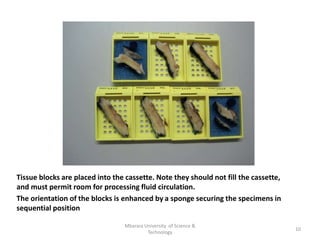
Tissue blocks are placed into the cassette. Note they should not fill the cassette,
and must permit room for processing fluid circulation.
The orientation of the blocks is enhanced by a sponge securing the specimens in
sequential position
Mbarara University of Science &
Technology
10
General Principles/Rules of grossing tissue.
• There should never be more than one
container open at a time to ensure that
each specimen is returned to its appropriate
container so there is no chance of mix up.
• Qualified staff should do sampling of
specimen.
• The grossing of the specimen can be done
either before fixation or following it.
• It is ideal to gross larger specimen in a fresh
state and smaller following fixation.
Mbarara University of Science & Technology 11
General Principles/Rules of grossing tissue…
• The sample should be described in terms of the
shape, size, color, texture and defining
characteristics of the specimen.
• This means that small biopsies, for example
endoscopic mucosal samples, may simply be
afforded a simple descriptor in the form of the
number of pieces and the size (SI units, usually
mm) of the largest piece of tissue.
• E.g ‘three pieces of brown tissue, the largest 3
mm diameter’
Mbarara University of Science & Technology 12
General Principles/Rules of grossing tissue.…
• A properly completed surgical pathology
requisition form containing the patient’s
identification, age, sex, essential clinical data,
nature of operation, surgical findings, tissue
submitted and the site of biopsied specimen
should accompany every specimen.
• If more than one specimen has to be placed in
the same container, for the same patient, they
must be clearly marked, which is most readily
done by means of sutures;
Mbarara University of Science & Technology 13
Cont’
• Description of additional specimens received
from the same patient must be mentioned.
• Non tissue materials such as bullets, implants,
foreign bodies should be recorded as it may
be essential for medico legal cases.
Mbarara University of Science & Technology 14
General Principles of grossing tissue…
• Only labeled specimens should be accepted. The
label should be firmly attached to the body of the
container so that it cannot be separated.
• Specimen labels should not be attached to just
the lid but the body of the container as well.
• Incorrect identification of any specimen results in
the wrong diagnosis and incorrect treatment to
potentially two patients.
Mbarara University of Science & Technology 15
General Principles of grossing tissue…
• Measurements of the skin surface dimensions
and depth should be documented.
• Any tissue that is small enough to slip through
the cassette holes should be wrapped in
processing tissue paper or a processing mesh
bag.
• Tissue should only be inked if it conveys
information such as orientation and margins in
excisions, or which side to embed down.
Mbarara University of Science & Technology 16
General Principles of grossing tissue…
• Unusual skin surface or pigmentation should
be noted.
• Thickness of the specimen; A uniform
thickness of the specimen is an obvious
requirement for processing, but it is difficult
to achieve under conditions of insufficient
fixation or inadequate hardening of
specimen.
Mbarara University of Science & Technology 17
Cont’
• The tissue thickens should ideally be 2 to 4
mm in thickness.
• Under no circumstances should any portion of
the specimen be discarded before the case is
signed out.
Mbarara University of Science & Technology 18
Safety during Grossing
• All tissues must be considered potentially
hazardous and universal precautions must
be taken when grossing tissue.
• Formalin fumes are also known to be a
health hazard. It is a severe eye and skin
irritant and is toxic by ingestion and
inhalation, these can be minimized by
proper tissue handling and fixation of the
specimen before grossing.
Mbarara University of Science & Technology 19
Cont’
• Adequate protective measures to protect from
infection must be undertaken such as use of
disposable gowns, gloves, facemasks and eye
gear.
• Wash hands regularly to avoid spread of
infection.
Mbarara University of Science & Technology 20
Cont’
• Grossing should be under a fume hood or
safety cabinet designed to extract formalin
vapors
• Contact with chemicals should be minimized
and the protective gear should be disposed off
in correct manner.
• The laboratory personnel should clean all
instruments and working surface with a
disinfectant.
Mbarara University of Science & Technology 21
General Procedure for grossing.
1.Assemble the requirements and wear PPE.
2.Correspond the identifiers on the specimen
container with those on the request form.
3.Make a general inspection of the specimen,
with identification of all of its normal and
abnormal components.
4.Macroscopically describe the specimen by
looking at and noting features like; colour,
texture, dimensions, weight, shape and unique
features like ulcerations, skin , muscle that
may be attached to specimen
Mbarara University of Science & Technology 22
General Procedure for grossing…
5.Place the specimen on a grossing board
and orient the tissue in its anatomical
position.
6.The identification markers for orientation
such as sutures must be carefully
considered.
7.Surgical margins should be identified
correctly after orienting.
Mbarara University of Science & Technology 23
Cont’
8.Photographs of the specimen are then taken,
before its dissected.
9.The pathologist must use sharp cutting
instrument to avoid artifacts and cuts through
the specimen to revel the inner part (cut
surface).
10.The macroscopic description of the cut
surface is then noted
Mbarara University of Science & Technology 24
Cont’…
11.If the cut surface contains a tumor, its
deception like colour, texture , dimension
are noted.
12.Photographs of the cut surface are
then taken.
13.Orientation will determine the depth
of invasion of the lesion and the margins
of resection.
Mbarara University of Science & Technology 25
Cont’
14.The specimen is then sampled to make
representative portions of the entire gross
specimen.
15.The sampled tissue is then placed in a labeled
tissue cassette.
16.The sampled tissue should be of 2-4 mm.
Mbarara University of Science & Technology 26
Cont’
17. The tissue cassettes are then covered and
placed in a specimen 10%NBF ready for
processing
18. The working area and instruments are
cleaned after grossing..
Mbarara University of Science & Technology 27
Note
1.At no point should tissue dry during
grossing
2.Contamination of the specimen can occur
anytime during the handling of the
specimen, for example, floaters, cutting
board metastasis which must be carefully
eliminated, by washing the cutting tools and
grossing board with running tape water
before cutting another specimen.
Mbarara University of Science & Technology 28
Cont’
• 3.Tissue samples dissected from the main
specimen should be immediately placed in
tissue cassettes with surface to be sectioned
facing down wards, so that it is embedded
correctly.
Mbarara University of Science & Technology 29
These cassettes are over-loaded.
If processing goes ahead the
specimens will be distorted and
it is likely that the processing will
be incomplete
These illegible cassette labels
are totally unacceptable
Mbarara University of Science &
Technology
30
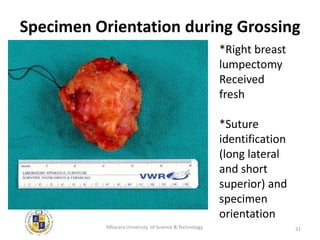
Specimen Orientation during Grossing
*Right breast
lumpectomy
Received
fresh
*Suture
identification
(long lateral
and short
superior) and
specimen
orientation
Mbarara University of Science & Technology 31
Specimen Painting/Inking
Margins
identified and
painted
*Anterior yellow
*Superior blue
*Posterior black
*Inferior red
Mbarara University of Science & Technology 32
The purpose of inking during grossing
1. To determine the margins of the specimen.
2. Indicate specific areas of interest to the
pathologist
3. To indicate the mode of embedding.
4. Maintain the anatomic orientation of the
specimen. Inks of different colors designating
each of six specimen margins (superior, inferior
,medial, lateral, anterior and posterior) can
ideally be used to do this.
Mbarara University of Science & Technology 33
Note
• Inking cut surfaces of tissue one color will help
in embedding to determine which surface
should be embedded down, where inked
surfaces will meet the blade first during the
microtomy process.
• Inking is typically reserved for excisions.
• Inking margins on biopsies is not required
since a second procedure is anticipated based
on the diagnosis of the biopsy
Mbarara University of Science & Technology 34
Formalin Fixation
Mbarara University of Science & Technology 35
Specimen Slicing/bread loafing
Specimen
serially
sectioned
*Lesion
identified
*Margin
evident
Mbarara University of Science & Technology 36
THE END
Thank you
Mbarara University of Science & Technology 37
Reference
1. World Journal of Dentistry, April-June2010;1(1):35-
41
2. Handling and Grossing of Large Breast Specimens
Anita Bane MB, BCh, FRCPath, PhD ,Juravinski
Hospital & Cancer Centre McMaster University
3. UCI Histopathology laboratory Standard Operating
Procedure, GROSSING/CUT UP 2017.
4. Bancroft’s Theory and Practice of Histological
Techniques, seventh edition 2012
38
Mbarara University of Science & Technology

Grossing.pptx

  • 1.
    Mbarara University ofScience & Technology 1
  • 2.
    Mbarara University ofScience & Technology 2 Specimen received and taken to the grossing room Left: specimen received with adequate formalin for size Right: specimen received with little formalin for size
  • 3.
    Introduction • Grossing isthe macroscopic description of tissue. • Gross description provides information that aides the pathologist in making a diagnosis during microscopic evaluation of the tissue. • It includes cutting smaller pieces of tissue from the entire gross specimen submitted to the laboratory. Mbarara University of Science & Technology 3
  • 4.
    Cont’ • These piecesof tissue are likely to be more diagnostically significant in relation to the entire specimen, and are placed in tissue processing cassettes for processing. • An accurate diagnosis from the tissue is dependent upon the correct identification during grossing Mbarara University of Science & Technology 4
  • 5.
    Requirements for agrossing room • Weighing scale • Measuring cylinder • Camera • Pencil and pens for labeling cassettes • Tissue cassettes • Grossing ink Mbarara University of Science & Technology 5 • Ruler with millimeter scale • Magnifying lens • 10% Neutral buffered formalin • Waste bins, sharps container. • Disinfectant (70% alcohol)
  • 6.
    Requirements for agrossing room…… • Sink with running tape water • Fume extractor/ fume hood • Surgical blades and scalpels • Grossing knife, scissor and forceps • Formalin absorbent padr • Water proof apron • Mask, Gloves • Grossing board Mbarara University of Science & Technology 6
  • 7.
    Mbarara University ofScience & Technology 7
  • 8.
    . Mbarara University ofScience & Technology 8
  • 9.
    . Mbarara University ofScience & Technology 9
  • 10.
    Tissue blocks areplaced into the cassette. Note they should not fill the cassette, and must permit room for processing fluid circulation. The orientation of the blocks is enhanced by a sponge securing the specimens in sequential position Mbarara University of Science & Technology 10
  • 11.
    General Principles/Rules ofgrossing tissue. • There should never be more than one container open at a time to ensure that each specimen is returned to its appropriate container so there is no chance of mix up. • Qualified staff should do sampling of specimen. • The grossing of the specimen can be done either before fixation or following it. • It is ideal to gross larger specimen in a fresh state and smaller following fixation. Mbarara University of Science & Technology 11
  • 12.
    General Principles/Rules ofgrossing tissue… • The sample should be described in terms of the shape, size, color, texture and defining characteristics of the specimen. • This means that small biopsies, for example endoscopic mucosal samples, may simply be afforded a simple descriptor in the form of the number of pieces and the size (SI units, usually mm) of the largest piece of tissue. • E.g ‘three pieces of brown tissue, the largest 3 mm diameter’ Mbarara University of Science & Technology 12
  • 13.
    General Principles/Rules ofgrossing tissue.… • A properly completed surgical pathology requisition form containing the patient’s identification, age, sex, essential clinical data, nature of operation, surgical findings, tissue submitted and the site of biopsied specimen should accompany every specimen. • If more than one specimen has to be placed in the same container, for the same patient, they must be clearly marked, which is most readily done by means of sutures; Mbarara University of Science & Technology 13
  • 14.
    Cont’ • Description ofadditional specimens received from the same patient must be mentioned. • Non tissue materials such as bullets, implants, foreign bodies should be recorded as it may be essential for medico legal cases. Mbarara University of Science & Technology 14
  • 15.
    General Principles ofgrossing tissue… • Only labeled specimens should be accepted. The label should be firmly attached to the body of the container so that it cannot be separated. • Specimen labels should not be attached to just the lid but the body of the container as well. • Incorrect identification of any specimen results in the wrong diagnosis and incorrect treatment to potentially two patients. Mbarara University of Science & Technology 15
  • 16.
    General Principles ofgrossing tissue… • Measurements of the skin surface dimensions and depth should be documented. • Any tissue that is small enough to slip through the cassette holes should be wrapped in processing tissue paper or a processing mesh bag. • Tissue should only be inked if it conveys information such as orientation and margins in excisions, or which side to embed down. Mbarara University of Science & Technology 16
  • 17.
    General Principles ofgrossing tissue… • Unusual skin surface or pigmentation should be noted. • Thickness of the specimen; A uniform thickness of the specimen is an obvious requirement for processing, but it is difficult to achieve under conditions of insufficient fixation or inadequate hardening of specimen. Mbarara University of Science & Technology 17
  • 18.
    Cont’ • The tissuethickens should ideally be 2 to 4 mm in thickness. • Under no circumstances should any portion of the specimen be discarded before the case is signed out. Mbarara University of Science & Technology 18
  • 19.
    Safety during Grossing •All tissues must be considered potentially hazardous and universal precautions must be taken when grossing tissue. • Formalin fumes are also known to be a health hazard. It is a severe eye and skin irritant and is toxic by ingestion and inhalation, these can be minimized by proper tissue handling and fixation of the specimen before grossing. Mbarara University of Science & Technology 19
  • 20.
    Cont’ • Adequate protectivemeasures to protect from infection must be undertaken such as use of disposable gowns, gloves, facemasks and eye gear. • Wash hands regularly to avoid spread of infection. Mbarara University of Science & Technology 20
  • 21.
    Cont’ • Grossing shouldbe under a fume hood or safety cabinet designed to extract formalin vapors • Contact with chemicals should be minimized and the protective gear should be disposed off in correct manner. • The laboratory personnel should clean all instruments and working surface with a disinfectant. Mbarara University of Science & Technology 21
  • 22.
    General Procedure forgrossing. 1.Assemble the requirements and wear PPE. 2.Correspond the identifiers on the specimen container with those on the request form. 3.Make a general inspection of the specimen, with identification of all of its normal and abnormal components. 4.Macroscopically describe the specimen by looking at and noting features like; colour, texture, dimensions, weight, shape and unique features like ulcerations, skin , muscle that may be attached to specimen Mbarara University of Science & Technology 22
  • 23.
    General Procedure forgrossing… 5.Place the specimen on a grossing board and orient the tissue in its anatomical position. 6.The identification markers for orientation such as sutures must be carefully considered. 7.Surgical margins should be identified correctly after orienting. Mbarara University of Science & Technology 23
  • 24.
    Cont’ 8.Photographs of thespecimen are then taken, before its dissected. 9.The pathologist must use sharp cutting instrument to avoid artifacts and cuts through the specimen to revel the inner part (cut surface). 10.The macroscopic description of the cut surface is then noted Mbarara University of Science & Technology 24
  • 25.
    Cont’… 11.If the cutsurface contains a tumor, its deception like colour, texture , dimension are noted. 12.Photographs of the cut surface are then taken. 13.Orientation will determine the depth of invasion of the lesion and the margins of resection. Mbarara University of Science & Technology 25
  • 26.
    Cont’ 14.The specimen isthen sampled to make representative portions of the entire gross specimen. 15.The sampled tissue is then placed in a labeled tissue cassette. 16.The sampled tissue should be of 2-4 mm. Mbarara University of Science & Technology 26
  • 27.
    Cont’ 17. The tissuecassettes are then covered and placed in a specimen 10%NBF ready for processing 18. The working area and instruments are cleaned after grossing.. Mbarara University of Science & Technology 27
  • 28.
    Note 1.At no pointshould tissue dry during grossing 2.Contamination of the specimen can occur anytime during the handling of the specimen, for example, floaters, cutting board metastasis which must be carefully eliminated, by washing the cutting tools and grossing board with running tape water before cutting another specimen. Mbarara University of Science & Technology 28
  • 29.
    Cont’ • 3.Tissue samplesdissected from the main specimen should be immediately placed in tissue cassettes with surface to be sectioned facing down wards, so that it is embedded correctly. Mbarara University of Science & Technology 29
  • 30.
    These cassettes areover-loaded. If processing goes ahead the specimens will be distorted and it is likely that the processing will be incomplete These illegible cassette labels are totally unacceptable Mbarara University of Science & Technology 30
  • 31.
    Specimen Orientation duringGrossing *Right breast lumpectomy Received fresh *Suture identification (long lateral and short superior) and specimen orientation Mbarara University of Science & Technology 31
  • 32.
    Specimen Painting/Inking Margins identified and painted *Anterioryellow *Superior blue *Posterior black *Inferior red Mbarara University of Science & Technology 32
  • 33.
    The purpose ofinking during grossing 1. To determine the margins of the specimen. 2. Indicate specific areas of interest to the pathologist 3. To indicate the mode of embedding. 4. Maintain the anatomic orientation of the specimen. Inks of different colors designating each of six specimen margins (superior, inferior ,medial, lateral, anterior and posterior) can ideally be used to do this. Mbarara University of Science & Technology 33
  • 34.
    Note • Inking cutsurfaces of tissue one color will help in embedding to determine which surface should be embedded down, where inked surfaces will meet the blade first during the microtomy process. • Inking is typically reserved for excisions. • Inking margins on biopsies is not required since a second procedure is anticipated based on the diagnosis of the biopsy Mbarara University of Science & Technology 34
  • 35.
    Formalin Fixation Mbarara Universityof Science & Technology 35
  • 36.
  • 37.
    THE END Thank you MbararaUniversity of Science & Technology 37
  • 38.
    Reference 1. World Journalof Dentistry, April-June2010;1(1):35- 41 2. Handling and Grossing of Large Breast Specimens Anita Bane MB, BCh, FRCPath, PhD ,Juravinski Hospital & Cancer Centre McMaster University 3. UCI Histopathology laboratory Standard Operating Procedure, GROSSING/CUT UP 2017. 4. Bancroft’s Theory and Practice of Histological Techniques, seventh edition 2012 38 Mbarara University of Science & Technology