BY: VEENU GUPTA
(PGT CHEMISTRY)
APS RAKHMUTHI
 “The periodic table is a tabular
method of displaying the
elements in such a way, that the
elements having similar
properties occur in the same
vertical column or group”.
 Increase in the discovery of different
elements made it difficult to organise all that
was known about the elements.
 To study a large number of elements with
ease, various attempts were made. The
attempts resulted in the classification of
elements into metals and non-metals.
 Dobereiner’s Triads
 Newland’s law of octaves.
 Johann Wolfgang Dobereiner, a German chemist, classified
the known elements in groups of three elements on the basis
of similarities in their properties. These groups were called
triads.This classification is based on the atomic mass.
 According to this, when elements are arranged in order of
increasing atomic masses, groups of three elements, having
similar properties are obtained. The atomic mass of middle
element of the triad being nearly equal to the average of the
atomic masses of the other two elements.
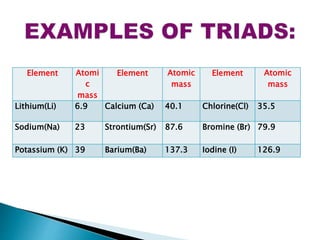
 e.g., atomic masses of Li, Na and K are respectively 7, 23
and 39, thus the mean of atomic masses of I St and 3rd
element is equal to the average of the atomic masses of the
other two elements.
Element Atomi
c
mass
Element Atomic
mass
Element Atomic
mass
Lithium(Li) 6.9 Calcium (Ca) 40.1 Chlorine(Cl) 35.5
Sodium(Na) 23 Strontium(Sr) 87.6 Bromine (Br) 79.9
Potassium (K) 39 Barium(Ba) 137.3 Iodine (I) 126.9
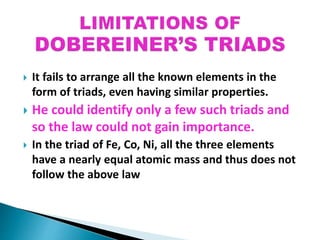
 It fails to arrange all the known elements in the
form of triads, even having similar properties.
 He could identify only a few such triads and
so the law could not gain importance.
 In the triad of Fe, Co, Ni, all the three elements
have a nearly equal atomic mass and thus does not
follow the above law
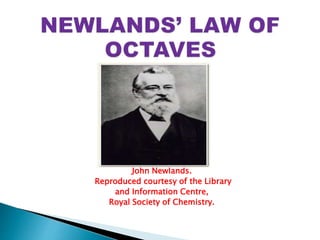
John Newlands.
Reproduced courtesy of the Library
and Information Centre,
Royal Society of Chemistry.
 ‘John Newlands’, an English scientist, arranged the
known elements in the order of increasing atomic
masses and called it the ‘Law of Octaves’. It is known
as ‘Newlands’ Law of Octaves’.
 According to this law “when elements are placed in
order of increasing atomic masses, the physical and
chemical properties of every 8th element are a
repetition of the properties of the first element
weight like the eight note of musical scale.”
 It contained the elements from hydrogen to
thorium.
 Properties of every eighth element were similar to
that of the first element.
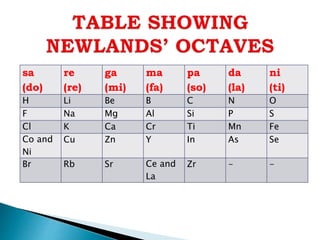
sa
(do)
re
(re)
ga
(mi)
ma
(fa)
pa
(so)
da
(la)
ni
(ti)
H Li Be B C N O
F Na Mg Al Si P S
Cl K Ca Cr Ti Mn Fe
Co and
Ni
Cu Zn Y In As Se
Br Rb Sr Ce and
La
Zr - -
 This classification worked well for lighter
elements only up to Ca.
 This classification gave us a relation between
the properties of the elements and their
atomic masses.
 It was shown by this classification for the first
time that there exists a periodicity in the
properties of the elements.
 Law of octaves was applicable only upto calcium (only
for lighter elements). After calcium every eighth
element did not possess the properties similar to that
of the first element.
 This classification failed when the heavier elements
beyond Ca were arranged according to Newland’s law
of octaves.
 Newlands assumed that only 56 elements existed in
nature and no more elements would be discovered in
the future. But later on several new element were
discovered whose properties did not fit into law of
octaves.
 (iv) At the time of this law, noble gases were unknown. When
noble gases were discovered, neon (Ne) between F and Na, and
argon (Ar) between Cl and K, it becomes the ninth element and
not the eighth which has the similar properties.
 v) In order to fit elements into his table, Newlands put even two
elements together in one slot and that too in the column of unlike
elements having very different properties.
For example, the two elements cobalt (Co) and nickel (Ni) were
put together in just one slot and that too in the column of
elements like fluorine, chlorine and bromine which have very
different properties from these elements.
 (vi) Iron (Fe) element which resemble elements like cobalt and
nickel in properties, was placed far away from these elements.
 Thus, Newland‟s classification was not accepted.
 According to this “The physical
and chemical properties of the
elements are the periodic
function of their atomic masses.”
 The repetition of properties
of elements after certain
regular intervals is known
as Periodicity of Properties.
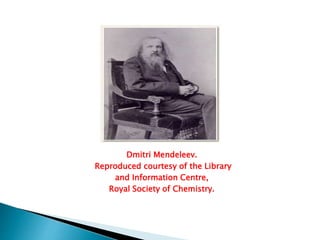
Dmitri Mendeleev.
Reproduced courtesy of the Library
and Information Centre,
Royal Society of Chemistry.
 Dmitri Ivanovich – 5 ’ Mendeleev, a Russian
demist, was the most important contributor
to the early development of a periodic table
of elements wherein the elements were
arranged on the basis of their atomic mass
and chemical properties.
 Mendeleev arranged 63 elements known at that time in the periodic table.
According to Mendeleev “the properties of the elements are a periodic
function of their atomic masses.” The elements with similar physical and
chemical properties came under the same groups.
 In the periodic table, the elements are arranged in vertical rows called
groups and horizontal rows called periods.
 There are eight groups indicated by Roman Numerals I, II, III, IV, V, VI, VII,
VIII. The elements belonging to first seven groups have been divided into
sub-groups designated as A and B on the basis of similarities.
 The elements that are present on the left hand side in each group constitute
sub-group A while those on the right hand side form sub-group B. Group VIII
consists of nine elements arranged in three triads.
 There are six periods (numbered 1, 2, 3, 4, 5 and 6). In order to accomodate
more elements, the periods 4, 5, 6 are divided into two halves. The first half
of the elements are placed in the upper left corners and the second half
occupy lower right corners in each box.
 Systematic Study Of Elements: The arrangement of elements in
groups and periods made the study of elements quite systematic
in the sense that if properties of one element in a particular group
are known,those of the others can be easily predicted.
 Prediction of new elements and their properties: Many gaps were
left in this table for undiscovered elements. However, properties
of these elements could be predicted in advance from their
expected position. This helped in the discovery of these elements.
The elements silicon, gallium and germanium were discovered in
this manner.
 Correction of doubtful atomic masses : Mendeleev corrected the
atomic masses of certain elements with the help of their expected
positions and properties.
 He could not assign a correct position of hydrogen in his periodic table,
as the properties of hydrogen resembles both with alkali metals as well
as with halogens.
 No place could be assigned to isotopes of an element.
 The isotopes of the same element will be given different position if
atomic number is taken as basis, which will disturb the symmetry of the
periodic table.
 The atomic masses do not increases in a regular manner in going from
one elements to the next.
 The properties of elements are periodic functions of their atomic mass.
 It has 8 groups.
 Elements with same properties are placed in different groups like
platinum and Gold
 There were three gaps left by Mendeleev in his Periodic Table.
 No distinction was made between metals and non-metals.
 Transition elements are placed together in Group VIII.
 Inert gases were not known at the time of Mendeleev
 This law was given by Henry Moseley in
1913. It states, “The physical and
chemical properties of the elements are
the periodic function of their atomic
numbers”.
 Modern periodic table is based on
atomic number of elements.
 Periodicity may be defined as the repetition
of the similar properties of the elements
placed in a group and separated by certain
definite gap of atomic numbers.
 The cause of periodicity is the resemblance in
properties of the elements is the repetition
of the same valence shell electronic
configuration
 Moseley proposed this modern periodic table and according to which
“the physical and chemical properties of elements are periodic
function of their atomic number and not atomic mass.“
 Group: The vertical columns in Mendeleev’s, as well as in Modern
Periodic Table, are called groups.
 Period: The horizontal rows in the Modern Periodic Table and
Mendeleev’s Periodic Table are called periods.
 There are 18 groups and 7 (seven) periods in the Modern Periodic
Table.
 The elements belonging to a particular group make a family and
usually named after the first member. In a group all the elements
contain the same number of valence electrons.
 In a period all the elements contain the same number of shells, but
as we move from left to right the number of valence shell electrons
increases by one unit. The maximum number of electrons that can be
accommodated in a shell can be calculated by the formula 2n2 where
n is the number of the given shell from the nucleus.
 The trends observed in some important properties of the
elements in :
 moving down the group (from top to bottom of the table)
and
 across a period (from left to right in a period)
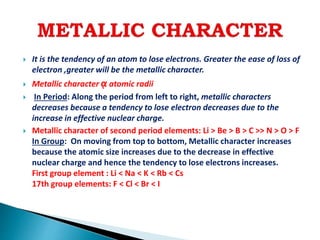
 Valency may be defined as the combining capacity of the atom of an
element with atoms of other elements in order to acquire the stable
configuration (i.e. 8 electron in valence shell. In some special cases it is 2
electrons).
 The valency of an element is determined by the number of valence
electrons present in the outermost shell of its atom (i.e. the combining
capacity of an element is known as its valency).
 In Period: On moving from left to right in a period, the valency first
increases from 1 to 4 and then decreases to zero .
Example; valency of 2nd period elements are 0
 In Groups: On moving from top to bottom in a group, the valency
remains same because the number of valence electrons remains the
same. Example: Valency of first group elements = 1
Valency of second group elements = 2.
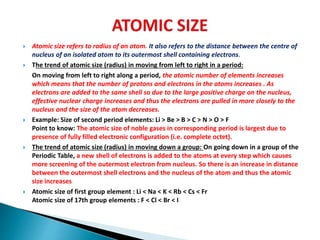
 Atomic size refers to radius of an atom. It also refers to the distance between the centre of
nucleus of an isolated atom to its outermost shell containing electrons.
 The trend of atomic size (radius) in moving from left to right in a period:
On moving from left to right along a period, the atomic number of elements increases
which means that the number of protons and electrons in the atoms increases . As
electrons are added to the same shell so due to the large positive charge on the nucleus,
effective nuclear charge increases and thus the electrons are pulled in more closely to the
nucleus and the size of the atom decreases.
 Example: Size of second period elements: Li > Be > B > C > N > O > F
Point to know: The atomic size of noble gases in corresponding period is largest due to
presence of fully filled electronic configuration (i.e. complete octet).
 The trend of atomic size (radius) in moving down a group: On going down in a group of the
Periodic Table, a new shell of electrons is added to the atoms at every step which causes
more screening of the outermost electron from nucleus. So there is an increase in distance
between the outermost shell electrons and the nucleus of the atom and thus the atomic
size increases
 Atomic size of first group element : Li < Na < K < Rb < Cs < Fr
Atomic size of 17th group elements : F < Cl < Br < I
 It is the tendency of an atom to lose electrons. Greater the ease of loss of
electron ,greater will be the metallic character.
 Metallic character ᾳ atomic radii
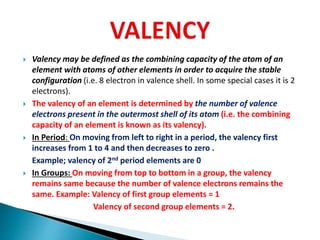
 In Period: Along the period from left to right, metallic characters
decreases because a tendency to lose electron decreases due to the
increase in effective nuclear charge.
 Metallic character of second period elements: Li > Be > B > C >> N > O > F
In Group: On moving from top to bottom, Metallic character increases
because the atomic size increases due to the decrease in effective
nuclear charge and hence the tendency to lose electrons increases.
First group element : Li < Na < K < Rb < Cs
17th group elements: F < Cl < Br < I
 It is tendency of an atom to gain electrons. Greater the ease of
gain of electron ,greater will be the non-metallic character.
 Non-Metallic character ᾳ (1/ atomic radii)
 In Period: Along the period from left to right, non-metallic
character increases because tendency to gain electrons increases
due to increase in nucleus charge.
 Non-metallic character of 2nd period elements :
Li < Be < B < C < N < O < F
 In Group: On moving from top to bottom in a group, non-metallic
character decreases because atomic size increases and tendency to
gain electrons decreases.
 Non-metallic character of 17th period element: F > Cl > Br > I
 In metals: Chemical reactivity of metals increases
down the group because tendency to lose electrons
increases.
Example ; Li < Na < K < Rb < Cs (1st group)
 In non-metals: Chemical reactivity of non-metals
decreases down the group because tendency to
gain electrons decreases.
Example: F > Cl > Br > I (17th group)
 It is tendency of an element to attract the shared pair of
electrons towards it in a covalently bonded molecule.
 It increases with increase of nuclear charge or decrease in
atomic size.
 Along the period electronegativity increases.
Example ;Li < Be < B < C < N < O < F.
 Down the group electronegativity decreases.
Example ; Li > Na > K > Rb > Cs
F > Cl > Br > I
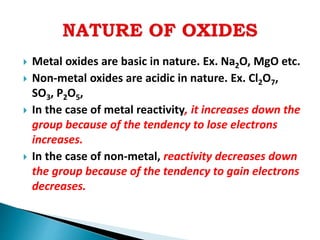
 Metal oxides are basic in nature. Ex. Na2O, MgO etc.
 Non-metal oxides are acidic in nature. Ex. Cl2O7,
SO3, P2O5,
 In the case of metal reactivity, it increases down the
group because of the tendency to lose electrons
increases.
 In the case of non-metal, reactivity decreases down
the group because of the tendency to gain electrons
decreases.
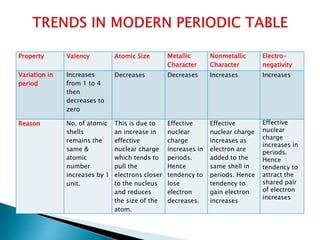
Property Valency Atomic Size Metallic
Character
Nonmetallic
Character
Electro-
negativity
Variation in
period
Increases
from 1 to 4
then
decreases to
zero
Decreases Decreases Increases Increases
Reason No. of atomic
shells
remains the
same &
atomic
number
increases by 1
unit.
This is due to
an increase in
effective
nuclear charge
which tends to
pull the
electrons closer
to the nucleus
and reduces
the size of the
atom.
Effective
nuclear
charge
increases in
periods.
Hence
tendency to
lose
electron
decreases.
Effective
nuclear charge
increases as
electron are
added to the
same shell in
periods. Hence
tendency to
gain electron
increases
Effective
nuclear
charge
increases in
periods.
Hence
tendency to
attract the
shared pair
of electron
increases
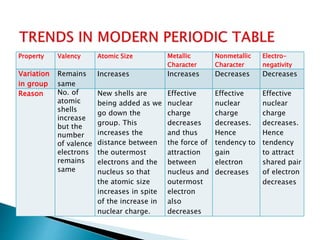
Property Valency Atomic Size Metallic
Character
Nonmetallic
Character
Electro-
negativity
Variation
in group
Remains
same
Increases Increases Decreases Decreases
Reason No. of
atomic
shells
increase
but the
number
of valence
electrons
remains
same
New shells are
being added as we
go down the
group. This
increases the
distance between
the outermost
electrons and the
nucleus so that
the atomic size
increases in spite
of the increase in
nuclear charge.
Effective
nuclear
charge
decreases
and thus
the force of
attraction
between
nucleus and
outermost
electron
also
decreases
Effective
nuclear
charge
decreases.
Hence
tendency to
gain
electron
decreases
Effective
nuclear
charge
decreases.
Hence
tendency
to attract
shared pair
of electron
decreases
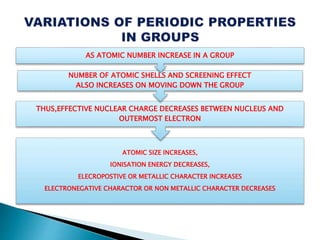
ATOMIC SIZE INCREASES,
IONISATION ENERGY DECREASES,
ELECROPOSTIVE OR METALLIC CHARACTER INCREASES
ELECTRONEGATIVE CHARACTOR OR NON METALLIC CHARACTER DECREASES
THUS,EFFECTIVE NUCLEAR CHARGE DECREASES BETWEEN NUCLEUS AND
OUTERMOST ELECTRON
NUMBER OF ATOMIC SHELLS AND SCREENING EFFECT
ALSO INCREASES ON MOVING DOWN THE GROUP
AS ATOMIC NUMBER INCREASE IN A GROUP
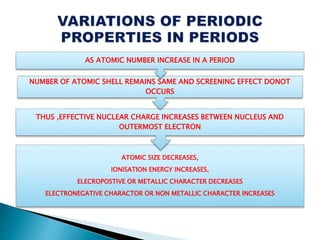
ATOMIC SIZE DECREASES,
IONISATION ENERGY INCREASES,
ELECROPOSTIVE OR METALLIC CHARACTER DECREASES
ELECTRONEGATIVE CHARACTOR OR NON METALLIC CHARACTER INCREASES
THUS ,EFFECTIVE NUCLEAR CHARGE INCREASES BETWEEN NUCLEUS AND
OUTERMOST ELECTRON
NUMBER OF ATOMIC SHELL REMAINS SAME AND SCREENING EFFECT DONOT
OCCURS
AS ATOMIC NUMBER INCREASE IN A PERIOD
THANKS

Periodic classification of elements 10 CHM(5)

  • 1.
    BY: VEENU GUPTA (PGTCHEMISTRY) APS RAKHMUTHI
  • 2.
     “The periodictable is a tabular method of displaying the elements in such a way, that the elements having similar properties occur in the same vertical column or group”.
  • 3.
     Increase inthe discovery of different elements made it difficult to organise all that was known about the elements.  To study a large number of elements with ease, various attempts were made. The attempts resulted in the classification of elements into metals and non-metals.
  • 4.
     Dobereiner’s Triads Newland’s law of octaves.
  • 5.
     Johann WolfgangDobereiner, a German chemist, classified the known elements in groups of three elements on the basis of similarities in their properties. These groups were called triads.This classification is based on the atomic mass.  According to this, when elements are arranged in order of increasing atomic masses, groups of three elements, having similar properties are obtained. The atomic mass of middle element of the triad being nearly equal to the average of the atomic masses of the other two elements.  e.g., atomic masses of Li, Na and K are respectively 7, 23 and 39, thus the mean of atomic masses of I St and 3rd element is equal to the average of the atomic masses of the other two elements.
  • 6.
    Element Atomi c mass Element Atomic mass ElementAtomic mass Lithium(Li) 6.9 Calcium (Ca) 40.1 Chlorine(Cl) 35.5 Sodium(Na) 23 Strontium(Sr) 87.6 Bromine (Br) 79.9 Potassium (K) 39 Barium(Ba) 137.3 Iodine (I) 126.9
  • 7.
     It failsto arrange all the known elements in the form of triads, even having similar properties.  He could identify only a few such triads and so the law could not gain importance.  In the triad of Fe, Co, Ni, all the three elements have a nearly equal atomic mass and thus does not follow the above law
  • 8.
    John Newlands. Reproduced courtesyof the Library and Information Centre, Royal Society of Chemistry.
  • 9.
     ‘John Newlands’,an English scientist, arranged the known elements in the order of increasing atomic masses and called it the ‘Law of Octaves’. It is known as ‘Newlands’ Law of Octaves’.  According to this law “when elements are placed in order of increasing atomic masses, the physical and chemical properties of every 8th element are a repetition of the properties of the first element weight like the eight note of musical scale.”
  • 10.
     It containedthe elements from hydrogen to thorium.  Properties of every eighth element were similar to that of the first element.
  • 11.
    sa (do) re (re) ga (mi) ma (fa) pa (so) da (la) ni (ti) H Li BeB C N O F Na Mg Al Si P S Cl K Ca Cr Ti Mn Fe Co and Ni Cu Zn Y In As Se Br Rb Sr Ce and La Zr - -
  • 12.
     This classificationworked well for lighter elements only up to Ca.  This classification gave us a relation between the properties of the elements and their atomic masses.  It was shown by this classification for the first time that there exists a periodicity in the properties of the elements.
  • 13.
     Law ofoctaves was applicable only upto calcium (only for lighter elements). After calcium every eighth element did not possess the properties similar to that of the first element.  This classification failed when the heavier elements beyond Ca were arranged according to Newland’s law of octaves.  Newlands assumed that only 56 elements existed in nature and no more elements would be discovered in the future. But later on several new element were discovered whose properties did not fit into law of octaves.
  • 14.
     (iv) Atthe time of this law, noble gases were unknown. When noble gases were discovered, neon (Ne) between F and Na, and argon (Ar) between Cl and K, it becomes the ninth element and not the eighth which has the similar properties.  v) In order to fit elements into his table, Newlands put even two elements together in one slot and that too in the column of unlike elements having very different properties. For example, the two elements cobalt (Co) and nickel (Ni) were put together in just one slot and that too in the column of elements like fluorine, chlorine and bromine which have very different properties from these elements.  (vi) Iron (Fe) element which resemble elements like cobalt and nickel in properties, was placed far away from these elements.  Thus, Newland‟s classification was not accepted.
  • 15.
     According tothis “The physical and chemical properties of the elements are the periodic function of their atomic masses.”
  • 16.
     The repetitionof properties of elements after certain regular intervals is known as Periodicity of Properties.
  • 17.
    Dmitri Mendeleev. Reproduced courtesyof the Library and Information Centre, Royal Society of Chemistry.
  • 18.
     Dmitri Ivanovich– 5 ’ Mendeleev, a Russian demist, was the most important contributor to the early development of a periodic table of elements wherein the elements were arranged on the basis of their atomic mass and chemical properties.
  • 19.
     Mendeleev arranged63 elements known at that time in the periodic table. According to Mendeleev “the properties of the elements are a periodic function of their atomic masses.” The elements with similar physical and chemical properties came under the same groups.  In the periodic table, the elements are arranged in vertical rows called groups and horizontal rows called periods.  There are eight groups indicated by Roman Numerals I, II, III, IV, V, VI, VII, VIII. The elements belonging to first seven groups have been divided into sub-groups designated as A and B on the basis of similarities.  The elements that are present on the left hand side in each group constitute sub-group A while those on the right hand side form sub-group B. Group VIII consists of nine elements arranged in three triads.  There are six periods (numbered 1, 2, 3, 4, 5 and 6). In order to accomodate more elements, the periods 4, 5, 6 are divided into two halves. The first half of the elements are placed in the upper left corners and the second half occupy lower right corners in each box.
  • 20.
     Systematic StudyOf Elements: The arrangement of elements in groups and periods made the study of elements quite systematic in the sense that if properties of one element in a particular group are known,those of the others can be easily predicted.  Prediction of new elements and their properties: Many gaps were left in this table for undiscovered elements. However, properties of these elements could be predicted in advance from their expected position. This helped in the discovery of these elements. The elements silicon, gallium and germanium were discovered in this manner.  Correction of doubtful atomic masses : Mendeleev corrected the atomic masses of certain elements with the help of their expected positions and properties.
  • 21.
     He couldnot assign a correct position of hydrogen in his periodic table, as the properties of hydrogen resembles both with alkali metals as well as with halogens.  No place could be assigned to isotopes of an element.  The isotopes of the same element will be given different position if atomic number is taken as basis, which will disturb the symmetry of the periodic table.  The atomic masses do not increases in a regular manner in going from one elements to the next.  The properties of elements are periodic functions of their atomic mass.  It has 8 groups.  Elements with same properties are placed in different groups like platinum and Gold  There were three gaps left by Mendeleev in his Periodic Table.  No distinction was made between metals and non-metals.  Transition elements are placed together in Group VIII.  Inert gases were not known at the time of Mendeleev
  • 22.
     This lawwas given by Henry Moseley in 1913. It states, “The physical and chemical properties of the elements are the periodic function of their atomic numbers”.  Modern periodic table is based on atomic number of elements.
  • 23.
     Periodicity maybe defined as the repetition of the similar properties of the elements placed in a group and separated by certain definite gap of atomic numbers.  The cause of periodicity is the resemblance in properties of the elements is the repetition of the same valence shell electronic configuration
  • 24.
     Moseley proposedthis modern periodic table and according to which “the physical and chemical properties of elements are periodic function of their atomic number and not atomic mass.“  Group: The vertical columns in Mendeleev’s, as well as in Modern Periodic Table, are called groups.  Period: The horizontal rows in the Modern Periodic Table and Mendeleev’s Periodic Table are called periods.  There are 18 groups and 7 (seven) periods in the Modern Periodic Table.  The elements belonging to a particular group make a family and usually named after the first member. In a group all the elements contain the same number of valence electrons.  In a period all the elements contain the same number of shells, but as we move from left to right the number of valence shell electrons increases by one unit. The maximum number of electrons that can be accommodated in a shell can be calculated by the formula 2n2 where n is the number of the given shell from the nucleus.
  • 25.
     The trendsobserved in some important properties of the elements in :  moving down the group (from top to bottom of the table) and  across a period (from left to right in a period)
  • 26.
     Valency maybe defined as the combining capacity of the atom of an element with atoms of other elements in order to acquire the stable configuration (i.e. 8 electron in valence shell. In some special cases it is 2 electrons).  The valency of an element is determined by the number of valence electrons present in the outermost shell of its atom (i.e. the combining capacity of an element is known as its valency).  In Period: On moving from left to right in a period, the valency first increases from 1 to 4 and then decreases to zero . Example; valency of 2nd period elements are 0  In Groups: On moving from top to bottom in a group, the valency remains same because the number of valence electrons remains the same. Example: Valency of first group elements = 1 Valency of second group elements = 2.
  • 27.
     Atomic sizerefers to radius of an atom. It also refers to the distance between the centre of nucleus of an isolated atom to its outermost shell containing electrons.  The trend of atomic size (radius) in moving from left to right in a period: On moving from left to right along a period, the atomic number of elements increases which means that the number of protons and electrons in the atoms increases . As electrons are added to the same shell so due to the large positive charge on the nucleus, effective nuclear charge increases and thus the electrons are pulled in more closely to the nucleus and the size of the atom decreases.  Example: Size of second period elements: Li > Be > B > C > N > O > F Point to know: The atomic size of noble gases in corresponding period is largest due to presence of fully filled electronic configuration (i.e. complete octet).  The trend of atomic size (radius) in moving down a group: On going down in a group of the Periodic Table, a new shell of electrons is added to the atoms at every step which causes more screening of the outermost electron from nucleus. So there is an increase in distance between the outermost shell electrons and the nucleus of the atom and thus the atomic size increases  Atomic size of first group element : Li < Na < K < Rb < Cs < Fr Atomic size of 17th group elements : F < Cl < Br < I

  • 28.
     It isthe tendency of an atom to lose electrons. Greater the ease of loss of electron ,greater will be the metallic character.  Metallic character ᾳ atomic radii  In Period: Along the period from left to right, metallic characters decreases because a tendency to lose electron decreases due to the increase in effective nuclear charge.  Metallic character of second period elements: Li > Be > B > C >> N > O > F In Group: On moving from top to bottom, Metallic character increases because the atomic size increases due to the decrease in effective nuclear charge and hence the tendency to lose electrons increases. First group element : Li < Na < K < Rb < Cs 17th group elements: F < Cl < Br < I
  • 29.
     It istendency of an atom to gain electrons. Greater the ease of gain of electron ,greater will be the non-metallic character.  Non-Metallic character ᾳ (1/ atomic radii)  In Period: Along the period from left to right, non-metallic character increases because tendency to gain electrons increases due to increase in nucleus charge.  Non-metallic character of 2nd period elements : Li < Be < B < C < N < O < F  In Group: On moving from top to bottom in a group, non-metallic character decreases because atomic size increases and tendency to gain electrons decreases.  Non-metallic character of 17th period element: F > Cl > Br > I
  • 30.
     In metals:Chemical reactivity of metals increases down the group because tendency to lose electrons increases. Example ; Li < Na < K < Rb < Cs (1st group)  In non-metals: Chemical reactivity of non-metals decreases down the group because tendency to gain electrons decreases. Example: F > Cl > Br > I (17th group)
  • 31.
     It istendency of an element to attract the shared pair of electrons towards it in a covalently bonded molecule.  It increases with increase of nuclear charge or decrease in atomic size.  Along the period electronegativity increases. Example ;Li < Be < B < C < N < O < F.  Down the group electronegativity decreases. Example ; Li > Na > K > Rb > Cs F > Cl > Br > I
  • 32.
     Metal oxidesare basic in nature. Ex. Na2O, MgO etc.  Non-metal oxides are acidic in nature. Ex. Cl2O7, SO3, P2O5,  In the case of metal reactivity, it increases down the group because of the tendency to lose electrons increases.  In the case of non-metal, reactivity decreases down the group because of the tendency to gain electrons decreases.
  • 33.
    Property Valency AtomicSize Metallic Character Nonmetallic Character Electro- negativity Variation in period Increases from 1 to 4 then decreases to zero Decreases Decreases Increases Increases Reason No. of atomic shells remains the same & atomic number increases by 1 unit. This is due to an increase in effective nuclear charge which tends to pull the electrons closer to the nucleus and reduces the size of the atom. Effective nuclear charge increases in periods. Hence tendency to lose electron decreases. Effective nuclear charge increases as electron are added to the same shell in periods. Hence tendency to gain electron increases Effective nuclear charge increases in periods. Hence tendency to attract the shared pair of electron increases
  • 34.
    Property Valency AtomicSize Metallic Character Nonmetallic Character Electro- negativity Variation in group Remains same Increases Increases Decreases Decreases Reason No. of atomic shells increase but the number of valence electrons remains same New shells are being added as we go down the group. This increases the distance between the outermost electrons and the nucleus so that the atomic size increases in spite of the increase in nuclear charge. Effective nuclear charge decreases and thus the force of attraction between nucleus and outermost electron also decreases Effective nuclear charge decreases. Hence tendency to gain electron decreases Effective nuclear charge decreases. Hence tendency to attract shared pair of electron decreases
  • 35.
    ATOMIC SIZE INCREASES, IONISATIONENERGY DECREASES, ELECROPOSTIVE OR METALLIC CHARACTER INCREASES ELECTRONEGATIVE CHARACTOR OR NON METALLIC CHARACTER DECREASES THUS,EFFECTIVE NUCLEAR CHARGE DECREASES BETWEEN NUCLEUS AND OUTERMOST ELECTRON NUMBER OF ATOMIC SHELLS AND SCREENING EFFECT ALSO INCREASES ON MOVING DOWN THE GROUP AS ATOMIC NUMBER INCREASE IN A GROUP
  • 36.
    ATOMIC SIZE DECREASES, IONISATIONENERGY INCREASES, ELECROPOSTIVE OR METALLIC CHARACTER DECREASES ELECTRONEGATIVE CHARACTOR OR NON METALLIC CHARACTER INCREASES THUS ,EFFECTIVE NUCLEAR CHARGE INCREASES BETWEEN NUCLEUS AND OUTERMOST ELECTRON NUMBER OF ATOMIC SHELL REMAINS SAME AND SCREENING EFFECT DONOT OCCURS AS ATOMIC NUMBER INCREASE IN A PERIOD
  • 37.