Atoms, Elements, and the Periodic Table
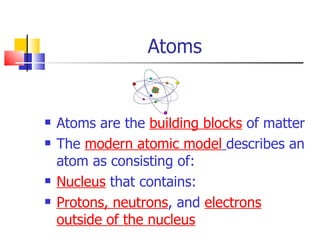
Atoms Atoms are the  building blocks  of matter The  modern atomic model   describes an atom as consisting of: Nucleus  that contains: Protons, neutrons , and  electrons outside of the nucleus
Sub atomic Particles Protons Found in the  nucleus Have a  positive charge (+) Each element in the periodic table has its own specific number of protons
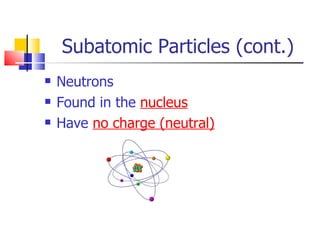
Subatomic Particles (cont.) Neutrons Found in the  nucleus Have  no charge (neutral)
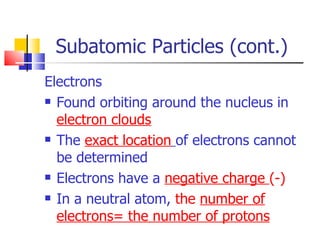
Subatomic Particles (cont.) Electrons Found orbiting around the nucleus in  electron clouds The  exact location   of electrons cannot be determined Electrons have a  negative charge  (-) In a neutral atom,  the  number of electrons= the number of protons
Atomic Number  Atomic number is: The  number of protons   in an element Every atom of a specific element has  the same number of protons Example: Hydrogen has  1 proton Carbon has  6 protons
Isotopes Isotopes of an element  are: Elements having the same number of  protons ,  but different  numbers neutrons Examples: Carbon  12 , 6 protons+  6   neutrons Carbon  13 , 6 protons+ 7 neutrons Carbon  14 ,  6  protons +   8  neutrons
Mass Number  Mass number is: The  number of protons   +  neutrons  in the  nucleus  of an atom
The Periodic Table  In 1869,  Dmitri Mendeleev   developed the first periodic table based on  atomic mass : (atomic mass=  #protons+#neutrons in the nucleus of the atom) In 1913,  Thomas Moseley  developed the modern periodic table based on  atomic number (atomic number= #protons in the nucleus of the atom)
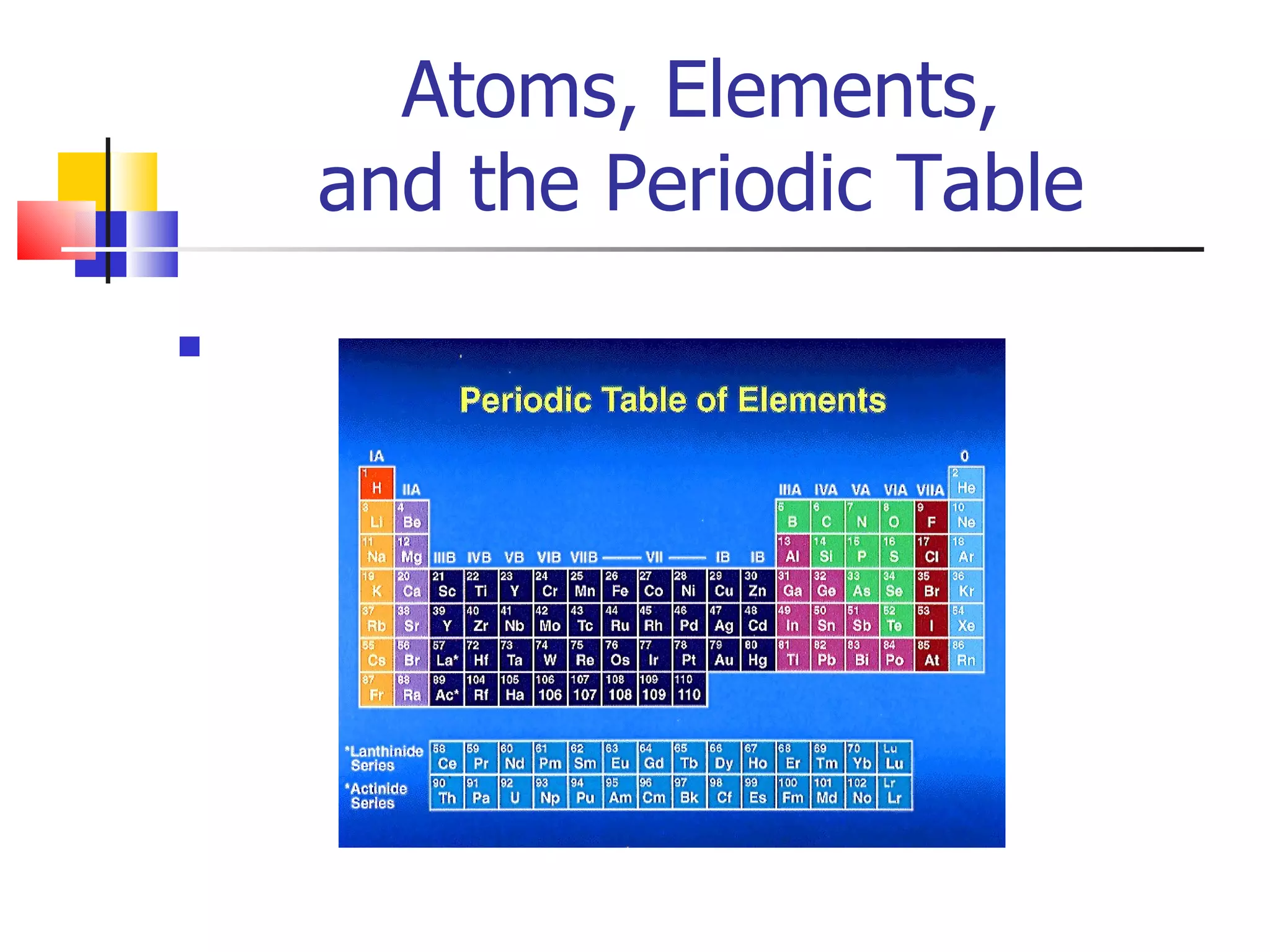
The Periodic Table (cont.)  Periodic  means: Repeating according to a pattern The modern periodic table is arranged in  columns   and  rows Columns   go up and down (think of columns on a building) Rows  go from left to right
The Periodic Table (cont.)   Groups or Families  Columns are called: Groups  or   Families There are  18   groups or families in the periodic table Elements in the  same group or family   have the same number of  valence electrons Valence electrons are the  number of electrons  in the  outer most energy level   Group 1 has 1 valence electron
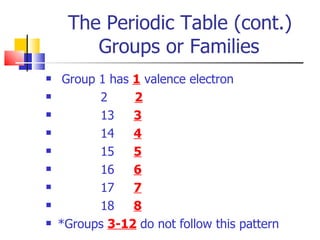
The Periodic Table (cont.)   Groups or Families  Group 1 has  1  valence electron 2  2 13  3 14  4 15  5 16  6 17  7 18  8 *Groups  3-12  do not follow this pattern
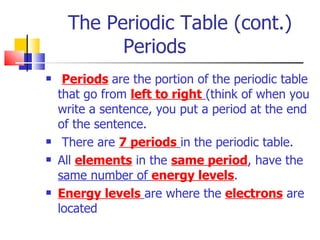
The Periodic Table (cont.)   Periods  Periods   are the portion of the periodic table that go from  left to right   (think of when you write a sentence, you put a period at the end of the sentence. There are  7 periods   in the periodic table. All  elements  in the  same period , have the  same number of  energy levels . Energy levels   are where the  electrons  are located
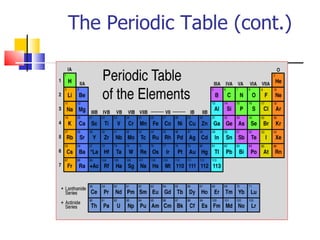
The Periodic Table (cont.)

Atoms, Elements, And Periodic Table 2010

  • 1.
    Atoms, Elements, andthe Periodic Table
  • 2.
    Atoms Atoms arethe building blocks of matter The modern atomic model describes an atom as consisting of: Nucleus that contains: Protons, neutrons , and electrons outside of the nucleus
  • 3.
    Sub atomic ParticlesProtons Found in the nucleus Have a positive charge (+) Each element in the periodic table has its own specific number of protons
  • 4.
    Subatomic Particles (cont.)Neutrons Found in the nucleus Have no charge (neutral)
  • 5.
    Subatomic Particles (cont.)Electrons Found orbiting around the nucleus in electron clouds The exact location of electrons cannot be determined Electrons have a negative charge (-) In a neutral atom, the number of electrons= the number of protons
  • 6.
    Atomic Number Atomic number is: The number of protons in an element Every atom of a specific element has the same number of protons Example: Hydrogen has 1 proton Carbon has 6 protons
  • 7.
    Isotopes Isotopes ofan element are: Elements having the same number of protons , but different numbers neutrons Examples: Carbon 12 , 6 protons+ 6 neutrons Carbon 13 , 6 protons+ 7 neutrons Carbon 14 , 6 protons + 8 neutrons
  • 8.
    Mass Number Mass number is: The number of protons + neutrons in the nucleus of an atom
  • 9.
    The Periodic Table In 1869, Dmitri Mendeleev developed the first periodic table based on atomic mass : (atomic mass= #protons+#neutrons in the nucleus of the atom) In 1913, Thomas Moseley developed the modern periodic table based on atomic number (atomic number= #protons in the nucleus of the atom)
  • 10.
    The Periodic Table(cont.) Periodic means: Repeating according to a pattern The modern periodic table is arranged in columns and rows Columns go up and down (think of columns on a building) Rows go from left to right
  • 11.
    The Periodic Table(cont.) Groups or Families Columns are called: Groups or Families There are 18 groups or families in the periodic table Elements in the same group or family have the same number of valence electrons Valence electrons are the number of electrons in the outer most energy level Group 1 has 1 valence electron
  • 12.
    The Periodic Table(cont.) Groups or Families Group 1 has 1 valence electron 2 2 13 3 14 4 15 5 16 6 17 7 18 8 *Groups 3-12 do not follow this pattern
  • 13.
    The Periodic Table(cont.) Periods Periods are the portion of the periodic table that go from left to right (think of when you write a sentence, you put a period at the end of the sentence. There are 7 periods in the periodic table. All elements in the same period , have the same number of energy levels . Energy levels are where the electrons are located
  • 14.