The Periodic Table
Why is the Periodic Table important
to me?
• The periodic table is the
most useful tool to a
chemist.
• You get to use it as a
reference or resource.
• It organizes lots of
information about all the
known elements.
Pre-Periodic Table Chemistry …
• …was a mess!!!
• No organization of
elements.
• Imagine going to a grocery
store with no organization!!
• Difficult to find information.
• Chemistry didn’t make
sense.
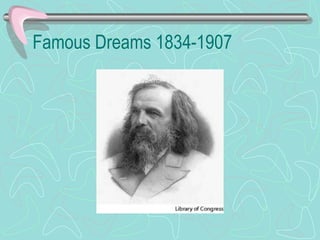
Famous Dreams 1834-1907
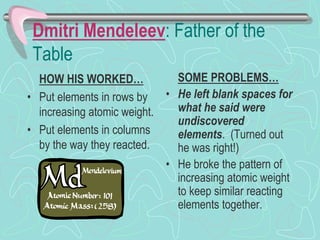
Dmitri Mendeleev: Father of the
Table
HOW HIS WORKED…
• Put elements in rows by
increasing atomic weight.
• Put elements in columns
by the way they reacted.
SOME PROBLEMS…
• He left blank spaces for
what he said were
undiscovered
elements. (Turned out
he was right!)
• He broke the pattern of
increasing atomic weight
to keep similar reacting
elements together.
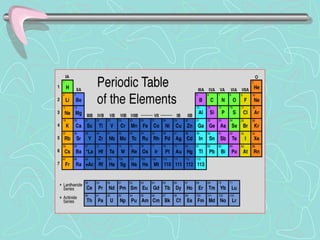
• Metals are on the left and non-metals are on the
right.
• Metalloids are along the diagonal line that
separates them and has properties of both
metals and non-metals.
The current table is organized by
increasing Atomic Number.
The Current Periodic Table
Periods on the periodic table go from
left to right. All of the elements in a
period have the same number of atomic
orbitals. Every element in the top row
has one orbital for it’s electrons. All of
the elements in the second row have
two orbitals for their electrons.
Review
• How many periods are on the periodic table?
• How many orbitals would all the elements in
period 4 have?
Groups…Here’s Where the Periodic
Table Gets Useful!!
• Elements in the
same group
have similar
chemical and
physical
properties!!
• (Mendeleev did that on purpose.)
Why??
• They have the same
number of valence
electrons.
• They will form the same
kinds of ions.
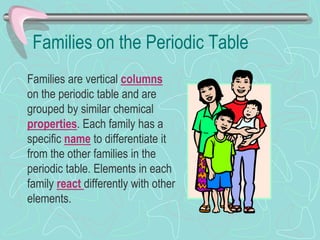
Families on the Periodic Table
Families are vertical columns
on the periodic table and are
grouped by similar chemical
properties. Each family has a
specific name to differentiate it
from the other families in the
periodic table. Elements in each
family react differently with other
elements.
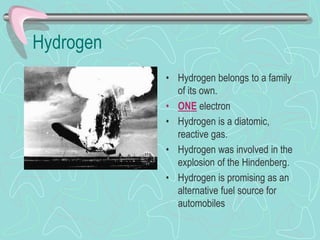
Hydrogen
• Hydrogen belongs to a family
of its own.
• ONE electron
• Hydrogen is a diatomic,
reactive gas.
• Hydrogen was involved in the
explosion of the Hindenberg.
• Hydrogen is promising as an
alternative fuel source for
automobiles
Alkali Metals
• 1st column on the
periodic table (Group 1)
not including hydrogen.
• Very reactive metals,
always combined with
something else in nature
(like in salt).
• Soft enough to cut with a
butter knife
Alkaline Earth Metals
• TWO electrons
• Reactive metals that are
always combined with
nonmetals in nature.
• Several of these
elements are important
mineral nutrients (such
as Mg and Ca
• Conduct electricity
Transition Metals
• Elements in groups 3-12
Good conductors of heat
and electricity
• Includes metals used in
jewelry and
construction.
• Metals used “as metal.”
Boron Family
• Elements in group 13
• 3 electrons
• Most are metals
• Aluminum metal was
once rare and
expensive, not a
“disposable metal.”
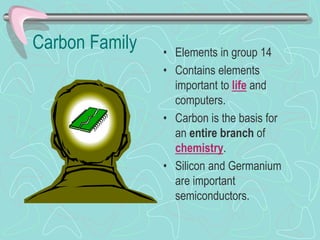
Carbon Family • Elements in group 14
• Contains elements
important to life and
computers.
• Carbon is the basis for
an entire branch of
chemistry.
• Silicon and Germanium
are important
semiconductors.
Review
• Name three ways
groups 1, 2 and
transition are used in
everyday life?
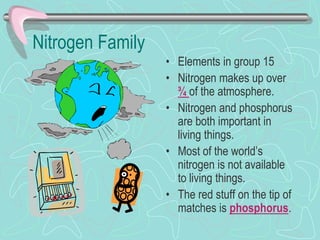
Nitrogen Family
• Elements in group 15
• Nitrogen makes up over
¾ of the atmosphere.
• Nitrogen and phosphorus
are both important in
living things.
• Most of the world’s
nitrogen is not available
to living things.
• The red stuff on the tip of
matches is phosphorus.
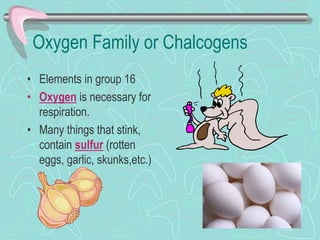
Oxygen Family or Chalcogens
• Elements in group 16
• Oxygen is necessary for
respiration.
• Many things that stink,
contain sulfur (rotten
eggs, garlic, skunks,etc.)
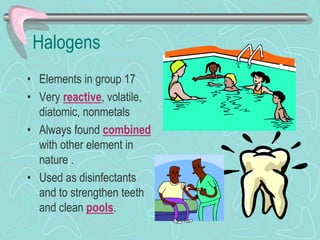
Halogens
• Elements in group 17
• Very reactive, volatile,
diatomic, nonmetals
• Always found combined
with other element in
nature .
• Used as disinfectants
and to strengthen teeth
and clean pools.
The Noble Gases
The Noble Gases
• Elements in group 18
• Non-reactive,
monatomic gases
• Used in lighted “neon”
signs
• Used in blimps to fix the
Hindenberg problem.
• Have a full valence shell.
Review
• Which family is the
MOST reactive?
• Which family is the
LEAST reactive?
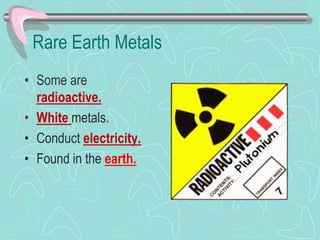
Rare Earth Metals
• Some are
radioactive.
• White metals.
• Conduct electricity.
• Found in the earth.

periodictablepowerpoint.ppt

  • 1.
  • 3.
    Why is thePeriodic Table important to me? • The periodic table is the most useful tool to a chemist. • You get to use it as a reference or resource. • It organizes lots of information about all the known elements.
  • 4.
    Pre-Periodic Table Chemistry… • …was a mess!!! • No organization of elements. • Imagine going to a grocery store with no organization!! • Difficult to find information. • Chemistry didn’t make sense.
  • 5.
  • 6.
    Dmitri Mendeleev: Fatherof the Table HOW HIS WORKED… • Put elements in rows by increasing atomic weight. • Put elements in columns by the way they reacted. SOME PROBLEMS… • He left blank spaces for what he said were undiscovered elements. (Turned out he was right!) • He broke the pattern of increasing atomic weight to keep similar reacting elements together.
  • 7.
    • Metals areon the left and non-metals are on the right. • Metalloids are along the diagonal line that separates them and has properties of both metals and non-metals. The current table is organized by increasing Atomic Number.
  • 8.
    The Current PeriodicTable Periods on the periodic table go from left to right. All of the elements in a period have the same number of atomic orbitals. Every element in the top row has one orbital for it’s electrons. All of the elements in the second row have two orbitals for their electrons.
  • 9.
    Review • How manyperiods are on the periodic table? • How many orbitals would all the elements in period 4 have?
  • 10.
    Groups…Here’s Where thePeriodic Table Gets Useful!! • Elements in the same group have similar chemical and physical properties!! • (Mendeleev did that on purpose.) Why?? • They have the same number of valence electrons. • They will form the same kinds of ions.
  • 11.
    Families on thePeriodic Table Families are vertical columns on the periodic table and are grouped by similar chemical properties. Each family has a specific name to differentiate it from the other families in the periodic table. Elements in each family react differently with other elements.
  • 12.
    Hydrogen • Hydrogen belongsto a family of its own. • ONE electron • Hydrogen is a diatomic, reactive gas. • Hydrogen was involved in the explosion of the Hindenberg. • Hydrogen is promising as an alternative fuel source for automobiles
  • 13.
    Alkali Metals • 1stcolumn on the periodic table (Group 1) not including hydrogen. • Very reactive metals, always combined with something else in nature (like in salt). • Soft enough to cut with a butter knife
  • 14.
    Alkaline Earth Metals •TWO electrons • Reactive metals that are always combined with nonmetals in nature. • Several of these elements are important mineral nutrients (such as Mg and Ca • Conduct electricity
  • 15.
    Transition Metals • Elementsin groups 3-12 Good conductors of heat and electricity • Includes metals used in jewelry and construction. • Metals used “as metal.”
  • 16.
    Boron Family • Elementsin group 13 • 3 electrons • Most are metals • Aluminum metal was once rare and expensive, not a “disposable metal.”
  • 17.
    Carbon Family •Elements in group 14 • Contains elements important to life and computers. • Carbon is the basis for an entire branch of chemistry. • Silicon and Germanium are important semiconductors.
  • 18.
    Review • Name threeways groups 1, 2 and transition are used in everyday life?
  • 19.
    Nitrogen Family • Elementsin group 15 • Nitrogen makes up over ¾ of the atmosphere. • Nitrogen and phosphorus are both important in living things. • Most of the world’s nitrogen is not available to living things. • The red stuff on the tip of matches is phosphorus.
  • 20.
    Oxygen Family orChalcogens • Elements in group 16 • Oxygen is necessary for respiration. • Many things that stink, contain sulfur (rotten eggs, garlic, skunks,etc.)
  • 21.
    Halogens • Elements ingroup 17 • Very reactive, volatile, diatomic, nonmetals • Always found combined with other element in nature . • Used as disinfectants and to strengthen teeth and clean pools.
  • 22.
  • 23.
    The Noble Gases •Elements in group 18 • Non-reactive, monatomic gases • Used in lighted “neon” signs • Used in blimps to fix the Hindenberg problem. • Have a full valence shell.
  • 24.
    Review • Which familyis the MOST reactive? • Which family is the LEAST reactive?
  • 25.
    Rare Earth Metals •Some are radioactive. • White metals. • Conduct electricity. • Found in the earth.