The Periodic Table of The Elements
Elements are like a collection As more and more elements were discovered it became more important to  organize  and  classify  them
Between the late 1700’s and mid 1800’s scientists, using mostly atomic spectroscopy, doubled the number of known elements.
In early 1800’s, German chemist J.W. Dobereiner observed that several of the elements could be classified into groups of three which he called triads
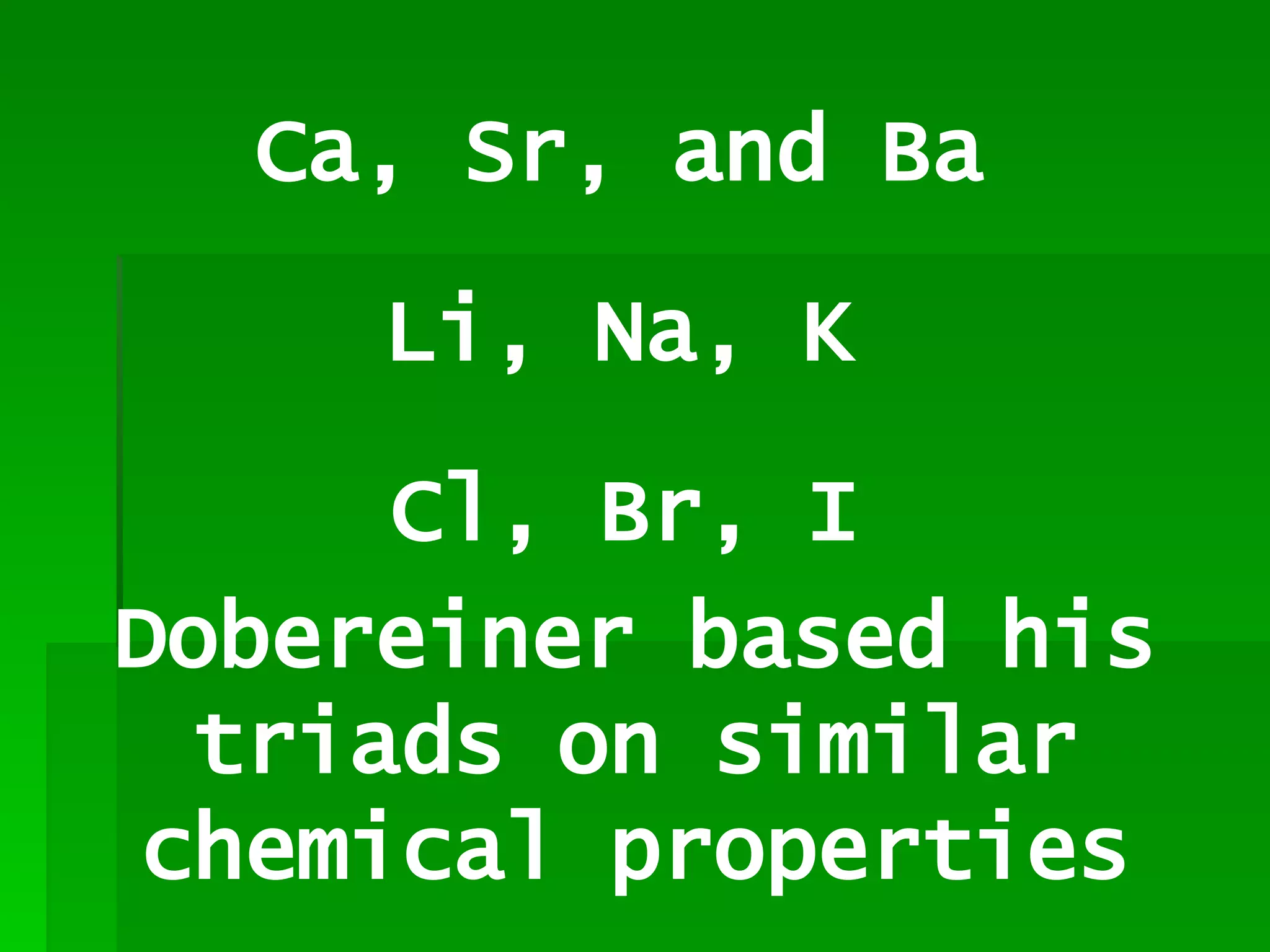
Ca, Sr, and Ba Li, Na, K Cl, Br, I Dobereiner based his triads on similar chemical properties
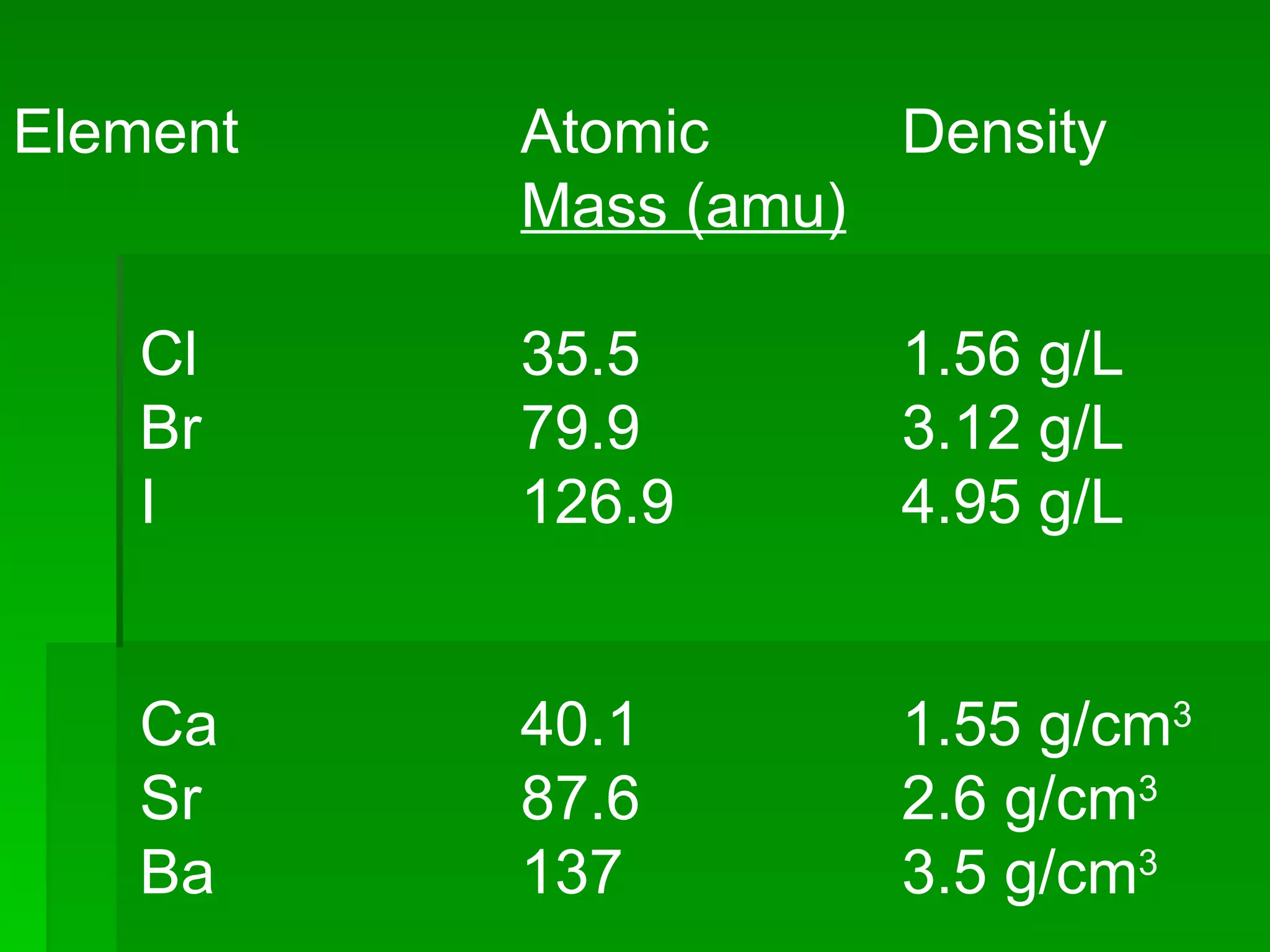
In addition: Many of the properties of the middle element in each triad are approximate averages of the properties of the first and third element
Element Atomic Density Mass (amu) Cl 35.5 1.56 g/L Br 79.9 3.12 g/L I 126.9 4.95 g/L Ca 40.1 1.55 g/cm 3 Sr 87.6 2.6 g/cm 3 Ba 137 3.5 g/cm 3
In 1865, English chemist J.A.R Newlands presented another way to classify and organize the 62 elements known at the time
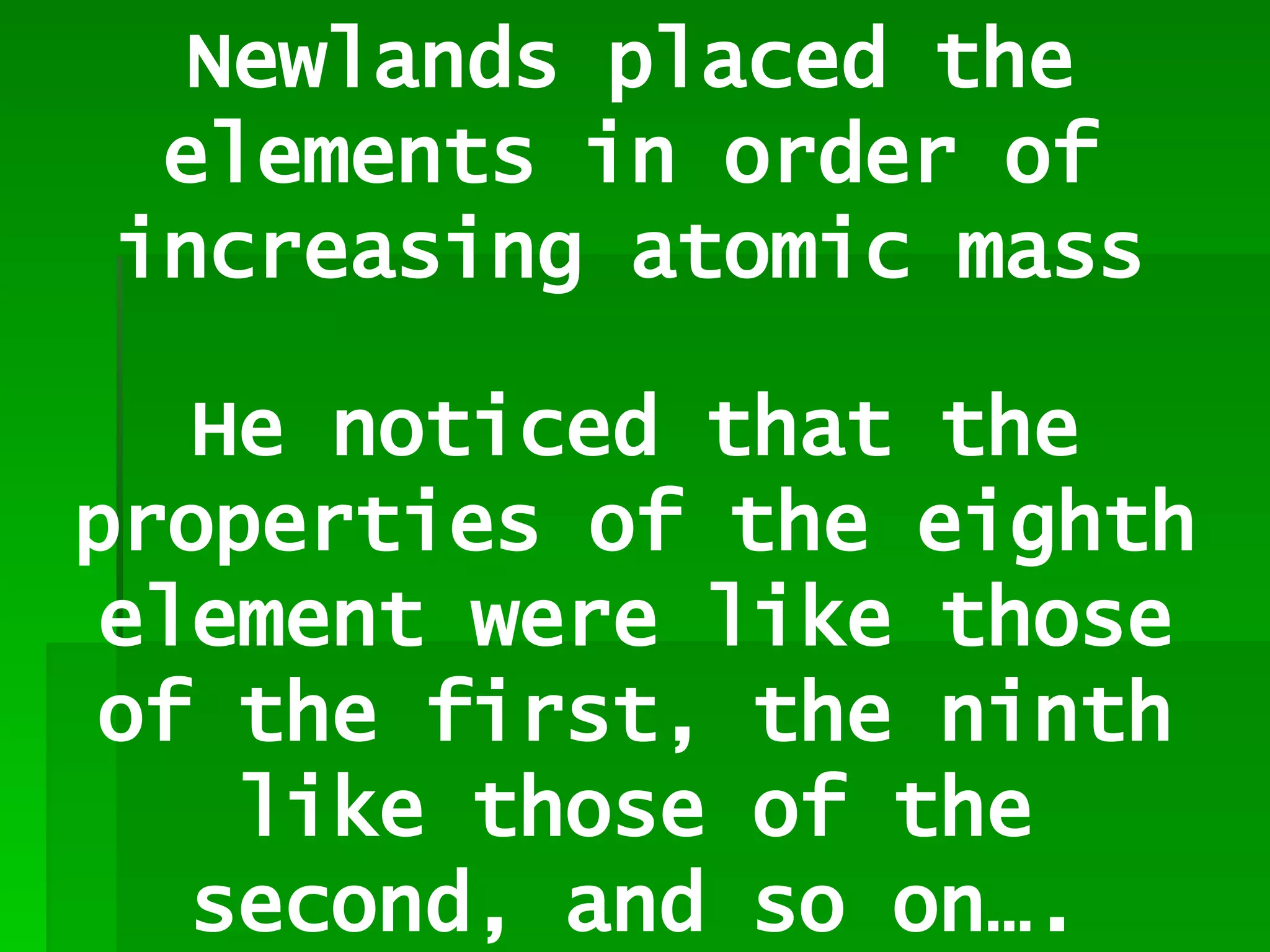
Newlands placed the elements in order of increasing atomic mass He noticed that the properties of the eighth element were like those of the first, the ninth like those of the second, and so on….
He called this repeating pattern of every eight elements   THE LAW OF OCTAVES After the eight notes of the musical scale
Because he linked chemistry to music, he was not taken seriously! It took 20 years for him to receive credit for recognizing periodicity
In 1869 Russian Chemist Dimitri Mendeleev and German chemist Lothar Meyer published nearly identical ways of classifying
But Mendeleev is generally more credited with the 1 st  periodic table for 2 reasons: He published first He was better at explaining it than Meyer
Mendeleev also saw the “periods” Credited with publishing the first “periodic table”
 
Mendeleev got lots of credit because he left gaps for missing elements!
In 1913, English Chemist James Moseley Presented a way of organizing the elements that we still use today.
Moseley was the first to put the elements in order of increasing Atomic #
Atomic # represents the number of protons in the nucleus of each element
When he did this, he saw the same repeating periodic pattern, without the exceptions that Mendeleev had to switch around
Periodic Law When the elements are arranged in increasing order by their atomic numbers, their properties repeat periodically
The Modern Periodic Table
Each Square Tells about a different element H Element Symbol Hydrogen Element Name Not always there 1 Atomic Number Represents the number of PROTONS in each atom of this element 1.009 Atomic Mass Represents the number of PROTONS AND AVERAGE NUMBER OF NEUTRONS in each atom of this element
Atomic Number 1: 1 proton (positive charge particles) in nucleus of EVERY hydrogen atom Atomic Number 1: ALSO means 1 electron (negatively charged particle) OUTSIDE the nucleus Atoms are NEUTRAL: Same number of positives as negatives  Atomic Mass of 1.009 means that there is an average of 1.009 PROTONS AND NEUTRONS in the nucleus… Since there is already 1 proton (AND THAT CAN NOT CHANGE AND STILL BE HYDROGEN) That means that the average atom of Hydrogen has 0 Neutrons! H Hydrogen 1 1.009
Let’s do another 4 Particles  2 MUST BE Protons 4-2 = 2 Neutrons in nucleus He Helium 2 4.003
Each block tells us about the element… The periodic table arranges the elements into rows and columns based on similarities
Vertical columns are called groups. Elements are placed in columns by similar properties. Also called families
Alkali Metals Group 1 ALL elements in Group 1 have 1 electron in their outer region
Alkali Earth Metals Group 2 ALL elements in Group 2 have 2 electrons in their outer region
Boron Family Group 13 ALL elements in Group 13 have 3 electrons in their outer region
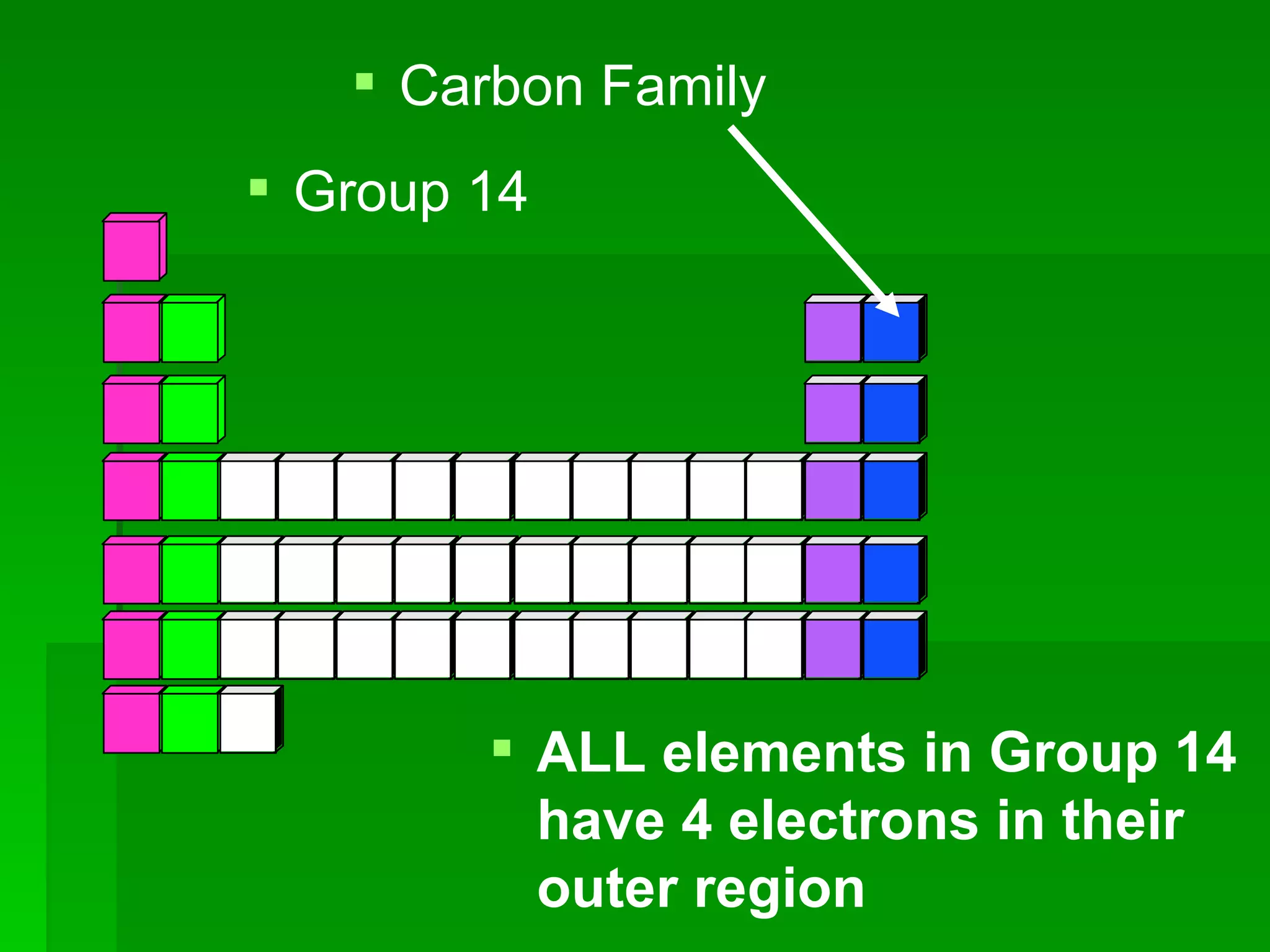
Carbon Family Group 14 ALL elements in Group 14 have 4 electrons in their outer region
Nitrogen Family Group 15 ALL elements in Group 15 have 5 electrons in their outer region
Oxygen Family A.K.A. the Chalcogens Group 16 ALL elements in Group 16 have 6 electrons in their outer region
Halogens Group 17 ALL elements in Group 17 have 7 electrons in their outer region
Noble Gasses Group 18 ALL elements in Group 18 have 8 electrons in their outer region
Lanthanide Series Actinide Series
Horizontal rows are called  “Periods” Each period also shows something in common
 
Period 1 Each element has one region of space for electrons around it
Period 2 Each element in this period has two regions of space around it for  electrons
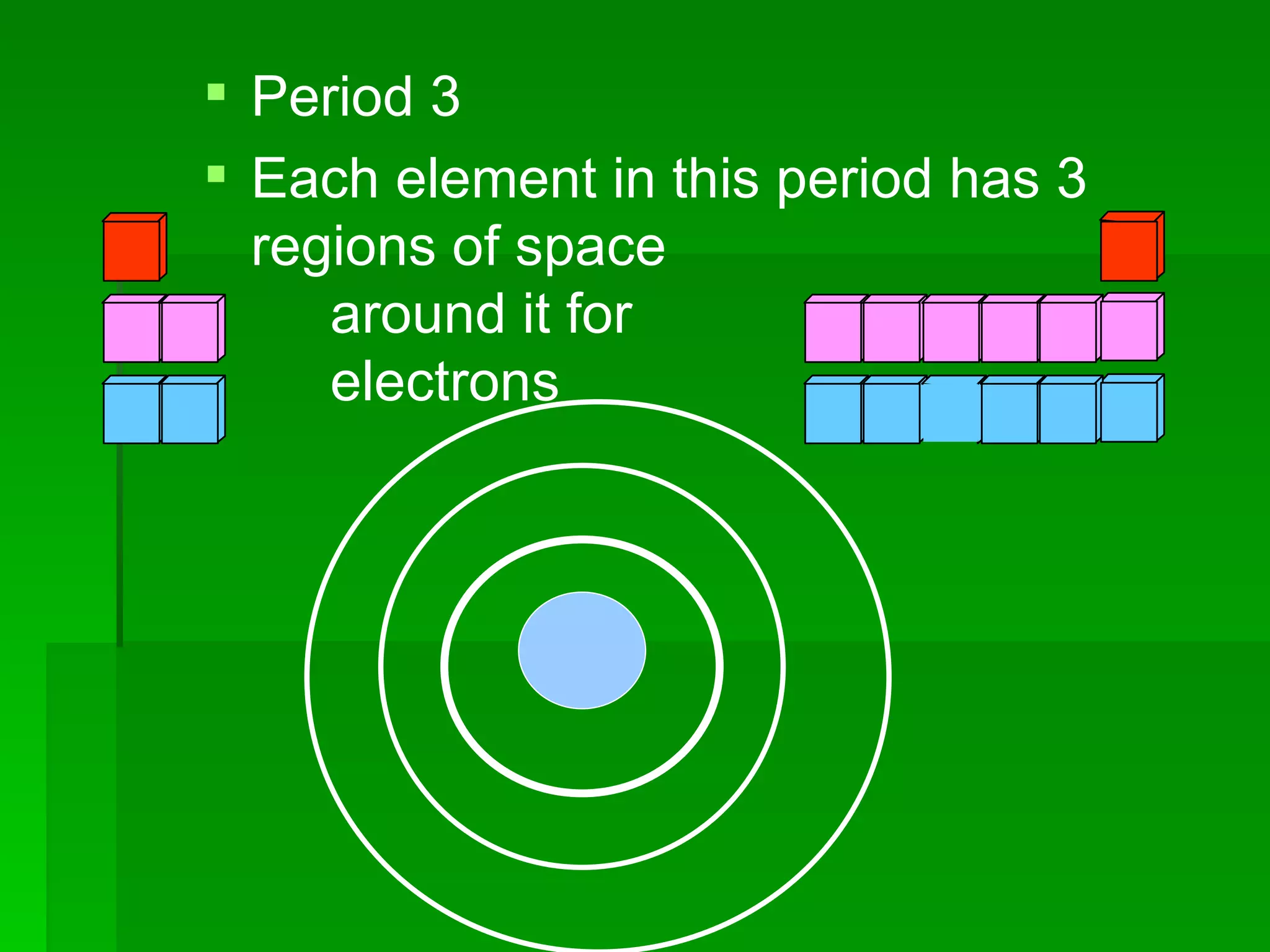
Period 3 Each element in this period has 3 regions of space around it for  electrons
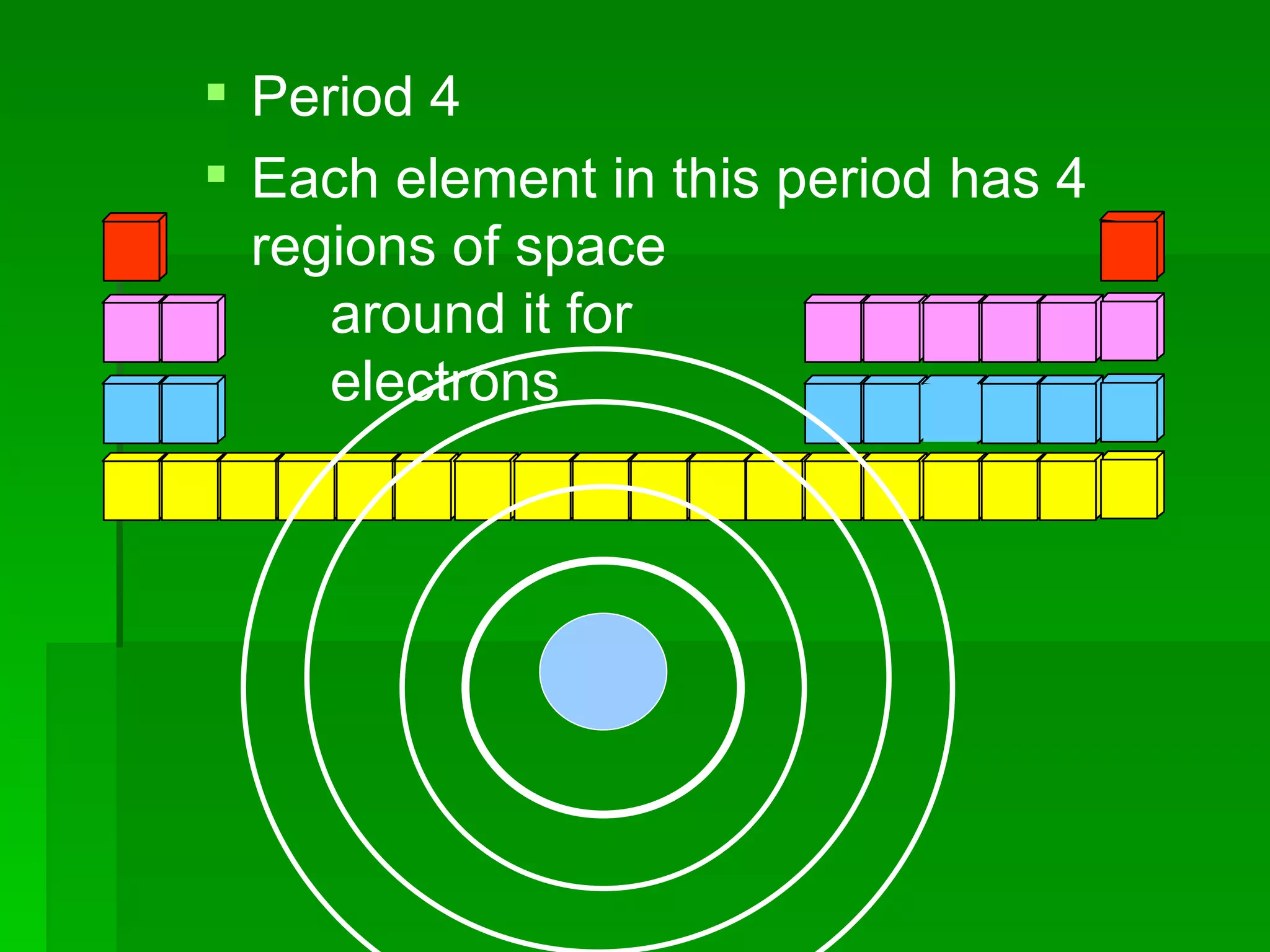
Period 4 Each element in this period has 4 regions of space around it for  electrons
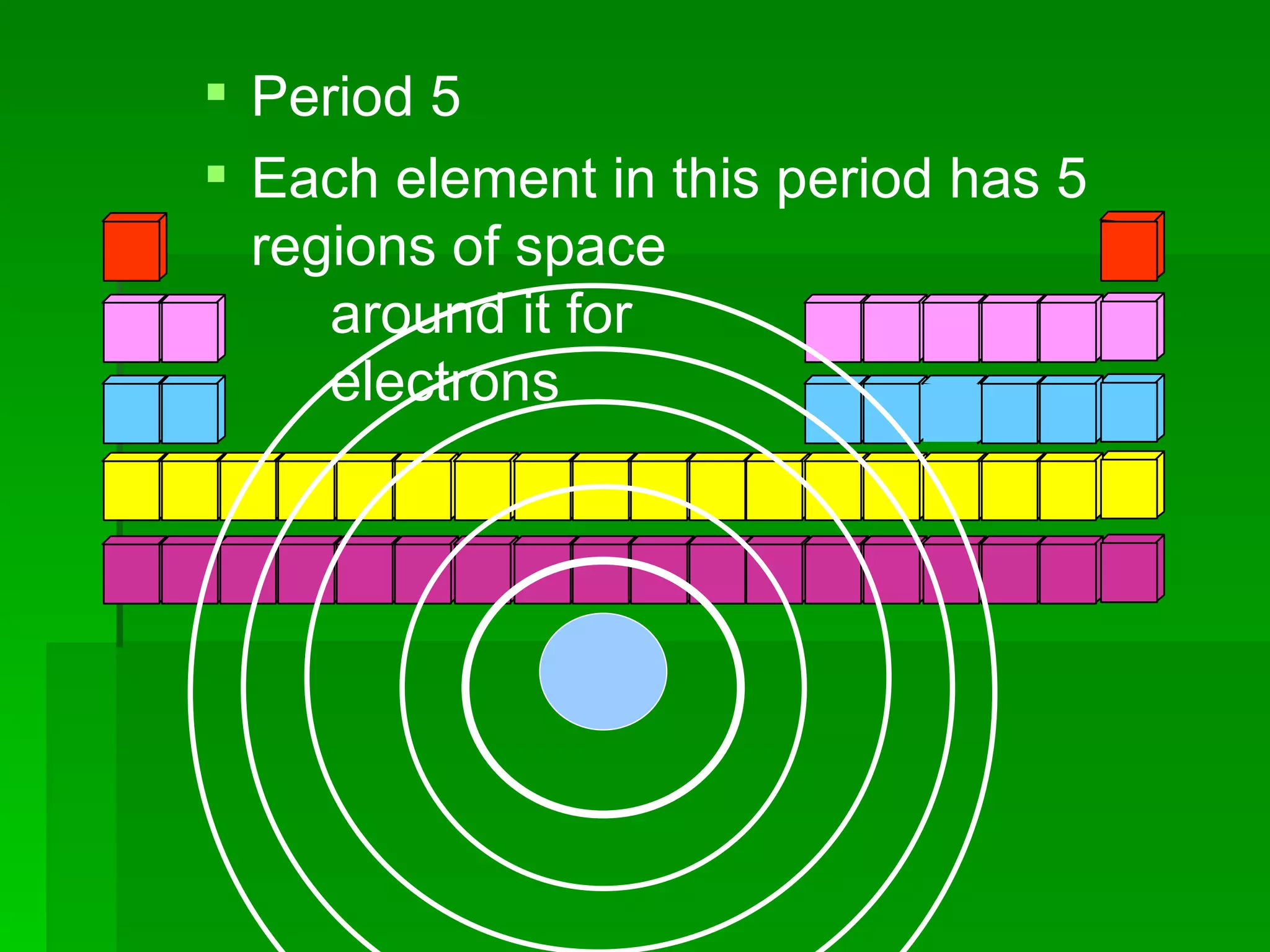
Period 5 Each element in this period has 5 regions of space around it for  electrons
Period 6 Each element in this period has 6 regions of space around it for  electrons The Lanthanides are part of period 6
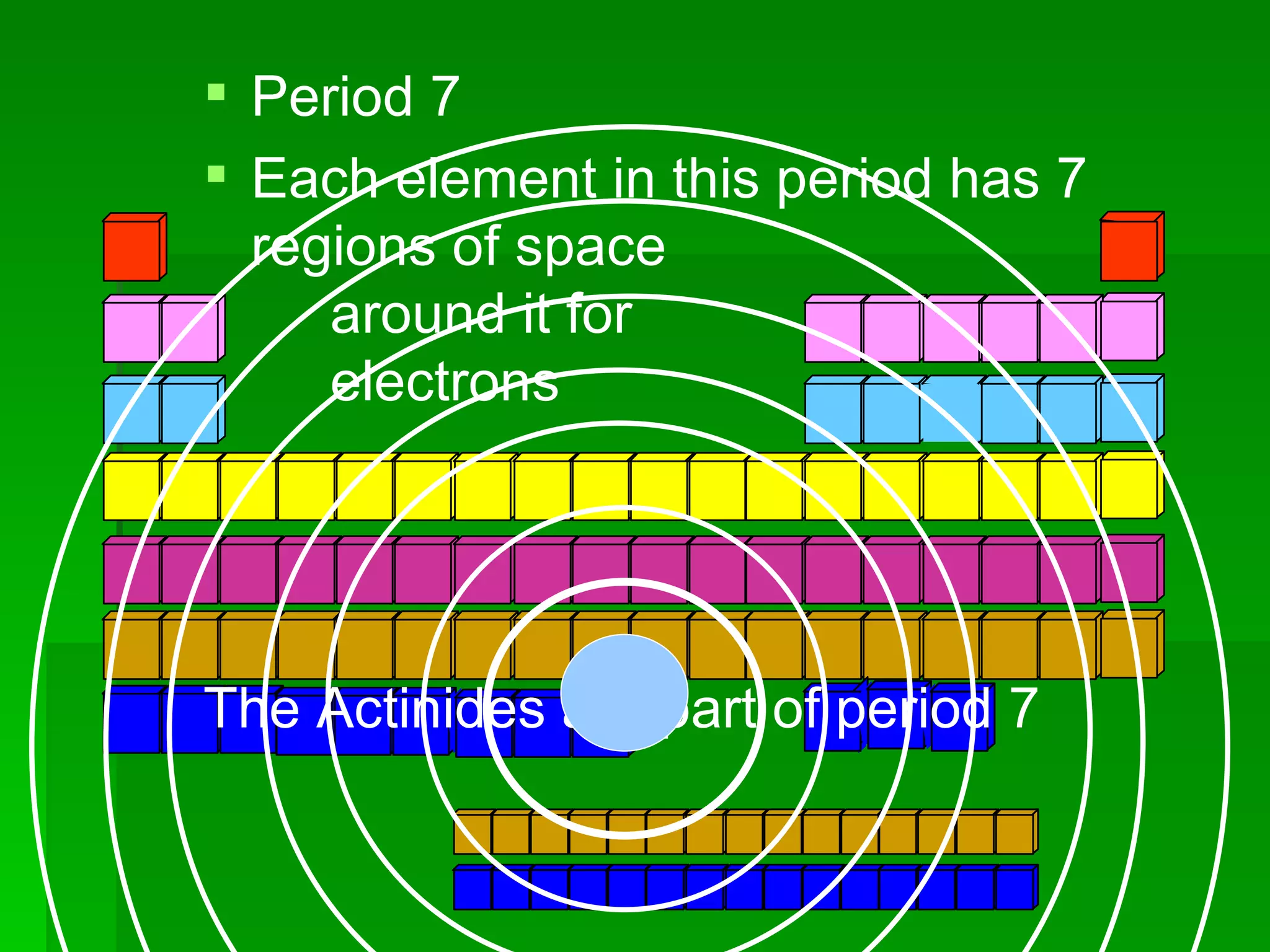
Period 7 Each element in this period has 7 regions of space around it for  electrons The Actinides are part of period 7
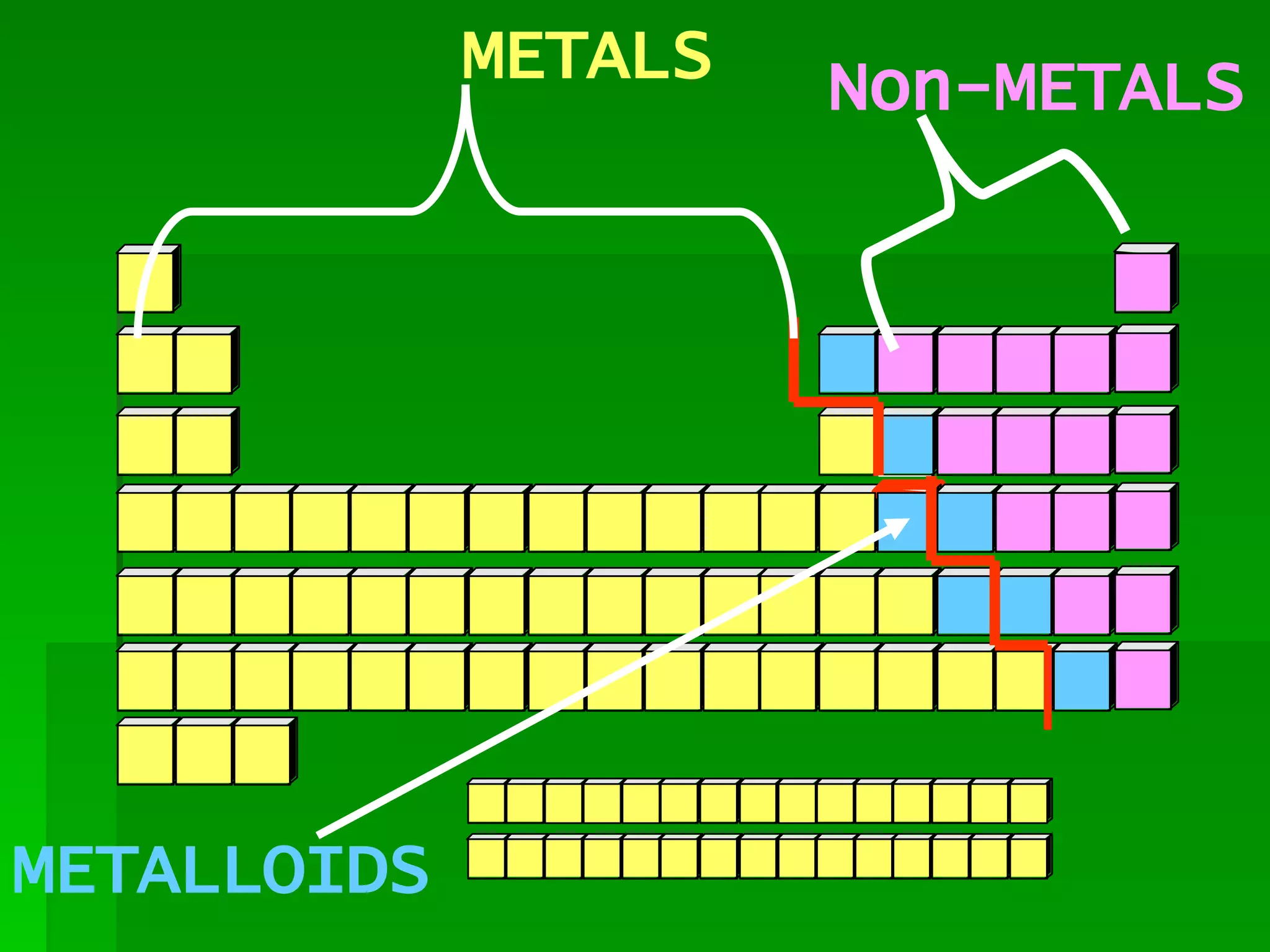
The periodic table can also show larger “Groups”
METALS Non-METALS METALLOIDS
Tall columns are collectively referred to as the “representative elements”
Short, center groups are collectively referred to as the “transition elements”
Two long rows on bottom are collectively referred to as the “inner transition metals”
Periodic Trends
Atomic Size First problem where do you start measuring. The electron cloud doesn’t have a definite edge. They get around this by measuring more than 1 atom at a time.
Atomic Size Atomic Radius = half the distance between two nuclei of a diatomic molecule. } Radius
Trends in Atomic Size  Influenced by two factors. Energy Level Higher energy level is further away. Charge on nucleus More charge pulls electrons in closer.
Group trends As we go down a group Each atom has another energy level, So the atoms get bigger. H Li Na K Rb
Periodic Trends As you go across a period the radius gets smaller. Same energy level. More nuclear charge. Outermost electrons are closer. Na Mg Al Si P S Cl Ar

The Periodic Table

  • 1.
    The Periodic Tableof The Elements
  • 2.
    Elements are likea collection As more and more elements were discovered it became more important to organize and classify them
  • 3.
    Between the late1700’s and mid 1800’s scientists, using mostly atomic spectroscopy, doubled the number of known elements.
  • 4.
    In early 1800’s,German chemist J.W. Dobereiner observed that several of the elements could be classified into groups of three which he called triads
  • 5.
    Ca, Sr, andBa Li, Na, K Cl, Br, I Dobereiner based his triads on similar chemical properties
  • 6.
    In addition: Manyof the properties of the middle element in each triad are approximate averages of the properties of the first and third element
  • 7.
    Element Atomic DensityMass (amu) Cl 35.5 1.56 g/L Br 79.9 3.12 g/L I 126.9 4.95 g/L Ca 40.1 1.55 g/cm 3 Sr 87.6 2.6 g/cm 3 Ba 137 3.5 g/cm 3
  • 8.
    In 1865, Englishchemist J.A.R Newlands presented another way to classify and organize the 62 elements known at the time
  • 9.
    Newlands placed theelements in order of increasing atomic mass He noticed that the properties of the eighth element were like those of the first, the ninth like those of the second, and so on….
  • 10.
    He called thisrepeating pattern of every eight elements THE LAW OF OCTAVES After the eight notes of the musical scale
  • 11.
    Because he linkedchemistry to music, he was not taken seriously! It took 20 years for him to receive credit for recognizing periodicity
  • 12.
    In 1869 RussianChemist Dimitri Mendeleev and German chemist Lothar Meyer published nearly identical ways of classifying
  • 13.
    But Mendeleev isgenerally more credited with the 1 st periodic table for 2 reasons: He published first He was better at explaining it than Meyer
  • 14.
    Mendeleev also sawthe “periods” Credited with publishing the first “periodic table”
  • 15.
  • 16.
    Mendeleev got lotsof credit because he left gaps for missing elements!
  • 17.
    In 1913, EnglishChemist James Moseley Presented a way of organizing the elements that we still use today.
  • 18.
    Moseley was thefirst to put the elements in order of increasing Atomic #
  • 19.
    Atomic # representsthe number of protons in the nucleus of each element
  • 20.
    When he didthis, he saw the same repeating periodic pattern, without the exceptions that Mendeleev had to switch around
  • 21.
    Periodic Law Whenthe elements are arranged in increasing order by their atomic numbers, their properties repeat periodically
  • 22.
  • 23.
    Each Square Tellsabout a different element H Element Symbol Hydrogen Element Name Not always there 1 Atomic Number Represents the number of PROTONS in each atom of this element 1.009 Atomic Mass Represents the number of PROTONS AND AVERAGE NUMBER OF NEUTRONS in each atom of this element
  • 24.
    Atomic Number 1:1 proton (positive charge particles) in nucleus of EVERY hydrogen atom Atomic Number 1: ALSO means 1 electron (negatively charged particle) OUTSIDE the nucleus Atoms are NEUTRAL: Same number of positives as negatives Atomic Mass of 1.009 means that there is an average of 1.009 PROTONS AND NEUTRONS in the nucleus… Since there is already 1 proton (AND THAT CAN NOT CHANGE AND STILL BE HYDROGEN) That means that the average atom of Hydrogen has 0 Neutrons! H Hydrogen 1 1.009
  • 25.
    Let’s do another4 Particles 2 MUST BE Protons 4-2 = 2 Neutrons in nucleus He Helium 2 4.003
  • 26.
    Each block tellsus about the element… The periodic table arranges the elements into rows and columns based on similarities
  • 27.
    Vertical columns arecalled groups. Elements are placed in columns by similar properties. Also called families
  • 28.
    Alkali Metals Group1 ALL elements in Group 1 have 1 electron in their outer region
  • 29.
    Alkali Earth MetalsGroup 2 ALL elements in Group 2 have 2 electrons in their outer region
  • 30.
    Boron Family Group13 ALL elements in Group 13 have 3 electrons in their outer region
  • 31.
    Carbon Family Group14 ALL elements in Group 14 have 4 electrons in their outer region
  • 32.
    Nitrogen Family Group15 ALL elements in Group 15 have 5 electrons in their outer region
  • 33.
    Oxygen Family A.K.A.the Chalcogens Group 16 ALL elements in Group 16 have 6 electrons in their outer region
  • 34.
    Halogens Group 17ALL elements in Group 17 have 7 electrons in their outer region
  • 35.
    Noble Gasses Group18 ALL elements in Group 18 have 8 electrons in their outer region
  • 36.
  • 37.
    Horizontal rows arecalled “Periods” Each period also shows something in common
  • 38.
  • 39.
    Period 1 Eachelement has one region of space for electrons around it
  • 40.
    Period 2 Eachelement in this period has two regions of space around it for electrons
  • 41.
    Period 3 Eachelement in this period has 3 regions of space around it for electrons
  • 42.
    Period 4 Eachelement in this period has 4 regions of space around it for electrons
  • 43.
    Period 5 Eachelement in this period has 5 regions of space around it for electrons
  • 44.
    Period 6 Eachelement in this period has 6 regions of space around it for electrons The Lanthanides are part of period 6
  • 45.
    Period 7 Eachelement in this period has 7 regions of space around it for electrons The Actinides are part of period 7
  • 46.
    The periodic tablecan also show larger “Groups”
  • 47.
  • 48.
    Tall columns arecollectively referred to as the “representative elements”
  • 49.
    Short, center groupsare collectively referred to as the “transition elements”
  • 50.
    Two long rowson bottom are collectively referred to as the “inner transition metals”
  • 51.
  • 52.
    Atomic Size Firstproblem where do you start measuring. The electron cloud doesn’t have a definite edge. They get around this by measuring more than 1 atom at a time.
  • 53.
    Atomic Size AtomicRadius = half the distance between two nuclei of a diatomic molecule. } Radius
  • 54.
    Trends in AtomicSize Influenced by two factors. Energy Level Higher energy level is further away. Charge on nucleus More charge pulls electrons in closer.
  • 55.
    Group trends Aswe go down a group Each atom has another energy level, So the atoms get bigger. H Li Na K Rb
  • 56.
    Periodic Trends Asyou go across a period the radius gets smaller. Same energy level. More nuclear charge. Outermost electrons are closer. Na Mg Al Si P S Cl Ar