1 of 16 © Boardworks Ltd 2009
2 of 16 © Boardworks Ltd 2009
Reactions of the halogens
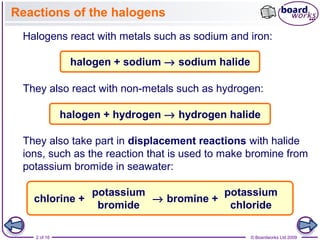
Halogens react with metals such as sodium and iron:
They also take part in displacement reactions with halide
ions, such as the reaction that is used to make bromine from
potassium bromide in seawater:
halogen + hydrogen → hydrogen halide
They also react with non-metals such as hydrogen:
halogen + sodium → sodium halide
chlorine +
potassium
bromide
potassium
chloride
→ bromine +
3 of 16 © Boardworks Ltd 2009
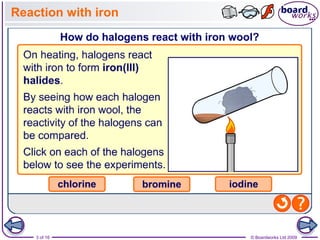
Reaction with iron
4 of 16 © Boardworks Ltd 2009
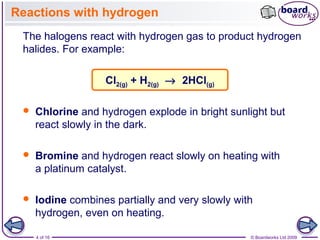
Reactions with hydrogen
 Chlorine and hydrogen explode in bright sunlight but
react slowly in the dark.
The halogens react with hydrogen gas to product hydrogen
halides. For example:
Cl2(g) + H2(g) → 2HCl(g)
 Iodine combines partially and very slowly with
hydrogen, even on heating.
 Bromine and hydrogen react slowly on heating with
a platinum catalyst.
5 of 16 © Boardworks Ltd 2009
Redox reactions of halogens
6 of 16 © Boardworks Ltd 2009
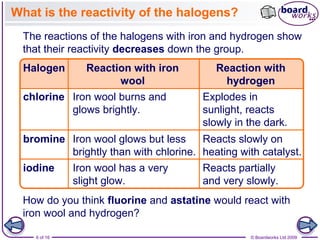
What is the reactivity of the halogens?
The reactions of the halogens with iron and hydrogen show
that their reactivity decreases down the group.
How do you think fluorine and astatine would react with
iron wool and hydrogen?
Iron wool burns and
glows brightly.
Iron wool has a very
slight glow.
Iron wool glows but less
brightly than with chlorine.
chlorine
bromine
iodine
Halogen Reaction with iron
wool
Reaction with
hydrogen
Explodes in
sunlight, reacts
slowly in the dark.
Reacts slowly on
heating with catalyst.
Reacts partially
and very slowly.
7 of 16 © Boardworks Ltd 2009
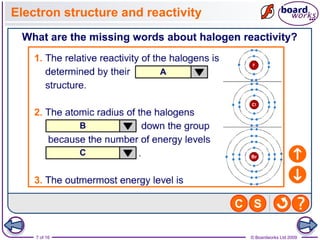
Electron structure and reactivity
8 of 16 © Boardworks Ltd 2009
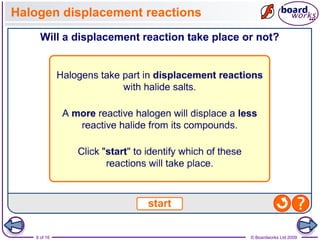
Halogen displacement reactions
9 of 16 © Boardworks Ltd 2009
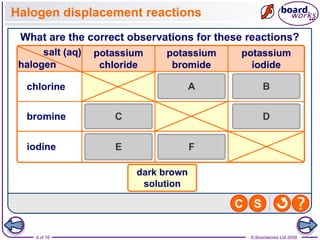
Halogen displacement reactions
10 of 16 © Boardworks Ltd 2009
Halogen displacement reactions
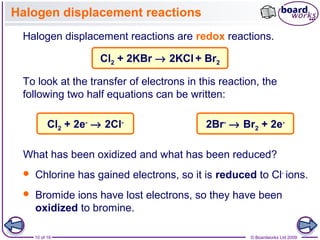
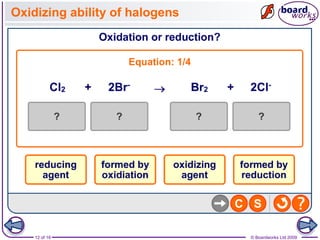
Halogen displacement reactions are redox reactions.
Cl2 + 2KBr → 2KCl + Br2
To look at the transfer of electrons in this reaction, the
following two half equations can be written:
 Chlorine has gained electrons, so it is reduced to Cl-
ions.
What has been oxidized and what has been reduced?
2Br-
→ Br2 + 2e-
Cl2 + 2e-
→ 2Cl-
 Bromide ions have lost electrons, so they have been
oxidized to bromine.
11 of 16 © Boardworks Ltd 2009
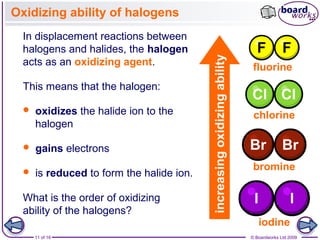
Oxidizing ability of halogens
fluorine
increasingoxidizingability iodine
bromine
chlorine
In displacement reactions between
halogens and halides, the halogen
acts as an oxidizing agent.
This means that the halogen:
What is the order of oxidizing
ability of the halogens?
 is reduced to form the halide ion.
 gains electrons
 oxidizes the halide ion to the
halogen
12 of 16 © Boardworks Ltd 2009
Oxidizing ability of halogens
13 of 16 © Boardworks Ltd 2009
Chlorine and disproportionation
14 of 16 © Boardworks Ltd 2009
Reaction of chlorine with water
Chlorination of drinking water raises questions about individual
freedom because it makes it difficult for individuals to opt out.
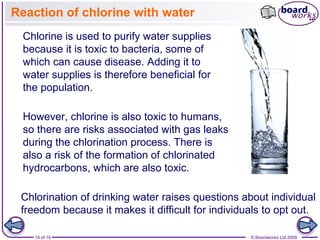
Chlorine is used to purify water supplies
because it is toxic to bacteria, some of
which can cause disease. Adding it to
water supplies is therefore beneficial for
the population.
However, chlorine is also toxic to humans,
so there are risks associated with gas leaks
during the chlorination process. There is
also a risk of the formation of chlorinated
hydrocarbons, which are also toxic.
15 of 16 © Boardworks Ltd 2009
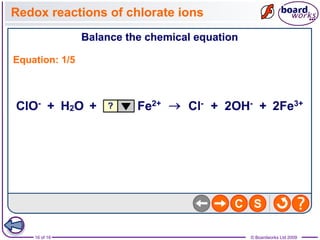
Bleach and the chlorate(I) ion
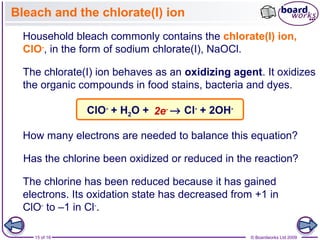
Household bleach commonly contains the chlorate(I) ion,
ClO-
, in the form of sodium chlorate(I), NaOCl.
ClO-
+ H2O + → Cl-
+ 2OH-
The chlorine has been reduced because it has gained
electrons. Its oxidation state has decreased from +1 in
ClO-
to –1 in Cl-
.
How many electrons are needed to balance this equation?
The chlorate(I) ion behaves as an oxidizing agent. It oxidizes
the organic compounds in food stains, bacteria and dyes.
Has the chlorine been oxidized or reduced in the reaction?
2e-
16 of 16 © Boardworks Ltd 2009
Redox reactions of chlorate ions

Halogens part 2 chemical properties

  • 1.
    1 of 16© Boardworks Ltd 2009
  • 2.
    2 of 16© Boardworks Ltd 2009 Reactions of the halogens Halogens react with metals such as sodium and iron: They also take part in displacement reactions with halide ions, such as the reaction that is used to make bromine from potassium bromide in seawater: halogen + hydrogen → hydrogen halide They also react with non-metals such as hydrogen: halogen + sodium → sodium halide chlorine + potassium bromide potassium chloride → bromine +
  • 3.
    3 of 16© Boardworks Ltd 2009 Reaction with iron
  • 4.
    4 of 16© Boardworks Ltd 2009 Reactions with hydrogen  Chlorine and hydrogen explode in bright sunlight but react slowly in the dark. The halogens react with hydrogen gas to product hydrogen halides. For example: Cl2(g) + H2(g) → 2HCl(g)  Iodine combines partially and very slowly with hydrogen, even on heating.  Bromine and hydrogen react slowly on heating with a platinum catalyst.
  • 5.
    5 of 16© Boardworks Ltd 2009 Redox reactions of halogens
  • 6.
    6 of 16© Boardworks Ltd 2009 What is the reactivity of the halogens? The reactions of the halogens with iron and hydrogen show that their reactivity decreases down the group. How do you think fluorine and astatine would react with iron wool and hydrogen? Iron wool burns and glows brightly. Iron wool has a very slight glow. Iron wool glows but less brightly than with chlorine. chlorine bromine iodine Halogen Reaction with iron wool Reaction with hydrogen Explodes in sunlight, reacts slowly in the dark. Reacts slowly on heating with catalyst. Reacts partially and very slowly.
  • 7.
    7 of 16© Boardworks Ltd 2009 Electron structure and reactivity
  • 8.
    8 of 16© Boardworks Ltd 2009 Halogen displacement reactions
  • 9.
    9 of 16© Boardworks Ltd 2009 Halogen displacement reactions
  • 10.
    10 of 16© Boardworks Ltd 2009 Halogen displacement reactions Halogen displacement reactions are redox reactions. Cl2 + 2KBr → 2KCl + Br2 To look at the transfer of electrons in this reaction, the following two half equations can be written:  Chlorine has gained electrons, so it is reduced to Cl- ions. What has been oxidized and what has been reduced? 2Br- → Br2 + 2e- Cl2 + 2e- → 2Cl-  Bromide ions have lost electrons, so they have been oxidized to bromine.
  • 11.
    11 of 16© Boardworks Ltd 2009 Oxidizing ability of halogens fluorine increasingoxidizingability iodine bromine chlorine In displacement reactions between halogens and halides, the halogen acts as an oxidizing agent. This means that the halogen: What is the order of oxidizing ability of the halogens?  is reduced to form the halide ion.  gains electrons  oxidizes the halide ion to the halogen
  • 12.
    12 of 16© Boardworks Ltd 2009 Oxidizing ability of halogens
  • 13.
    13 of 16© Boardworks Ltd 2009 Chlorine and disproportionation
  • 14.
    14 of 16© Boardworks Ltd 2009 Reaction of chlorine with water Chlorination of drinking water raises questions about individual freedom because it makes it difficult for individuals to opt out. Chlorine is used to purify water supplies because it is toxic to bacteria, some of which can cause disease. Adding it to water supplies is therefore beneficial for the population. However, chlorine is also toxic to humans, so there are risks associated with gas leaks during the chlorination process. There is also a risk of the formation of chlorinated hydrocarbons, which are also toxic.
  • 15.
    15 of 16© Boardworks Ltd 2009 Bleach and the chlorate(I) ion Household bleach commonly contains the chlorate(I) ion, ClO- , in the form of sodium chlorate(I), NaOCl. ClO- + H2O + → Cl- + 2OH- The chlorine has been reduced because it has gained electrons. Its oxidation state has decreased from +1 in ClO- to –1 in Cl- . How many electrons are needed to balance this equation? The chlorate(I) ion behaves as an oxidizing agent. It oxidizes the organic compounds in food stains, bacteria and dyes. Has the chlorine been oxidized or reduced in the reaction? 2e-
  • 16.
    16 of 16© Boardworks Ltd 2009 Redox reactions of chlorate ions

Editor's Notes

  • #3 Teacher notes Students could be asked to write balanced symbol equations for these reactions.
  • #4 Teacher notes This virtual experiment compares the reactivity of the halogens with iron wool. It could be used as a precursor to running the practical in the lab, or as a revision exercise. When using this activity it should be made clear that for iodine the reaction takes several minutes of strong heating before it reacts. This is illustrated by the stop watch, but is not run in real time.
  • #5 Teacher notes Substances can obtain the activation energy they need to react from (sun)light. Halogens can also react with other non-metals. For example, fluorine is so reactive that it can even form bonds with the noble gases such as xenon. Xenon(II) fluoride (XeF 2 ) is made by the reaction of xenon and fluorine, using heat or electricity to provide the activation energy. It is used to etch patterns on silicon chips. If XeF 2 is heated, it reacts to form xenon(VI) fluoride, XeF 6 . XeF 4 also exists. The xenon fluorides are often used in exam question to test knowledge of molecular shapes. XeF 2 is linear, XeF 4 is square planar, and XeF 6 is octahedral. See the ‘ Structure and Shape ’ presentation for more information about molecular shapes.
  • #6 Teacher notes Students should remember the mnemonic OILRIG – O xidation I s L oss of electrons; R eduction I s G ain of electrons. See the ‘ Redox reactions ’ presentation for more information about redox reactions and half equations.
  • #7 Teacher notes Fluorine and hydrogen explode even in the dark at temperatures as low as -200°C. Fluorine and iron wool ignite immediately and burn more vigorously than chlorine and iron wool. The reactions of astatine would be expected to be similar to those of iodine but less vigorous.
  • #11 Teacher notes See the ‘ Redox Reactions ’ presentation for more information about redox reactions.
  • #12 Teacher notes Students could be encouraged to see the relative oxidizing ability of the halogens as their ability to accept electrons, relating it to the size, nuclear charge and shielding. Also they could connect this trend to the electronegativity values and with the electron structures of the ions.
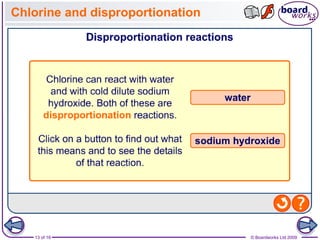
  • #14 Teacher notes The reaction of chlorine and water shown here is used in water purification: see slide 22 of this presentation. The reaction of sodium hydroxide and water shown here is used to make bleach: see slide 23 of this presentation.
  • #15 Photo credit: Danvlchenko Iaroslav / Shutterstock.com Teacher notes Addition of fluoride to drinking water is also carried out in certain areas and there are debates about extending the practice. The main benefit is reduction of tooth decay. However, fluoride can cause dental fluorosis (flecks of white in the teeth which can turn brown) and critics have linked it to other, more serious, health problems.
  • #16 Teacher notes The chlorate(I) ion reacts with acids to form chlorine. Care must therefore be taken to avoid bleach coming into contact with acids in the home because chlorine gas is toxic. The chlorate(I) ion is unstable. It decomposes to form chloride ions and the chlorate(V) ion, ClO 3 - : 3ClO - → 2Cl - + ClO 3 - This is another disproportionation reaction, in which the chlorine atoms are both oxidized from oxidation state +1 to +5 in ClO 3 - , and reduced to -1 in Cl - . The chlorate(V) ion is an oxidizing agent: ClO 3 - + 6H + + 6e - → Cl - + 3H 2 O Potassium and sodium chlorate, KClO 3 and NaClO 3 , are used in weedkillers. They can also be used to oxidize the sucrose molecules in jelly babies in a common demonstration.