By: Matthew Gahman
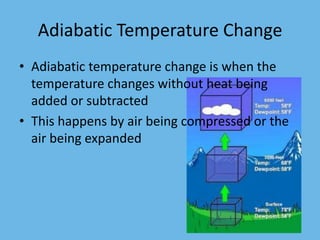
Adiabatic Temperature Change
• Adiabatic temperature change is when the
  temperature changes without heat being
  added or subtracted
• This happens by air being compressed or the
  air being expanded
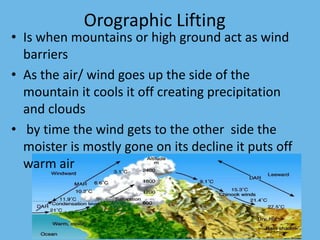
Orographic Lifting
• Is when mountains or high ground act as wind
  barriers
• As the air/ wind goes up the side of the
  mountain it cools it off creating precipitation
  and clouds
• by time the wind gets to the other side the
  moister is mostly gone on its decline it puts off
  warm air
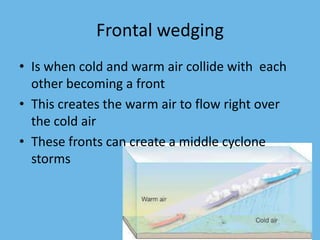
Frontal wedging
• Is when cold and warm air collide with each
  other becoming a front
• This creates the warm air to flow right over
  the cold air
• These fronts can create a middle cyclone
  storms
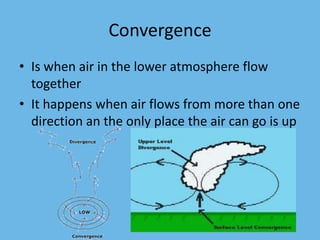
Convergence
• Is when air in the lower atmosphere flow
  together
• It happens when air flows from more than one
  direction an the only place the air can go is up
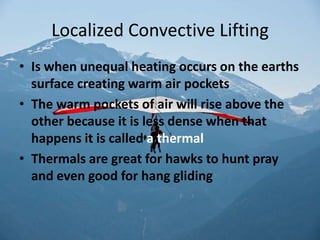
Localized Convective Lifting
• Is when unequal heating occurs on the earths
  surface creating warm air pockets
• The warm pockets of air will rise above the
  other because it is less dense when that
  happens it is called a thermal
• Thermals are great for hawks to hunt pray
  and even good for hang gliding
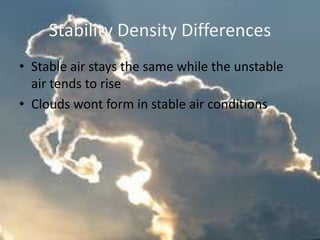
Stability Density Differences
• Stable air stays the same while the unstable
  air tends to rise
• Clouds wont form in stable air conditions
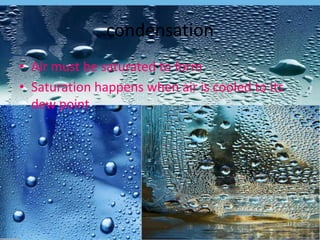
condensation
• Air must be saturated to form
• Saturation happens when air is cooled to its
  dew point
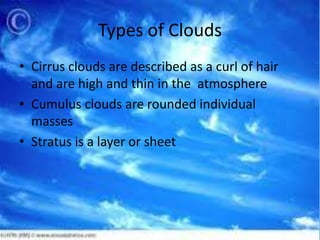
Types of Clouds
• Cirrus clouds are described as a curl of hair
  and are high and thin in the atmosphere
• Cumulus clouds are rounded individual
  masses
• Stratus is a layer or sheet
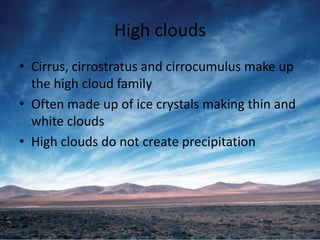
High clouds
• Cirrus, cirrostratus and cirrocumulus make up
  the high cloud family
• Often made up of ice crystals making thin and
  white clouds
• High clouds do not create precipitation
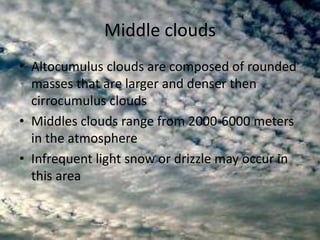
Middle clouds
• Altocumulus clouds are composed of rounded
  masses that are larger and denser then
  cirrocumulus clouds
• Middles clouds range from 2000-6000 meters
  in the atmosphere
• Infrequent light snow or drizzle may occur in
  this area
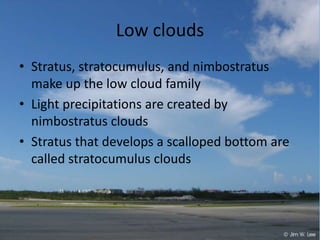
Low clouds
• Stratus, stratocumulus, and nimbostratus
  make up the low cloud family
• Light precipitations are created by
  nimbostratus clouds
• Stratus that develops a scalloped bottom are
  called stratocumulus clouds
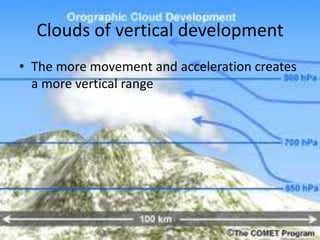
Clouds of vertical development
• The more movement and acceleration creates
  a more vertical range
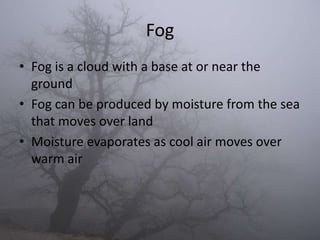
Fog
• Fog is a cloud with a base at or near the
  ground
• Fog can be produced by moisture from the sea
  that moves over land
• Moisture evaporates as cool air moves over
  warm air
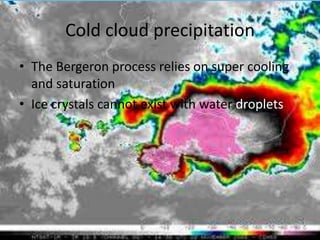
Cold cloud precipitation
• The Bergeron process relies on super cooling
  and saturation
• Ice crystals cannot exist with water droplets
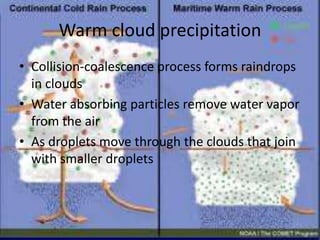
Warm cloud precipitation
• Collision-coalescence process forms raindrops
  in clouds
• Water absorbing particles remove water vapor
  from the air
• As droplets move through the clouds that join
  with smaller droplets
Rain and Snow
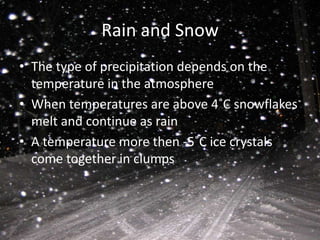
• The type of precipitation depends on the
  temperature in the atmosphere
• When temperatures are above 4˚C snowflakes
  melt and continue as rain
• A temperature more then -5˚C ice crystals
  come together in clumps
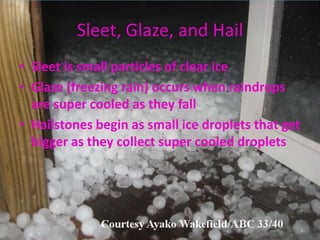
Sleet, Glaze, and Hail
• Sleet is small particles of clear ice
• Glaze (freezing rain) occurs when raindrops
  are super cooled as they fall
• Hailstones begin as small ice droplets that get
  bigger as they collect super cooled droplets
The end

period 4 M Gahmn 5mjoseph

  • 1.
  • 2.
    Adiabatic Temperature Change •Adiabatic temperature change is when the temperature changes without heat being added or subtracted • This happens by air being compressed or the air being expanded
  • 3.
    Orographic Lifting • Iswhen mountains or high ground act as wind barriers • As the air/ wind goes up the side of the mountain it cools it off creating precipitation and clouds • by time the wind gets to the other side the moister is mostly gone on its decline it puts off warm air
  • 4.
    Frontal wedging • Iswhen cold and warm air collide with each other becoming a front • This creates the warm air to flow right over the cold air • These fronts can create a middle cyclone storms
  • 5.
    Convergence • Is whenair in the lower atmosphere flow together • It happens when air flows from more than one direction an the only place the air can go is up
  • 6.
    Localized Convective Lifting •Is when unequal heating occurs on the earths surface creating warm air pockets • The warm pockets of air will rise above the other because it is less dense when that happens it is called a thermal • Thermals are great for hawks to hunt pray and even good for hang gliding
  • 7.
    Stability Density Differences •Stable air stays the same while the unstable air tends to rise • Clouds wont form in stable air conditions
  • 8.
    condensation • Air mustbe saturated to form • Saturation happens when air is cooled to its dew point
  • 9.
    Types of Clouds •Cirrus clouds are described as a curl of hair and are high and thin in the atmosphere • Cumulus clouds are rounded individual masses • Stratus is a layer or sheet
  • 10.
    High clouds • Cirrus,cirrostratus and cirrocumulus make up the high cloud family • Often made up of ice crystals making thin and white clouds • High clouds do not create precipitation
  • 11.
    Middle clouds • Altocumulusclouds are composed of rounded masses that are larger and denser then cirrocumulus clouds • Middles clouds range from 2000-6000 meters in the atmosphere • Infrequent light snow or drizzle may occur in this area
  • 12.
    Low clouds • Stratus,stratocumulus, and nimbostratus make up the low cloud family • Light precipitations are created by nimbostratus clouds • Stratus that develops a scalloped bottom are called stratocumulus clouds
  • 13.
    Clouds of verticaldevelopment • The more movement and acceleration creates a more vertical range
  • 14.
    Fog • Fog isa cloud with a base at or near the ground • Fog can be produced by moisture from the sea that moves over land • Moisture evaporates as cool air moves over warm air
  • 15.
    Cold cloud precipitation •The Bergeron process relies on super cooling and saturation • Ice crystals cannot exist with water droplets
  • 16.
    Warm cloud precipitation •Collision-coalescence process forms raindrops in clouds • Water absorbing particles remove water vapor from the air • As droplets move through the clouds that join with smaller droplets
  • 17.
    Rain and Snow •The type of precipitation depends on the temperature in the atmosphere • When temperatures are above 4˚C snowflakes melt and continue as rain • A temperature more then -5˚C ice crystals come together in clumps
  • 18.
    Sleet, Glaze, andHail • Sleet is small particles of clear ice • Glaze (freezing rain) occurs when raindrops are super cooled as they fall • Hailstones begin as small ice droplets that get bigger as they collect super cooled droplets
  • 19.