Miss Joseph
      Period 1
By: Katelyn Spieker
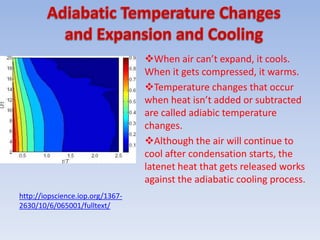
When air can’t expand, it cools.
                                  When it gets compressed, it warms.
                                  Temperature changes that occur
                                  when heat isn’t added or subtracted
                                  are called adiabic temperature
                                  changes.
                                  Although the air will continue to
                                  cool after condensation starts, the
                                  latenet heat that gets released works
                                  against the adiabatic cooling process.
http://iopscience.iop.org/1367-
2630/10/6/065001/fulltext/
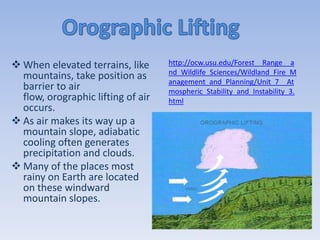
 When elevated terrains, like      http://ocw.usu.edu/Forest__Range__a
                                    nd_Wildlife_Sciences/Wildland_Fire_M
  mountains, take position as       anagement_and_Planning/Unit_7__At
  barrier to air                    mospheric_Stability_and_Instability_3.
  flow, orographic lifting of air   html
  occurs.
 As air makes its way up a
  mountain slope, adiabatic
  cooling often generates
  precipitation and clouds.
 Many of the places most
  rainy on Earth are located
  on these windward
  mountain slopes.
http://www.geo.hunter.cuny.edu
                                  /~tbw/wc.notes/4.moisture.atm.
                                  stability/frontal_wedging.htm


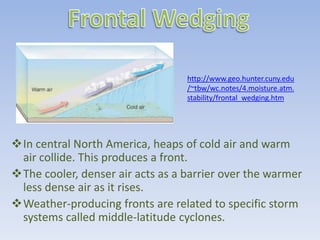
In central North America, heaps of cold air and warm
 air collide. This produces a front.
The cooler, denser air acts as a barrier over the warmer
 less dense air as it rises.
Weather-producing fronts are related to specific storm
 systems called middle-latitude cyclones.
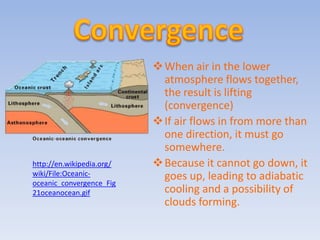
 When air in the lower
                             atmosphere flows together,
                             the result is lifting
                             (convergence)
                            If air flows in from more than
                             one direction, it must go
                             somewhere.
http://en.wikipedia.org/    Because it cannot go down, it
wiki/File:Oceanic-           goes up, leading to adiabatic
oceanic_convergence_Fig
21oceanocean.gif             cooling and a possibility of
                             clouds forming.
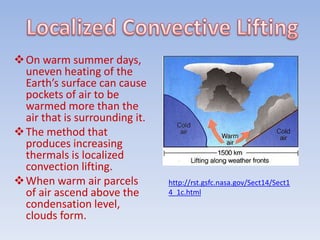
 On warm summer days,
  uneven heating of the
  Earth’s surface can cause
  pockets of air to be
  warmed more than the
  air that is surrounding it.
 The method that
  produces increasing
  thermals is localized
  convection lifting.
 When warm air parcels         http://rst.gsfc.nasa.gov/Sect14/Sect1
  of air ascend above the       4_1c.html
  condensation level,
  clouds form.
http://deved.meted.ucar.ed
u/marine/mbl/print.htm


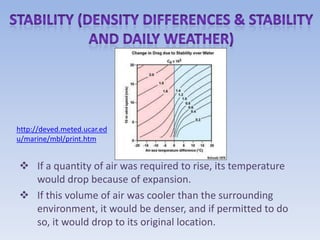
 If a quantity of air was required to rise, its temperature
  would drop because of expansion.
 If this volume of air was cooler than the surrounding
  environment, it would be denser, and if permitted to do
  so, it would drop to its original location.
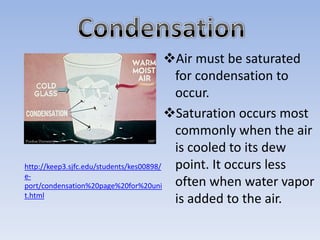
Air must be saturated
                                          for condensation to
                                          occur.
                                         Saturation occurs most
                                          commonly when the air
                                          is cooled to its dew
http://keep3.sjfc.edu/students/kes00898/  point. It occurs less
e-
port/condensation%20page%20for%20uni      often when water vapor
t.html
                                          is added to the air.
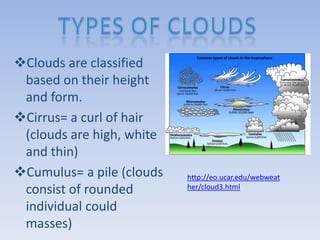
Clouds are classified
 based on their height
 and form.
Cirrus= a curl of hair
 (clouds are high, white
 and thin)
Cumulus= a pile (clouds   http://eo.ucar.edu/webweat
 consist of rounded        her/cloud3.html

 individual could
 masses)
http://mynasadata.larc.nasa.gov/g
                                        lossary.php?&letter=H


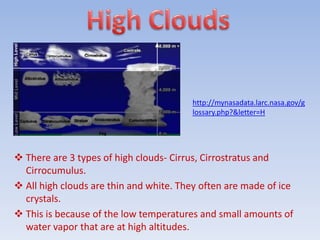
 There are 3 types of high clouds- Cirrus, Cirrostratus and
  Cirrocumulus.
 All high clouds are thin and white. They often are made of ice
  crystals.
 This is because of the low temperatures and small amounts of
  water vapor that are at high altitudes.
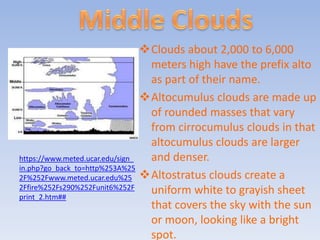
Clouds about 2,000 to 6,000
                                    meters high have the prefix alto
                                    as part of their name.
                                   Altocumulus clouds are made up
                                    of rounded masses that vary
                                    from cirrocumulus clouds in that
                                    altocumulus clouds are larger
https://www.meted.ucar.edu/sign_    and denser.
in.php?go_back_to=http%253A%25
2F%252Fwww.meted.ucar.edu%25       Altostratus clouds create a
2Ffire%252Fs290%252Funit6%252F      uniform white to grayish sheet
print_2.htm##
                                    that covers the sky with the sun
                                    or moon, looking like a bright
                                    spot.
http://www.free-online-private-pilot-
  ground-school.com/Aviation-Weather-
  Principles.html


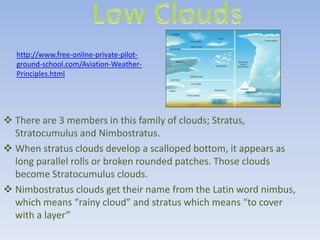
 There are 3 members in this family of clouds; Stratus,
  Stratocumulus and Nimbostratus.
 When stratus clouds develop a scalloped bottom, it appears as
  long parallel rolls or broken rounded patches. Those clouds
  become Stratocumulus clouds.
 Nimbostratus clouds get their name from the Latin word nimbus,
  which means “rainy cloud” and stratus which means “to cover
  with a layer”
http://www.astrobio.net/press
                                release/3936/the-secrets-of-
                                the-rain


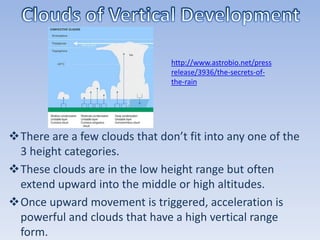
There are a few clouds that don’t fit into any one of the
 3 height categories.
These clouds are in the low height range but often
 extend upward into the middle or high altitudes.
Once upward movement is triggered, acceleration is
 powerful and clouds that have a high vertical range
 form.
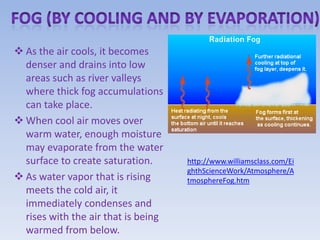
 As the air cools, it becomes
  denser and drains into low
  areas such as river valleys
  where thick fog accumulations
  can take place.
 When cool air moves over
  warm water, enough moisture
  may evaporate from the water
  surface to create saturation.      http://www.williamsclass.com/Ei
                                     ghthScienceWork/Atmosphere/A
 As water vapor that is rising      tmosphereFog.htm
  meets the cold air, it
  immediately condenses and
  rises with the air that is being
  warmed from below.
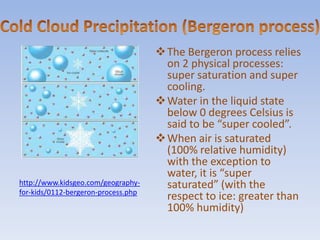
 The Bergeron process relies
                                       on 2 physical processes:
                                       super saturation and super
                                       cooling.
                                      Water in the liquid state
                                       below 0 degrees Celsius is
                                       said to be “super cooled”.
                                      When air is saturated
                                       (100% relative humidity)
                                       with the exception to
                                       water, it is “super
http://www.kidsgeo.com/geography-      saturated” (with the
for-kids/0112-bergeron-process.php
                                       respect to ice: greater than
                                       100% humidity)
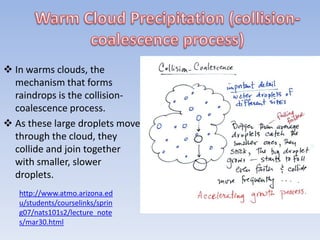
 In warms clouds, the
  mechanism that forms
  raindrops is the collision-
  coalescence process.
 As these large droplets move
  through the cloud, they
  collide and join together
  with smaller, slower
  droplets.
   http://www.atmo.arizona.ed
   u/students/courselinks/sprin
   g07/nats101s2/lecture_note
   s/mar30.html
http://www.shutterstock.com/pic-
                                    65745589/stock-photo-heavy-cloud-
                                    with-rain-and-snow-hi-res-d-
                                    rendered-icon-with-clipping-
                                    paths.html


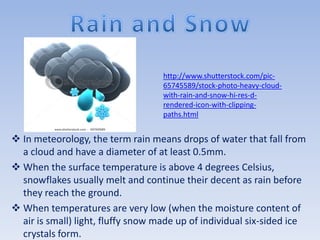
 In meteorology, the term rain means drops of water that fall from
  a cloud and have a diameter of at least 0.5mm.
 When the surface temperature is above 4 degrees Celsius,
  snowflakes usually melt and continue their decent as rain before
  they reach the ground.
 When temperatures are very low (when the moisture content of
  air is small) light, fluffy snow made up of individual six-sided ice
  crystals form.
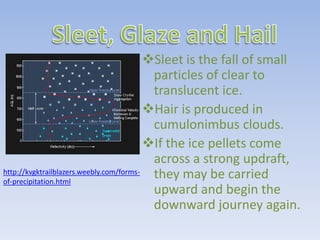
Sleet is the fall of small
                                           particles of clear to
                                           translucent ice.
                                          Hair is produced in
                                           cumulonimbus clouds.
                                          If the ice pellets come
                                           across a strong updraft,
http://kvgktrailblazers.weebly.com/forms-
of-precipitation.html
                                           they may be carried
                                           upward and begin the
                                           downward journey again.

1kspieker

  • 1.
    Miss Joseph Period 1 By: Katelyn Spieker
  • 2.
    When air can’texpand, it cools. When it gets compressed, it warms. Temperature changes that occur when heat isn’t added or subtracted are called adiabic temperature changes. Although the air will continue to cool after condensation starts, the latenet heat that gets released works against the adiabatic cooling process. http://iopscience.iop.org/1367- 2630/10/6/065001/fulltext/
  • 3.
     When elevatedterrains, like http://ocw.usu.edu/Forest__Range__a nd_Wildlife_Sciences/Wildland_Fire_M mountains, take position as anagement_and_Planning/Unit_7__At barrier to air mospheric_Stability_and_Instability_3. flow, orographic lifting of air html occurs.  As air makes its way up a mountain slope, adiabatic cooling often generates precipitation and clouds.  Many of the places most rainy on Earth are located on these windward mountain slopes.
  • 4.
    http://www.geo.hunter.cuny.edu /~tbw/wc.notes/4.moisture.atm. stability/frontal_wedging.htm In central North America, heaps of cold air and warm air collide. This produces a front. The cooler, denser air acts as a barrier over the warmer less dense air as it rises. Weather-producing fronts are related to specific storm systems called middle-latitude cyclones.
  • 5.
     When airin the lower atmosphere flows together, the result is lifting (convergence)  If air flows in from more than one direction, it must go somewhere. http://en.wikipedia.org/  Because it cannot go down, it wiki/File:Oceanic- goes up, leading to adiabatic oceanic_convergence_Fig 21oceanocean.gif cooling and a possibility of clouds forming.
  • 6.
     On warmsummer days, uneven heating of the Earth’s surface can cause pockets of air to be warmed more than the air that is surrounding it.  The method that produces increasing thermals is localized convection lifting.  When warm air parcels http://rst.gsfc.nasa.gov/Sect14/Sect1 of air ascend above the 4_1c.html condensation level, clouds form.
  • 7.
    http://deved.meted.ucar.ed u/marine/mbl/print.htm  If aquantity of air was required to rise, its temperature would drop because of expansion.  If this volume of air was cooler than the surrounding environment, it would be denser, and if permitted to do so, it would drop to its original location.
  • 8.
    Air must besaturated for condensation to occur. Saturation occurs most commonly when the air is cooled to its dew http://keep3.sjfc.edu/students/kes00898/ point. It occurs less e- port/condensation%20page%20for%20uni often when water vapor t.html is added to the air.
  • 9.
    Clouds are classified based on their height and form. Cirrus= a curl of hair (clouds are high, white and thin) Cumulus= a pile (clouds http://eo.ucar.edu/webweat consist of rounded her/cloud3.html individual could masses)
  • 10.
    http://mynasadata.larc.nasa.gov/g lossary.php?&letter=H  There are 3 types of high clouds- Cirrus, Cirrostratus and Cirrocumulus.  All high clouds are thin and white. They often are made of ice crystals.  This is because of the low temperatures and small amounts of water vapor that are at high altitudes.
  • 11.
    Clouds about 2,000to 6,000 meters high have the prefix alto as part of their name. Altocumulus clouds are made up of rounded masses that vary from cirrocumulus clouds in that altocumulus clouds are larger https://www.meted.ucar.edu/sign_ and denser. in.php?go_back_to=http%253A%25 2F%252Fwww.meted.ucar.edu%25 Altostratus clouds create a 2Ffire%252Fs290%252Funit6%252F uniform white to grayish sheet print_2.htm## that covers the sky with the sun or moon, looking like a bright spot.
  • 12.
    http://www.free-online-private-pilot- ground-school.com/Aviation-Weather- Principles.html  There are 3 members in this family of clouds; Stratus, Stratocumulus and Nimbostratus.  When stratus clouds develop a scalloped bottom, it appears as long parallel rolls or broken rounded patches. Those clouds become Stratocumulus clouds.  Nimbostratus clouds get their name from the Latin word nimbus, which means “rainy cloud” and stratus which means “to cover with a layer”
  • 13.
    http://www.astrobio.net/press release/3936/the-secrets-of- the-rain There are a few clouds that don’t fit into any one of the 3 height categories. These clouds are in the low height range but often extend upward into the middle or high altitudes. Once upward movement is triggered, acceleration is powerful and clouds that have a high vertical range form.
  • 14.
     As theair cools, it becomes denser and drains into low areas such as river valleys where thick fog accumulations can take place.  When cool air moves over warm water, enough moisture may evaporate from the water surface to create saturation. http://www.williamsclass.com/Ei ghthScienceWork/Atmosphere/A  As water vapor that is rising tmosphereFog.htm meets the cold air, it immediately condenses and rises with the air that is being warmed from below.
  • 15.
     The Bergeronprocess relies on 2 physical processes: super saturation and super cooling.  Water in the liquid state below 0 degrees Celsius is said to be “super cooled”.  When air is saturated (100% relative humidity) with the exception to water, it is “super http://www.kidsgeo.com/geography- saturated” (with the for-kids/0112-bergeron-process.php respect to ice: greater than 100% humidity)
  • 16.
     In warmsclouds, the mechanism that forms raindrops is the collision- coalescence process.  As these large droplets move through the cloud, they collide and join together with smaller, slower droplets. http://www.atmo.arizona.ed u/students/courselinks/sprin g07/nats101s2/lecture_note s/mar30.html
  • 17.
    http://www.shutterstock.com/pic- 65745589/stock-photo-heavy-cloud- with-rain-and-snow-hi-res-d- rendered-icon-with-clipping- paths.html  In meteorology, the term rain means drops of water that fall from a cloud and have a diameter of at least 0.5mm.  When the surface temperature is above 4 degrees Celsius, snowflakes usually melt and continue their decent as rain before they reach the ground.  When temperatures are very low (when the moisture content of air is small) light, fluffy snow made up of individual six-sided ice crystals form.
  • 18.
    Sleet is thefall of small particles of clear to translucent ice. Hair is produced in cumulonimbus clouds. If the ice pellets come across a strong updraft, http://kvgktrailblazers.weebly.com/forms- of-precipitation.html they may be carried upward and begin the downward journey again.