Dan Manns
Adiabatic temperature changes
and expansion and cooling
 When temperature changes even
though there has been no changes to
the heat.
 It happens because air gets compressed
and is allowed to expand.
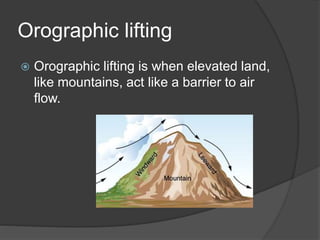
Orographic lifting
 Orographic lifting is when elevated land,
like mountains, act like a barrier to air
flow.
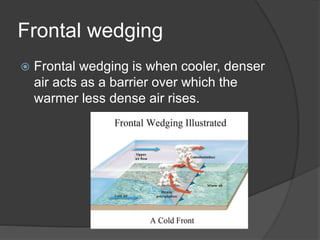
Frontal wedging
 Frontal wedging is when cooler, denser
air acts as a barrier over which the
warmer less dense air rises.
Convergence
 Convergence is whenever air in the
lower atmosphere flows together lifting
results.
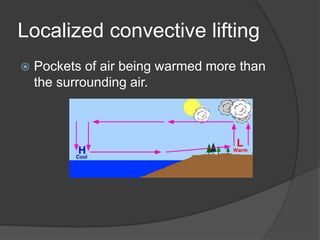
Localized convective lifting
 Pockets of air being warmed more than
the surrounding air.
Stability
 If a volume of air was forced to rise, its
temperature would drop because of
expansion.
 If this volume of air was cooler than the
surrounding environment, it would be
denser, and if allowed to do so, it would
sink to its original position.
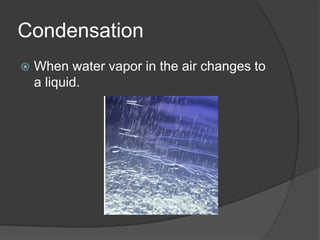
Condensation
 When water vapor in the air changes to
a liquid.
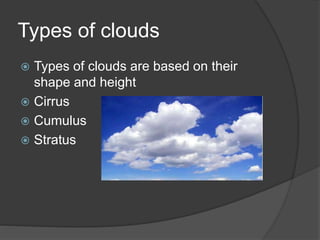
Types of clouds
 Types of clouds are based on their
shape and height
 Cirrus
 Cumulus
 Stratus
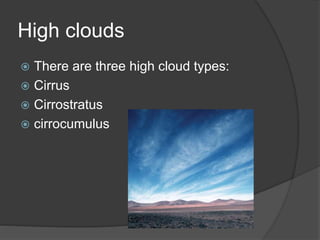
High clouds
 There are three high cloud types:
 Cirrus
 Cirrostratus
 cirrocumulus
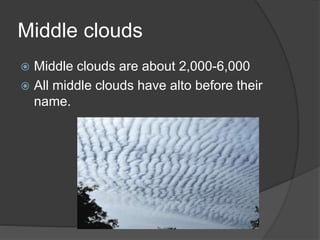
Middle clouds
 Middle clouds are about 2,000-6,000
 All middle clouds have alto before their
name.
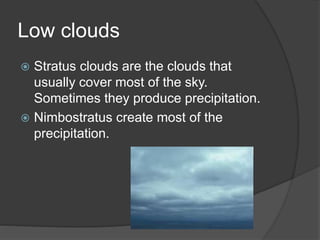
Low clouds
 Stratus clouds are the clouds that
usually cover most of the sky.
Sometimes they produce precipitation.
 Nimbostratus create most of the
precipitation.
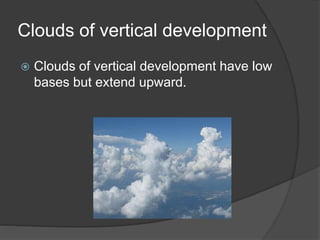
Clouds of vertical development
 Clouds of vertical development have low
bases but extend upward.
Fog
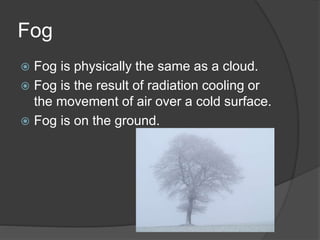
 Fog is physically the same as a cloud.
 Fog is the result of radiation cooling or
the movement of air over a cold surface.
 Fog is on the ground.
Cold cloud precipitation (Bergeron
process)
 The Bergeron process relies on
supercooling and supersaturation.
 Water that is below o degrees Celsius is
supercooled.
 When air is saturated it is
supersaturated.
Warm cloud precipitation
 In warm clouds, clouds are formed by
the collision-coalescence process.
 Some water absorbing particles can
remove water vapor from the air when it
is not saturated.
Rain and snow
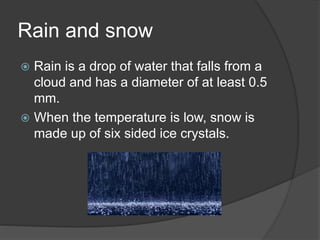
 Rain is a drop of water that falls from a
cloud and has a diameter of at least 0.5
mm.
 When the temperature is low, snow is
made up of six sided ice crystals.
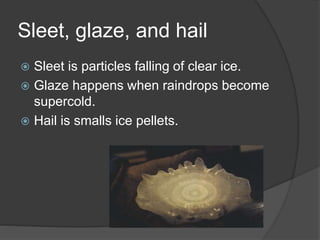
Sleet, glaze, and hail
 Sleet is particles falling of clear ice.
 Glaze happens when raindrops become
supercold.
 Hail is smalls ice pellets.

4dmanns

  • 1.
  • 2.
    Adiabatic temperature changes andexpansion and cooling  When temperature changes even though there has been no changes to the heat.  It happens because air gets compressed and is allowed to expand.
  • 3.
    Orographic lifting  Orographiclifting is when elevated land, like mountains, act like a barrier to air flow.
  • 4.
    Frontal wedging  Frontalwedging is when cooler, denser air acts as a barrier over which the warmer less dense air rises.
  • 5.
    Convergence  Convergence iswhenever air in the lower atmosphere flows together lifting results.
  • 6.
    Localized convective lifting Pockets of air being warmed more than the surrounding air.
  • 7.
    Stability  If avolume of air was forced to rise, its temperature would drop because of expansion.  If this volume of air was cooler than the surrounding environment, it would be denser, and if allowed to do so, it would sink to its original position.
  • 8.
    Condensation  When watervapor in the air changes to a liquid.
  • 9.
    Types of clouds Types of clouds are based on their shape and height  Cirrus  Cumulus  Stratus
  • 10.
    High clouds  Thereare three high cloud types:  Cirrus  Cirrostratus  cirrocumulus
  • 11.
    Middle clouds  Middleclouds are about 2,000-6,000  All middle clouds have alto before their name.
  • 12.
    Low clouds  Stratusclouds are the clouds that usually cover most of the sky. Sometimes they produce precipitation.  Nimbostratus create most of the precipitation.
  • 13.
    Clouds of verticaldevelopment  Clouds of vertical development have low bases but extend upward.
  • 14.
    Fog  Fog isphysically the same as a cloud.  Fog is the result of radiation cooling or the movement of air over a cold surface.  Fog is on the ground.
  • 15.
    Cold cloud precipitation(Bergeron process)  The Bergeron process relies on supercooling and supersaturation.  Water that is below o degrees Celsius is supercooled.  When air is saturated it is supersaturated.
  • 16.
    Warm cloud precipitation In warm clouds, clouds are formed by the collision-coalescence process.  Some water absorbing particles can remove water vapor from the air when it is not saturated.
  • 17.
    Rain and snow Rain is a drop of water that falls from a cloud and has a diameter of at least 0.5 mm.  When the temperature is low, snow is made up of six sided ice crystals.
  • 18.
    Sleet, glaze, andhail  Sleet is particles falling of clear ice.  Glaze happens when raindrops become supercold.  Hail is smalls ice pellets.