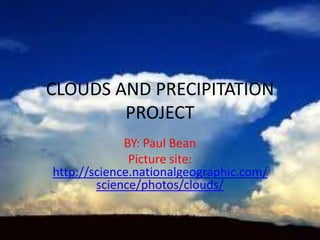
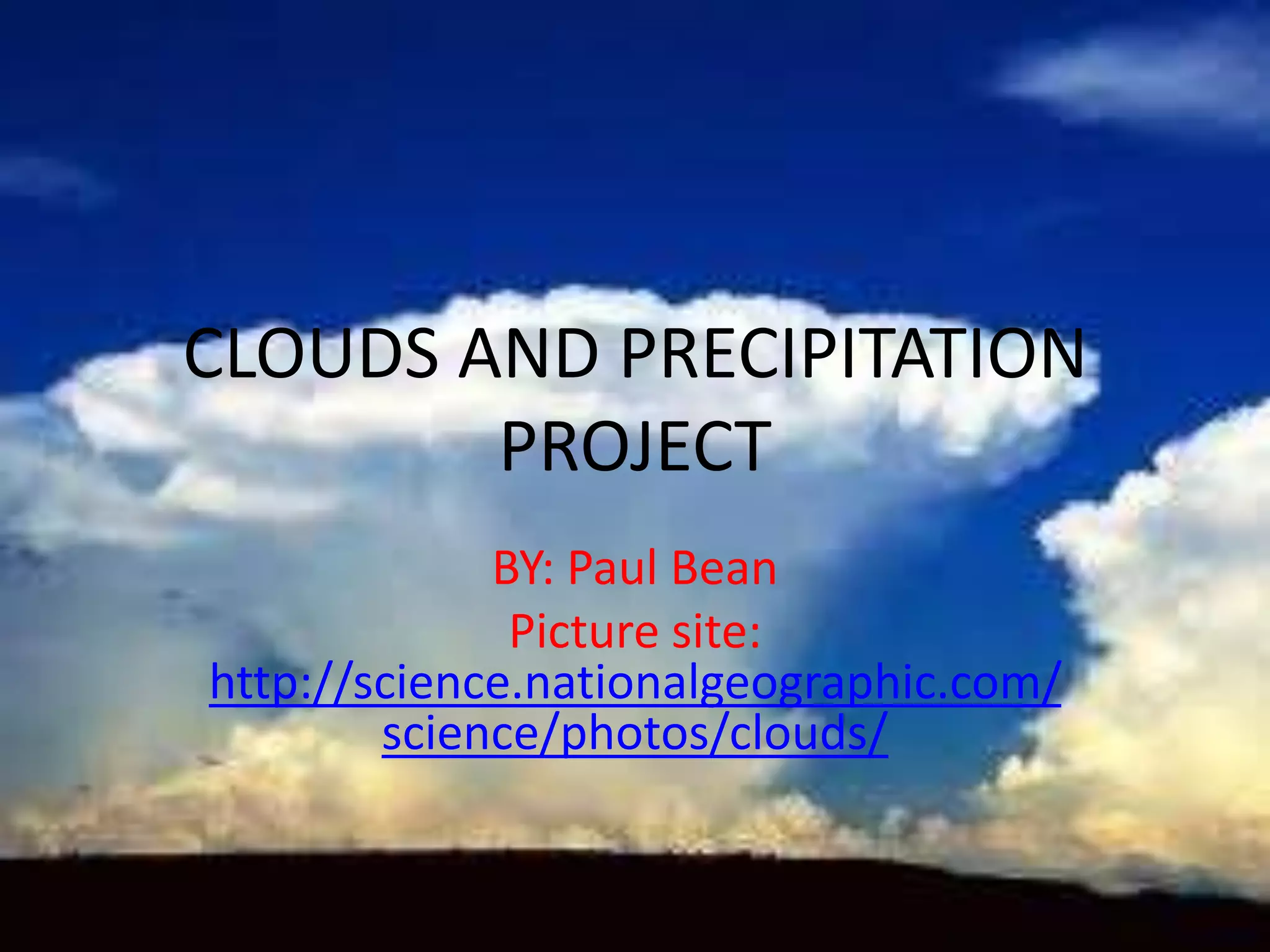
CLOUDS AND PRECIPITATION
        PROJECT
             BY: Paul Bean
              Picture site:
http://science.nationalgeographic.com/
        science/photos/clouds/
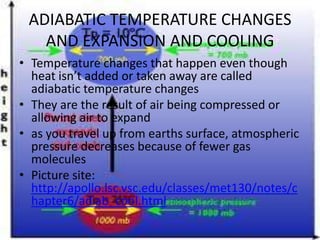
ADIABATIC TEMPERATURE CHANGES
   AND EXPANSION AND COOLING
• Temperature changes that happen even though
  heat isn’t added or taken away are called
  adiabatic temperature changes
• They are the result of air being compressed or
  allowing air to expand
• as you travel up from earths surface, atmospheric
  pressure decreases because of fewer gas
  molecules
• Picture site:
  http://apollo.lsc.vsc.edu/classes/met130/notes/c
  hapter6/adiab_cool.html
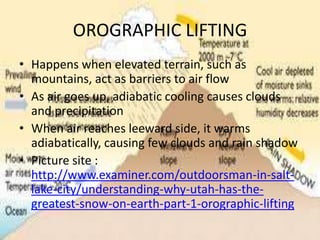
OROGRAPHIC LIFTING
• Happens when elevated terrain, such as
  mountains, act as barriers to air flow
• As air goes up, adiabatic cooling causes clouds
  and precipitation
• When air reaches leeward side, it warms
  adiabatically, causing few clouds and rain shadow
• Picture site :
  http://www.examiner.com/outdoorsman-in-salt-
  lake-city/understanding-why-utah-has-the-
  greatest-snow-on-earth-part-1-orographic-lifting
FRONTAL WEDGING
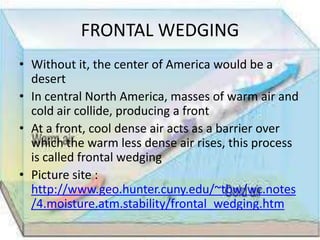
• Without it, the center of America would be a
  desert
• In central North America, masses of warm air and
  cold air collide, producing a front
• At a front, cool dense air acts as a barrier over
  which the warm less dense air rises, this process
  is called frontal wedging
• Picture site :
  http://www.geo.hunter.cuny.edu/~tbw/wc.notes
  /4.moisture.atm.stability/frontal_wedging.htm
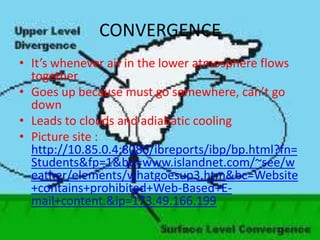
CONVERGENCE
• It’s whenever air in the lower atmosphere flows
  together
• Goes up because must go somewhere, can’t go
  down
• Leads to clouds and adiabatic cooling
• Picture site :
  http://10.85.0.4:8080/ibreports/ibp/bp.html?fn=
  Students&fp=1&bu=www.islandnet.com/~see/w
  eather/elements/whatgoesup3.htm&bc=Website
  +contains+prohibited+Web-Based+E-
  mail+content.&ip=173.49.166.199
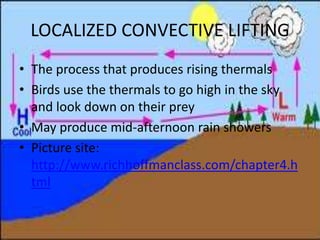
LOCALIZED CONVECTIVE LIFTING
• The process that produces rising thermals
• Birds use the thermals to go high in the sky
  and look down on their prey
• May produce mid-afternoon rain showers
• Picture site:
  http://www.richhoffmanclass.com/chapter4.h
  tml
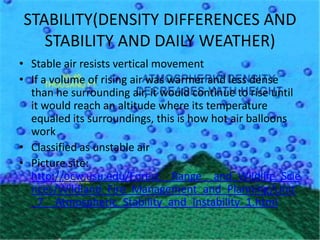
STABILITY(DENSITY DIFFERENCES AND
   STABILITY AND DAILY WEATHER)
• Stable air resists vertical movement
• If a volume of rising air was warmer and less dense
  than he surrounding air, it would continue to rise until
  it would reach an altitude where its temperature
  equaled its surroundings, this is how hot air balloons
  work
• Classified as unstable air
• Picture site:
  http://ocw.usu.edu/Forest__Range__and_Wildlife_Scie
  nces/Wildland_Fire_Management_and_Planning/Unit
  _7__Atmospheric_Stability_and_Instability_1.html
CONDENSATION
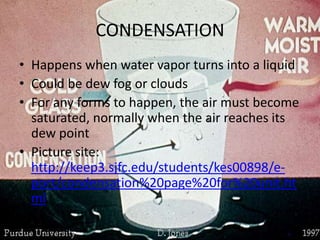
• Happens when water vapor turns into a liquid
• Could be dew fog or clouds
• For any forms to happen, the air must become
  saturated, normally when the air reaches its
  dew point
• Picture site:
  http://keep3.sjfc.edu/students/kes00898/e-
  port/condensation%20page%20for%20unit.ht
  ml
TYPES OF CLOUDS
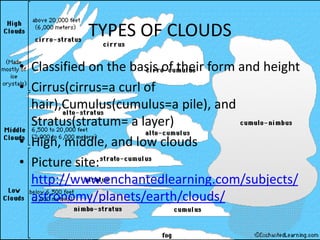
• Classified on the basis of their form and height
• Cirrus(cirrus=a curl of
  hair),Cumulus(cumulus=a pile), and
  Stratus(stratum= a layer)
• High, middle, and low clouds
• Picture site:
  http://www.enchantedlearning.com/subjects/
  astronomy/planets/earth/clouds/
HIGH CLOUDS
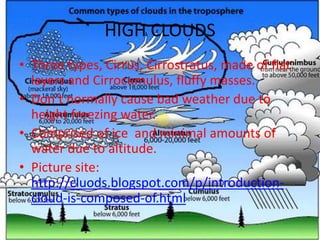
• Three types, Cirrus, Cirrostratus, made of flat
  layers and Cirrocumulus, fluffy masses.
• Don’t normally cause bad weather due to
  height freezing water.
• Comprised of ice and minimal amounts of
  water due to altitude.
• Picture site:
  http://cluods.blogspot.com/p/introduction-
  cloud-is-composed-of.html
MIDDLE CLOUDS
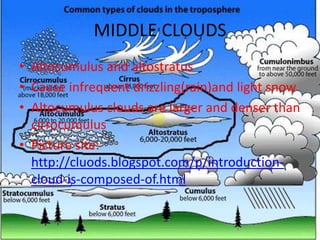
• Altocumulus and altostratus
• Cause infrequent drizzling(rain)and light snow
• Altocumulus clouds are larger and denser than
  cirrocumulus
• Picture site:
  http://cluods.blogspot.com/p/introduction-
  cloud-is-composed-of.html
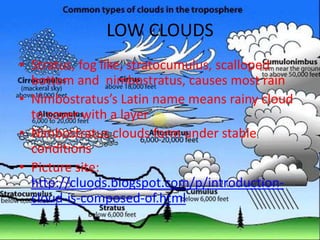
LOW CLOUDS
• Stratus, fog like, stratocumulus, scalloped
  bottom and nimbostratus, causes most rain
• Nimbostratus’s Latin name means rainy cloud
  to cover with a layer
• Nimbostratus clouds form under stable
  conditions
• Picture site:
  http://cluods.blogspot.com/p/introduction-
  cloud-is-composed-of.html
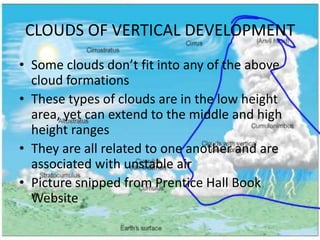
CLOUDS OF VERTICAL DEVELOPMENT
• Some clouds don’t fit into any of the above
  cloud formations
• These types of clouds are in the low height
  area, yet can extend to the middle and high
  height ranges
• They are all related to one another and are
  associated with unstable air
• Picture snipped from Prentice Hall Book
  Website
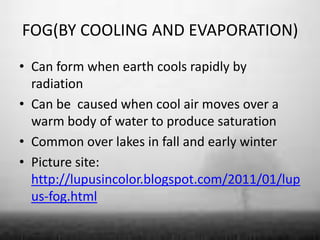
FOG(BY COOLING AND EVAPORATION)
• Can form when earth cools rapidly by
  radiation
• Can be caused when cool air moves over a
  warm body of water to produce saturation
• Common over lakes in fall and early winter
• Picture site:
  http://lupusincolor.blogspot.com/2011/01/lup
  us-fog.html
COLD CLOUD
 PRECIPITATION(BERGERON PROCESS)
• Relies on super cooling and super saturation
• Whatever water the supercooled water
  touches, it freezes that water
• Supersaturation allows more water to the ice
  crystal to grow
• Picture site:
  http://www.sleepingdogstudios.com/Network
  /Earth%20Science/ES_18_Rev_files/frame.ht
  m#slide0021.htm
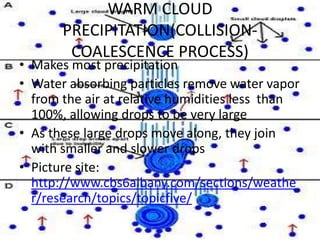
WARM CLOUD
       PRECIPITATION(COLLISION-
        COALESCENCE PROCESS)
• Makes most precipitation
• Water absorbing particles remove water vapor
  from the air at relative humidities less than
  100%, allowing drops to be very large
• As these large drops move along, they join
  with smaller and slower drops
• Picture site:
  http://www.cbs6albany.com/sections/weathe
  r/research/topics/topicfive/
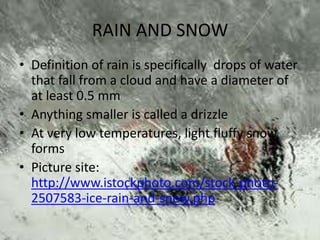
RAIN AND SNOW
• Definition of rain is specifically drops of water
  that fall from a cloud and have a diameter of
  at least 0.5 mm
• Anything smaller is called a drizzle
• At very low temperatures, light fluffy snow
  forms
• Picture site:
  http://www.istockphoto.com/stock-photo-
  2507583-ice-rain-and-snow.php
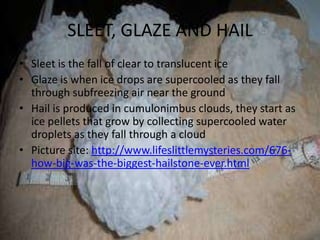
SLEET, GLAZE AND HAIL
• Sleet is the fall of clear to translucent ice
• Glaze is when ice drops are supercooled as they fall
  through subfreezing air near the ground
• Hail is produced in cumulonimbus clouds, they start as
  ice pellets that grow by collecting supercooled water
  droplets as they fall through a cloud
• Picture site: http://www.lifeslittlemysteries.com/676-
  how-big-was-the-biggest-hailstone-ever.html
THE
END!!!!!!!!!!!!!!!!!!!!!!!!!!!!!!!!!!!!!!!!
!!!!!!!!!!!!!!!!!!!!!!!!!!!!!!!!!!!!!!!!!!!!!
!!!!!!!!!!!!!!!!!!!!!!!!!!!!!!!!!!!!!!!!!!!!!
                By: Paul Bean
                 Picture site:
    http://www.flickr.com/photos/2703267
            3@N02/2615193708/

5 pbean

  • 1.
    CLOUDS AND PRECIPITATION PROJECT BY: Paul Bean Picture site: http://science.nationalgeographic.com/ science/photos/clouds/
  • 2.
    ADIABATIC TEMPERATURE CHANGES AND EXPANSION AND COOLING • Temperature changes that happen even though heat isn’t added or taken away are called adiabatic temperature changes • They are the result of air being compressed or allowing air to expand • as you travel up from earths surface, atmospheric pressure decreases because of fewer gas molecules • Picture site: http://apollo.lsc.vsc.edu/classes/met130/notes/c hapter6/adiab_cool.html
  • 3.
    OROGRAPHIC LIFTING • Happenswhen elevated terrain, such as mountains, act as barriers to air flow • As air goes up, adiabatic cooling causes clouds and precipitation • When air reaches leeward side, it warms adiabatically, causing few clouds and rain shadow • Picture site : http://www.examiner.com/outdoorsman-in-salt- lake-city/understanding-why-utah-has-the- greatest-snow-on-earth-part-1-orographic-lifting
  • 4.
    FRONTAL WEDGING • Withoutit, the center of America would be a desert • In central North America, masses of warm air and cold air collide, producing a front • At a front, cool dense air acts as a barrier over which the warm less dense air rises, this process is called frontal wedging • Picture site : http://www.geo.hunter.cuny.edu/~tbw/wc.notes /4.moisture.atm.stability/frontal_wedging.htm
  • 5.
    CONVERGENCE • It’s wheneverair in the lower atmosphere flows together • Goes up because must go somewhere, can’t go down • Leads to clouds and adiabatic cooling • Picture site : http://10.85.0.4:8080/ibreports/ibp/bp.html?fn= Students&fp=1&bu=www.islandnet.com/~see/w eather/elements/whatgoesup3.htm&bc=Website +contains+prohibited+Web-Based+E- mail+content.&ip=173.49.166.199
  • 6.
    LOCALIZED CONVECTIVE LIFTING •The process that produces rising thermals • Birds use the thermals to go high in the sky and look down on their prey • May produce mid-afternoon rain showers • Picture site: http://www.richhoffmanclass.com/chapter4.h tml
  • 7.
    STABILITY(DENSITY DIFFERENCES AND STABILITY AND DAILY WEATHER) • Stable air resists vertical movement • If a volume of rising air was warmer and less dense than he surrounding air, it would continue to rise until it would reach an altitude where its temperature equaled its surroundings, this is how hot air balloons work • Classified as unstable air • Picture site: http://ocw.usu.edu/Forest__Range__and_Wildlife_Scie nces/Wildland_Fire_Management_and_Planning/Unit _7__Atmospheric_Stability_and_Instability_1.html
  • 8.
    CONDENSATION • Happens whenwater vapor turns into a liquid • Could be dew fog or clouds • For any forms to happen, the air must become saturated, normally when the air reaches its dew point • Picture site: http://keep3.sjfc.edu/students/kes00898/e- port/condensation%20page%20for%20unit.ht ml
  • 9.
    TYPES OF CLOUDS •Classified on the basis of their form and height • Cirrus(cirrus=a curl of hair),Cumulus(cumulus=a pile), and Stratus(stratum= a layer) • High, middle, and low clouds • Picture site: http://www.enchantedlearning.com/subjects/ astronomy/planets/earth/clouds/
  • 10.
    HIGH CLOUDS • Threetypes, Cirrus, Cirrostratus, made of flat layers and Cirrocumulus, fluffy masses. • Don’t normally cause bad weather due to height freezing water. • Comprised of ice and minimal amounts of water due to altitude. • Picture site: http://cluods.blogspot.com/p/introduction- cloud-is-composed-of.html
  • 11.
    MIDDLE CLOUDS • Altocumulusand altostratus • Cause infrequent drizzling(rain)and light snow • Altocumulus clouds are larger and denser than cirrocumulus • Picture site: http://cluods.blogspot.com/p/introduction- cloud-is-composed-of.html
  • 12.
    LOW CLOUDS • Stratus,fog like, stratocumulus, scalloped bottom and nimbostratus, causes most rain • Nimbostratus’s Latin name means rainy cloud to cover with a layer • Nimbostratus clouds form under stable conditions • Picture site: http://cluods.blogspot.com/p/introduction- cloud-is-composed-of.html
  • 13.
    CLOUDS OF VERTICALDEVELOPMENT • Some clouds don’t fit into any of the above cloud formations • These types of clouds are in the low height area, yet can extend to the middle and high height ranges • They are all related to one another and are associated with unstable air • Picture snipped from Prentice Hall Book Website
  • 14.
    FOG(BY COOLING ANDEVAPORATION) • Can form when earth cools rapidly by radiation • Can be caused when cool air moves over a warm body of water to produce saturation • Common over lakes in fall and early winter • Picture site: http://lupusincolor.blogspot.com/2011/01/lup us-fog.html
  • 15.
    COLD CLOUD PRECIPITATION(BERGERONPROCESS) • Relies on super cooling and super saturation • Whatever water the supercooled water touches, it freezes that water • Supersaturation allows more water to the ice crystal to grow • Picture site: http://www.sleepingdogstudios.com/Network /Earth%20Science/ES_18_Rev_files/frame.ht m#slide0021.htm
  • 16.
    WARM CLOUD PRECIPITATION(COLLISION- COALESCENCE PROCESS) • Makes most precipitation • Water absorbing particles remove water vapor from the air at relative humidities less than 100%, allowing drops to be very large • As these large drops move along, they join with smaller and slower drops • Picture site: http://www.cbs6albany.com/sections/weathe r/research/topics/topicfive/
  • 17.
    RAIN AND SNOW •Definition of rain is specifically drops of water that fall from a cloud and have a diameter of at least 0.5 mm • Anything smaller is called a drizzle • At very low temperatures, light fluffy snow forms • Picture site: http://www.istockphoto.com/stock-photo- 2507583-ice-rain-and-snow.php
  • 18.
    SLEET, GLAZE ANDHAIL • Sleet is the fall of clear to translucent ice • Glaze is when ice drops are supercooled as they fall through subfreezing air near the ground • Hail is produced in cumulonimbus clouds, they start as ice pellets that grow by collecting supercooled water droplets as they fall through a cloud • Picture site: http://www.lifeslittlemysteries.com/676- how-big-was-the-biggest-hailstone-ever.html
  • 19.