Clouds and
Precipitation
By: Eric Dzieniszewski
Adiabatic Temperatures
Changes
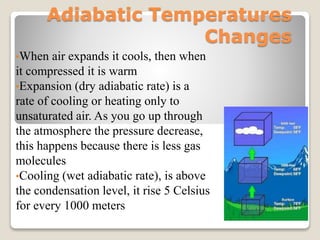
•When air expands it cools, then when
it compressed it is warm
•Expansion (dry adiabatic rate) is a
rate of cooling or heating only to
unsaturated air. As you go up through
the atmosphere the pressure decrease,
this happens because there is less gas
molecules
•Cooling (wet adiabatic rate), is above
the condensation level, it rise 5 Celsius
for every 1000 meters
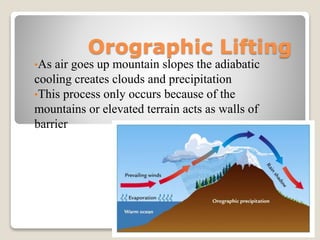
Orographic Lifting
•As air goes up mountain slopes the adiabatic
cooling creates clouds and precipitation
•This process only occurs because of the
mountains or elevated terrain acts as walls of
barrier
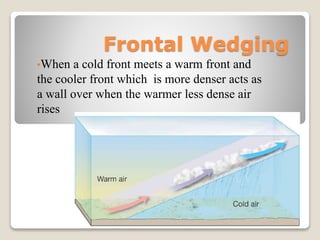
Frontal Wedging
•When a cold front meets a warm front and
the cooler front which is more denser acts as
a wall over when the warmer less dense air
rises
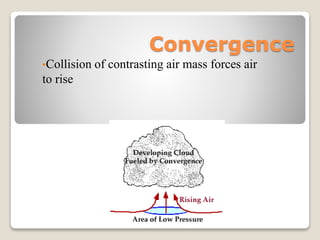
Convergence
•Collision of contrasting air mass forces air
to rise
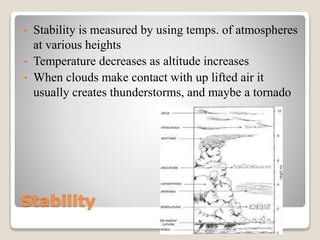
Stability
• Stability is measured by using temps. of atmospheres
at various heights
• Temperature decreases as altitude increases
• When clouds make contact with up lifted air it
usually creates thunderstorms, and maybe a tornado
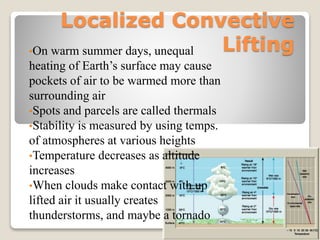
Localized Convective
Lifting•On warm summer days, unequal
heating of Earth’s surface may cause
pockets of air to be warmed more than
surrounding air
•Spots and parcels are called thermals
•Stability is measured by using temps.
of atmospheres at various heights
•Temperature decreases as altitude
increases
•When clouds make contact with up
lifted air it usually creates
thunderstorms, and maybe a tornado
Condensation
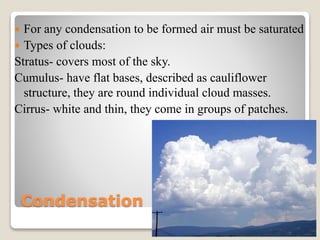
 For any condensation to be formed air must be saturated
 Types of clouds:
Stratus- covers most of the sky.
Cumulus- have flat bases, described as cauliflower
structure, they are round individual cloud masses.
Cirrus- white and thin, they come in groups of patches.
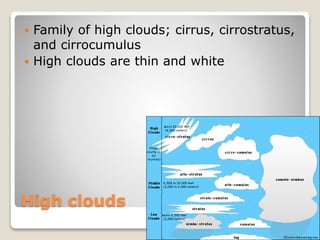
High clouds
 Family of high clouds; cirrus, cirrostratus,
and cirrocumulus
 High clouds are thin and white
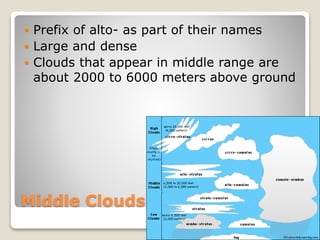
Middle Clouds
 Prefix of alto- as part of their names
 Large and dense
 Clouds that appear in middle range are
about 2000 to 6000 meters above ground
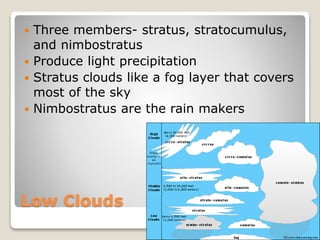
Low Clouds
 Three members- stratus, stratocumulus,
and nimbostratus
 Produce light precipitation
 Stratus clouds like a fog layer that covers
most of the sky
 Nimbostratus are the rain makers
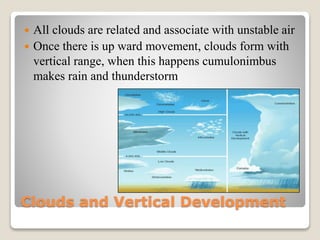
Clouds and Vertical Development
 All clouds are related and associate with unstable air
 Once there is up ward movement, clouds form with
vertical range, when this happens cumulonimbus
makes rain and thunderstorm
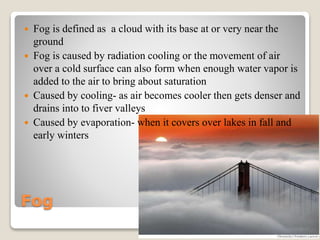
Fog
 Fog is defined as a cloud with its base at or very near the
ground
 Fog is caused by radiation cooling or the movement of air
over a cold surface can also form when enough water vapor is
added to the air to bring about saturation
 Caused by cooling- as air becomes cooler then gets denser and
drains into to fiver valleys
 Caused by evaporation- when it covers over lakes in fall and
early winters
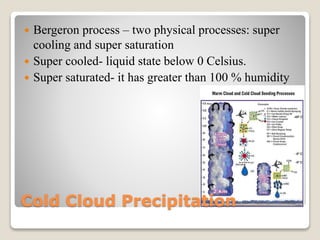
Cold Cloud Precipitation
 Bergeron process – two physical processes: super
cooling and super saturation
 Super cooled- liquid state below 0 Celsius.
 Super saturated- it has greater than 100 % humidity
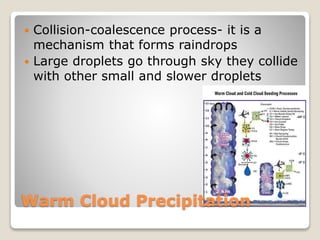
Warm Cloud Precipitation
 Collision-coalescence process- it is a
mechanism that forms raindrops
 Large droplets go through sky they collide
with other small and slower droplets
Rain and Snow
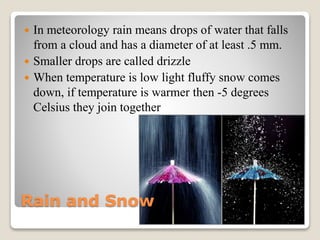
 In meteorology rain means drops of water that falls
from a cloud and has a diameter of at least .5 mm.
 Smaller drops are called drizzle
 When temperature is low light fluffy snow comes
down, if temperature is warmer then -5 degrees
Celsius they join together
Sleet, Glaze, and Hail
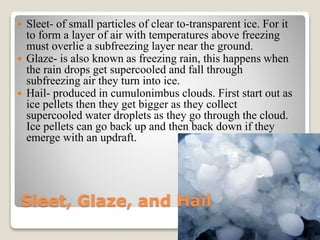
 Sleet- of small particles of clear to-transparent ice. For it
to form a layer of air with temperatures above freezing
must overlie a subfreezing layer near the ground.
 Glaze- is also known as freezing rain, this happens when
the rain drops get supercooled and fall through
subfreezing air they turn into ice.
 Hail- produced in cumulonimbus clouds. First start out as
ice pellets then they get bigger as they collect
supercooled water droplets as they go through the cloud.
Ice pellets can go back up and then back down if they
emerge with an updraft.
Pictures sited
1st slide picture- clouds_guardian.jpg
2nd slide picture-adiabatic.jpg
3rd slide picture- figure_02-20.jpg
4th slide picture- frontal.wedging.jpg
5th slide picture-cnvrg1.gif
6th slide picture-
675_173_107-different-types-cloud-nome
nclature
7th slide picture-Instability_20Diagram.jpg
8th slide picture- cumulonimbus.jpg
9th , 10th , and 11th slide picture-clouds.GIF
Pictures cited continued…
12th slide picture- cloud-types.gif
13th slide picture- fog.jpg
14th and 15th slide picture- fig-6.JPG
16th slide picture- rain-and-snow1.jpg
17th slide picture-hail.jpg
The End!!

5EDzieniszewski

  • 1.
  • 2.
    Adiabatic Temperatures Changes •When airexpands it cools, then when it compressed it is warm •Expansion (dry adiabatic rate) is a rate of cooling or heating only to unsaturated air. As you go up through the atmosphere the pressure decrease, this happens because there is less gas molecules •Cooling (wet adiabatic rate), is above the condensation level, it rise 5 Celsius for every 1000 meters
  • 3.
    Orographic Lifting •As airgoes up mountain slopes the adiabatic cooling creates clouds and precipitation •This process only occurs because of the mountains or elevated terrain acts as walls of barrier
  • 4.
    Frontal Wedging •When acold front meets a warm front and the cooler front which is more denser acts as a wall over when the warmer less dense air rises
  • 5.
    Convergence •Collision of contrastingair mass forces air to rise
  • 6.
    Stability • Stability ismeasured by using temps. of atmospheres at various heights • Temperature decreases as altitude increases • When clouds make contact with up lifted air it usually creates thunderstorms, and maybe a tornado
  • 7.
    Localized Convective Lifting•On warmsummer days, unequal heating of Earth’s surface may cause pockets of air to be warmed more than surrounding air •Spots and parcels are called thermals •Stability is measured by using temps. of atmospheres at various heights •Temperature decreases as altitude increases •When clouds make contact with up lifted air it usually creates thunderstorms, and maybe a tornado
  • 8.
    Condensation  For anycondensation to be formed air must be saturated  Types of clouds: Stratus- covers most of the sky. Cumulus- have flat bases, described as cauliflower structure, they are round individual cloud masses. Cirrus- white and thin, they come in groups of patches.
  • 9.
    High clouds  Familyof high clouds; cirrus, cirrostratus, and cirrocumulus  High clouds are thin and white
  • 10.
    Middle Clouds  Prefixof alto- as part of their names  Large and dense  Clouds that appear in middle range are about 2000 to 6000 meters above ground
  • 11.
    Low Clouds  Threemembers- stratus, stratocumulus, and nimbostratus  Produce light precipitation  Stratus clouds like a fog layer that covers most of the sky  Nimbostratus are the rain makers
  • 12.
    Clouds and VerticalDevelopment  All clouds are related and associate with unstable air  Once there is up ward movement, clouds form with vertical range, when this happens cumulonimbus makes rain and thunderstorm
  • 13.
    Fog  Fog isdefined as a cloud with its base at or very near the ground  Fog is caused by radiation cooling or the movement of air over a cold surface can also form when enough water vapor is added to the air to bring about saturation  Caused by cooling- as air becomes cooler then gets denser and drains into to fiver valleys  Caused by evaporation- when it covers over lakes in fall and early winters
  • 14.
    Cold Cloud Precipitation Bergeron process – two physical processes: super cooling and super saturation  Super cooled- liquid state below 0 Celsius.  Super saturated- it has greater than 100 % humidity
  • 15.
    Warm Cloud Precipitation Collision-coalescence process- it is a mechanism that forms raindrops  Large droplets go through sky they collide with other small and slower droplets
  • 16.
    Rain and Snow In meteorology rain means drops of water that falls from a cloud and has a diameter of at least .5 mm.  Smaller drops are called drizzle  When temperature is low light fluffy snow comes down, if temperature is warmer then -5 degrees Celsius they join together
  • 17.
    Sleet, Glaze, andHail  Sleet- of small particles of clear to-transparent ice. For it to form a layer of air with temperatures above freezing must overlie a subfreezing layer near the ground.  Glaze- is also known as freezing rain, this happens when the rain drops get supercooled and fall through subfreezing air they turn into ice.  Hail- produced in cumulonimbus clouds. First start out as ice pellets then they get bigger as they collect supercooled water droplets as they go through the cloud. Ice pellets can go back up and then back down if they emerge with an updraft.
  • 18.
    Pictures sited 1st slidepicture- clouds_guardian.jpg 2nd slide picture-adiabatic.jpg 3rd slide picture- figure_02-20.jpg 4th slide picture- frontal.wedging.jpg 5th slide picture-cnvrg1.gif 6th slide picture- 675_173_107-different-types-cloud-nome nclature 7th slide picture-Instability_20Diagram.jpg 8th slide picture- cumulonimbus.jpg 9th , 10th , and 11th slide picture-clouds.GIF
  • 19.
    Pictures cited continued… 12thslide picture- cloud-types.gif 13th slide picture- fog.jpg 14th and 15th slide picture- fig-6.JPG 16th slide picture- rain-and-snow1.jpg 17th slide picture-hail.jpg
  • 20.