Unit 4 Lesson 2 Clouds and Cloud Formation
Copyright © Houghton Mifflin Harcourt Publishing Company
Head in the Clouds
Copyright © Houghton Mifflin Harcourt Publishing Company
What are clouds?
• A cloud is a collection of small water droplets or
ice crystals that are suspended in the air.
• Clouds are visible because water droplets and ice
crystals reflect light.
• Clouds are usually associated with precipitation,
but most cloud types do not produce precipitation.
Unit 4 Lesson 2 Clouds and Cloud Formation
How do clouds affect climate?
• The pattern of precipitation from clouds in an area
will determine the climate of that area.
• Thick, low-altitude clouds reflect more sunlight
back into space and help to cool Earth.
• Thin, high-altitude clouds absorb some energy
that radiates from Earth and reradiate some of it
back to Earth’s surface. This warms Earth.
Copyright © Houghton Mifflin Harcourt Publishing Company
Unit 4 Lesson 2 Clouds and Cloud Formation
How do clouds form?
• Clouds form when water vapor condenses, or
changes from a gas to a liquid.
• For water vapor to condense, moist air must be
cooled to a certain temperature, and the air must
be holding the maximum amount of water vapor
possible.
• If air rises high enough into the atmosphere, it
cools to its dew point.
Copyright © Houghton Mifflin Harcourt Publishing Company
Unit 4 Lesson 2 Clouds and Cloud Formation
How do clouds form?
• Dew point is defined as the temperature at which
the rate of condensation equals the rate of
saturation.
• Saturation means that the air is holding the
maximum quantity of water vapor possible at a
given temperature or pressure.
• Dew point is the temperature at which water
vapor in saturated air can condense and form
water droplets or ice crystals.
Copyright © Houghton Mifflin Harcourt Publishing Company
Unit 4 Lesson 2 Clouds and Cloud Formation
How do clouds form?
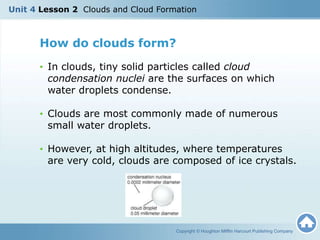
• In clouds, tiny solid particles called cloud
condensation nuclei are the surfaces on which
water droplets condense.
• Clouds are most commonly made of numerous
small water droplets.
• However, at high altitudes, where temperatures
are very cold, clouds are composed of ice crystals.
Copyright © Houghton Mifflin Harcourt Publishing Company
Unit 4 Lesson 2 Clouds and Cloud Formation
What is the role of solar energy in
cloud formation?
• Solar energy drives the water cycle and thus
provides the energy for cloud formation.
• Water on the surface of the land and the oceans
absorbs solar energy and becomes water vapor, in
a process called evaporation.
• Cloud formation takes place when water droplets
or ice crystals condense on solid particles in the
air.
Copyright © Houghton Mifflin Harcourt Publishing Company
Unit 4 Lesson 2 Clouds and Cloud Formation
What processes cool air enough to form
clouds?
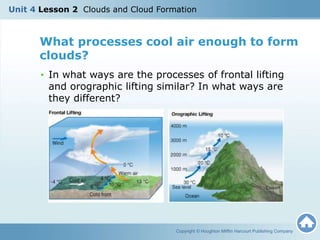
• Air can be cooled to its dew point in several ways,
including frontal and orographic lifting.
• Frontal lifting can occur when a warm air mass
rises over a cold air mass, or when a mass of cold
air slides under a mass of warm air.
• Orographic lifting occurs when an obstacle, such
as a mountain range, forces a mass of air upward.
Copyright © Houghton Mifflin Harcourt Publishing Company
Unit 4 Lesson 2 Clouds and Cloud Formation
What processes cool air enough to form
clouds?
Copyright © Houghton Mifflin Harcourt Publishing Company
Unit 4 Lesson 2 Clouds and Cloud Formation
• In what ways are the processes of frontal lifting
and orographic lifting similar? In what ways are
they different?
What are three cloud shapes?
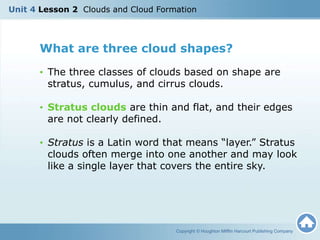
• The three classes of clouds based on shape are
stratus, cumulus, and cirrus clouds.
• Stratus clouds are thin and flat, and their edges
are not clearly defined.
• Stratus is a Latin word that means “layer.” Stratus
clouds often merge into one another and may look
like a single layer that covers the entire sky.
Copyright © Houghton Mifflin Harcourt Publishing Company
Unit 4 Lesson 2 Clouds and Cloud Formation
What are three cloud shapes?
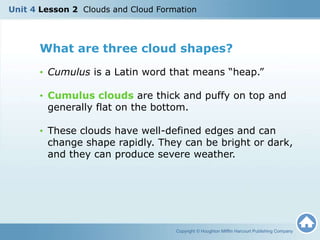
• Cumulus is a Latin word that means “heap.”
• Cumulus clouds are thick and puffy on top and
generally flat on the bottom.
• These clouds have well-defined edges and can
change shape rapidly. They can be bright or dark,
and they can produce severe weather.
Copyright © Houghton Mifflin Harcourt Publishing Company
Unit 4 Lesson 2 Clouds and Cloud Formation
What are three cloud shapes?
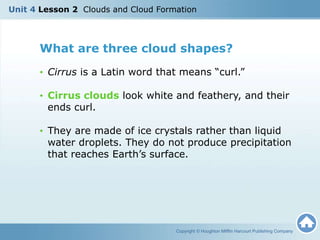
• Cirrus is a Latin word that means “curl.”
• Cirrus clouds look white and feathery, and their
ends curl.
• They are made of ice crystals rather than liquid
water droplets. They do not produce precipitation
that reaches Earth’s surface.
Copyright © Houghton Mifflin Harcourt Publishing Company
Unit 4 Lesson 2 Clouds and Cloud Formation
I’ve Looked at Clouds from Both
Sides Now
Copyright © Houghton Mifflin Harcourt Publishing Company
What are the types of clouds based on
altitude?
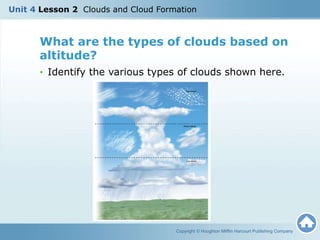
• The four classes of clouds based on altitude are
low clouds, middle clouds, high clouds, and clouds
of vertical development.
• These four classes are made up of 10 cloud types.
• Prefixes are used to name the clouds that belong
to some of these classes.
Unit 4 Lesson 2 Clouds and Cloud Formation
What are the types of clouds based on
altitude?
• Low clouds form between Earth’s surface and
2,000 m altitude. They are commonly made up of
water droplets.
• The three types of low clouds are stratus,
stratocumulus, and nimbostratus.
• There is no special prefix for naming low clouds.
However, nimbus means “rain,” so nimbostratus
clouds are rain clouds.
Copyright © Houghton Mifflin Harcourt Publishing Company
Unit 4 Lesson 2 Clouds and Cloud Formation
What are the types of clouds based on
altitude?
• Middle clouds form between 2,000 m and 6,000 m
altitude. They are commonly made up of water
droplets, but may be made up of ice crystals.
• The prefix alto- is used to name middle clouds.
• The two types of middle clouds are altocumulus
and altostratus.
Copyright © Houghton Mifflin Harcourt Publishing Company
Unit 4 Lesson 2 Clouds and Cloud Formation
What are the types of clouds based on
altitude?
• High clouds form above 6,000 m altitude, where
air temperature is below freezing. Therefore, high
clouds are made up of ice crystals.
• The prefix cirro- is used to name high clouds.
• Cirrus, cirrocumulus, and cirrostratus are the
types of high clouds.
Copyright © Houghton Mifflin Harcourt Publishing Company
Unit 4 Lesson 2 Clouds and Cloud Formation
What are the types of clouds based on
altitude?
• A cloud of vertical development can have its base
at low altitude, but its top can reach higher than
12,000 m.
• The two types of clouds of vertical development
are cumulus and cumulonimbus.
• Cumulonimbus clouds are linked to severe
weather and can produce rain, hail, lightning,
tornadoes, and rapidly sinking columns of air.
Copyright © Houghton Mifflin Harcourt Publishing Company
Unit 4 Lesson 2 Clouds and Cloud Formation
What are the types of clouds based on
altitude?
• Identify the various types of clouds shown here.
Copyright © Houghton Mifflin Harcourt Publishing Company
Unit 4 Lesson 2 Clouds and Cloud Formation
How does fog form?
• Water vapor that condenses very near Earth’s
surface is called fog. It forms when moist air near
Earth’s surface or moving across cold water cools
to its dew point.
• Ground fog, or radiation fog, generally forms in
low-lying areas on clear, calm nights. Sea fog, or
advection fog, occurs at all times of day.
• Steam fog forms when evaporation takes place
into cold air that is lying over warmer water.
Copyright © Houghton Mifflin Harcourt Publishing Company
Unit 4 Lesson 2 Clouds and Cloud Formation
Clouds on Other Worlds
Copyright © Houghton Mifflin Harcourt Publishing Company
• Like Earth, other bodies in the solar system have
clouds in their atmosphere.
• There are clouds on Venus, Mars, Jupiter, and
Saturn. The clouds of Jupiter and Saturn are
arranged in bands that circle the planets.
• Saturn’s moon Titan has clouds in a thick, planet-
like atmosphere.

Clouds and cloud_formation

  • 1.
    Unit 4 Lesson2 Clouds and Cloud Formation Copyright © Houghton Mifflin Harcourt Publishing Company
  • 2.
    Head in theClouds Copyright © Houghton Mifflin Harcourt Publishing Company What are clouds? • A cloud is a collection of small water droplets or ice crystals that are suspended in the air. • Clouds are visible because water droplets and ice crystals reflect light. • Clouds are usually associated with precipitation, but most cloud types do not produce precipitation. Unit 4 Lesson 2 Clouds and Cloud Formation
  • 3.
    How do cloudsaffect climate? • The pattern of precipitation from clouds in an area will determine the climate of that area. • Thick, low-altitude clouds reflect more sunlight back into space and help to cool Earth. • Thin, high-altitude clouds absorb some energy that radiates from Earth and reradiate some of it back to Earth’s surface. This warms Earth. Copyright © Houghton Mifflin Harcourt Publishing Company Unit 4 Lesson 2 Clouds and Cloud Formation
  • 4.
    How do cloudsform? • Clouds form when water vapor condenses, or changes from a gas to a liquid. • For water vapor to condense, moist air must be cooled to a certain temperature, and the air must be holding the maximum amount of water vapor possible. • If air rises high enough into the atmosphere, it cools to its dew point. Copyright © Houghton Mifflin Harcourt Publishing Company Unit 4 Lesson 2 Clouds and Cloud Formation
  • 5.
    How do cloudsform? • Dew point is defined as the temperature at which the rate of condensation equals the rate of saturation. • Saturation means that the air is holding the maximum quantity of water vapor possible at a given temperature or pressure. • Dew point is the temperature at which water vapor in saturated air can condense and form water droplets or ice crystals. Copyright © Houghton Mifflin Harcourt Publishing Company Unit 4 Lesson 2 Clouds and Cloud Formation
  • 6.
    How do cloudsform? • In clouds, tiny solid particles called cloud condensation nuclei are the surfaces on which water droplets condense. • Clouds are most commonly made of numerous small water droplets. • However, at high altitudes, where temperatures are very cold, clouds are composed of ice crystals. Copyright © Houghton Mifflin Harcourt Publishing Company Unit 4 Lesson 2 Clouds and Cloud Formation
  • 7.
    What is therole of solar energy in cloud formation? • Solar energy drives the water cycle and thus provides the energy for cloud formation. • Water on the surface of the land and the oceans absorbs solar energy and becomes water vapor, in a process called evaporation. • Cloud formation takes place when water droplets or ice crystals condense on solid particles in the air. Copyright © Houghton Mifflin Harcourt Publishing Company Unit 4 Lesson 2 Clouds and Cloud Formation
  • 8.
    What processes coolair enough to form clouds? • Air can be cooled to its dew point in several ways, including frontal and orographic lifting. • Frontal lifting can occur when a warm air mass rises over a cold air mass, or when a mass of cold air slides under a mass of warm air. • Orographic lifting occurs when an obstacle, such as a mountain range, forces a mass of air upward. Copyright © Houghton Mifflin Harcourt Publishing Company Unit 4 Lesson 2 Clouds and Cloud Formation
  • 9.
    What processes coolair enough to form clouds? Copyright © Houghton Mifflin Harcourt Publishing Company Unit 4 Lesson 2 Clouds and Cloud Formation • In what ways are the processes of frontal lifting and orographic lifting similar? In what ways are they different?
  • 10.
    What are threecloud shapes? • The three classes of clouds based on shape are stratus, cumulus, and cirrus clouds. • Stratus clouds are thin and flat, and their edges are not clearly defined. • Stratus is a Latin word that means “layer.” Stratus clouds often merge into one another and may look like a single layer that covers the entire sky. Copyright © Houghton Mifflin Harcourt Publishing Company Unit 4 Lesson 2 Clouds and Cloud Formation
  • 11.
    What are threecloud shapes? • Cumulus is a Latin word that means “heap.” • Cumulus clouds are thick and puffy on top and generally flat on the bottom. • These clouds have well-defined edges and can change shape rapidly. They can be bright or dark, and they can produce severe weather. Copyright © Houghton Mifflin Harcourt Publishing Company Unit 4 Lesson 2 Clouds and Cloud Formation
  • 12.
    What are threecloud shapes? • Cirrus is a Latin word that means “curl.” • Cirrus clouds look white and feathery, and their ends curl. • They are made of ice crystals rather than liquid water droplets. They do not produce precipitation that reaches Earth’s surface. Copyright © Houghton Mifflin Harcourt Publishing Company Unit 4 Lesson 2 Clouds and Cloud Formation
  • 13.
    I’ve Looked atClouds from Both Sides Now Copyright © Houghton Mifflin Harcourt Publishing Company What are the types of clouds based on altitude? • The four classes of clouds based on altitude are low clouds, middle clouds, high clouds, and clouds of vertical development. • These four classes are made up of 10 cloud types. • Prefixes are used to name the clouds that belong to some of these classes. Unit 4 Lesson 2 Clouds and Cloud Formation
  • 14.
    What are thetypes of clouds based on altitude? • Low clouds form between Earth’s surface and 2,000 m altitude. They are commonly made up of water droplets. • The three types of low clouds are stratus, stratocumulus, and nimbostratus. • There is no special prefix for naming low clouds. However, nimbus means “rain,” so nimbostratus clouds are rain clouds. Copyright © Houghton Mifflin Harcourt Publishing Company Unit 4 Lesson 2 Clouds and Cloud Formation
  • 15.
    What are thetypes of clouds based on altitude? • Middle clouds form between 2,000 m and 6,000 m altitude. They are commonly made up of water droplets, but may be made up of ice crystals. • The prefix alto- is used to name middle clouds. • The two types of middle clouds are altocumulus and altostratus. Copyright © Houghton Mifflin Harcourt Publishing Company Unit 4 Lesson 2 Clouds and Cloud Formation
  • 16.
    What are thetypes of clouds based on altitude? • High clouds form above 6,000 m altitude, where air temperature is below freezing. Therefore, high clouds are made up of ice crystals. • The prefix cirro- is used to name high clouds. • Cirrus, cirrocumulus, and cirrostratus are the types of high clouds. Copyright © Houghton Mifflin Harcourt Publishing Company Unit 4 Lesson 2 Clouds and Cloud Formation
  • 17.
    What are thetypes of clouds based on altitude? • A cloud of vertical development can have its base at low altitude, but its top can reach higher than 12,000 m. • The two types of clouds of vertical development are cumulus and cumulonimbus. • Cumulonimbus clouds are linked to severe weather and can produce rain, hail, lightning, tornadoes, and rapidly sinking columns of air. Copyright © Houghton Mifflin Harcourt Publishing Company Unit 4 Lesson 2 Clouds and Cloud Formation
  • 18.
    What are thetypes of clouds based on altitude? • Identify the various types of clouds shown here. Copyright © Houghton Mifflin Harcourt Publishing Company Unit 4 Lesson 2 Clouds and Cloud Formation
  • 19.
    How does fogform? • Water vapor that condenses very near Earth’s surface is called fog. It forms when moist air near Earth’s surface or moving across cold water cools to its dew point. • Ground fog, or radiation fog, generally forms in low-lying areas on clear, calm nights. Sea fog, or advection fog, occurs at all times of day. • Steam fog forms when evaporation takes place into cold air that is lying over warmer water. Copyright © Houghton Mifflin Harcourt Publishing Company Unit 4 Lesson 2 Clouds and Cloud Formation
  • 20.
    Unit 4 Lesson2 Clouds and Cloud Formation Clouds on Other Worlds Copyright © Houghton Mifflin Harcourt Publishing Company • Like Earth, other bodies in the solar system have clouds in their atmosphere. • There are clouds on Venus, Mars, Jupiter, and Saturn. The clouds of Jupiter and Saturn are arranged in bands that circle the planets. • Saturn’s moon Titan has clouds in a thick, planet- like atmosphere.