Clouds and Precipitation

      By: Alex Kryzan
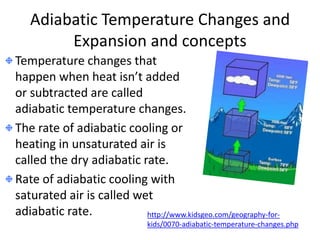
Adiabatic Temperature Changes and
        Expansion and concepts
Temperature changes that
happen when heat isn’t added
or subtracted are called
adiabatic temperature changes.
The rate of adiabatic cooling or
heating in unsaturated air is
called the dry adiabatic rate.
Rate of adiabatic cooling with
saturated air is called wet
adiabatic rate.           http://www.kidsgeo.com/geography-for-
                               kids/0070-adiabatic-temperature-changes.php
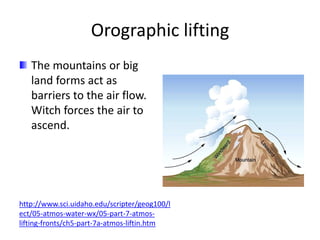
Orographic lifting
   The mountains or big
   land forms act as
   barriers to the air flow.
   Witch forces the air to
   ascend.


http://www.sci.uidaho.edu/scripter/geog100/l
ect/05-atmos-water-wx/05-part-7-atmos-
lifting-fronts/ch5-part-7a-atmos-liftin.htm
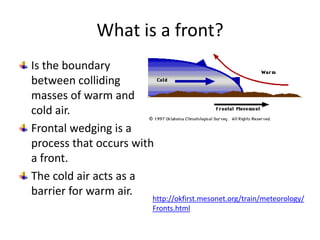
What is a front?
Is the boundary
between colliding
masses of warm and
cold air.
Frontal wedging is a
process that occurs with
a front.
The cold air acts as a
barrier for warm air.
                       http://okfirst.mesonet.org/train/meteorology/
                       Fronts.html
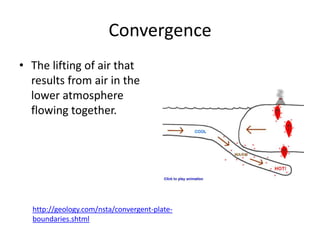
Convergence
• The lifting of air that
  results from air in the
  lower atmosphere
  flowing together.


  http://geology.com/nsta/convergent-plate-
  boundaries.shtml
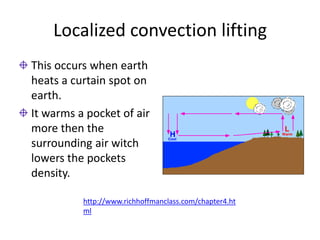
Localized convection lifting
This occurs when earth
heats a curtain spot on
earth.
It warms a pocket of air
more then the
surrounding air witch
lowers the pockets
density.

          http://www.richhoffmanclass.com/chapter4.ht
          ml
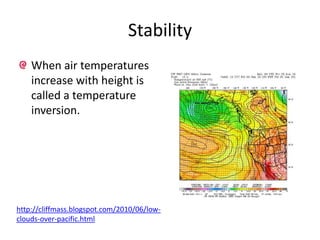
Stability
    When air temperatures
    increase with height is
    called a temperature
    inversion.


http://cliffmass.blogspot.com/2010/06/low-
clouds-over-pacific.html
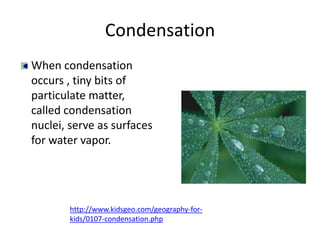
Condensation
When condensation
occurs , tiny bits of
particulate matter,
called condensation
nuclei, serve as surfaces
for water vapor.


       http://www.kidsgeo.com/geography-for-
       kids/0107-condensation.php
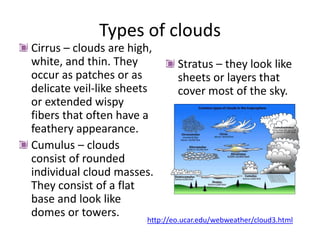
Types of clouds
Cirrus – clouds are high,
white, and thin. They          Stratus – they look like
occur as patches or as         sheets or layers that
delicate veil-like sheets      cover most of the sky.
or extended wispy
fibers that often have a
feathery appearance.
Cumulus – clouds
consist of rounded
individual cloud masses.
They consist of a flat
base and look like
domes or towers.
                       http://eo.ucar.edu/webweather/cloud3.html
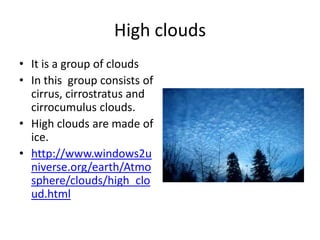
High clouds
• It is a group of clouds
• In this group consists of
  cirrus, cirrostratus and
  cirrocumulus clouds.
• High clouds are made of
  ice.
• http://www.windows2u
  niverse.org/earth/Atmo
  sphere/clouds/high_clo
  ud.html
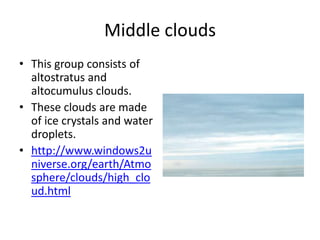
Middle clouds
• This group consists of
  altostratus and
  altocumulus clouds.
• These clouds are made
  of ice crystals and water
  droplets.
• http://www.windows2u
  niverse.org/earth/Atmo
  sphere/clouds/high_clo
  ud.html
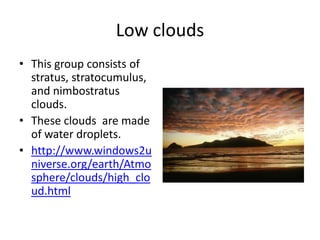
Low clouds
• This group consists of
  stratus, stratocumulus,
  and nimbostratus
  clouds.
• These clouds are made
  of water droplets.
• http://www.windows2u
  niverse.org/earth/Atmo
  sphere/clouds/high_clo
  ud.html
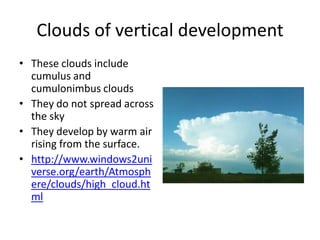
Clouds of vertical development
• These clouds include
  cumulus and
  cumulonimbus clouds
• They do not spread across
  the sky
• They develop by warm air
  rising from the surface.
• http://www.windows2uni
  verse.org/earth/Atmosph
  ere/clouds/high_cloud.ht
  ml
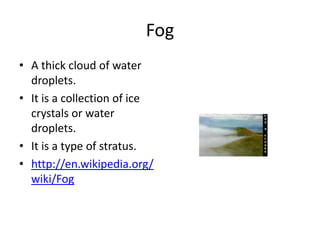
Fog
• A thick cloud of water
  droplets.
• It is a collection of ice
  crystals or water
  droplets.
• It is a type of stratus.
• http://en.wikipedia.org/
  wiki/Fog
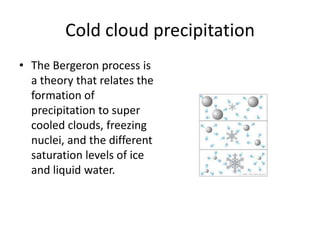
Cold cloud precipitation
• The Bergeron process is
  a theory that relates the
  formation of
  precipitation to super
  cooled clouds, freezing
  nuclei, and the different
  saturation levels of ice
  and liquid water.
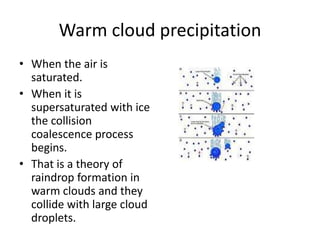
Warm cloud precipitation
• When the air is
  saturated.
• When it is
  supersaturated with ice
  the collision
  coalescence process
  begins.
• That is a theory of
  raindrop formation in
  warm clouds and they
  collide with large cloud
  droplets.
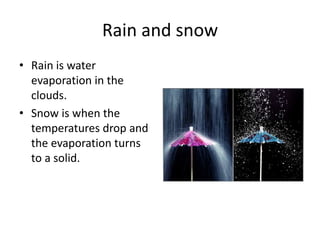
Rain and snow
• Rain is water
  evaporation in the
  clouds.
• Snow is when the
  temperatures drop and
  the evaporation turns
  to a solid.
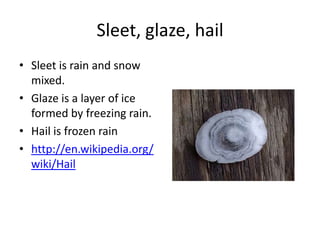
Sleet, glaze, hail
• Sleet is rain and snow
  mixed.
• Glaze is a layer of ice
  formed by freezing rain.
• Hail is frozen rain
• http://en.wikipedia.org/
  wiki/Hail

2akryzan

  • 1.
  • 2.
    Adiabatic Temperature Changesand Expansion and concepts Temperature changes that happen when heat isn’t added or subtracted are called adiabatic temperature changes. The rate of adiabatic cooling or heating in unsaturated air is called the dry adiabatic rate. Rate of adiabatic cooling with saturated air is called wet adiabatic rate. http://www.kidsgeo.com/geography-for- kids/0070-adiabatic-temperature-changes.php
  • 3.
    Orographic lifting The mountains or big land forms act as barriers to the air flow. Witch forces the air to ascend. http://www.sci.uidaho.edu/scripter/geog100/l ect/05-atmos-water-wx/05-part-7-atmos- lifting-fronts/ch5-part-7a-atmos-liftin.htm
  • 4.
    What is afront? Is the boundary between colliding masses of warm and cold air. Frontal wedging is a process that occurs with a front. The cold air acts as a barrier for warm air. http://okfirst.mesonet.org/train/meteorology/ Fronts.html
  • 5.
    Convergence • The liftingof air that results from air in the lower atmosphere flowing together. http://geology.com/nsta/convergent-plate- boundaries.shtml
  • 6.
    Localized convection lifting Thisoccurs when earth heats a curtain spot on earth. It warms a pocket of air more then the surrounding air witch lowers the pockets density. http://www.richhoffmanclass.com/chapter4.ht ml
  • 7.
    Stability When air temperatures increase with height is called a temperature inversion. http://cliffmass.blogspot.com/2010/06/low- clouds-over-pacific.html
  • 8.
    Condensation When condensation occurs ,tiny bits of particulate matter, called condensation nuclei, serve as surfaces for water vapor. http://www.kidsgeo.com/geography-for- kids/0107-condensation.php
  • 9.
    Types of clouds Cirrus– clouds are high, white, and thin. They Stratus – they look like occur as patches or as sheets or layers that delicate veil-like sheets cover most of the sky. or extended wispy fibers that often have a feathery appearance. Cumulus – clouds consist of rounded individual cloud masses. They consist of a flat base and look like domes or towers. http://eo.ucar.edu/webweather/cloud3.html
  • 10.
    High clouds • Itis a group of clouds • In this group consists of cirrus, cirrostratus and cirrocumulus clouds. • High clouds are made of ice. • http://www.windows2u niverse.org/earth/Atmo sphere/clouds/high_clo ud.html
  • 11.
    Middle clouds • Thisgroup consists of altostratus and altocumulus clouds. • These clouds are made of ice crystals and water droplets. • http://www.windows2u niverse.org/earth/Atmo sphere/clouds/high_clo ud.html
  • 12.
    Low clouds • Thisgroup consists of stratus, stratocumulus, and nimbostratus clouds. • These clouds are made of water droplets. • http://www.windows2u niverse.org/earth/Atmo sphere/clouds/high_clo ud.html
  • 13.
    Clouds of verticaldevelopment • These clouds include cumulus and cumulonimbus clouds • They do not spread across the sky • They develop by warm air rising from the surface. • http://www.windows2uni verse.org/earth/Atmosph ere/clouds/high_cloud.ht ml
  • 14.
    Fog • A thickcloud of water droplets. • It is a collection of ice crystals or water droplets. • It is a type of stratus. • http://en.wikipedia.org/ wiki/Fog
  • 15.
    Cold cloud precipitation •The Bergeron process is a theory that relates the formation of precipitation to super cooled clouds, freezing nuclei, and the different saturation levels of ice and liquid water.
  • 16.
    Warm cloud precipitation •When the air is saturated. • When it is supersaturated with ice the collision coalescence process begins. • That is a theory of raindrop formation in warm clouds and they collide with large cloud droplets.
  • 17.
    Rain and snow •Rain is water evaporation in the clouds. • Snow is when the temperatures drop and the evaporation turns to a solid.
  • 18.
    Sleet, glaze, hail •Sleet is rain and snow mixed. • Glaze is a layer of ice formed by freezing rain. • Hail is frozen rain • http://en.wikipedia.org/ wiki/Hail