Precipitation From Clouds
The Bergeron Process
• The Bergeron Process

• Named for Swedish meteorologist Tor Bergeron
• Upper troposphere temperatures can drop as low
  as -50° C (-58° F)
• Two important properties of water:
  – Water does not freeze at 0°C (32° F)
  – Pure water suspended in air does not freeze until it
    reaches a temperature of nearly -40°C (-40°F).
The Bergeron Process
• In this state, water is said to be “supercooled”.

• Supercooled water will freeze if it impacts an
  object.
  – This is why aircraft experience icing conditions
    when they pass through a cloud made up of
    supercooled droplets.
  – This is also why the stuff we call freezing rain or
    glaze falls as a liquid and then forms a sheet of ice
    when it strikes pavement or a tree branch.
The Bergeron Process
• Additionally, supercooled droplets will freeze on
  contact with solid particles that have a crystal
  form closely resembling ice (like silver oxide- the
  chemical compound used in cloud seeding).
• These types of materials are referred to as frozen
  nuclei.
• Freezing nuclei in the atmosphere are sparse and
  do not become active until the temperature
  reaches -10°C (14°F).
The Bergeron Process
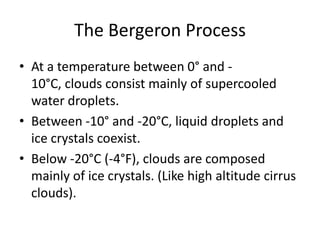
• At a temperature between 0° and -
  10°C, clouds consist mainly of supercooled
  water droplets.
• Between -10° and -20°C, liquid droplets and
  ice crystals coexist.
• Below -20°C (-4°F), clouds are composed
  mainly of ice crystals. (Like high altitude cirrus
  clouds).
The Bergeron Process
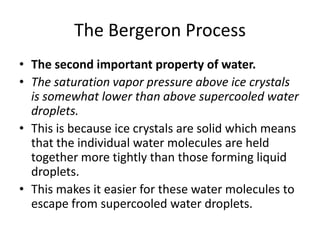
• The second important property of water.
• The saturation vapor pressure above ice crystals
  is somewhat lower than above supercooled water
  droplets.
• This is because ice crystals are solid which means
  that the individual water molecules are held
  together more tightly than those forming liquid
  droplets.
• This makes it easier for these water molecules to
  escape from supercooled water droplets.
Precipitation
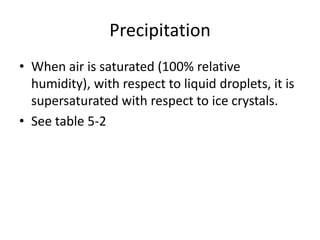
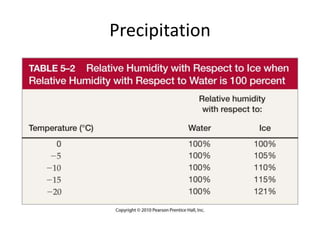
• When air is saturated (100% relative
  humidity), with respect to liquid droplets, it is
  supersaturated with respect to ice crystals.
• See table 5-2
Precipitation
Precipitation
• So, how does precipitation form?
• Picture a cloud at a temperature of -10° C
  (14°F)
• Each ice crystal is surrounded by thousands of
  liquid droplets.
• Because the air was initially saturated 100%
  with respect to liquid water, it will be
  supersaturated (over 100%) with respect to
  the newly formed ice crystals.
Precipitation
• As a result of this supersaturated condition,
  ice crystals continue to gather water moisture
  and they grow.
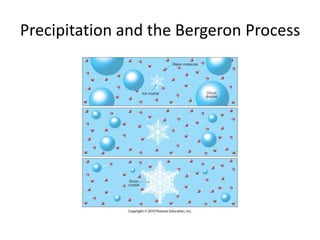
Precipitation and the Bergeron Process
• Because the level of supersaturation with respect
  to ice can be great, the growth of snow crystals
  continues and generates crystals large enough to
  fall.
• These crystals in turn are enlarged as they pass
  through the cloud by collision with water
  droplets.
• Air movement in the cloud can cause some of
  these crystals to break apart, and they become
  freezing nuclei for other liquid droplets.
Precipitation and the Bergeron Process
• A chain reaction develops and produces many
  snow crystals.
• These snow crystals, through a process called
  accretion, form into larger masses called
  snowflakes.
• Large snowflakes may consist of 10 to 30
  individual crystals.
Precipitation and the Bergeron Process
• In summary, the Bergeron process can
  produce precipitation throughout the year in
  the middle latitudes so long as the upper
  portions of the clouds are cold enough for the
  generation of ice crystals.
• The type of precipitation that reaches the
  ground (rain, snow, sleet, freezing rain)
  depends on temperature in the lower few
  kilometers of the atmosphere.

The Bergeron Process

  • 1.
  • 2.
    The Bergeron Process •The Bergeron Process • Named for Swedish meteorologist Tor Bergeron • Upper troposphere temperatures can drop as low as -50° C (-58° F) • Two important properties of water: – Water does not freeze at 0°C (32° F) – Pure water suspended in air does not freeze until it reaches a temperature of nearly -40°C (-40°F).
  • 3.
    The Bergeron Process •In this state, water is said to be “supercooled”. • Supercooled water will freeze if it impacts an object. – This is why aircraft experience icing conditions when they pass through a cloud made up of supercooled droplets. – This is also why the stuff we call freezing rain or glaze falls as a liquid and then forms a sheet of ice when it strikes pavement or a tree branch.
  • 4.
    The Bergeron Process •Additionally, supercooled droplets will freeze on contact with solid particles that have a crystal form closely resembling ice (like silver oxide- the chemical compound used in cloud seeding). • These types of materials are referred to as frozen nuclei. • Freezing nuclei in the atmosphere are sparse and do not become active until the temperature reaches -10°C (14°F).
  • 5.
    The Bergeron Process •At a temperature between 0° and - 10°C, clouds consist mainly of supercooled water droplets. • Between -10° and -20°C, liquid droplets and ice crystals coexist. • Below -20°C (-4°F), clouds are composed mainly of ice crystals. (Like high altitude cirrus clouds).
  • 6.
    The Bergeron Process •The second important property of water. • The saturation vapor pressure above ice crystals is somewhat lower than above supercooled water droplets. • This is because ice crystals are solid which means that the individual water molecules are held together more tightly than those forming liquid droplets. • This makes it easier for these water molecules to escape from supercooled water droplets.
  • 7.
    Precipitation • When airis saturated (100% relative humidity), with respect to liquid droplets, it is supersaturated with respect to ice crystals. • See table 5-2
  • 8.
  • 9.
    Precipitation • So, howdoes precipitation form? • Picture a cloud at a temperature of -10° C (14°F) • Each ice crystal is surrounded by thousands of liquid droplets. • Because the air was initially saturated 100% with respect to liquid water, it will be supersaturated (over 100%) with respect to the newly formed ice crystals.
  • 10.
    Precipitation • As aresult of this supersaturated condition, ice crystals continue to gather water moisture and they grow.
  • 11.
    Precipitation and theBergeron Process
  • 12.
    Precipitation and theBergeron Process • Because the level of supersaturation with respect to ice can be great, the growth of snow crystals continues and generates crystals large enough to fall. • These crystals in turn are enlarged as they pass through the cloud by collision with water droplets. • Air movement in the cloud can cause some of these crystals to break apart, and they become freezing nuclei for other liquid droplets.
  • 13.
    Precipitation and theBergeron Process • A chain reaction develops and produces many snow crystals. • These snow crystals, through a process called accretion, form into larger masses called snowflakes. • Large snowflakes may consist of 10 to 30 individual crystals.
  • 14.
    Precipitation and theBergeron Process • In summary, the Bergeron process can produce precipitation throughout the year in the middle latitudes so long as the upper portions of the clouds are cold enough for the generation of ice crystals. • The type of precipitation that reaches the ground (rain, snow, sleet, freezing rain) depends on temperature in the lower few kilometers of the atmosphere.