By Brianna Shevlin
Adiabatic Temperature Changes
and Expansion and Cooling
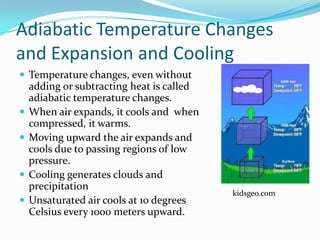
 Temperature changes, even without
    adding or subtracting heat is called
    adiabatic temperature changes.
   When air expands, it cools and when
    compressed, it warms.
   Moving upward the air expands and
    cools due to passing regions of low
    pressure.
   Cooling generates clouds and
    precipitation
                                           kidsgeo.com
   Unsaturated air cools at 10 degrees
    Celsius every 1000 meters upward.
Orographic Lifting
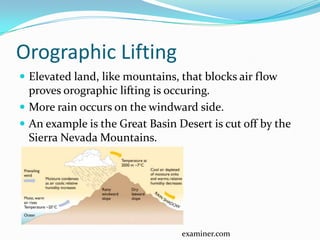
 Elevated land, like mountains, that blocks air flow
  proves orographic lifting is occuring.
 More rain occurs on the windward side.
 An example is the Great Basin Desert is cut off by the
  Sierra Nevada Mountains.


                                 examiner.com
Frontal Wedging
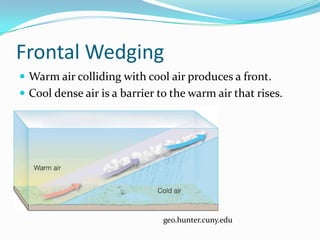
 Warm air colliding with cool air produces a front.
 Cool dense air is a barrier to the warm air that rises.


                               geo.hunter.cuny.edu
Convergence
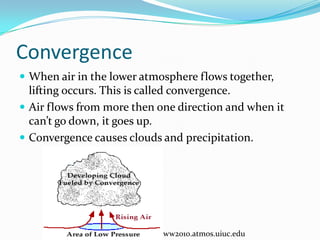
 When air in the lower atmosphere flows together,
  lifting occurs. This is called convergence.
 Air flows from more then one direction and when it
  can’t go down, it goes up.
 Convergence causes clouds and precipitation.


                            ww2010.atmos.uiuc.edu
Localized Collective Lifting
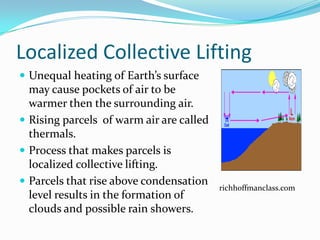
 Unequal heating of Earth’s surface
  may cause pockets of air to be
  warmer then the surrounding air.
 Rising parcels of warm air are called
  thermals.
 Process that makes parcels is
  localized collective lifting.
 Parcels that rise above condensation
                                          richhoffmanclass.com
  level results in the formation of
  clouds and possible rain showers.
Stability
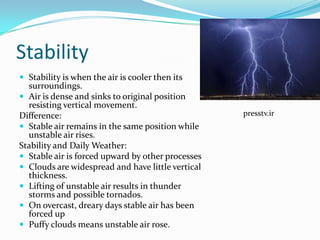
 Stability is when the air is cooler then its
  surroundings.
 Air is dense and sinks to original position
  resisting vertical movement.
Difference:                                        presstv.ir
 Stable air remains in the same position while
  unstable air rises.
Stability and Daily Weather:
 Stable air is forced upward by other processes
 Clouds are widespread and have little vertical
  thickness.
 Lifting of unstable air results in thunder
  storms and possible tornados.
 On overcast, dreary days stable air has been
  forced up
 Puffy clouds means unstable air rose.
Condensation
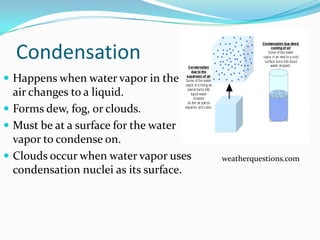
 Happens when water vapor in the
  air changes to a liquid.
 Forms dew, fog, or clouds.
 Must be at a surface for the water
  vapor to condense on.
 Clouds occur when water vapor uses    weatherquestions.com
  condensation nuclei as its surface.
Types of Clouds
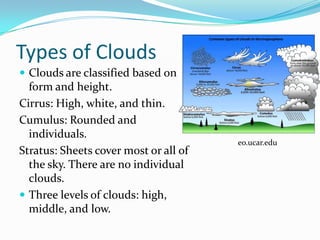
 Clouds are classified based on
  form and height.
Cirrus: High, white, and thin.
Cumulus: Rounded and
  individuals.
                                       eo.ucar.edu
Stratus: Sheets cover most or all of
  the sky. There are no individual
  clouds.
 Three levels of clouds: high,
  middle, and low.
High Clouds
 Bases are above 6000 meters.
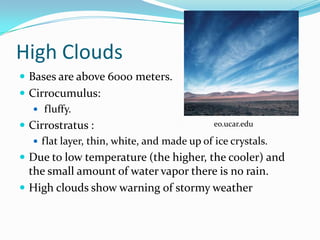
 Cirrocumulus:
    fluffy.
 Cirrostratus :                            eo.ucar.edu

    flat layer, thin, white, and made up of ice crystals.
 Due to low temperature (the higher, the cooler) and
  the small amount of water vapor there is no rain.
 High clouds show warning of stormy weather
Middle Clouds
 Bases are 2000-6000 meters high.
 Altocumulous:
    rounded, large, and dense.
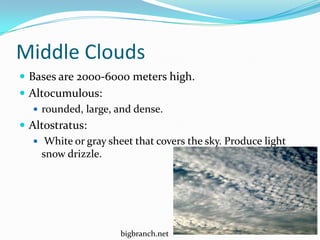
 Altostratus:
    White or gray sheet that covers the sky. Produce light
     snow drizzle.


                      bigbranch.net
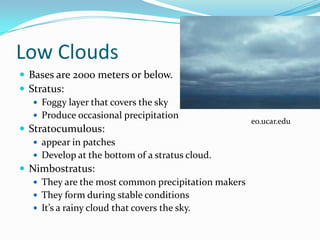
Low Clouds
 Bases are 2000 meters or below.
 Stratus:
    Foggy layer that covers the sky
    Produce occasional precipitation
                                                     eo.ucar.edu
 Stratocumulous:
    appear in patches
    Develop at the bottom of a stratus cloud.
 Nimbostratus:
    They are the most common precipitation makers
    They form during stable conditions
    It’s a rainy cloud that covers the sky.
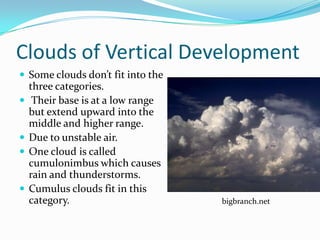
Clouds of Vertical Development
 Some clouds don’t fit into the
    three categories.
    Their base is at a low range
    but extend upward into the
    middle and higher range.
   Due to unstable air.
   One cloud is called
    cumulonimbus which causes
    rain and thunderstorms.
   Cumulus clouds fit in this
    category.                       bigbranch.net
brainharmonycenter.com


Fog
Fog:
 Clouds with bases near the ground.
 Happens due to radiation cooling or movement or air over a cool
  surface.
Cooling:
 Cools rapidly by radiation on cool, clear nights.
 A thin layer of air near the ground is cooled below dewpoint.
 Air cools and becomes dense, draining into low areas.
Evaporation:
 There is a steaming appearance.
 When cool air is over warm water there may be enough moisture
  to evaporate and produce saturation
 Increase in water vapor.
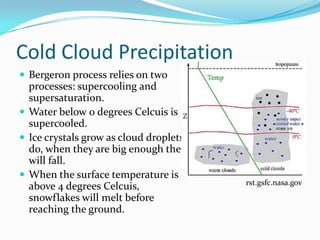
Cold Cloud Precipitation
 Bergeron process relies on two
  processes: supercooling and
  supersaturation.
 Water below 0 degrees Celcuis is
  supercooled.
 Ice crystals grow as cloud droplets
  do, when they are big enough they
  will fall.
 When the surface temperature is
                                        rst.gsfc.nasa.gov
  above 4 degrees Celcuis,
  snowflakes will melt before
  reaching the ground.
Warm Cloud Precipitation
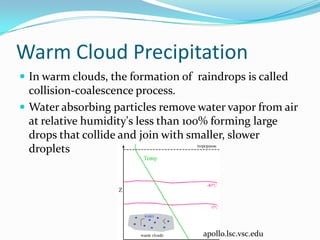
 In warm clouds, the formation of raindrops is called
  collision-coalescence process.
 Water absorbing particles remove water vapor from air
  at relative humidity's less than 100% forming large
  drops that collide and join with smaller, slower
  droplets


                                    apollo.lsc.vsc.edu
Rain and Snow
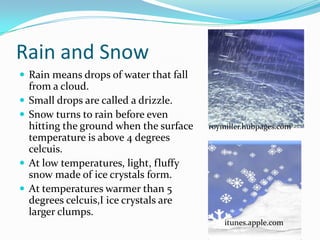
 Rain means drops of water that fall
    from a cloud.
   Small drops are called a drizzle.
   Snow turns to rain before even
    hitting the ground when the surface   roymiller.hubpages.com
    temperature is above 4 degrees
    celcuis.
   At low temperatures, light, fluffy
    snow made of ice crystals form.
   At temperatures warmer than 5
    degrees celcuis,I ice crystals are
    larger clumps.
                                              itunes.apple.com
wunderground.com


Sleet, Glaze, and Hail
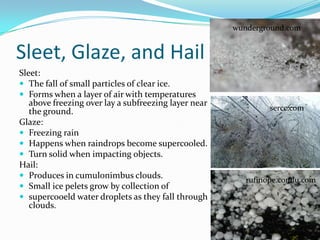
Sleet:
 The fall of small particles of clear ice.
 Forms when a layer of air with temperatures
   above freezing over lay a subfreezing layer near
   the ground.                                                 sercc.com
Glaze:
 Freezing rain
 Happens when raindrops become supercooled.
 Turn solid when impacting objects.
Hail:
 Produces in cumulonimbus clouds.
                                                         rufinope.comlu.com
 Small ice pelets grow by collection of
 supercooeld water droplets as they fall through
   clouds.
Bri’s Presentation on
      Clouds and
     Precipitation!
       The End!

4bshevlin

  • 1.
  • 2.
    Adiabatic Temperature Changes andExpansion and Cooling  Temperature changes, even without adding or subtracting heat is called adiabatic temperature changes.  When air expands, it cools and when compressed, it warms.  Moving upward the air expands and cools due to passing regions of low pressure.  Cooling generates clouds and precipitation kidsgeo.com  Unsaturated air cools at 10 degrees Celsius every 1000 meters upward.
  • 3.
    Orographic Lifting  Elevatedland, like mountains, that blocks air flow proves orographic lifting is occuring.  More rain occurs on the windward side.  An example is the Great Basin Desert is cut off by the Sierra Nevada Mountains. examiner.com
  • 4.
    Frontal Wedging  Warmair colliding with cool air produces a front.  Cool dense air is a barrier to the warm air that rises. geo.hunter.cuny.edu
  • 5.
    Convergence  When airin the lower atmosphere flows together, lifting occurs. This is called convergence.  Air flows from more then one direction and when it can’t go down, it goes up.  Convergence causes clouds and precipitation. ww2010.atmos.uiuc.edu
  • 6.
    Localized Collective Lifting Unequal heating of Earth’s surface may cause pockets of air to be warmer then the surrounding air.  Rising parcels of warm air are called thermals.  Process that makes parcels is localized collective lifting.  Parcels that rise above condensation richhoffmanclass.com level results in the formation of clouds and possible rain showers.
  • 7.
    Stability  Stability iswhen the air is cooler then its surroundings.  Air is dense and sinks to original position resisting vertical movement. Difference: presstv.ir  Stable air remains in the same position while unstable air rises. Stability and Daily Weather:  Stable air is forced upward by other processes  Clouds are widespread and have little vertical thickness.  Lifting of unstable air results in thunder storms and possible tornados.  On overcast, dreary days stable air has been forced up  Puffy clouds means unstable air rose.
  • 8.
    Condensation  Happens whenwater vapor in the air changes to a liquid.  Forms dew, fog, or clouds.  Must be at a surface for the water vapor to condense on.  Clouds occur when water vapor uses weatherquestions.com condensation nuclei as its surface.
  • 9.
    Types of Clouds Clouds are classified based on form and height. Cirrus: High, white, and thin. Cumulus: Rounded and individuals. eo.ucar.edu Stratus: Sheets cover most or all of the sky. There are no individual clouds.  Three levels of clouds: high, middle, and low.
  • 10.
    High Clouds  Basesare above 6000 meters.  Cirrocumulus:  fluffy.  Cirrostratus : eo.ucar.edu  flat layer, thin, white, and made up of ice crystals.  Due to low temperature (the higher, the cooler) and the small amount of water vapor there is no rain.  High clouds show warning of stormy weather
  • 11.
    Middle Clouds  Basesare 2000-6000 meters high.  Altocumulous:  rounded, large, and dense.  Altostratus:  White or gray sheet that covers the sky. Produce light snow drizzle. bigbranch.net
  • 12.
    Low Clouds  Basesare 2000 meters or below.  Stratus:  Foggy layer that covers the sky  Produce occasional precipitation eo.ucar.edu  Stratocumulous:  appear in patches  Develop at the bottom of a stratus cloud.  Nimbostratus:  They are the most common precipitation makers  They form during stable conditions  It’s a rainy cloud that covers the sky.
  • 13.
    Clouds of VerticalDevelopment  Some clouds don’t fit into the three categories.  Their base is at a low range but extend upward into the middle and higher range.  Due to unstable air.  One cloud is called cumulonimbus which causes rain and thunderstorms.  Cumulus clouds fit in this category. bigbranch.net
  • 14.
    brainharmonycenter.com Fog Fog:  Clouds withbases near the ground.  Happens due to radiation cooling or movement or air over a cool surface. Cooling:  Cools rapidly by radiation on cool, clear nights.  A thin layer of air near the ground is cooled below dewpoint.  Air cools and becomes dense, draining into low areas. Evaporation:  There is a steaming appearance.  When cool air is over warm water there may be enough moisture to evaporate and produce saturation  Increase in water vapor.
  • 15.
    Cold Cloud Precipitation Bergeron process relies on two processes: supercooling and supersaturation.  Water below 0 degrees Celcuis is supercooled.  Ice crystals grow as cloud droplets do, when they are big enough they will fall.  When the surface temperature is rst.gsfc.nasa.gov above 4 degrees Celcuis, snowflakes will melt before reaching the ground.
  • 16.
    Warm Cloud Precipitation In warm clouds, the formation of raindrops is called collision-coalescence process.  Water absorbing particles remove water vapor from air at relative humidity's less than 100% forming large drops that collide and join with smaller, slower droplets apollo.lsc.vsc.edu
  • 17.
    Rain and Snow Rain means drops of water that fall from a cloud.  Small drops are called a drizzle.  Snow turns to rain before even hitting the ground when the surface roymiller.hubpages.com temperature is above 4 degrees celcuis.  At low temperatures, light, fluffy snow made of ice crystals form.  At temperatures warmer than 5 degrees celcuis,I ice crystals are larger clumps. itunes.apple.com
  • 18.
    wunderground.com Sleet, Glaze, andHail Sleet:  The fall of small particles of clear ice.  Forms when a layer of air with temperatures above freezing over lay a subfreezing layer near the ground. sercc.com Glaze:  Freezing rain  Happens when raindrops become supercooled.  Turn solid when impacting objects. Hail:  Produces in cumulonimbus clouds. rufinope.comlu.com  Small ice pelets grow by collection of  supercooeld water droplets as they fall through clouds.
  • 19.
    Bri’s Presentation on Clouds and Precipitation! The End!