By: Courtney Smith
arm.html


    Adiabatic Temperature Changes
    and Expansion and Cooling
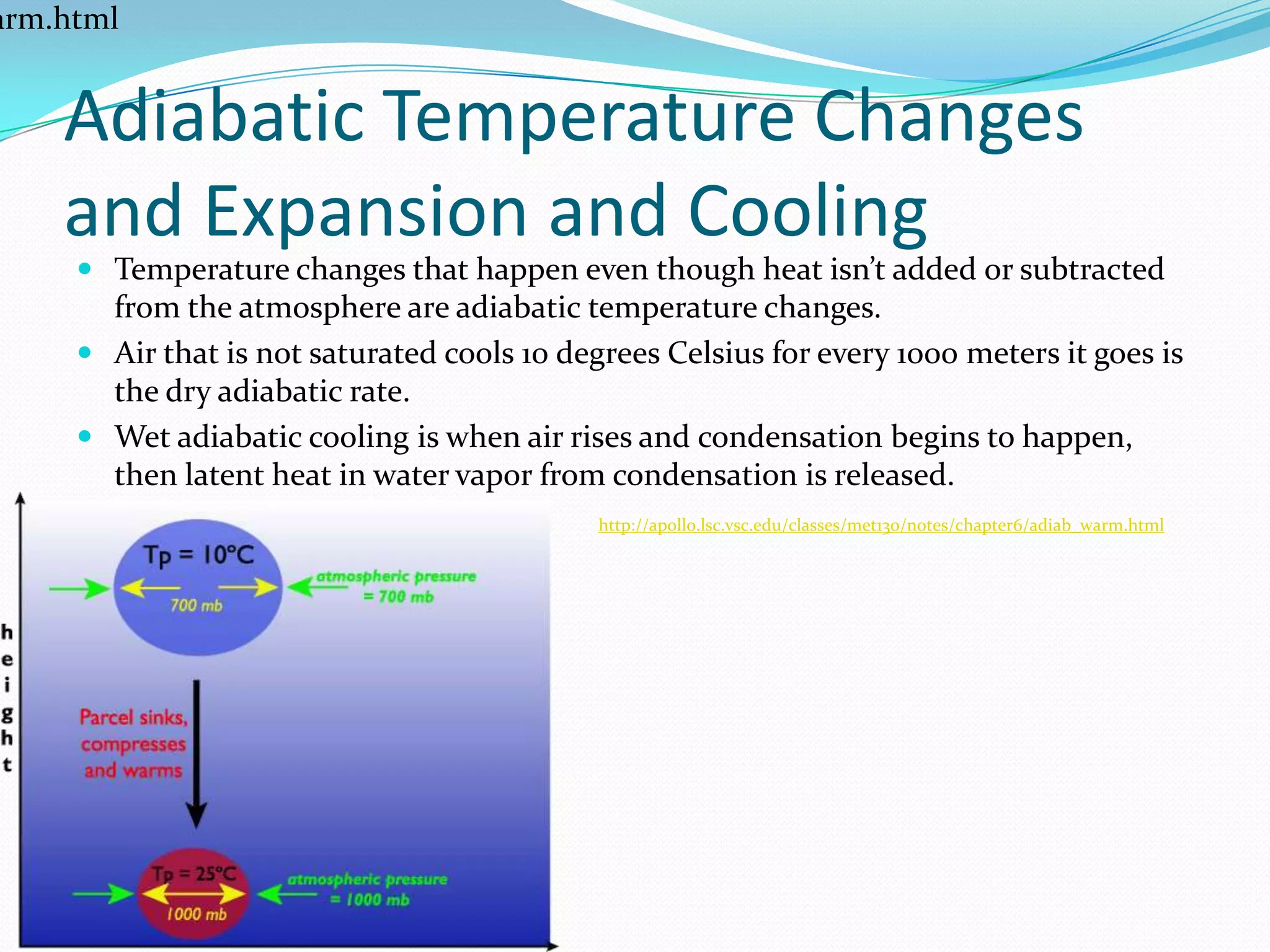
      Temperature changes that happen even though heat isn’t added or subtracted
       from the atmosphere are adiabatic temperature changes.
      Air that is not saturated cools 10 degrees Celsius for every 1000 meters it goes is
       the dry adiabatic rate.
      Wet adiabatic cooling is when air rises and condensation begins to happen,
       then latent heat in water vapor from condensation is released.
                                            http://apollo.lsc.vsc.edu/classes/met130/notes/chapter6/adiab_warm.html


     
Orographic Lifting
 When land masses, such as mountains, block air flow, orographic lifting of the
  air happens.
 Clouds and precipitation occur due to adiabatic cooling and cause
  precipitation.
 Much of the air’s humidity is lost when air reaches the leeward side of the
  mountain.
 http://www.examiner.com/outdoorsman-in-salt-lake-city/understanding-why-
  utah-has-the-greatest-snow-on-earth-part-1-orographic-lifting
Frontal Wedging
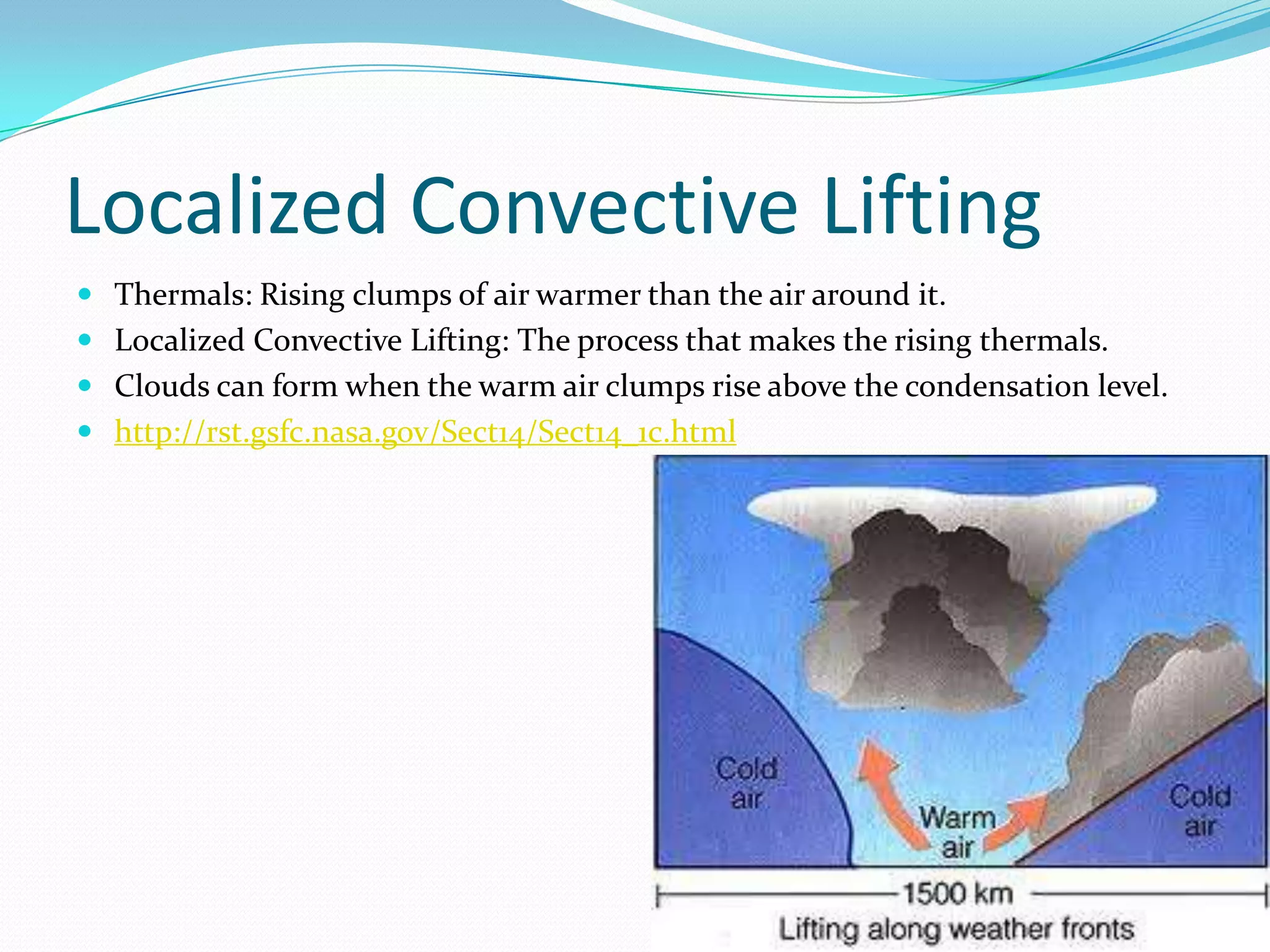
 A front is when hot air and cold air meet in the atmosphere.
 Frontal wedging is when cool and dense air barriers warm and less
  dense air that is rising.
 Storm-system weather fronts are also known as middle latitude
  cyclones.
 http://www.wou.edu/las/physci/taylor/gs106/atm2_precip_files/frame.
  htm#slide0004.htm
Convergence
 Convergence is when air in the lower part of the atmosphere flows together and
  causes lifting.
 Florida’s weather is an example of convergence.
 When air flows in more than one direction, it begins to rise. It leads to
  adiabatic cooling and sometimes cloud formation.
Localized Convective Lifting
 Thermals: Rising clumps of air warmer than the air around it.
 Localized Convective Lifting: The process that makes the rising thermals.
 Clouds can form when the warm air clumps rise above the condensation level.
 http://rst.gsfc.nasa.gov/Sect14/Sect14_1c.html
Stability
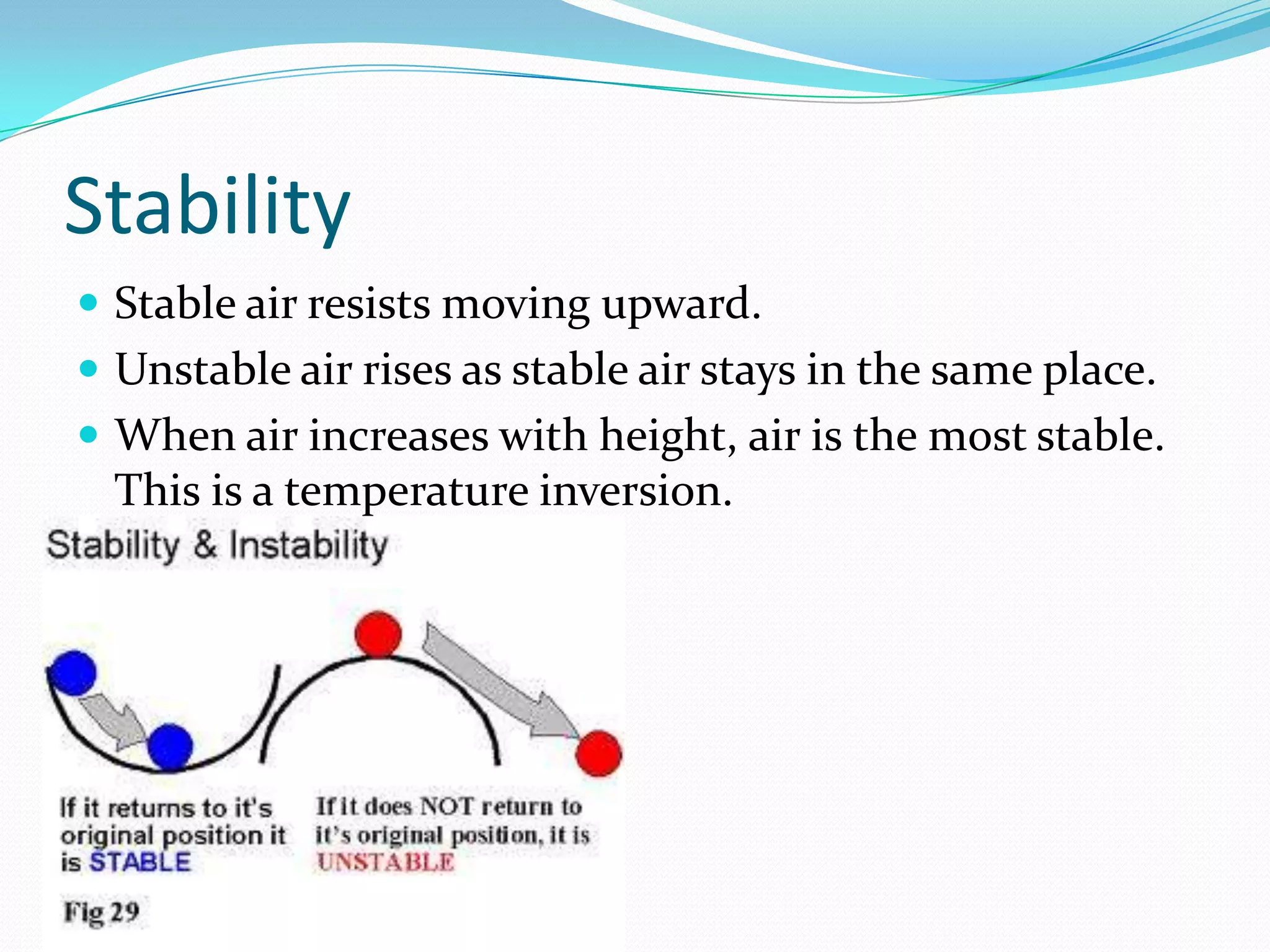
 Stable air resists moving upward.
 Unstable air rises as stable air stays in the same place.
 When air increases with height, air is the most stable.
  This is a temperature inversion.
Condensation
 Air must be saturated for condensation to happen.
 Condensation nuclei occur when there is condensation
  in the air above the ground.
 When condensation nuclei is in the air, relative
  humidity goes over 100%
   http://keep3.sjfc.edu/students/kes00898/e-port/condensation%20page%20for%20unit.html
Types of Clouds
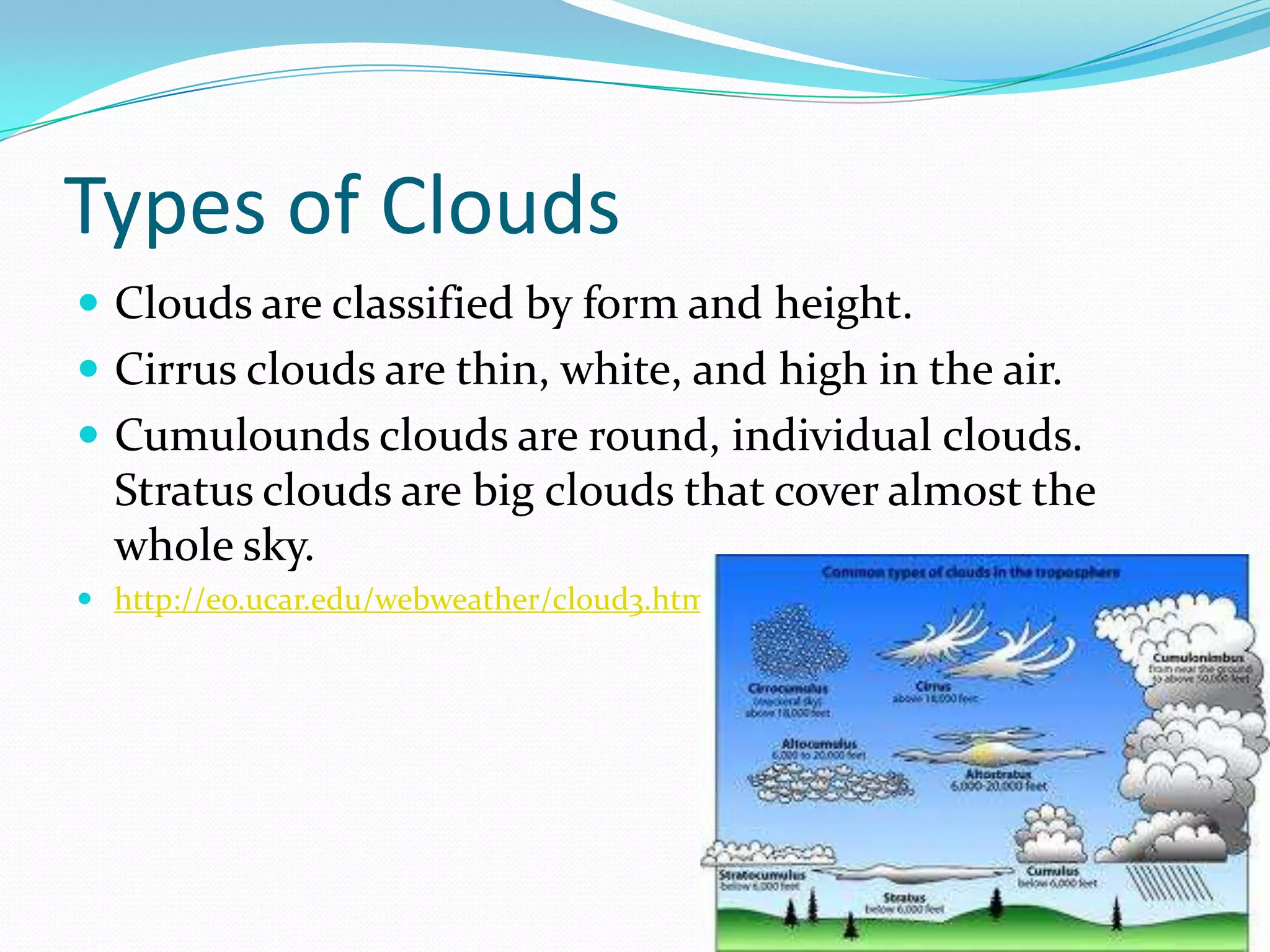
 Clouds are classified by form and height.
 Cirrus clouds are thin, white, and high in the air.
 Cumulounds clouds are round, individual clouds.
  Stratus clouds are big clouds that cover almost the
  whole sky.
 http://eo.ucar.edu/webweather/cloud3.html
High Clouds
 Cirrocumulous clouds are fluffy clouds.
 Cirrostratus clouds are flatter clouds.
 Cirrus clounds are high, white, and thin clouds.
Middle Clouds
 Altocumulouds clouds are large, dense, and round clouds.
 Altostratus clouds are white and grayish clouds that cover the
  sky, moon, and sun but they are still noticeable through it.
 Middle clouds are from 2000 to 6000 meters in the air.
 http://www.allstar.fiu.edu/aero/fltenv3.htm
Clouds of Verticle Development
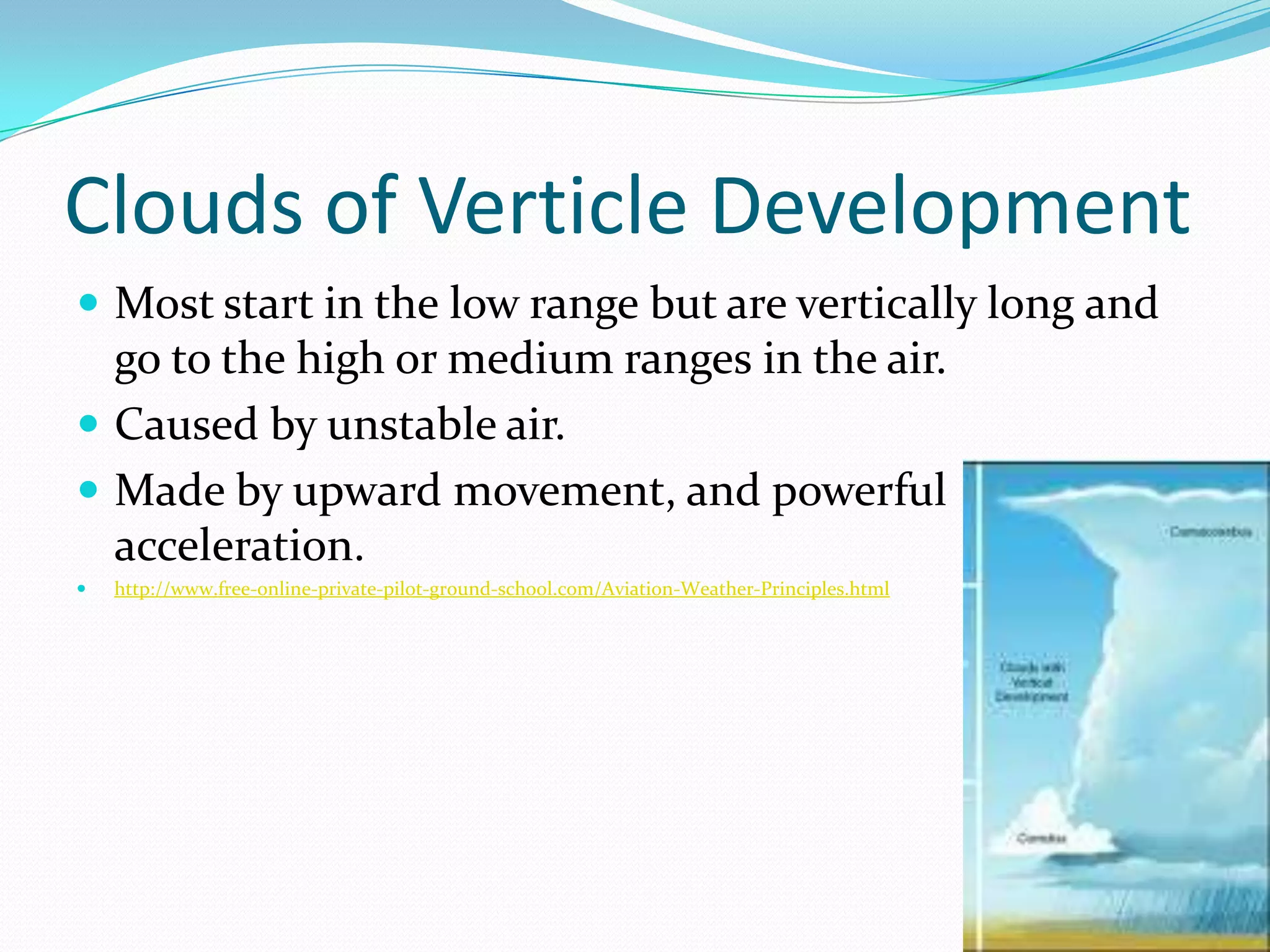
 Most start in the low range but are vertically long and
  go to the high or medium ranges in the air.
 Caused by unstable air.
 Made by upward movement, and powerful
  acceleration.
   http://www.free-online-private-pilot-ground-school.com/Aviation-Weather-Principles.html
Low Clouds
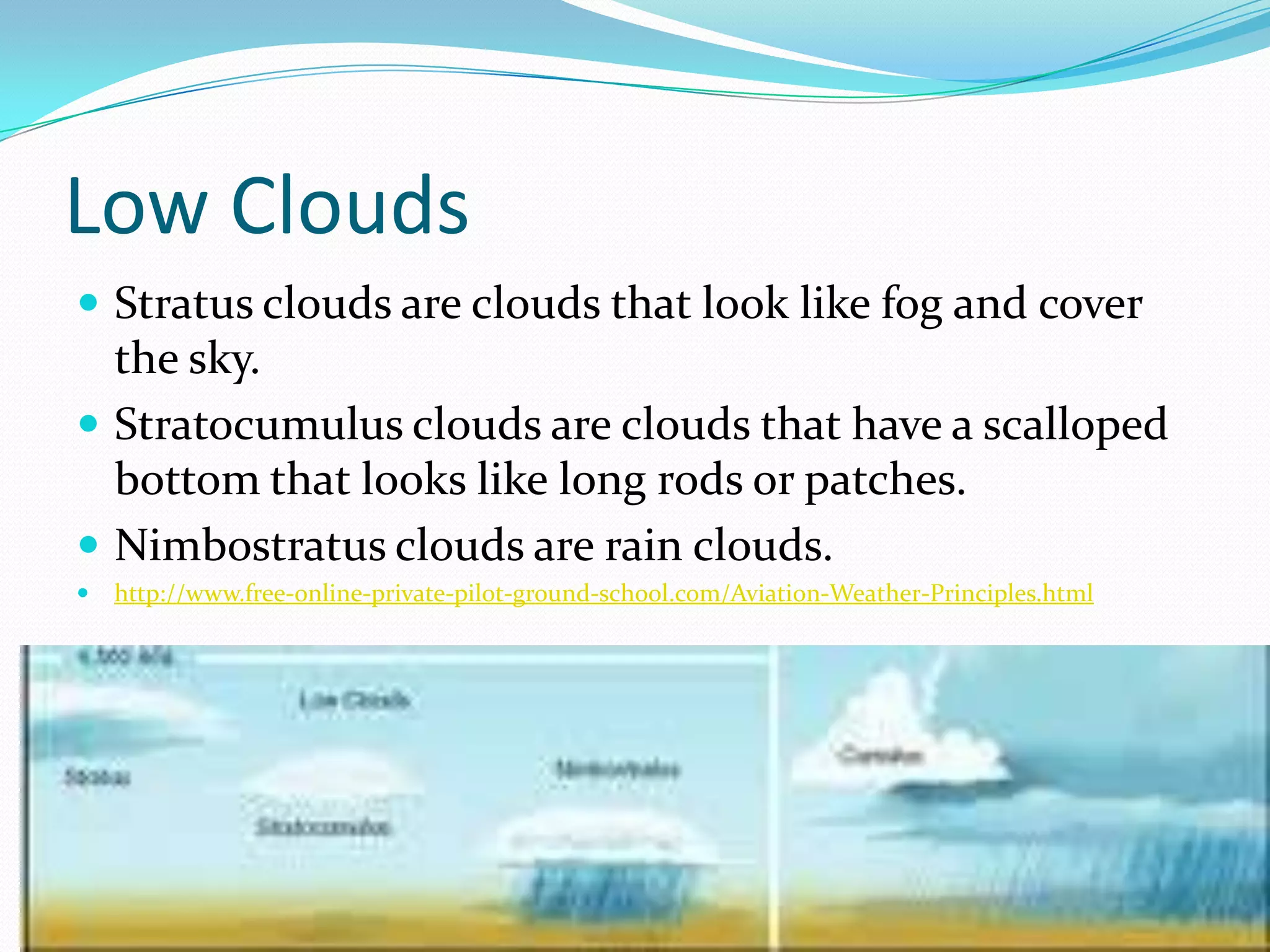
 Stratus clouds are clouds that look like fog and cover
  the sky.
 Stratocumulus clouds are clouds that have a scalloped
  bottom that looks like long rods or patches.
 Nimbostratus clouds are rain clouds.
   http://www.free-online-private-pilot-ground-school.com/Aviation-Weather-Principles.html
Fog
 A cloud that is very close to the ground.
 Happens when Earth cools rapidly by radiation.
 Cool air goes over warm water, evaporation occurs, air
    becomes saturated, and water vapor meets cold air and
    it condenses and mixes with the warm air being
    warmed.
   http://photoshoptutorials.ws/photoshop-tutorials/photo-effects/fog.html
Cold Cloud Precipitation
 Supercooled water is water in the liquid state at 0
  degrees Celcius that will freeze when it hits a solid
  object.
 When air is saturated with water, it is supersaturated
  with ice.
   http://nanopatentsandinnovations.blogspot.com/2010/06/amount-of-dust-pollen-matters-for-cloud.html
Warm Cloud Precipitation
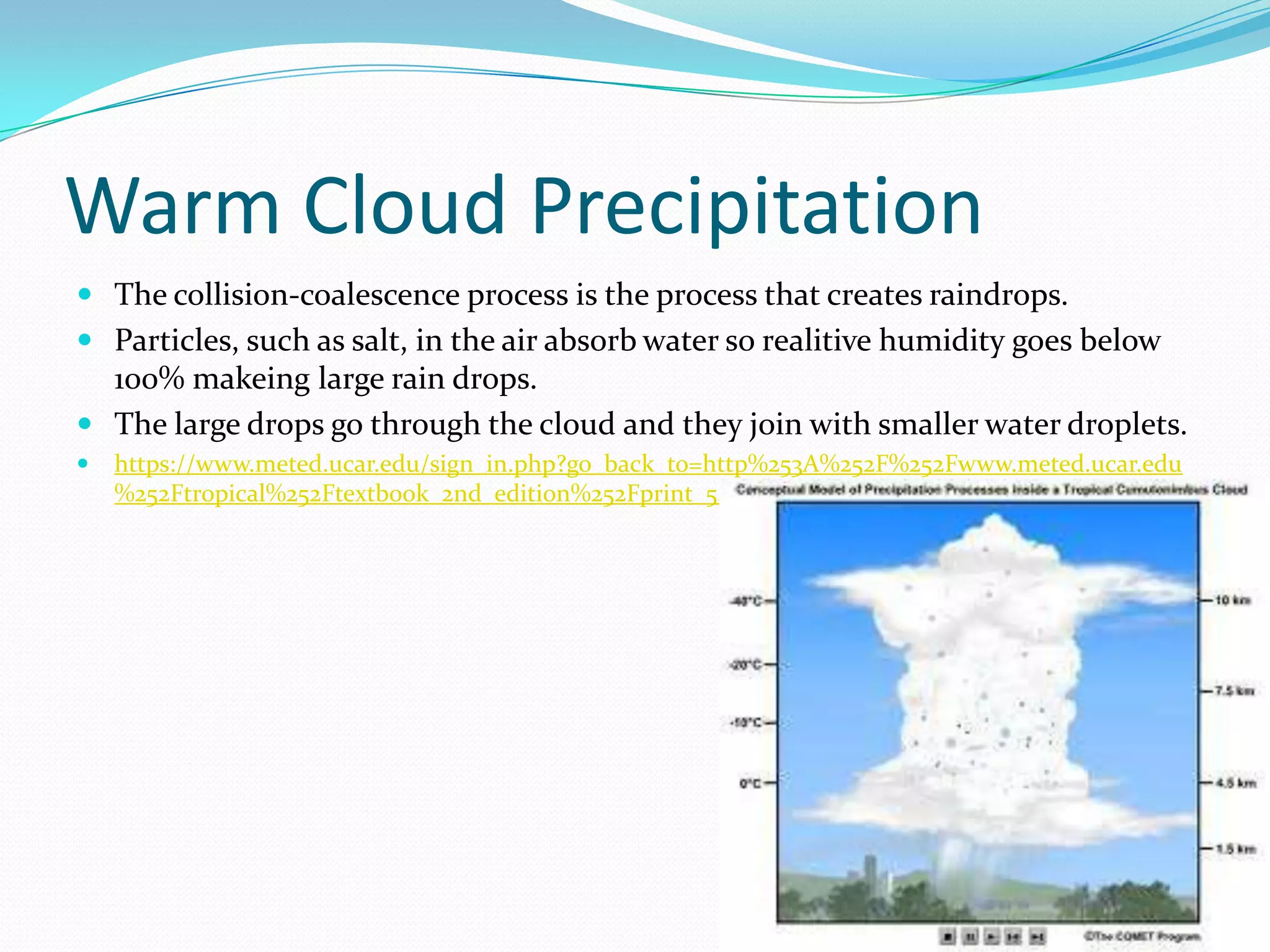
 The collision-coalescence process is the process that creates raindrops.
 Particles, such as salt, in the air absorb water so realitive humidity goes below
  100% makeing large rain drops.
 The large drops go through the cloud and they join with smaller water droplets.
   https://www.meted.ucar.edu/sign_in.php?go_back_to=http%253A%252F%252Fwww.meted.ucar.edu
    %252Ftropical%252Ftextbook_2nd_edition%252Fprint_5.htm
Rain and Snow
 Snowflakes usually melt when the temerature at the surface is above 4 degrees Celcius, so
  snowflakes usually melt before they hit the ground.
 When there is a low humidity, snow crystals form.
 Snow crystals mix together into clumps when the temerature is above -5 degrees celcius.
 http://kohd.com/page/213587
 http://roymiller.hubpages.com/hub/quotes-about-rain
Sleet, Glaze, and Hail
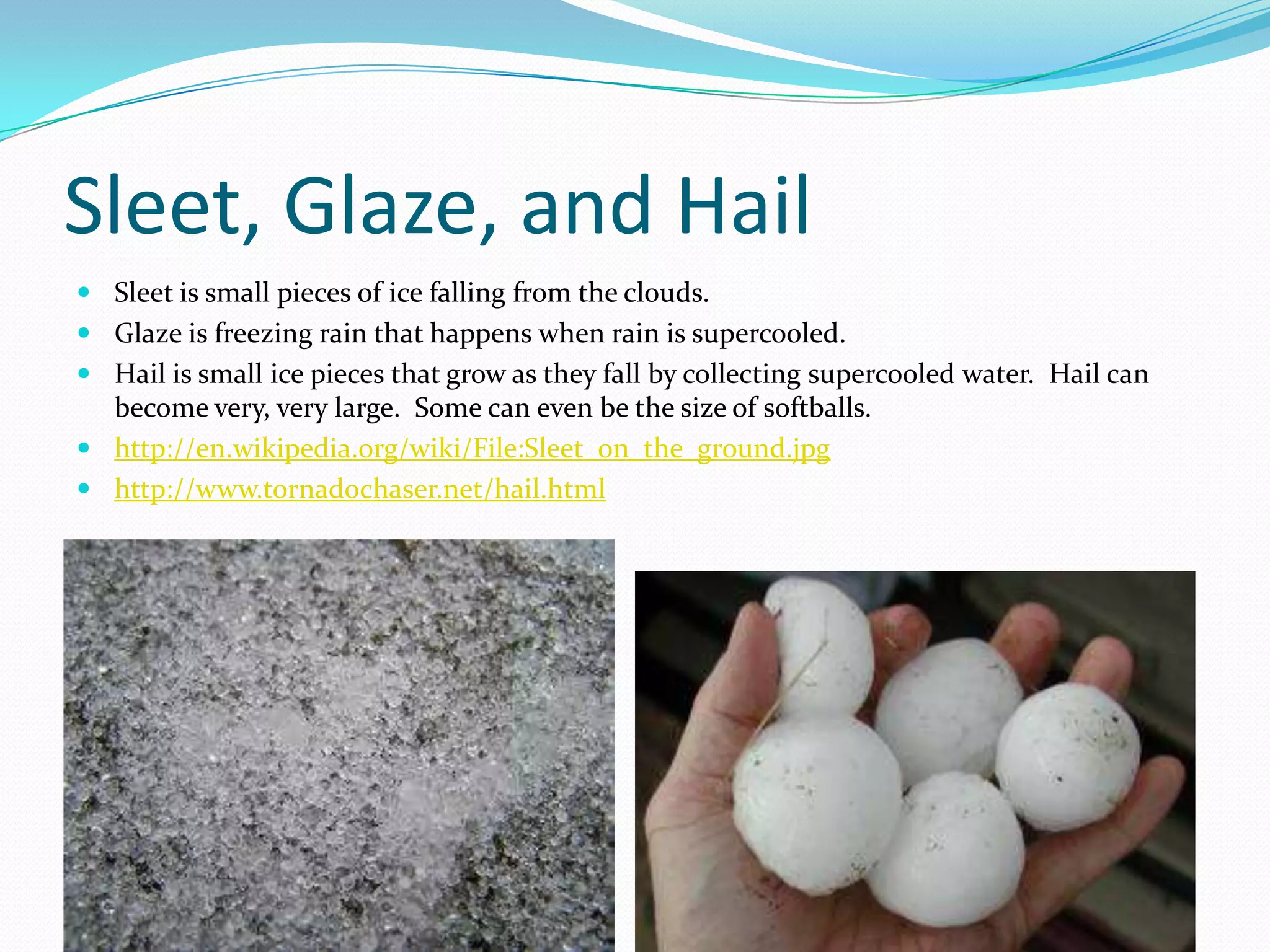
 Sleet is small pieces of ice falling from the clouds.
 Glaze is freezing rain that happens when rain is supercooled.
 Hail is small ice pieces that grow as they fall by collecting supercooled water. Hail can
  become very, very large. Some can even be the size of softballs.
 http://en.wikipedia.org/wiki/File:Sleet_on_the_ground.jpg
 http://www.tornadochaser.net/hail.html
The End!

5csmith

  • 1.
  • 2.
    arm.html Adiabatic Temperature Changes and Expansion and Cooling  Temperature changes that happen even though heat isn’t added or subtracted from the atmosphere are adiabatic temperature changes.  Air that is not saturated cools 10 degrees Celsius for every 1000 meters it goes is the dry adiabatic rate.  Wet adiabatic cooling is when air rises and condensation begins to happen, then latent heat in water vapor from condensation is released.  http://apollo.lsc.vsc.edu/classes/met130/notes/chapter6/adiab_warm.html 
  • 3.
    Orographic Lifting  Whenland masses, such as mountains, block air flow, orographic lifting of the air happens.  Clouds and precipitation occur due to adiabatic cooling and cause precipitation.  Much of the air’s humidity is lost when air reaches the leeward side of the mountain.  http://www.examiner.com/outdoorsman-in-salt-lake-city/understanding-why- utah-has-the-greatest-snow-on-earth-part-1-orographic-lifting
  • 4.
    Frontal Wedging  Afront is when hot air and cold air meet in the atmosphere.  Frontal wedging is when cool and dense air barriers warm and less dense air that is rising.  Storm-system weather fronts are also known as middle latitude cyclones.  http://www.wou.edu/las/physci/taylor/gs106/atm2_precip_files/frame. htm#slide0004.htm
  • 5.
    Convergence  Convergence iswhen air in the lower part of the atmosphere flows together and causes lifting.  Florida’s weather is an example of convergence.  When air flows in more than one direction, it begins to rise. It leads to adiabatic cooling and sometimes cloud formation.
  • 6.
    Localized Convective Lifting Thermals: Rising clumps of air warmer than the air around it.  Localized Convective Lifting: The process that makes the rising thermals.  Clouds can form when the warm air clumps rise above the condensation level.  http://rst.gsfc.nasa.gov/Sect14/Sect14_1c.html
  • 7.
    Stability  Stable airresists moving upward.  Unstable air rises as stable air stays in the same place.  When air increases with height, air is the most stable. This is a temperature inversion.
  • 8.
    Condensation  Air mustbe saturated for condensation to happen.  Condensation nuclei occur when there is condensation in the air above the ground.  When condensation nuclei is in the air, relative humidity goes over 100%  http://keep3.sjfc.edu/students/kes00898/e-port/condensation%20page%20for%20unit.html
  • 9.
    Types of Clouds Clouds are classified by form and height.  Cirrus clouds are thin, white, and high in the air.  Cumulounds clouds are round, individual clouds. Stratus clouds are big clouds that cover almost the whole sky.  http://eo.ucar.edu/webweather/cloud3.html
  • 10.
    High Clouds  Cirrocumulousclouds are fluffy clouds.  Cirrostratus clouds are flatter clouds.  Cirrus clounds are high, white, and thin clouds.
  • 11.
    Middle Clouds  Altocumuloudsclouds are large, dense, and round clouds.  Altostratus clouds are white and grayish clouds that cover the sky, moon, and sun but they are still noticeable through it.  Middle clouds are from 2000 to 6000 meters in the air.  http://www.allstar.fiu.edu/aero/fltenv3.htm
  • 12.
    Clouds of VerticleDevelopment  Most start in the low range but are vertically long and go to the high or medium ranges in the air.  Caused by unstable air.  Made by upward movement, and powerful acceleration.  http://www.free-online-private-pilot-ground-school.com/Aviation-Weather-Principles.html
  • 13.
    Low Clouds  Stratusclouds are clouds that look like fog and cover the sky.  Stratocumulus clouds are clouds that have a scalloped bottom that looks like long rods or patches.  Nimbostratus clouds are rain clouds.  http://www.free-online-private-pilot-ground-school.com/Aviation-Weather-Principles.html
  • 14.
    Fog  A cloudthat is very close to the ground.  Happens when Earth cools rapidly by radiation.  Cool air goes over warm water, evaporation occurs, air becomes saturated, and water vapor meets cold air and it condenses and mixes with the warm air being warmed.  http://photoshoptutorials.ws/photoshop-tutorials/photo-effects/fog.html
  • 15.
    Cold Cloud Precipitation Supercooled water is water in the liquid state at 0 degrees Celcius that will freeze when it hits a solid object.  When air is saturated with water, it is supersaturated with ice.  http://nanopatentsandinnovations.blogspot.com/2010/06/amount-of-dust-pollen-matters-for-cloud.html
  • 16.
    Warm Cloud Precipitation The collision-coalescence process is the process that creates raindrops.  Particles, such as salt, in the air absorb water so realitive humidity goes below 100% makeing large rain drops.  The large drops go through the cloud and they join with smaller water droplets.  https://www.meted.ucar.edu/sign_in.php?go_back_to=http%253A%252F%252Fwww.meted.ucar.edu %252Ftropical%252Ftextbook_2nd_edition%252Fprint_5.htm
  • 17.
    Rain and Snow Snowflakes usually melt when the temerature at the surface is above 4 degrees Celcius, so snowflakes usually melt before they hit the ground.  When there is a low humidity, snow crystals form.  Snow crystals mix together into clumps when the temerature is above -5 degrees celcius.  http://kohd.com/page/213587  http://roymiller.hubpages.com/hub/quotes-about-rain
  • 18.
    Sleet, Glaze, andHail  Sleet is small pieces of ice falling from the clouds.  Glaze is freezing rain that happens when rain is supercooled.  Hail is small ice pieces that grow as they fall by collecting supercooled water. Hail can become very, very large. Some can even be the size of softballs.  http://en.wikipedia.org/wiki/File:Sleet_on_the_ground.jpg  http://www.tornadochaser.net/hail.html
  • 19.