Perception
Perception
2
Perception
Perception means perceiving i.e, giving
meaning to the environment around us.
Definitions:
 Stephen P. Robbins defined perception is a process by
which individuals organize and interpret their sensory
impressions in order to give meaning to their
environment.
 Perception refers to the way we try to
understand the world around us
3
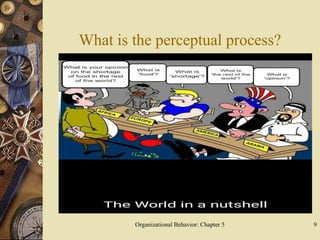
What is the perceptual process?
Perception.
– The process by which people select, organize,
interpret, retrieve, and respond to information.
– Perceptual information is gathered from:
• Sight.
• Hearing.
• Touch.
• Taste.
• Smell.
Perception
4
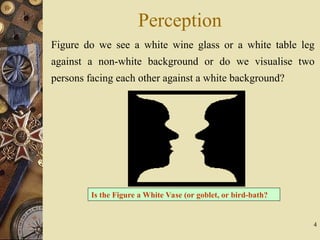
Figure do we see a white wine glass or a white table leg
against a non-white background or do we visualise two
persons facing each other against a white background?
Is the Figure a White Vase (or goblet, or bird-bath?
5
What is the perceptual process?
Factors influencing the perceptual process.
– Characteristics of the perceiver.
– Characteristics of the setting.
– Characteristics of the perceived.
6
What is the perceptual process?
Characteristics of the perceiver.
– The perceptual process is influenced by the
perceiver’s:
• Past experiences.
• Needs or motives.
• Personality.
• Values and attitudes.
7
What is the perceptual process?
Characteristics of the setting.
– The perceptual process is influenced by the
setting’s:
• Physical context.
• Social context.
• Organizational context.
8
What is the perceptual process?
 Characteristics of the perceived.
– The perceptual process is influenced by characteristics
of the perceived person, object, or event, such as:
• Contrast.
• Intensity.
• Figure-ground separation.
• Size.
• Motion.
• Repetition or novelty.
What is the perceptual process?
Organizational Behavior: Chapter 5 9
10
What is the perceptual process?
Stages of the perceptual process.
Receiving Stimuli
–Selection of stimuli
–Organization of stimuli
–Interpretation of stimuli
11
What is the perceptual process?
Receiving Stimuli
A stimulus is any unit of output of any of the
senses. sensory reception is taking place
through human organs such as eye, nose,
skin, ear, mouth. They receive the sensory
inputs.
12
What is the perceptual process?
– Selection of stimuli –
– After receiving the stimuli from the
environment, some are to be selected for
further processing. External and internal
factors are taken into consideration
while selecting a stimuli.
13
What is the perceptual process?
Organization of stimuli –
 The stimuli received from the
environment must be organized so as to
assign some meaning to them.
14
What is the perceptual process?
Interpretation of stimuli –
After the data have been received and organized,
the perceiver interprets or assigns meaning to
the information.
15
What is the perceptual process?
Response to the perceptual process.
– Thoughts.
– Feelings.
– Actions.
16
What are common
perceptual distortions?
Common perceptual distortions include:
– Stereotypes or prototypes.
– Halo effects.
– Selective perception.
– Projection.
– Contrast effects.
– Self-fulfilling prophecy.
17
What are common
perceptual distortions?
Stereotypes or prototypes.
– Combines information based on the category
or class to which a person, situation, or object
belongs.
– Forming genaralised belief about a group
which can lead to bias judgment
18
What are common
perceptual distortions?
Halo effects.
– when one attribute of a person or single
characteristics or situation is used to develop an
overall impression of the individual or situation.
– Likely to occur in the organization stage.
– Individual differences are obscured.
– Important in the performance appraisal process.
19
What are common
perceptual distortions?
 Selective perception.
– The tendency to single out those aspects of a
situation, person, or object that are consistent
with one’s needs, values, or attitudes.
– Strongest impact is at the attention stage.
– Focusing on certain details while ignoring others
20
What are common
perceptual distortions?
Projection.
– The assignment of one’s personal attributes to
other individuals.
– Especially likely to occur in interpretation
stage.
– Projection can be controlled through a high
degree of self-awareness and empathy.
21
What are common
perceptual distortions?
Contrast effects.
– Occur when an individual is compared to other
people on the same characteristics on which
the others rank higher or lower.
22
What are common
perceptual distortions?
Self-fulfilling prophecy.
– The tendency to create or find in another
situation or individual that which one expected
to find.
– Can have either positive or negative outcomes.
– Managers should adopt positive and optimistic
approaches to people at work.
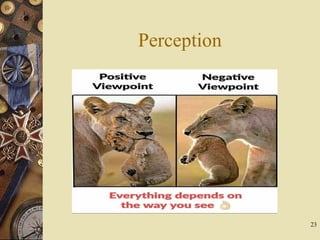
Perception
23
Strategies for Improving
Perceptual Skills: 7 Strategies
 Knowing Oneself Accurately
 Empathize with Others
 Have a Positive Attitude
 Postpone Impression Formation
 Communicating Openly
 Comparing One's Perceptions with that of Others
 Introducing Diversity Management Programs
24
How can we improve perception?
Here are some tips to help you get started on
improving your perception skills
Learn how to read body language.
Practice active listening.
Be aware of your own biases.
Work to understand what the other person is saying.
Embrace empathy and sympathy.
Recheck before conclusion.
Check references.
25

Unit 4-4 Perceptioooooooooooooooooon.ppt

  • 1.
  • 2.
    2 Perception Perception means perceivingi.e, giving meaning to the environment around us. Definitions:  Stephen P. Robbins defined perception is a process by which individuals organize and interpret their sensory impressions in order to give meaning to their environment.  Perception refers to the way we try to understand the world around us
  • 3.
    3 What is theperceptual process? Perception. – The process by which people select, organize, interpret, retrieve, and respond to information. – Perceptual information is gathered from: • Sight. • Hearing. • Touch. • Taste. • Smell.
  • 4.
    Perception 4 Figure do wesee a white wine glass or a white table leg against a non-white background or do we visualise two persons facing each other against a white background? Is the Figure a White Vase (or goblet, or bird-bath?
  • 5.
    5 What is theperceptual process? Factors influencing the perceptual process. – Characteristics of the perceiver. – Characteristics of the setting. – Characteristics of the perceived.
  • 6.
    6 What is theperceptual process? Characteristics of the perceiver. – The perceptual process is influenced by the perceiver’s: • Past experiences. • Needs or motives. • Personality. • Values and attitudes.
  • 7.
    7 What is theperceptual process? Characteristics of the setting. – The perceptual process is influenced by the setting’s: • Physical context. • Social context. • Organizational context.
  • 8.
    8 What is theperceptual process?  Characteristics of the perceived. – The perceptual process is influenced by characteristics of the perceived person, object, or event, such as: • Contrast. • Intensity. • Figure-ground separation. • Size. • Motion. • Repetition or novelty.
  • 9.
    What is theperceptual process? Organizational Behavior: Chapter 5 9
  • 10.
    10 What is theperceptual process? Stages of the perceptual process. Receiving Stimuli –Selection of stimuli –Organization of stimuli –Interpretation of stimuli
  • 11.
    11 What is theperceptual process? Receiving Stimuli A stimulus is any unit of output of any of the senses. sensory reception is taking place through human organs such as eye, nose, skin, ear, mouth. They receive the sensory inputs.
  • 12.
    12 What is theperceptual process? – Selection of stimuli – – After receiving the stimuli from the environment, some are to be selected for further processing. External and internal factors are taken into consideration while selecting a stimuli.
  • 13.
    13 What is theperceptual process? Organization of stimuli –  The stimuli received from the environment must be organized so as to assign some meaning to them.
  • 14.
    14 What is theperceptual process? Interpretation of stimuli – After the data have been received and organized, the perceiver interprets or assigns meaning to the information.
  • 15.
    15 What is theperceptual process? Response to the perceptual process. – Thoughts. – Feelings. – Actions.
  • 16.
    16 What are common perceptualdistortions? Common perceptual distortions include: – Stereotypes or prototypes. – Halo effects. – Selective perception. – Projection. – Contrast effects. – Self-fulfilling prophecy.
  • 17.
    17 What are common perceptualdistortions? Stereotypes or prototypes. – Combines information based on the category or class to which a person, situation, or object belongs. – Forming genaralised belief about a group which can lead to bias judgment
  • 18.
    18 What are common perceptualdistortions? Halo effects. – when one attribute of a person or single characteristics or situation is used to develop an overall impression of the individual or situation. – Likely to occur in the organization stage. – Individual differences are obscured. – Important in the performance appraisal process.
  • 19.
    19 What are common perceptualdistortions?  Selective perception. – The tendency to single out those aspects of a situation, person, or object that are consistent with one’s needs, values, or attitudes. – Strongest impact is at the attention stage. – Focusing on certain details while ignoring others
  • 20.
    20 What are common perceptualdistortions? Projection. – The assignment of one’s personal attributes to other individuals. – Especially likely to occur in interpretation stage. – Projection can be controlled through a high degree of self-awareness and empathy.
  • 21.
    21 What are common perceptualdistortions? Contrast effects. – Occur when an individual is compared to other people on the same characteristics on which the others rank higher or lower.
  • 22.
    22 What are common perceptualdistortions? Self-fulfilling prophecy. – The tendency to create or find in another situation or individual that which one expected to find. – Can have either positive or negative outcomes. – Managers should adopt positive and optimistic approaches to people at work.
  • 23.
  • 24.
    Strategies for Improving PerceptualSkills: 7 Strategies  Knowing Oneself Accurately  Empathize with Others  Have a Positive Attitude  Postpone Impression Formation  Communicating Openly  Comparing One's Perceptions with that of Others  Introducing Diversity Management Programs 24
  • 25.
    How can weimprove perception? Here are some tips to help you get started on improving your perception skills Learn how to read body language. Practice active listening. Be aware of your own biases. Work to understand what the other person is saying. Embrace empathy and sympathy. Recheck before conclusion. Check references. 25