Presented by:-
Who is a Child?
International conventions define
children as age 18 and under is a
child. But individual governments
may define ´child´ according to
different ages or other criteria.
Indifferent ages or other
criteria. In India, age under 14
What is a Labour?

One who works in a daily wage
basis on the days when he/she
has the work opportunities open
for him/her & rest sits ideal on
other days is termed as labour.
What is Child
Labour?
• As per ILO any person below
15years working is considered to
be a child labour.
• Full time work by a child
• To sustain self & family members.
Generally child labour is work
for children that harms them or
exploits them in some way.
Some ways are:– Physical
– Mental
– Morally
Did you know
• India has the highest number of
child labourers in the world.
• Acc to the National Sample
Survey Organization, nearly 16.4
million Indian children aged 5-15
yrs are engaged in various
works.
• As per ILO 90% of child labourers
Causes of Child
Labour
• Poverty
• Overexploitation
of population.

• Lack of schooling
and daily care.
• Limited choices
for women.

• Decrease of
resources.

• Abuse of the child.

• Decrease in
literacy.

• Uncaring
attitudes of
employees

• Increase of
poverty.

• Parental
Working area of
Children
•
•
•
•
•
•
•

Mills
Factories
Brick works
Chimney sweep
Coal mines
Street child
Country child
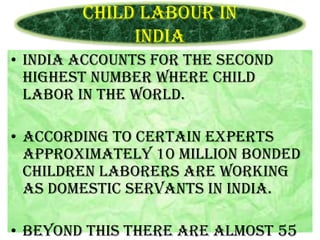
Child Labour in
India
• INDIA accounts for the second
highest number where child
labor in the world.
• According to certain experts
approximately 10 million bonded
children laborers are working
as domestic servants in India.
• Beyond this there are almost 55
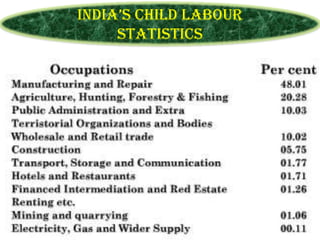
IndIa’s chIld labour
statistics
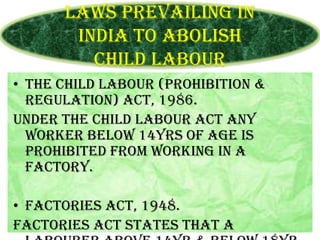
Laws prevailing in
India to abolish
Child Labour
• The Child Labour (Prohibition &
Regulation) Act, 1986.
Under the child labour act any
worker below 14yrs of age is
prohibited from working in a
factory.
• Factories Act, 1948.
Factories act states that a
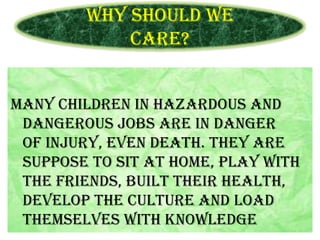
Why should we
care?
Many children in hazardous and
dangerous jobs are in danger
of injury, even death. They are
suppose to sit at home, play with
the friends, built their health,
develop the culture and load
themselves with knowledge
Children in need of
care & protection
• Orphans, abandoned & destitute
• Missing or run-away children
• Street & working children

• Children of sex workers
• Abused, tortured and exploited
• Children indulging in substance
abuse
• Children affected by natural
calamities, emergencies & man made
disasters
• Children with disabilities

• Child beggars
Solutions to reduce
Child Labour

• Increase family income
• Education
• Social services
• Family control of fertility
• Learn about the issue
• Support organizations that are
raising awareness
• Provide direct help to individual
children
Child Labour

Child Labour

  • 1.
  • 2.
    Who is aChild? International conventions define children as age 18 and under is a child. But individual governments child. But individual governments may define ´child´ according to different ages or other criteria. Indifferent ages or other criteria. In India, age under 14
  • 3.
    What is aLabour? One who works in a daily wage basis on the days when he/she has the work opportunities open for him/her & rest sits ideal on other days is termed as labour.
  • 4.
    What is Child Labour? •As per ILO any person below 15years working is considered to be a child labour. • Full time work by a child • To sustain self & family members.
  • 5.
    Generally child labouris work for children that harms them or exploits them in some way. Some ways are:– Physical – Mental – Morally
  • 6.
    Did you know •India has the highest number of child labourers in the world. • Acc to the National Sample Survey Organization, nearly 16.4 million Indian children aged 5-15 yrs are engaged in various works. • As per ILO 90% of child labourers
  • 7.
    Causes of Child Labour •Poverty • Overexploitation of population. • Lack of schooling and daily care. • Limited choices for women. • Decrease of resources. • Abuse of the child. • Decrease in literacy. • Uncaring attitudes of employees • Increase of poverty. • Parental
  • 8.
    Working area of Children • • • • • • • Mills Factories Brickworks Chimney sweep Coal mines Street child Country child
  • 9.
    Child Labour in India •INDIA accounts for the second highest number where child labor in the world. • According to certain experts approximately 10 million bonded children laborers are working as domestic servants in India. • Beyond this there are almost 55
  • 10.
  • 11.
    Laws prevailing in Indiato abolish Child Labour • The Child Labour (Prohibition & Regulation) Act, 1986. Under the child labour act any worker below 14yrs of age is prohibited from working in a factory. • Factories Act, 1948. Factories act states that a
  • 12.
    Why should we care? Manychildren in hazardous and dangerous jobs are in danger of injury, even death. They are suppose to sit at home, play with the friends, built their health, develop the culture and load themselves with knowledge
  • 13.
    Children in needof care & protection • Orphans, abandoned & destitute • Missing or run-away children • Street & working children • Children of sex workers
  • 14.
    • Abused, torturedand exploited • Children indulging in substance abuse • Children affected by natural calamities, emergencies & man made disasters • Children with disabilities • Child beggars
  • 15.
    Solutions to reduce ChildLabour • Increase family income • Education • Social services
  • 16.
    • Family controlof fertility • Learn about the issue • Support organizations that are raising awareness • Provide direct help to individual children