
PENETRATION
     TESTING
METHODOLOGY
      Ver. 1.0
 Cahyo Darujati, MT.
 Open Information Systems Security Group
REQUEST A
                 PENETRATION TEST
                           QUOTE
●   Find Holes Now Before Somebody Else
    Does :-p
●   FREE Consultation.
●   +62-8123-594969 (SMS ONLY)

             Heker Biasa, http://cahyod.dosen.narotama.ac.id/   2
Quote
●   Security is a process not a product
    (Bruce Schneier)


              Heker Biasa, http://cahyod.dosen.narotama.ac.id/       3
CONTENTS


What is Pen-Testing?
Why perfoms Pen-testing?
PHASE – I: PLANNING AND PREPARATION
PHASE – II: ASSESSMENT
PHASE – III: REPORTING, CLEAN UP &
DESTROY ARTIFACTS


              Heker Biasa, http://cahyod.dosen.narotama.ac.id/   4
What is Pen-Testing?
●   Penetration testing is the process of
    attempting to gain access to resources
    without knowledge of usernames,
    passwords and other normal means of
    access. If the focus is on computer
    resources, then examples of a
    successful penetration would be
    obtaining or subverting confidential
    documents, pricelists, databases and
    other protected information.
             Heker Biasa, http://cahyod.dosen.narotama.ac.id/   5
Why perfoms Pen-testing?
●   There are a variety of reasons for
    performing a penetration test. One of the
    main reasons is to find vulnerabilities
    and fix them before an attacker does.
    Sometimes, the IT department is aware
    of reported vulnerabilities but they need
    an outside expert to officially report them
    so that management will approve the
    resources necessary to fix them.

              Heker Biasa, http://cahyod.dosen.narotama.ac.id/   6
PHASE – I


PLANNING AND PREPARATION


     Heker Biasa, http://cahyod.dosen.narotama.ac.id/   7
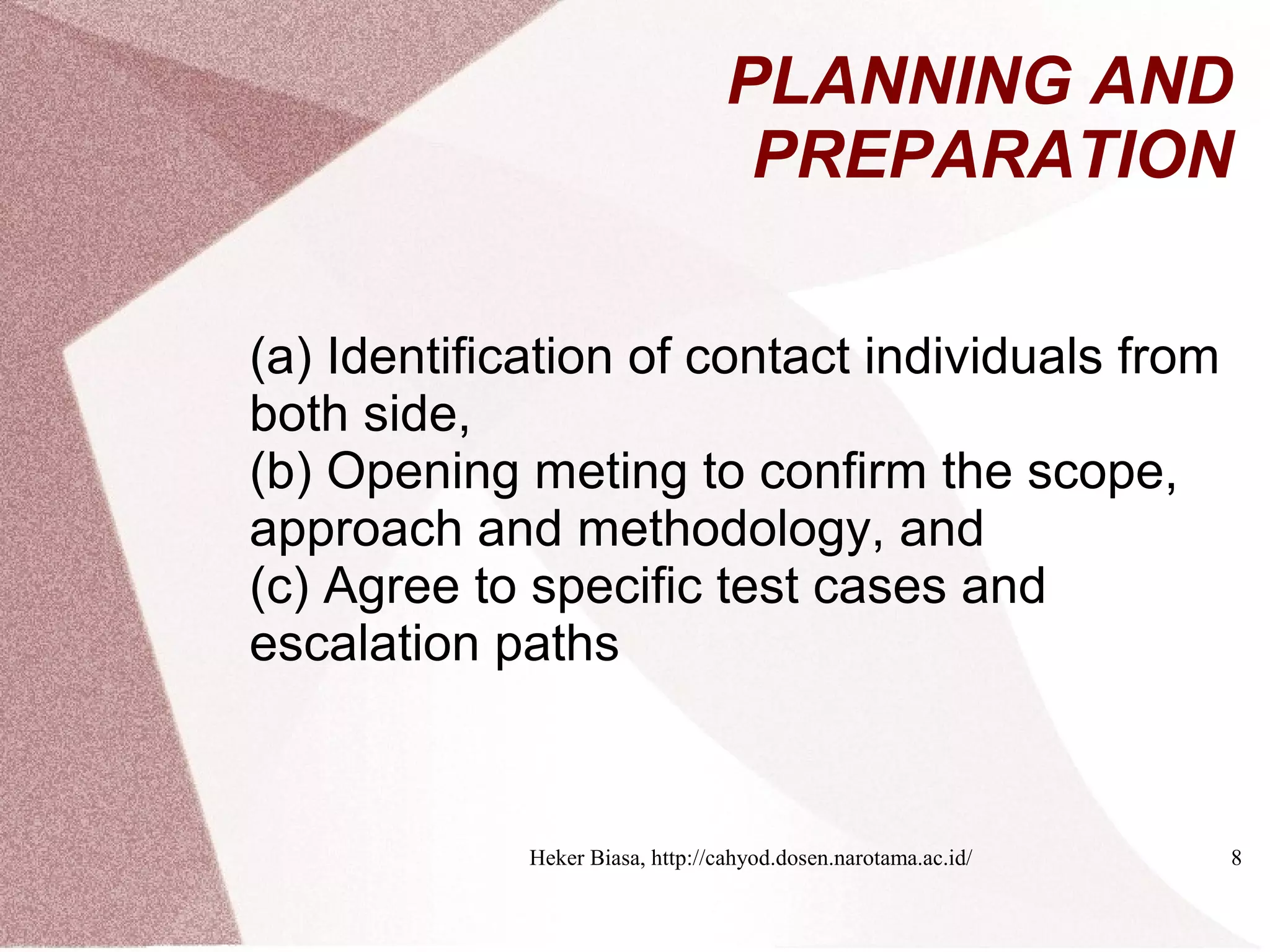
PLANNING AND
                                   PREPARATION

(a) Identification of contact individuals from
both side,
(b) Opening meting to confirm the scope,
approach and methodology, and
(c) Agree to specific test cases and
escalation paths


             Heker Biasa, http://cahyod.dosen.narotama.ac.id/   8
PHASE – II


ASSESSMENT


  Heker Biasa, http://cahyod.dosen.narotama.ac.id/   9
ASSESSMENT

1.Information Gathering
2.Network Mapping
3.Vulnerability Identification
4.Penetration
5.Gaining Access & Privilege Escalation
6.Enumerating Further
7.Compromise Remote Users/Sites
8.Maintaining Access
9.Covering Tracks

                    Heker Biasa, http://cahyod.dosen.narotama.ac.id/   10
1.Information Gathering


Essentially using the Internet to find all the
information you can about the target (company
and/or person) using both technical
(DNS/WHOIS) and non-technical (search
engines, news groups, mailing lists etc)
methods.


                 Heker Biasa, http://cahyod.dosen.narotama.ac.id/   11
2.Network Mapping

Many tools and applications can be used in this stage to aid the
discovery of technical information about the hosts and networks
involved in the test.
·Find live hosts
·Port and service scanning
·Perimeter network mapping (router, firewalls)
·Identifying critical services
·Operating System fingerprinting
·Identifying routes using Management Information Base (MIB)
·Service fingerprinting
                             Heker Biasa, http://cahyod.dosen.narotama.ac.id/   12
3.Vulnerability
                                                    Identification
The assessor will perform several activities to detect exploitable
weak points. These activities include:
1. Identify vulnerable services using service banners
2. Perform vulnerability scan to search for known
  vulnerabilities.
3. Perform false positive and false negative verification
4. Enumerate discovered vulnerabilities
5. Estimate probable impact (classify vulnerabilities found)
6. Identify attack paths and scenarios for exploitation

                        Heker Biasa, http://cahyod.dosen.narotama.ac.id/   13
4.Penetration
1.Find proof of concept code/tool
2.Develop tools/scripts
3.Test proof of concept code/tool
4.Customize proof of concept code/tool
5.Test proof of concept code/tool in an isolated environment
6.Use proof of concept code against target
7.The proof of concept code/tool is used against the target to
  gain as many points of unauthorized access as possible.
8.Verify or disprove the existence of vulnerabilities


                          Heker Biasa, http://cahyod.dosen.narotama.ac.id/   14
5.Gaining Access &
                       Privilege Escalation


5.1 Gaining Access
5.1.1 Gain Least Privilege
5.1.2 Compromise
5.1.3 Final Compromise on Target
5.2 Privilege Escalation


               Heker Biasa, http://cahyod.dosen.narotama.ac.id/   15
6.Enumerating Further
1.Obtain encrypted passwords for offline cracking
2.Obtain password (plaintext or encrypted) by using sniffing or
  other techniques
3.Sniff traffic and analyze it
4.Gather cookies and use them to exploit sessions and for
  password attacks
5.E-mail address gathering
6.Identifying routes and networks
7.Mapping internal networks


                           Heker Biasa, http://cahyod.dosen.narotama.ac.id/   16
7.Compromise Remote
                                Users/Sites
A single hole is sufficient to expose an entire network,
regardless of how secure the perimeter network may be. Any
system is as strong (in this case, as secure) as the weakest of
its parts.
Communications between remote users/sites and enterprise
networks may be provided with authentication and encryption
by using technologies such as VPN, to ensure that the data in
transit over the network cannot be faked nor eavesdropped.
In such scenarios the assessor should try to compromise
remote users, telecommuter and/or remote sites of an
enterprise. Those can give privileged access to internal
network.
                        Heker Biasa, http://cahyod.dosen.narotama.ac.id/   17
8.Maintaining Access


8.1 Covert Channels
8.2 Backdoors
8.3 Root-kits


           Heker Biasa, http://cahyod.dosen.narotama.ac.id/   18
9.Covering Tracks


9.1 Hide Files
9.2 Clear Logs
9.3 Defeat integrity checking
9.4 Defeat Anti-virus
9.5 Implement Root-kits


             Heker Biasa, http://cahyod.dosen.narotama.ac.id/   19
PHASE – III


REPORTING, CLEAN UP &
 DESTROY ARTIFACTS


       Heker Biasa, http://cahyod.dosen.narotama.ac.id/   20
REPORTING, CLEAN UP &
         DESTROY ARTIFACTS


3.1 Reporting
3.1.1 Verbal Reporting
3.1.2 Final Reporting
3.2 Clean Up and Destroy Artifacts


           Heker Biasa, http://cahyod.dosen.narotama.ac.id/   21
REQUEST A
                 PENETRATION TEST
                           QUOTE
●   Find Holes Now Before Somebody Else
    Does :-p
●   FREE Consultation.
●   +62-8123-594969 (SMS ONLY)

             Heker Biasa, http://cahyod.dosen.narotama.ac.id/   22
References


http://www.oissg.org/
http://www.schneier.com/
http://www.sans.org/


           Heker Biasa, http://cahyod.dosen.narotama.ac.id/   23
History


Ver 1.0 : Nov 13, 2012.


            Heker Biasa, http://cahyod.dosen.narotama.ac.id/         24

Pen test methodology

  • 1.
    PENETRATION TESTING METHODOLOGY Ver. 1.0 Cahyo Darujati, MT. Open Information Systems Security Group
  • 2.
    REQUEST A PENETRATION TEST QUOTE ● Find Holes Now Before Somebody Else Does :-p ● FREE Consultation. ● +62-8123-594969 (SMS ONLY) Heker Biasa, http://cahyod.dosen.narotama.ac.id/ 2
  • 3.
    Quote ● Security is a process not a product (Bruce Schneier) Heker Biasa, http://cahyod.dosen.narotama.ac.id/ 3
  • 4.
    CONTENTS What is Pen-Testing? Whyperfoms Pen-testing? PHASE – I: PLANNING AND PREPARATION PHASE – II: ASSESSMENT PHASE – III: REPORTING, CLEAN UP & DESTROY ARTIFACTS Heker Biasa, http://cahyod.dosen.narotama.ac.id/ 4
  • 5.
    What is Pen-Testing? ● Penetration testing is the process of attempting to gain access to resources without knowledge of usernames, passwords and other normal means of access. If the focus is on computer resources, then examples of a successful penetration would be obtaining or subverting confidential documents, pricelists, databases and other protected information. Heker Biasa, http://cahyod.dosen.narotama.ac.id/ 5
  • 6.
    Why perfoms Pen-testing? ● There are a variety of reasons for performing a penetration test. One of the main reasons is to find vulnerabilities and fix them before an attacker does. Sometimes, the IT department is aware of reported vulnerabilities but they need an outside expert to officially report them so that management will approve the resources necessary to fix them. Heker Biasa, http://cahyod.dosen.narotama.ac.id/ 6
  • 7.
    PHASE – I PLANNINGAND PREPARATION Heker Biasa, http://cahyod.dosen.narotama.ac.id/ 7
  • 8.
    PLANNING AND PREPARATION (a) Identification of contact individuals from both side, (b) Opening meting to confirm the scope, approach and methodology, and (c) Agree to specific test cases and escalation paths Heker Biasa, http://cahyod.dosen.narotama.ac.id/ 8
  • 9.
    PHASE – II ASSESSMENT Heker Biasa, http://cahyod.dosen.narotama.ac.id/ 9
  • 10.
    ASSESSMENT 1.Information Gathering 2.Network Mapping 3.VulnerabilityIdentification 4.Penetration 5.Gaining Access & Privilege Escalation 6.Enumerating Further 7.Compromise Remote Users/Sites 8.Maintaining Access 9.Covering Tracks Heker Biasa, http://cahyod.dosen.narotama.ac.id/ 10
  • 11.
    1.Information Gathering Essentially usingthe Internet to find all the information you can about the target (company and/or person) using both technical (DNS/WHOIS) and non-technical (search engines, news groups, mailing lists etc) methods. Heker Biasa, http://cahyod.dosen.narotama.ac.id/ 11
  • 12.
    2.Network Mapping Many toolsand applications can be used in this stage to aid the discovery of technical information about the hosts and networks involved in the test. ·Find live hosts ·Port and service scanning ·Perimeter network mapping (router, firewalls) ·Identifying critical services ·Operating System fingerprinting ·Identifying routes using Management Information Base (MIB) ·Service fingerprinting Heker Biasa, http://cahyod.dosen.narotama.ac.id/ 12
  • 13.
    3.Vulnerability Identification The assessor will perform several activities to detect exploitable weak points. These activities include: 1. Identify vulnerable services using service banners 2. Perform vulnerability scan to search for known vulnerabilities. 3. Perform false positive and false negative verification 4. Enumerate discovered vulnerabilities 5. Estimate probable impact (classify vulnerabilities found) 6. Identify attack paths and scenarios for exploitation Heker Biasa, http://cahyod.dosen.narotama.ac.id/ 13
  • 14.
    4.Penetration 1.Find proof ofconcept code/tool 2.Develop tools/scripts 3.Test proof of concept code/tool 4.Customize proof of concept code/tool 5.Test proof of concept code/tool in an isolated environment 6.Use proof of concept code against target 7.The proof of concept code/tool is used against the target to gain as many points of unauthorized access as possible. 8.Verify or disprove the existence of vulnerabilities Heker Biasa, http://cahyod.dosen.narotama.ac.id/ 14
  • 15.
    5.Gaining Access & Privilege Escalation 5.1 Gaining Access 5.1.1 Gain Least Privilege 5.1.2 Compromise 5.1.3 Final Compromise on Target 5.2 Privilege Escalation Heker Biasa, http://cahyod.dosen.narotama.ac.id/ 15
  • 16.
    6.Enumerating Further 1.Obtain encryptedpasswords for offline cracking 2.Obtain password (plaintext or encrypted) by using sniffing or other techniques 3.Sniff traffic and analyze it 4.Gather cookies and use them to exploit sessions and for password attacks 5.E-mail address gathering 6.Identifying routes and networks 7.Mapping internal networks Heker Biasa, http://cahyod.dosen.narotama.ac.id/ 16
  • 17.
    7.Compromise Remote Users/Sites A single hole is sufficient to expose an entire network, regardless of how secure the perimeter network may be. Any system is as strong (in this case, as secure) as the weakest of its parts. Communications between remote users/sites and enterprise networks may be provided with authentication and encryption by using technologies such as VPN, to ensure that the data in transit over the network cannot be faked nor eavesdropped. In such scenarios the assessor should try to compromise remote users, telecommuter and/or remote sites of an enterprise. Those can give privileged access to internal network. Heker Biasa, http://cahyod.dosen.narotama.ac.id/ 17
  • 18.
    8.Maintaining Access 8.1 CovertChannels 8.2 Backdoors 8.3 Root-kits Heker Biasa, http://cahyod.dosen.narotama.ac.id/ 18
  • 19.
    9.Covering Tracks 9.1 HideFiles 9.2 Clear Logs 9.3 Defeat integrity checking 9.4 Defeat Anti-virus 9.5 Implement Root-kits Heker Biasa, http://cahyod.dosen.narotama.ac.id/ 19
  • 20.
    PHASE – III REPORTING,CLEAN UP & DESTROY ARTIFACTS Heker Biasa, http://cahyod.dosen.narotama.ac.id/ 20
  • 21.
    REPORTING, CLEAN UP& DESTROY ARTIFACTS 3.1 Reporting 3.1.1 Verbal Reporting 3.1.2 Final Reporting 3.2 Clean Up and Destroy Artifacts Heker Biasa, http://cahyod.dosen.narotama.ac.id/ 21
  • 22.
    REQUEST A PENETRATION TEST QUOTE ● Find Holes Now Before Somebody Else Does :-p ● FREE Consultation. ● +62-8123-594969 (SMS ONLY) Heker Biasa, http://cahyod.dosen.narotama.ac.id/ 22
  • 23.
  • 24.
    History Ver 1.0 :Nov 13, 2012. Heker Biasa, http://cahyod.dosen.narotama.ac.id/ 24