Lecture 6

                   Deadlocks (Cont.d)
                 6.1. Deadlock avoidance
                 6.2. Deadlock prevention
                 6.3. Other issues


Sistem Operasi              http://fasilkom.narotama.ac.id/
                                                              1
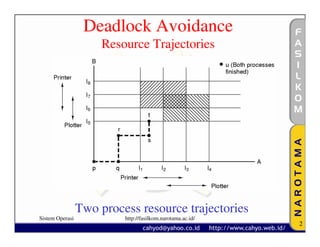
Deadlock Avoidance
                      Resource Trajectories


                 Two process resource trajectories
Sistem Operasi            http://fasilkom.narotama.ac.id/
                                                            2
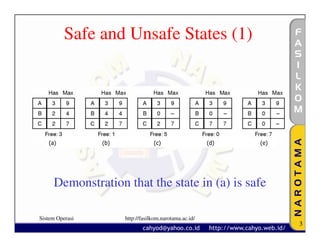
Safe and Unsafe States (1)


   (a)           (b)               (c)                   (d)   (e)


     Demonstration that the state in (a) is safe

Sistem Operasi         http://fasilkom.narotama.ac.id/
                                                                     3
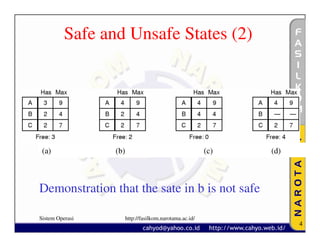
Safe and Unsafe States (2)


 (a)             (b)                                     (c)   (d)


Demonstration that the sate in b is not safe

Sistem Operasi         http://fasilkom.narotama.ac.id/
                                                                     4
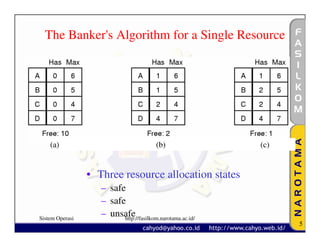
The Banker's Algorithm for a Single Resource


    (a)                                  (b)                (c)


                 • Three resource allocation states
                    – safe
                    – safe
Sistem Operasi
                    – unsafe
                          http://fasilkom.narotama.ac.id/
                                                                  5
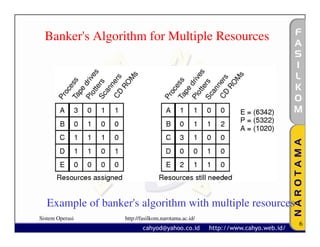
Banker's Algorithm for Multiple Resources


   Example of banker's algorithm with multiple resources
Sistem Operasi     http://fasilkom.narotama.ac.id/
                                                           6
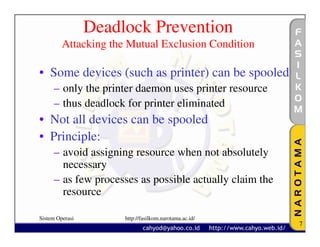
Deadlock Prevention
         Attacking the Mutual Exclusion Condition

• Some devices (such as printer) can be spooled
     – only the printer daemon uses printer resource
     – thus deadlock for printer eliminated
• Not all devices can be spooled
• Principle:
     – avoid assigning resource when not absolutely
       necessary
     – as few processes as possible actually claim the
       resource

Sistem Operasi        http://fasilkom.narotama.ac.id/
                                                         7
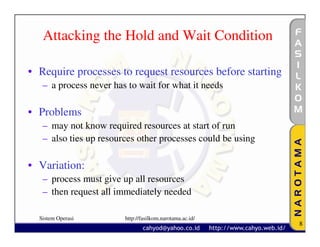
Attacking the Hold and Wait Condition

• Require processes to request resources before starting
   – a process never has to wait for what it needs

• Problems
   – may not know required resources at start of run
   – also ties up resources other processes could be using

• Variation:
   – process must give up all resources
   – then request all immediately needed

  Sistem Operasi        http://fasilkom.narotama.ac.id/
                                                             8
Attacking the No Preemption Condition


• This is not a viable option
• Consider a process given the printer
  – halfway through its job
  – now forcibly take away printer
  – !!??


  Sistem Operasi    http://fasilkom.narotama.ac.id/
                                                      9
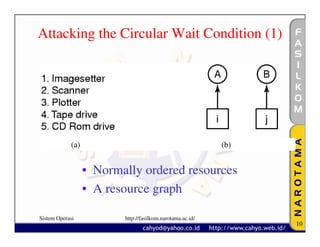
Attacking the Circular Wait Condition (1)


            (a)                                            (b)


                  • Normally ordered resources
                  • A resource graph

Sistem Operasi           http://fasilkom.narotama.ac.id/
                                                                 10
Attacking the Circular Wait Condition (1)


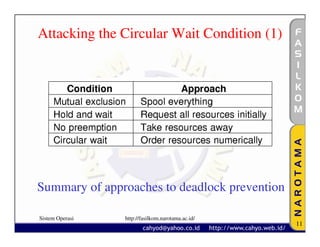
Summary of approaches to deadlock prevention

Sistem Operasi   http://fasilkom.narotama.ac.id/
                                                   11
Other Issues
                   Two-Phase Locking

• Phase One
     – process tries to lock all records it needs, one at a time
     – if needed record found locked, start over
     – (no real work done in phase one)
• If phase one succeeds, it starts second phase,
     – performing updates
     – releasing locks
• Note similarity to requesting all resources at once
• Algorithm works where programmer can arrange
     – program can be stopped, restarted

Sistem Operasi          http://fasilkom.narotama.ac.id/
                                                                   12
Nonresource Deadlocks

• Possible for two processes to deadlock
     – each is waiting for the other to do some task
• Can happen with semaphores
     – each process required to do a down() on two
       semaphores (mutex and another)
     – if done in wrong order, deadlock results


Sistem Operasi       http://fasilkom.narotama.ac.id/
                                                       13
Starvation
• Algorithm to allocate a resource
  – may be to give to shortest job first

• Works great for multiple short jobs in a system

• May cause long job to be postponed indefinitely
  – even though not blocked

• Solution:
  – First-come, first-serve policy
  Sistem Operasi     http://fasilkom.narotama.ac.id/
                                                       14
Question/Discussion


Sistem Operasi        http://fasilkom.narotama.ac.id/
                                                        15

Kcd226 Sistem Operasi Lecture06

  • 1.
    Lecture 6 Deadlocks (Cont.d) 6.1. Deadlock avoidance 6.2. Deadlock prevention 6.3. Other issues Sistem Operasi http://fasilkom.narotama.ac.id/ 1
  • 2.
    Deadlock Avoidance Resource Trajectories Two process resource trajectories Sistem Operasi http://fasilkom.narotama.ac.id/ 2
  • 3.
    Safe and UnsafeStates (1) (a) (b) (c) (d) (e) Demonstration that the state in (a) is safe Sistem Operasi http://fasilkom.narotama.ac.id/ 3
  • 4.
    Safe and UnsafeStates (2) (a) (b) (c) (d) Demonstration that the sate in b is not safe Sistem Operasi http://fasilkom.narotama.ac.id/ 4
  • 5.
    The Banker's Algorithmfor a Single Resource (a) (b) (c) • Three resource allocation states – safe – safe Sistem Operasi – unsafe http://fasilkom.narotama.ac.id/ 5
  • 6.
    Banker's Algorithm forMultiple Resources Example of banker's algorithm with multiple resources Sistem Operasi http://fasilkom.narotama.ac.id/ 6
  • 7.
    Deadlock Prevention Attacking the Mutual Exclusion Condition • Some devices (such as printer) can be spooled – only the printer daemon uses printer resource – thus deadlock for printer eliminated • Not all devices can be spooled • Principle: – avoid assigning resource when not absolutely necessary – as few processes as possible actually claim the resource Sistem Operasi http://fasilkom.narotama.ac.id/ 7
  • 8.
    Attacking the Holdand Wait Condition • Require processes to request resources before starting – a process never has to wait for what it needs • Problems – may not know required resources at start of run – also ties up resources other processes could be using • Variation: – process must give up all resources – then request all immediately needed Sistem Operasi http://fasilkom.narotama.ac.id/ 8
  • 9.
    Attacking the NoPreemption Condition • This is not a viable option • Consider a process given the printer – halfway through its job – now forcibly take away printer – !!?? Sistem Operasi http://fasilkom.narotama.ac.id/ 9
  • 10.
    Attacking the CircularWait Condition (1) (a) (b) • Normally ordered resources • A resource graph Sistem Operasi http://fasilkom.narotama.ac.id/ 10
  • 11.
    Attacking the CircularWait Condition (1) Summary of approaches to deadlock prevention Sistem Operasi http://fasilkom.narotama.ac.id/ 11
  • 12.
    Other Issues Two-Phase Locking • Phase One – process tries to lock all records it needs, one at a time – if needed record found locked, start over – (no real work done in phase one) • If phase one succeeds, it starts second phase, – performing updates – releasing locks • Note similarity to requesting all resources at once • Algorithm works where programmer can arrange – program can be stopped, restarted Sistem Operasi http://fasilkom.narotama.ac.id/ 12
  • 13.
    Nonresource Deadlocks • Possiblefor two processes to deadlock – each is waiting for the other to do some task • Can happen with semaphores – each process required to do a down() on two semaphores (mutex and another) – if done in wrong order, deadlock results Sistem Operasi http://fasilkom.narotama.ac.id/ 13
  • 14.
    Starvation • Algorithm toallocate a resource – may be to give to shortest job first • Works great for multiple short jobs in a system • May cause long job to be postponed indefinitely – even though not blocked • Solution: – First-come, first-serve policy Sistem Operasi http://fasilkom.narotama.ac.id/ 14
  • 15.
    Question/Discussion Sistem Operasi http://fasilkom.narotama.ac.id/ 15