“ Doing Interpretive Research”    - Geoff Walsham, 2006 Summary and Findings Team 6 (Balaji & Babu) 19 th  Feb 2009
Agenda Overview of “Doing Interpretive Research” paper Central message of the paper Theoretical gap that this paper is trying to bridge The Research Question  How is data collected and analysed? Findings of the paper Uniqueness about this paper Lacking in this paper
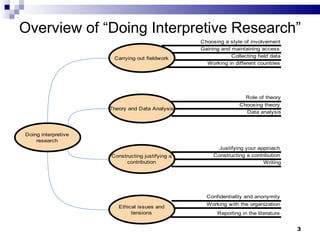
Overview of “Doing Interpretive Research”
Central Message of the paper How to carry out an interpretive research  (IS) from inception to publication Practical advice  for Interpretive IS researchers on Carrying out fieldwork;  Theory and data analysis;  Constructing and justifying a contribution;  Ethical issues and tensions. Extension of Walsham(1995) paper   - Interpretive case studies in IS research: nature and method
Theoretical gap At that time(2006) when the author came up with this paper there was  not much information  on  how  interpretive research should be carried out.  (mostly substantive contents on research topic and only little towards research conduct and method)  What was available for new researchers was  methodology in social science research  (do not provide specific material and examples directly concerned with interpretive research on IS) Walsham’s previous paper(1995) that solely dealt with interpretive case studies  (has now become old as IS has enhanced faster in the last decade  )
The Research Question What is the  general procedure or steps  for carrying out a IS interpretive research?  For an IS interpretive researcher : What must be the style of involvement ?  How to gain & maintain access for fieldwork ? How to collect field data ? How to do field research across countries ? How to choose a suitable theory for research and perform data analysis ? How to construct and justify the contribution and approach? What are the key ethical issues and tensions to be taken care?
How is data collected and analyzed? Data for this paper is collected and analyzed by Mr. Geoff Walsham based on  Literature Personal experiences from over two decades of own interpretive research work Discussion with other IS researchers and students
Findings of the paper Walsham(1995, 2006) provides a  set of directives  for conducting interpretive research  Focuses on choosing a style of involvement and analyzing data as well as constructing and justifying a contribution; Also, focuses on the ethical issues in research Sponsors  for a research always  expects positive projection  of their organization in the research It is  important to offer advice , help and provide constructive suggestions even if the researcher is a neutral observer to the show.
Uniqueness about this paper Development of  IS interpretive research  methodology  (a directive for new Interpretive researchers).  Discussion  about factors like  ethical issues and tensions  which provides a better means of decision making for researchers in their field activity.
What is lacking in the paper Clarity in  “Role of Theory”  section Social & cultural issues  encountered during the field study or research in different countries.
Questions & Answers
Thank you!!!

Walsham 2006 Summary (Team 6) V0.2[1]

  • 1.
    “ Doing InterpretiveResearch” - Geoff Walsham, 2006 Summary and Findings Team 6 (Balaji & Babu) 19 th Feb 2009
  • 2.
    Agenda Overview of“Doing Interpretive Research” paper Central message of the paper Theoretical gap that this paper is trying to bridge The Research Question How is data collected and analysed? Findings of the paper Uniqueness about this paper Lacking in this paper
  • 3.
    Overview of “DoingInterpretive Research”
  • 4.
    Central Message ofthe paper How to carry out an interpretive research (IS) from inception to publication Practical advice for Interpretive IS researchers on Carrying out fieldwork; Theory and data analysis; Constructing and justifying a contribution; Ethical issues and tensions. Extension of Walsham(1995) paper - Interpretive case studies in IS research: nature and method
  • 5.
    Theoretical gap Atthat time(2006) when the author came up with this paper there was not much information on how interpretive research should be carried out. (mostly substantive contents on research topic and only little towards research conduct and method) What was available for new researchers was methodology in social science research (do not provide specific material and examples directly concerned with interpretive research on IS) Walsham’s previous paper(1995) that solely dealt with interpretive case studies (has now become old as IS has enhanced faster in the last decade )
  • 6.
    The Research QuestionWhat is the general procedure or steps for carrying out a IS interpretive research? For an IS interpretive researcher : What must be the style of involvement ? How to gain & maintain access for fieldwork ? How to collect field data ? How to do field research across countries ? How to choose a suitable theory for research and perform data analysis ? How to construct and justify the contribution and approach? What are the key ethical issues and tensions to be taken care?
  • 7.
    How is datacollected and analyzed? Data for this paper is collected and analyzed by Mr. Geoff Walsham based on Literature Personal experiences from over two decades of own interpretive research work Discussion with other IS researchers and students
  • 8.
    Findings of thepaper Walsham(1995, 2006) provides a set of directives for conducting interpretive research Focuses on choosing a style of involvement and analyzing data as well as constructing and justifying a contribution; Also, focuses on the ethical issues in research Sponsors for a research always expects positive projection of their organization in the research It is important to offer advice , help and provide constructive suggestions even if the researcher is a neutral observer to the show.
  • 9.
    Uniqueness about thispaper Development of IS interpretive research methodology (a directive for new Interpretive researchers). Discussion about factors like ethical issues and tensions which provides a better means of decision making for researchers in their field activity.
  • 10.
    What is lackingin the paper Clarity in “Role of Theory” section Social & cultural issues encountered during the field study or research in different countries.
  • 11.
  • 12.