Peer Counseling Skills The TRIP Basics PROJECT DATE
Ice Breaker People Bingo
What is a Peer Counselor? WHY MIGHT SOMEONE GO TO A PEER INSTEAD OF A PROFESSIONAL? WHAT IS THE DIFFERENCE BETWEEN A PROFESSIONAL AND A PEER?
Peer Support Peers share  a distinctive history and a particular social context Peers often share similar values, experiences and lifestyles Peers are often the first people we turn to for support and can play a valuable role
Who  do you go to for support? What was it about the person that made you choose them? What did they do that you found helpful? Unhelpful?
What  was it about the person that made you choose them? •  Friendly •  Sincere •  Kind •  Warm •  Patient •  Approachable •  Interested •  A good listener •  Trustworthy •  Honest
What  did they do that the interaction did you find helpful? •   Reassured me that it isn’t unusual to find  some decisions/situations difficult •  Open minded, didn’t judge me •  Helped me clarify things •  Listened to me  •  Didn’t tell me what to do •  Didn't interrupt me •  Didn’t argue with me •  Didn’t Judge me
Person -Centered Peer Counseling Non directive People are experts on their own life,  thoughts, feelings People are capable of making their own  decisions Highly values the experience of the person  and the importance of their subjective reality Recognizes everyone as unique
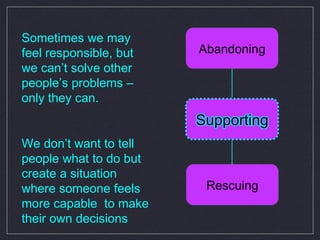
Rescuing Abandoning Sometimes we may feel responsible, but we can’t solve other people’s problems –only they can. We don’t want to tell people what to do but create a situation where someone feels more capable  to make their own decisions
Let peers know they are heard Allow peers to feel understood, that they are  not alone Assist peers in getting a clearer idea of what  they think and feel Give peers “food for thought” Allow peers to vent and release tension, at  least for a short while Can’t always find solutions in one discussion Just one small change can cause a series of  changes
 
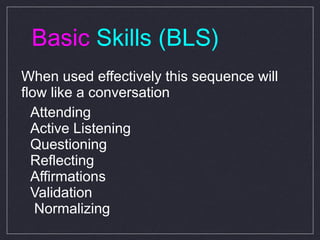
Basic  Skills (BLS) When used effectively this sequence will flow like a conversation Attending Active Listening Questioning Reflecting Affirmations Validation Normalizing
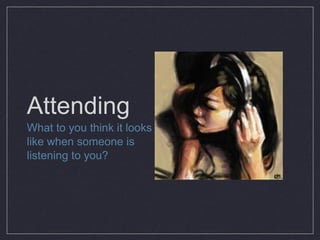
Attending What to you think it looks like when someone is listening to you?
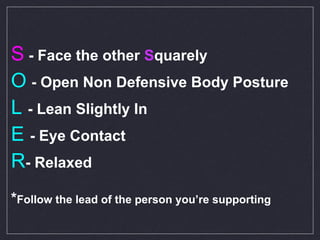
S  - Face the other  S quarely O   - Open Non Defensive Body Posture L   - Lean Slightly In  E   - Eye Contact R - Relaxed * Follow the lead of the person you’re supporting
Good Listening: Is it more then just being silent
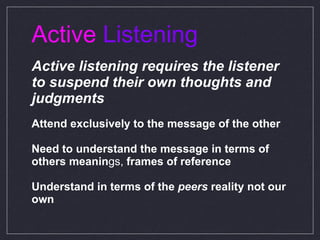
Active   Listening Active listening requires the listener to suspend their own thoughts and judgments Attend exclusively to   the message of the other Need to understand the message in terms of others meanin gs,  frames of reference Understand in terms of the   peers  reality not our   own
Communication   Activity: If you Listen will you understand?
Communication is  Complicated! What is meant, what is said and what is heard are sometimes very different things!! Room for interpretation In order to make sure you understand and to show understanding you need to check in
Open   and Closed Questions What are closed and open ended questions Examples: DO YOU FEEL UPSET? HOW ARE YOU FEELING?
Question  Activity: Find out about your partners day using closed questions
Activity: Now change those questions into open ended questions
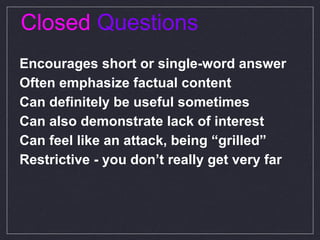
Closed  Questions Encourages short or single-word answer  Often emphasize factual content Can definitely be useful sometimes  Can also demonstrate lack of interest Can feel like an attack, being “grilled” Restrictive - you don’t really get very far
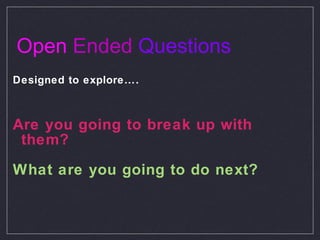
Open  Ended   Questions Designed to explore…. Are you going to break up with them?  What are you going to do next?
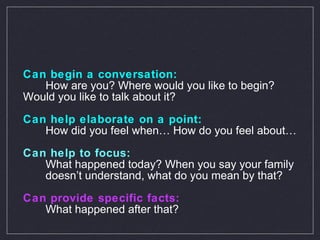
Can begin a conversation:  How are you? Where would you like to begin?  Would you like to talk about it?  Can help elaborate on a point:  How did you feel when… How do you feel about…   Can help to focus:  What happened today? When you say your family  doesn’t understand, what do you mean by that? Can provide specific facts: What happened after that?
Try and avoid: “ Why” Questions Leading and Either or Questions Poorly Timed Questions Too many Questions
Ref lec tion s? What are they?
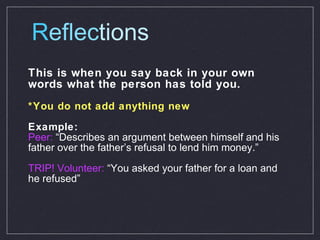
R eflec tions This is when you say back in your own words what the person has told you. *You do not add anything new Example: Peer:  “Describes an argument between himself and his father over the father’s refusal to lend him money.” TRIP! Volunteer:  “You asked your father for a loan and he refused”
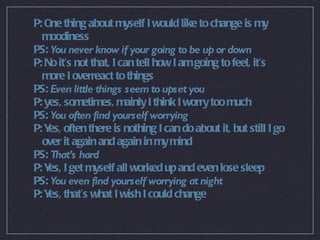
P: One thing about myself I would like to change is my moodiness PS:  You never know if your going to be up or down P: No it’s not that, I can tell how I am going to feel, it’s more I overreact to things PS:  Even little things seem to upset you P: yes, sometimes, mainly I think I worry too much PS:  You often find yourself worrying P: Yes, often there is nothing I can do about it, but still I go over it again and again in my mind PS:  That’s hard P: Yes, I get myself all worked up and even lose sleep PS:  You even find yourself worrying at night P: Yes, that’s what I wish I could change
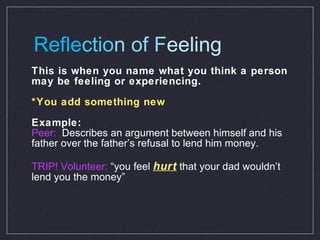
Refle ctio n of F eeling This is when you name what you think a person may be feeling or experiencing.  *You add something new  Example: Peer:   Describes an argument between himself and his father over the father’s refusal to lend him money. TRIP! Volunteer:  “you feel  hurt   that your dad wouldn’t lend you the money”
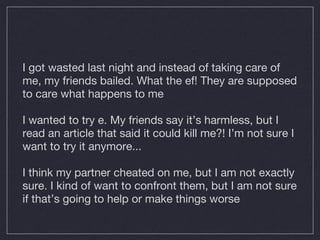
I got wasted last night and instead of taking care of me, my friends bailed. What the ef! They are supposed to care what happens to me I  wanted to try e. My friends say it’s harmless, but I read an article that said it could kill me?! I’m not sure I want to try it anymore... I think my partner cheated on me, but I am not exactly sure. I kind of want to confront them, but I am not sure if that’s going to help or make things worse
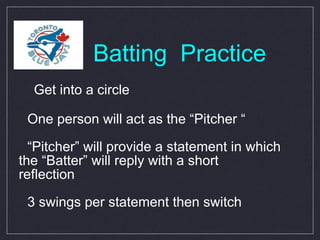
Batting  Practice Get into a circle One person will act as the “Pitcher “ “ Pitcher” will provide a statement in which  the “Batter” will reply with a short  reflection 3 swings per statement then switch
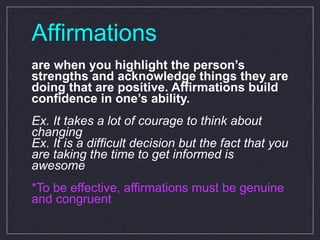
Affirmations are when you highlight the person’s strengths and acknowledge things they are doing that are positive. Affirmations build confidence in one’s ability.  Ex. It takes a lot of courage to think about changing Ex. It is a difficult decision but the fact that you are taking the time to get informed is awesome *To be effective, affirmations must be genuine and congruent
Validation acknowledges the worth of the caller and their right to their feelings. It reassures people that it is ok to have the feelings they have and recognizes the callers realities and experiences as being genuine Ex. That must be difficult. You have every right to be upset Ex. You take pride in your appearance and it hurts when someone doesn’t acknowledge that
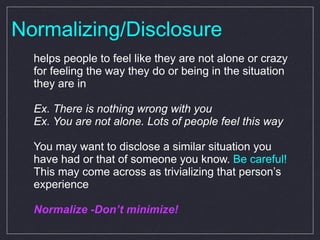
Normalizing/Disclosure helps people to feel like they are not alone or crazy for feeling the way they do or being in the situation they are in Ex. There is nothing wrong with you Ex. You are not alone. Lots of people feel this way You may want to disclose a similar situation you have had or that of someone you know.  Be careful!  This may come across as trivializing that person’s experience Normalize -Don’t minimize!
Sharing  Information and Resources Check to make sure the person wants the information before giving it  Build on what the person already knows, so find out what that is  Make sure the information is relevant and that the person is open to it. Be careful that you don’t lecture or get preachy.  Do not overload people with too much information. Small bits at a time Do not confuse information\referrals with advice. Present the information or referral as an option.
Problem Management Brainstorm alternatives/options Pros/Cons Goal Setting/Planning
Activity: What not to do?
What Not To Do: Ordering or commanding Warning Threatening Moralizing or preaching Advising and giving solutions Lecturing, intellectualizing Judging or criticizing  Praising, agreeing Reassuring sympathizing Diversion, distraction Minimizing
Role Plays Discuss something that you can personally speak about for a sustained amount of time This is practice so try not to make the role play too difficult (ex. extended silence, demanding advice, resisting everything) Topics may be:  Made up, a decision you are trying to make, a habit you are trying to change
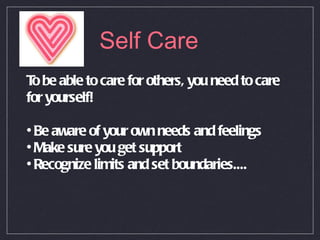
Self Care To be able to care for others, you need to care for yourself! Be aware of your own needs and feelings Make sure you get support Recognize limits and set boundaries....
Self care activity: Progressive relaxation
Boundaries A limit or edge that defines you as separate from someone else Allows for safe, healthy and positive relationships Necessary for peers and TRIP volunteers
Setting a Boundary If you have never or hardly ever said no, your first attempts may feel awkward or even rude. It gets easier! Do not let people place conditions on your helping them.  You will find it helpful to use gentle refusal when: A person makes unrealistic demands on you A person wants guarantees A person demands advice A person asks questions that make you uncomfortable A person is verbally abusive You just want to end the conversation
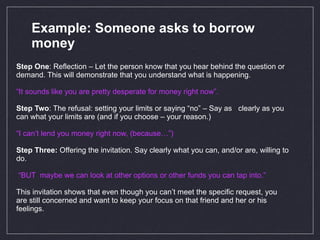
Example: Someone asks to borrow money Step One : Reflection – Let the person know that you hear behind the question or demand. This will demonstrate that you understand what is happening. “ It sounds like you are pretty desperate for money right now”.  Step Two : The refusal: setting your limits or saying “no” – Say as  clearly as you can what your limits are (and if you choose – your reason.) “ I can’t lend you money right now, (because…”)   Step Three:  Offering the invitation. Say clearly what you can, and/or are, willing to do. “ BUT  maybe we can look at other options or other funds you can tap into.”  This invitation shows that even though you can’t meet the specific request, you are still concerned and want to keep your focus on that friend and her or his feelings.
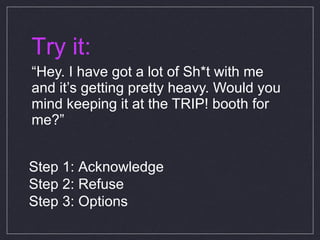
Try it: “ Hey. I have got a lot of Sh*t with me and it’s getting pretty heavy. Would you mind keeping it at the TRIP! booth for me?” Step 1: Acknowledge Step 2: Refuse Step 3: Options
Don’t worry! What if I don’t know what they want from me? What if I say the wrong thing? What if I don’t know the answer?

Peer Support

  • 1.
    Peer Counseling SkillsThe TRIP Basics PROJECT DATE
  • 2.
  • 3.
    What is aPeer Counselor? WHY MIGHT SOMEONE GO TO A PEER INSTEAD OF A PROFESSIONAL? WHAT IS THE DIFFERENCE BETWEEN A PROFESSIONAL AND A PEER?
  • 4.
    Peer Support Peersshare a distinctive history and a particular social context Peers often share similar values, experiences and lifestyles Peers are often the first people we turn to for support and can play a valuable role
  • 5.
    Who doyou go to for support? What was it about the person that made you choose them? What did they do that you found helpful? Unhelpful?
  • 6.
    What wasit about the person that made you choose them? • Friendly • Sincere • Kind • Warm • Patient • Approachable • Interested • A good listener • Trustworthy • Honest
  • 7.
    What didthey do that the interaction did you find helpful? • Reassured me that it isn’t unusual to find some decisions/situations difficult • Open minded, didn’t judge me • Helped me clarify things • Listened to me • Didn’t tell me what to do • Didn't interrupt me • Didn’t argue with me • Didn’t Judge me
  • 8.
    Person -Centered PeerCounseling Non directive People are experts on their own life, thoughts, feelings People are capable of making their own decisions Highly values the experience of the person and the importance of their subjective reality Recognizes everyone as unique
  • 9.
    Rescuing Abandoning Sometimeswe may feel responsible, but we can’t solve other people’s problems –only they can. We don’t want to tell people what to do but create a situation where someone feels more capable to make their own decisions
  • 10.
    Let peers knowthey are heard Allow peers to feel understood, that they are not alone Assist peers in getting a clearer idea of what they think and feel Give peers “food for thought” Allow peers to vent and release tension, at least for a short while Can’t always find solutions in one discussion Just one small change can cause a series of changes
  • 11.
  • 12.
    Basic Skills(BLS) When used effectively this sequence will flow like a conversation Attending Active Listening Questioning Reflecting Affirmations Validation Normalizing
  • 13.
    Attending What toyou think it looks like when someone is listening to you?
  • 14.
    S -Face the other S quarely O - Open Non Defensive Body Posture L - Lean Slightly In E - Eye Contact R - Relaxed * Follow the lead of the person you’re supporting
  • 15.
    Good Listening: Isit more then just being silent
  • 16.
    Active Listening Active listening requires the listener to suspend their own thoughts and judgments Attend exclusively to the message of the other Need to understand the message in terms of others meanin gs, frames of reference Understand in terms of the peers reality not our own
  • 17.
    Communication Activity: If you Listen will you understand?
  • 18.
    Communication is Complicated! What is meant, what is said and what is heard are sometimes very different things!! Room for interpretation In order to make sure you understand and to show understanding you need to check in
  • 19.
    Open and Closed Questions What are closed and open ended questions Examples: DO YOU FEEL UPSET? HOW ARE YOU FEELING?
  • 20.
    Question Activity:Find out about your partners day using closed questions
  • 21.
    Activity: Now changethose questions into open ended questions
  • 22.
    Closed QuestionsEncourages short or single-word answer Often emphasize factual content Can definitely be useful sometimes Can also demonstrate lack of interest Can feel like an attack, being “grilled” Restrictive - you don’t really get very far
  • 23.
    Open Ended Questions Designed to explore…. Are you going to break up with them? What are you going to do next?
  • 24.
    Can begin aconversation: How are you? Where would you like to begin? Would you like to talk about it? Can help elaborate on a point: How did you feel when… How do you feel about… Can help to focus: What happened today? When you say your family doesn’t understand, what do you mean by that? Can provide specific facts: What happened after that?
  • 25.
    Try and avoid:“ Why” Questions Leading and Either or Questions Poorly Timed Questions Too many Questions
  • 26.
    Ref lec tions? What are they?
  • 27.
    R eflec tionsThis is when you say back in your own words what the person has told you. *You do not add anything new Example: Peer: “Describes an argument between himself and his father over the father’s refusal to lend him money.” TRIP! Volunteer: “You asked your father for a loan and he refused”
  • 28.
    P: One thingabout myself I would like to change is my moodiness PS: You never know if your going to be up or down P: No it’s not that, I can tell how I am going to feel, it’s more I overreact to things PS: Even little things seem to upset you P: yes, sometimes, mainly I think I worry too much PS: You often find yourself worrying P: Yes, often there is nothing I can do about it, but still I go over it again and again in my mind PS: That’s hard P: Yes, I get myself all worked up and even lose sleep PS: You even find yourself worrying at night P: Yes, that’s what I wish I could change
  • 29.
    Refle ctio nof F eeling This is when you name what you think a person may be feeling or experiencing. *You add something new Example: Peer: Describes an argument between himself and his father over the father’s refusal to lend him money. TRIP! Volunteer: “you feel hurt that your dad wouldn’t lend you the money”
  • 30.
    I got wastedlast night and instead of taking care of me, my friends bailed. What the ef! They are supposed to care what happens to me I wanted to try e. My friends say it’s harmless, but I read an article that said it could kill me?! I’m not sure I want to try it anymore... I think my partner cheated on me, but I am not exactly sure. I kind of want to confront them, but I am not sure if that’s going to help or make things worse
  • 31.
    Batting PracticeGet into a circle One person will act as the “Pitcher “ “ Pitcher” will provide a statement in which the “Batter” will reply with a short reflection 3 swings per statement then switch
  • 32.
    Affirmations are whenyou highlight the person’s strengths and acknowledge things they are doing that are positive. Affirmations build confidence in one’s ability. Ex. It takes a lot of courage to think about changing Ex. It is a difficult decision but the fact that you are taking the time to get informed is awesome *To be effective, affirmations must be genuine and congruent
  • 33.
    Validation acknowledges theworth of the caller and their right to their feelings. It reassures people that it is ok to have the feelings they have and recognizes the callers realities and experiences as being genuine Ex. That must be difficult. You have every right to be upset Ex. You take pride in your appearance and it hurts when someone doesn’t acknowledge that
  • 34.
    Normalizing/Disclosure helps peopleto feel like they are not alone or crazy for feeling the way they do or being in the situation they are in Ex. There is nothing wrong with you Ex. You are not alone. Lots of people feel this way You may want to disclose a similar situation you have had or that of someone you know. Be careful! This may come across as trivializing that person’s experience Normalize -Don’t minimize!
  • 35.
    Sharing Informationand Resources Check to make sure the person wants the information before giving it Build on what the person already knows, so find out what that is Make sure the information is relevant and that the person is open to it. Be careful that you don’t lecture or get preachy. Do not overload people with too much information. Small bits at a time Do not confuse information\referrals with advice. Present the information or referral as an option.
  • 36.
    Problem Management Brainstormalternatives/options Pros/Cons Goal Setting/Planning
  • 37.
  • 38.
    What Not ToDo: Ordering or commanding Warning Threatening Moralizing or preaching Advising and giving solutions Lecturing, intellectualizing Judging or criticizing Praising, agreeing Reassuring sympathizing Diversion, distraction Minimizing
  • 39.
    Role Plays Discusssomething that you can personally speak about for a sustained amount of time This is practice so try not to make the role play too difficult (ex. extended silence, demanding advice, resisting everything) Topics may be: Made up, a decision you are trying to make, a habit you are trying to change
  • 40.
    Self Care Tobe able to care for others, you need to care for yourself! Be aware of your own needs and feelings Make sure you get support Recognize limits and set boundaries....
  • 41.
    Self care activity:Progressive relaxation
  • 42.
    Boundaries A limitor edge that defines you as separate from someone else Allows for safe, healthy and positive relationships Necessary for peers and TRIP volunteers
  • 43.
    Setting a BoundaryIf you have never or hardly ever said no, your first attempts may feel awkward or even rude. It gets easier! Do not let people place conditions on your helping them. You will find it helpful to use gentle refusal when: A person makes unrealistic demands on you A person wants guarantees A person demands advice A person asks questions that make you uncomfortable A person is verbally abusive You just want to end the conversation
  • 44.
    Example: Someone asksto borrow money Step One : Reflection – Let the person know that you hear behind the question or demand. This will demonstrate that you understand what is happening. “ It sounds like you are pretty desperate for money right now”. Step Two : The refusal: setting your limits or saying “no” – Say as clearly as you can what your limits are (and if you choose – your reason.) “ I can’t lend you money right now, (because…”) Step Three: Offering the invitation. Say clearly what you can, and/or are, willing to do. “ BUT maybe we can look at other options or other funds you can tap into.” This invitation shows that even though you can’t meet the specific request, you are still concerned and want to keep your focus on that friend and her or his feelings.
  • 45.
    Try it: “Hey. I have got a lot of Sh*t with me and it’s getting pretty heavy. Would you mind keeping it at the TRIP! booth for me?” Step 1: Acknowledge Step 2: Refuse Step 3: Options
  • 46.
    Don’t worry! Whatif I don’t know what they want from me? What if I say the wrong thing? What if I don’t know the answer?

Editor's Notes

  • #28 Is when you say back in your own words what the person has told you. It’s an opportunity for the person to hear back what they said and for you to check that you understood