What Is Grief?
Presented By:
Jimmie Adams
What is grief?
Grief is a natural response to loss. It’s the
emotional suffering you feel when something or
someone you love is taken away. The more
significant the loss, the more intense the grief
will be. You may associate grief with the death
of a loved one—which is often the cause of the
most intense type of grief.
Losses That Can Cause Grief
• Divorce or relationship breakup
• Loss of health
• Losing a job
• Loss of financial stability
• A miscarriage
• Retirement
• Death of a pet
• Loss of a cherished dream
• A loved one’s serious illness
• Loss of a friendship
• Loss of safety after a trauma
• Selling the family home
Everyone grieves differently
Grieving is a personal and highly individual
experience. How you grieve depends on many
factors, including your personality and coping
style, your life experience, your faith, and the
nature of the loss. The grieving process takes
time. Healing happens gradually; it can’t be
forced or hurried—and there is no “normal”
timetable for grieving.
Are there stages of grief?
In 1969, psychiatrist Elisabeth Kübler-Ross
introduced what became known as the “five
stages of grief.” These stages of grief were based
on her studies of the feelings of patients facing
terminal illness, but many people have
generalized them to other types of negative life
changes and losses, such as the death of a loved
one or a break-up.
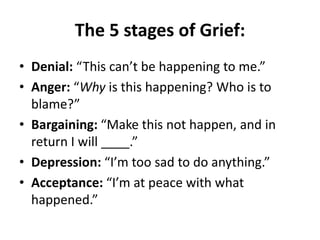
The 5 stages of Grief:
• Denial: “This can’t be happening to me.”
• Anger: “Why is this happening? Who is to
blame?”
• Bargaining: “Make this not happen, and in
return I will ____.”
• Depression: “I’m too sad to do anything.”
• Acceptance: “I’m at peace with what
happened.”
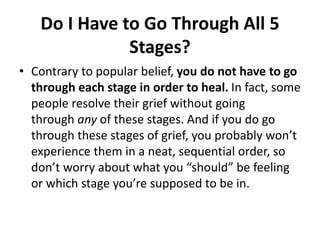
Do I Have to Go Through All 5
Stages?
• Contrary to popular belief, you do not have to go
through each stage in order to heal. In fact, some
people resolve their grief without going
through any of these stages. And if you do go
through these stages of grief, you probably won’t
experience them in a neat, sequential order, so
don’t worry about what you “should” be feeling
or which stage you’re supposed to be in.
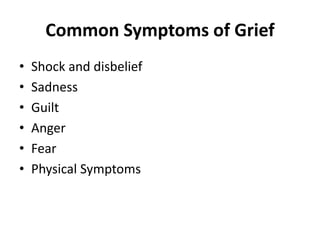
Common Symptoms of Grief
• Shock and disbelief
• Sadness
• Guilt
• Anger
• Fear
• Physical Symptoms
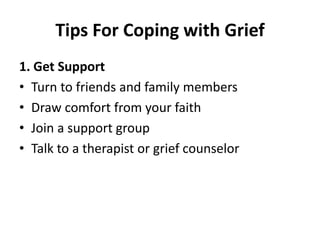
Tips For Coping with Grief
1. Get Support
• Turn to friends and family members
• Draw comfort from your faith
• Join a support group
• Talk to a therapist or grief counselor
Tips For Coping with Grief
2. Take care of yourself
• Face your feelings
• Express your feelings in a tangible or creative
way
• Look after your physical health
• Don’t let anyone tell you how to feel, and
don’t tell yourself how to feel either
• Plan ahead for grief “triggers.”
Grief: 7 Myths That Make
It Worse
Myth: We Grieve in Stages
You've no doubt heard about the "five stages" of
grief: denial, anger, bargaining, depression, and
acceptance. But there is little evidence that
people progress through any such stages.
Myth: The Second Year Is Hardest
Some people say the second year after you've
lost a loved one is harder than the first. Not
necessarily. In fact, recent studies suggest that,
for many bereaved people, the first six months
are the hardest, emotionally speaking. This isn't
to suggest that people stop missing their lost
loved one after a matter of months, only that
they have returned to somewhat normal
functioning.
Myth: You Have to Get It Out
For years, grieving people have been urged to
express themselves after the loss of a loved one.
But does talking about or writing about your loss
really help? There's no evidence to suggest that
it does. Some studies suggest that holding in
your sadness might actually be beneficial.
Myth: Delayed Reactions Are
Common
Will repressing grief's negative emotions lead to
deeper grief later on? Some therapists think so,
but researchers are skeptical.
Myth: Counseling Helps
Seeing a therapist or other counselor certainly
helps some people cope with grief. But not all.
In general, counseling seems to work best for
people whose grief has already lasted a long
time - but not those whose grief is more typical.
Myth: Women Grieve Harder
There's little evidence that women experience
grief more intensely than men. Overall, men and
women are more similar in the way they
experience grief than they are different.
Myth: Grief Is a Journey
Grief a "journey?" A "process?" Nice metaphors,
maybe, but a recent study that tracked the daily
emotions of the bereaved found so many ups
and downs that the idea of a journey seems
misguided. At this point, the best one can say
about grief is that it comes and goes - and then,
eventually, simply goes away.
Questions

Grief presentation

  • 1.
    What Is Grief? PresentedBy: Jimmie Adams
  • 2.
    What is grief? Griefis a natural response to loss. It’s the emotional suffering you feel when something or someone you love is taken away. The more significant the loss, the more intense the grief will be. You may associate grief with the death of a loved one—which is often the cause of the most intense type of grief.
  • 3.
    Losses That CanCause Grief • Divorce or relationship breakup • Loss of health • Losing a job • Loss of financial stability • A miscarriage • Retirement • Death of a pet • Loss of a cherished dream • A loved one’s serious illness • Loss of a friendship • Loss of safety after a trauma • Selling the family home
  • 4.
    Everyone grieves differently Grievingis a personal and highly individual experience. How you grieve depends on many factors, including your personality and coping style, your life experience, your faith, and the nature of the loss. The grieving process takes time. Healing happens gradually; it can’t be forced or hurried—and there is no “normal” timetable for grieving.
  • 5.
    Are there stagesof grief? In 1969, psychiatrist Elisabeth Kübler-Ross introduced what became known as the “five stages of grief.” These stages of grief were based on her studies of the feelings of patients facing terminal illness, but many people have generalized them to other types of negative life changes and losses, such as the death of a loved one or a break-up.
  • 6.
    The 5 stagesof Grief: • Denial: “This can’t be happening to me.” • Anger: “Why is this happening? Who is to blame?” • Bargaining: “Make this not happen, and in return I will ____.” • Depression: “I’m too sad to do anything.” • Acceptance: “I’m at peace with what happened.”
  • 7.
    Do I Haveto Go Through All 5 Stages? • Contrary to popular belief, you do not have to go through each stage in order to heal. In fact, some people resolve their grief without going through any of these stages. And if you do go through these stages of grief, you probably won’t experience them in a neat, sequential order, so don’t worry about what you “should” be feeling or which stage you’re supposed to be in.
  • 8.
    Common Symptoms ofGrief • Shock and disbelief • Sadness • Guilt • Anger • Fear • Physical Symptoms
  • 9.
    Tips For Copingwith Grief 1. Get Support • Turn to friends and family members • Draw comfort from your faith • Join a support group • Talk to a therapist or grief counselor
  • 10.
    Tips For Copingwith Grief 2. Take care of yourself • Face your feelings • Express your feelings in a tangible or creative way • Look after your physical health • Don’t let anyone tell you how to feel, and don’t tell yourself how to feel either • Plan ahead for grief “triggers.”
  • 11.
    Grief: 7 MythsThat Make It Worse
  • 12.
    Myth: We Grievein Stages You've no doubt heard about the "five stages" of grief: denial, anger, bargaining, depression, and acceptance. But there is little evidence that people progress through any such stages.
  • 13.
    Myth: The SecondYear Is Hardest Some people say the second year after you've lost a loved one is harder than the first. Not necessarily. In fact, recent studies suggest that, for many bereaved people, the first six months are the hardest, emotionally speaking. This isn't to suggest that people stop missing their lost loved one after a matter of months, only that they have returned to somewhat normal functioning.
  • 14.
    Myth: You Haveto Get It Out For years, grieving people have been urged to express themselves after the loss of a loved one. But does talking about or writing about your loss really help? There's no evidence to suggest that it does. Some studies suggest that holding in your sadness might actually be beneficial.
  • 15.
    Myth: Delayed ReactionsAre Common Will repressing grief's negative emotions lead to deeper grief later on? Some therapists think so, but researchers are skeptical.
  • 16.
    Myth: Counseling Helps Seeinga therapist or other counselor certainly helps some people cope with grief. But not all. In general, counseling seems to work best for people whose grief has already lasted a long time - but not those whose grief is more typical.
  • 17.
    Myth: Women GrieveHarder There's little evidence that women experience grief more intensely than men. Overall, men and women are more similar in the way they experience grief than they are different.
  • 18.
    Myth: Grief Isa Journey Grief a "journey?" A "process?" Nice metaphors, maybe, but a recent study that tracked the daily emotions of the bereaved found so many ups and downs that the idea of a journey seems misguided. At this point, the best one can say about grief is that it comes and goes - and then, eventually, simply goes away.
  • 19.