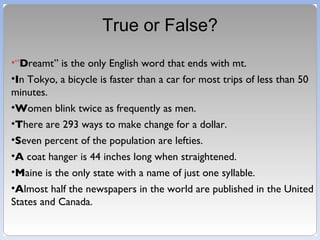
True or False? “ D reamt” is the only English word that ends with mt. I n Tokyo, a bicycle is faster than a car for most trips of less than 50 minutes. W omen blink twice as frequently as men. T here are 293 ways to make change for a dollar. S even percent of the population are lefties. A  coat hanger is 44 inches long when straightened. M aine is the only state with a name of just one syllable. A lmost half the newspapers in the world are published in the United States and Canada.
Dealing With Difficult People
The “Lunch and Earn” Facilitator S. Paul Kearley, CS Managing Partner,  Dale Carnegie Business Group Author: MUST Thinking
There seems to be some perverse human characteristic that likes to make easy things difficult.  ~Warren Buffett
Making Judgements We tend to judge people in 4 key areas: What they say How they say it What they do How they do it
Understand Difficult People How does it show? What are the causes? What are the possible solutions?
Take an action Get a result Evaluate the result Make an adjustment Take an action How We Learn
The Conflict Cycle Event Interpretation Emotional Response Physical   Response Attitude   Response Effect
Conflict Response Scale Avoid Win-Win Approach Dictate Oblige Compromise Stand Our Ground Collaborate
How Do You View Yourself?
“ Better Than” Way of Seeing A heart at war needs enemies to justify it’s existence.  It needs enemies and mistreatment more than it needs peace. View of Myself Superior Important Virtuous / Right View of Others Inferior Incapable / Irrelevant False / Wrong Feelings Impatient Disdainful Indifferent View of World Competitive Troubled Needs Me
“ I-Deserve” Way of Seeing  View of Myself Meritorious Mistreated / Victim Unappreciated View of Others Mistaken Mistreating Ungrateful Feelings Entitled Deprived Resentful View of World Unfair Unjust Owes Me
“ Must Be Seen As” Way of Seeing View of Myself Need to be well thought of Fake View of Others Judgemental Threatening My Audience Feelings Anxious / Afraid Needy / Stressed Overwhelmed View of World Dangerous Watching Judging me
“ Worse Than” Way of Seeing View of Myself Not as good Broken / Deficient Fated View of Others Advantaged Privileged Blessed Feelings Helpless Jealous / Bitter Depressed View of World Hard / Difficult Against me Ignoring me
The Peacemaking Pyramid Correct Dealing with things that are going wrong Helping  things  go right Get out of the box / Obtain a heart of peace Teach &  Communicate Listen & Learn Build the Relationship Build Relationships With Others Who Have Influence
The Choice Diagram Sense / Desire Seeing people as people with needs, cares, worries, fears that matter like mine Choice Honour the Sense I continue to see them as a person like myself Betray the Sense See others in ways that justify self betrayal.  They become an object of blame My Heart Goes To War (Better-than, I-Deserve, Worse-than, Must-be-seen-as) View of Myself View of Other Feelings View of World
Recovering Inner Clarity and Peace Look for signs of Blame, Justification, Horribilization, Ego, etc. Find an out-of-the-box place Ponder the situation anew (from the out-of-the-box place) Act upon what you have discovered; do what you are feeling you should do.
Questions for Clarity What are this person’s or people’s challenges, trials, burdens and pains? How am I, or some group of which I am a part, adding to these challenges, trials , burdens and pains? In what other ways have I or my group neglected or mistreated this person or group? In what ways are my self justification habits obscuring the truth and interfering with potential solutions? What am I feeling I should do for this person or group?  What could I do to help?
What  do I think? Why  do I think that? What  evidence do I have? My  example  is… The  evidence  shows… Therefore, I think… Think Speak 1-4 seconds for “reflection” Responding Effectively in Impromptu Situations
Cushion Cushion Your Response Avoid Using I hear you saying … I understand you said… I appreciate your view on … That’s an interesting point of view … But … However … Nevertheless …
Disagree Agreeably What  do I think? Why  do I think that? What  evidence do I have? My  example  is… The  evidence  shows… Therefore, I think… Think Speak 1-4 seconds for “reflection” Cushion
Begin with nothing.  Eliminate: - Prejudice - Emotions - Concepts - Opinions Listen “To” the other person instead of listening “For” something. Avoid replacing their reality with your own. Resist the temptation to compare their words with your own experiences. How to Listen Effectively
Ask questions for clarification, not just to ask questions. You don’t have to respond while the other person is talking. Picture what the other person is saying and summarize when the person has finished. Picture what “it” is, not what you assume “it” is. Your goal is to understand the person’s reality Listening (cont.)
Conflict Resolution Plan Specific conflict People involved Plan of Action Results expected Accountability Partner
The Risk of Anger Damaging trust Impairing judgement Diminishing concern for the other parties’ preferences Neglecting of one’s own goals
Destructive Emotional Expressions Blaming Attacking the other person Repressing it as long as we can
Healthy Emotional Expressions Name the accurate emotion Nonjudgmental Express in direct, straightforward manner Doesn’t blame or attack the other person Conveys that others do not cause our feelings
What is the outcome you want?  What are the options?   What are you going to do? When?  How do you want me to follow-up? Speed Coaching
You are simply guiding the other person through the uncharted territory of current reality.
3 Fundamental Techniques for Handling People Don't criticize, condemn or complain.  Give honest and sincere appreciation.  Become genuinely interested in other people.
Gain Willing Cooperation The only way to get the best of an argument is to avoid it.  Show respect for the other person's opinions. Never say "you're wrong.” If you are wrong, admit it quickly and emphatically.  Begin in a friendly way.  Get the other person saying "yes, yes" immediately.
Gain Willing Cooperation Let the other person do a great deal of talking.  Let the other person feel that the idea is his or hers.  Try honestly to see things from the other person's point of view.  Be sympathetic with the other person's ideas and desires.  Appeal to their nobler motives.
Gain Willing Cooperation Dramatize your ideas.  Throw down a challenge.
What assumptions am I making that I’m not aware that I’m making that’s giving me my current results? What can I now invent or create, that I have not yet invented, that will give me more choices? Being a “Breath of Fresh Air”
Name the Issue.  Select a specific example that illustrates the behaviour or situation you want to change.  Describe your emotions about this issue.  Clarify what is at stake.  Identify your contribution to the problem.  Having Difficult Conversations
Indicate your wish to resolve the issue.  Invite your partner to respond.  Inquire into your partner’s views.  Where are we now?  What have we learned?  Make an agreement and determine how you will hold each other responsible for keeping it. Difficult Conversations (cont.)
Write down your feelings Share your feelings with someone you trust Count to ten Listen to music Take a break Principles for Maintaining Emotional Control
Talk Through the Issue Stop and cool off. Talk and listen to each other. Find out what you both need. Brainstorm solutions. Choose the idea you both like best. Make a plan and go for it!
Conflict Inhibits Individual Growth
Conflict-Based Barriers to Organizational Growth Inaction Disagreements Attitude Erosion Minimal Motivation
Charting Conflict-Based Barriers Barrier? Who owns this? What’s in the way? When did this begin? Impact? How should we address it? Why is this happening?
Building Trust through Conflict Adapt Keep relationship warm Listen to values Act on what we hear Follow up Be willing to change
Turn Barriers into Opportunities Positive vs. negative self-talk Choose your battles Focus on what we can vs. can’t change Focus on potential ROI
Go the extra mile. Be flexible. See things from the other person’s point  of view.  Be empathetic. Maintaining Positive Conflict Resolution Strategies
Problem Solving Questions 1. What is the issue? 2. What is the root cause? 3. What are the possible solutions? 4. What is the best solution? 5. What is the 1 st  action I will take?
Summary of Tactics Have a positive attitude Meet on mutual ground Clearly define and agree on the issue Do your homework Take an honest inventory of yourself Look for shared interest
Summary of Tactics Deal with facts, not emotions Be Honest Present alternatives and provide evidence Be an expert communicator End on a good note Enjoy the process
Thanks for Attending!! For more information on Dale Carnegie, goto:  www.dalecarnegie.ca   To find about our new project starting soon in Halifax, call 1 800 561 2220

Dealing With Difficult People Webinar

  • 1.
    True or False?“ D reamt” is the only English word that ends with mt. I n Tokyo, a bicycle is faster than a car for most trips of less than 50 minutes. W omen blink twice as frequently as men. T here are 293 ways to make change for a dollar. S even percent of the population are lefties. A coat hanger is 44 inches long when straightened. M aine is the only state with a name of just one syllable. A lmost half the newspapers in the world are published in the United States and Canada.
  • 2.
  • 3.
    The “Lunch andEarn” Facilitator S. Paul Kearley, CS Managing Partner, Dale Carnegie Business Group Author: MUST Thinking
  • 4.
    There seems tobe some perverse human characteristic that likes to make easy things difficult.  ~Warren Buffett
  • 5.
    Making Judgements Wetend to judge people in 4 key areas: What they say How they say it What they do How they do it
  • 6.
    Understand Difficult PeopleHow does it show? What are the causes? What are the possible solutions?
  • 7.
    Take an actionGet a result Evaluate the result Make an adjustment Take an action How We Learn
  • 8.
    The Conflict CycleEvent Interpretation Emotional Response Physical Response Attitude Response Effect
  • 9.
    Conflict Response ScaleAvoid Win-Win Approach Dictate Oblige Compromise Stand Our Ground Collaborate
  • 10.
    How Do YouView Yourself?
  • 11.
    “ Better Than”Way of Seeing A heart at war needs enemies to justify it’s existence. It needs enemies and mistreatment more than it needs peace. View of Myself Superior Important Virtuous / Right View of Others Inferior Incapable / Irrelevant False / Wrong Feelings Impatient Disdainful Indifferent View of World Competitive Troubled Needs Me
  • 12.
    “ I-Deserve” Wayof Seeing View of Myself Meritorious Mistreated / Victim Unappreciated View of Others Mistaken Mistreating Ungrateful Feelings Entitled Deprived Resentful View of World Unfair Unjust Owes Me
  • 13.
    “ Must BeSeen As” Way of Seeing View of Myself Need to be well thought of Fake View of Others Judgemental Threatening My Audience Feelings Anxious / Afraid Needy / Stressed Overwhelmed View of World Dangerous Watching Judging me
  • 14.
    “ Worse Than”Way of Seeing View of Myself Not as good Broken / Deficient Fated View of Others Advantaged Privileged Blessed Feelings Helpless Jealous / Bitter Depressed View of World Hard / Difficult Against me Ignoring me
  • 15.
    The Peacemaking PyramidCorrect Dealing with things that are going wrong Helping things go right Get out of the box / Obtain a heart of peace Teach & Communicate Listen & Learn Build the Relationship Build Relationships With Others Who Have Influence
  • 16.
    The Choice DiagramSense / Desire Seeing people as people with needs, cares, worries, fears that matter like mine Choice Honour the Sense I continue to see them as a person like myself Betray the Sense See others in ways that justify self betrayal. They become an object of blame My Heart Goes To War (Better-than, I-Deserve, Worse-than, Must-be-seen-as) View of Myself View of Other Feelings View of World
  • 17.
    Recovering Inner Clarityand Peace Look for signs of Blame, Justification, Horribilization, Ego, etc. Find an out-of-the-box place Ponder the situation anew (from the out-of-the-box place) Act upon what you have discovered; do what you are feeling you should do.
  • 18.
    Questions for ClarityWhat are this person’s or people’s challenges, trials, burdens and pains? How am I, or some group of which I am a part, adding to these challenges, trials , burdens and pains? In what other ways have I or my group neglected or mistreated this person or group? In what ways are my self justification habits obscuring the truth and interfering with potential solutions? What am I feeling I should do for this person or group? What could I do to help?
  • 19.
    What doI think? Why do I think that? What evidence do I have? My example is… The evidence shows… Therefore, I think… Think Speak 1-4 seconds for “reflection” Responding Effectively in Impromptu Situations
  • 20.
    Cushion Cushion YourResponse Avoid Using I hear you saying … I understand you said… I appreciate your view on … That’s an interesting point of view … But … However … Nevertheless …
  • 21.
    Disagree Agreeably What do I think? Why do I think that? What evidence do I have? My example is… The evidence shows… Therefore, I think… Think Speak 1-4 seconds for “reflection” Cushion
  • 22.
    Begin with nothing. Eliminate: - Prejudice - Emotions - Concepts - Opinions Listen “To” the other person instead of listening “For” something. Avoid replacing their reality with your own. Resist the temptation to compare their words with your own experiences. How to Listen Effectively
  • 23.
    Ask questions forclarification, not just to ask questions. You don’t have to respond while the other person is talking. Picture what the other person is saying and summarize when the person has finished. Picture what “it” is, not what you assume “it” is. Your goal is to understand the person’s reality Listening (cont.)
  • 24.
    Conflict Resolution PlanSpecific conflict People involved Plan of Action Results expected Accountability Partner
  • 25.
    The Risk ofAnger Damaging trust Impairing judgement Diminishing concern for the other parties’ preferences Neglecting of one’s own goals
  • 26.
    Destructive Emotional ExpressionsBlaming Attacking the other person Repressing it as long as we can
  • 27.
    Healthy Emotional ExpressionsName the accurate emotion Nonjudgmental Express in direct, straightforward manner Doesn’t blame or attack the other person Conveys that others do not cause our feelings
  • 28.
    What is theoutcome you want?  What are the options?   What are you going to do? When? How do you want me to follow-up? Speed Coaching
  • 29.
    You are simplyguiding the other person through the uncharted territory of current reality.
  • 30.
    3 Fundamental Techniquesfor Handling People Don't criticize, condemn or complain. Give honest and sincere appreciation. Become genuinely interested in other people.
  • 31.
    Gain Willing CooperationThe only way to get the best of an argument is to avoid it. Show respect for the other person's opinions. Never say "you're wrong.” If you are wrong, admit it quickly and emphatically. Begin in a friendly way. Get the other person saying "yes, yes" immediately.
  • 32.
    Gain Willing CooperationLet the other person do a great deal of talking. Let the other person feel that the idea is his or hers. Try honestly to see things from the other person's point of view. Be sympathetic with the other person's ideas and desires. Appeal to their nobler motives.
  • 33.
    Gain Willing CooperationDramatize your ideas. Throw down a challenge.
  • 34.
    What assumptions amI making that I’m not aware that I’m making that’s giving me my current results? What can I now invent or create, that I have not yet invented, that will give me more choices? Being a “Breath of Fresh Air”
  • 35.
    Name the Issue. Select a specific example that illustrates the behaviour or situation you want to change.  Describe your emotions about this issue.  Clarify what is at stake.  Identify your contribution to the problem.  Having Difficult Conversations
  • 36.
    Indicate your wishto resolve the issue.  Invite your partner to respond.  Inquire into your partner’s views.  Where are we now? What have we learned?  Make an agreement and determine how you will hold each other responsible for keeping it. Difficult Conversations (cont.)
  • 37.
    Write down yourfeelings Share your feelings with someone you trust Count to ten Listen to music Take a break Principles for Maintaining Emotional Control
  • 38.
    Talk Through theIssue Stop and cool off. Talk and listen to each other. Find out what you both need. Brainstorm solutions. Choose the idea you both like best. Make a plan and go for it!
  • 39.
  • 40.
    Conflict-Based Barriers toOrganizational Growth Inaction Disagreements Attitude Erosion Minimal Motivation
  • 41.
    Charting Conflict-Based BarriersBarrier? Who owns this? What’s in the way? When did this begin? Impact? How should we address it? Why is this happening?
  • 42.
    Building Trust throughConflict Adapt Keep relationship warm Listen to values Act on what we hear Follow up Be willing to change
  • 43.
    Turn Barriers intoOpportunities Positive vs. negative self-talk Choose your battles Focus on what we can vs. can’t change Focus on potential ROI
  • 44.
    Go the extramile. Be flexible. See things from the other person’s point of view. Be empathetic. Maintaining Positive Conflict Resolution Strategies
  • 45.
    Problem Solving Questions1. What is the issue? 2. What is the root cause? 3. What are the possible solutions? 4. What is the best solution? 5. What is the 1 st action I will take?
  • 46.
    Summary of TacticsHave a positive attitude Meet on mutual ground Clearly define and agree on the issue Do your homework Take an honest inventory of yourself Look for shared interest
  • 47.
    Summary of TacticsDeal with facts, not emotions Be Honest Present alternatives and provide evidence Be an expert communicator End on a good note Enjoy the process
  • 48.
    Thanks for Attending!!For more information on Dale Carnegie, goto: www.dalecarnegie.ca To find about our new project starting soon in Halifax, call 1 800 561 2220