how to improve our
relationships using
win win communication 
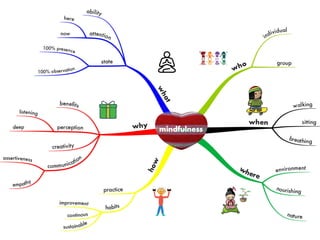
Improving the quality of our attention,
we can reach a state of 100% presence
and 100% observation,
which means mindfulness
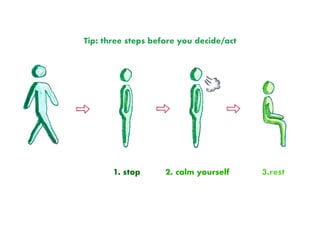
1. stop 2. calm yourself 3.rest
Tip: three steps before you decide/act
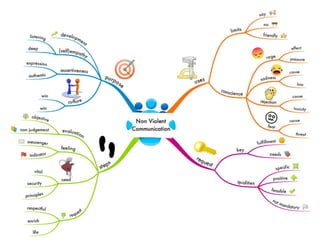
Non Violent Communication promotes
comprehension of oneself and others
through authenticity and empathy.
The aim is to develop relationships
within a win-win culture
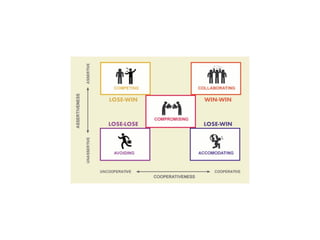
WIN-WIN
LOSE-WIN
LOSE-WIN
LOSE-LOSE
Empathy enables us to connect with
the other person’s point of view. The
word comes from a Greek word
meaning “perceive the subjective
experience of someone”
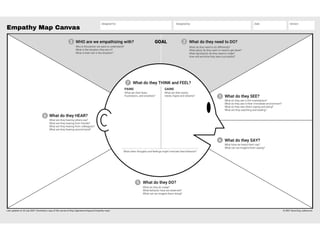
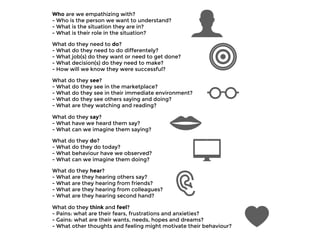
Who are we empathizing with?

- Who is the person we want to understand?

- What is the situation they are in?

- What is their role in the situation?
What do they need to do?

- What do they need to do differentely?

- What job(s) do they want or need to get done?

- What decision(s) do they need to make?

- How will we know they were successful?
What do they see? 

- What do they see in the marketplace?

- What do they see in their immediate environment?

- What do they see others saying and doing?

- What are they watching and reading?
What do they say?

- What have we heard them say?

- What can we imagine them saying?
What do they do?

- What do they do today?

- What behaviour have we observed?

- What can we imagine them doing?
What do they hear?

- What are they hearing others say?

- What are they hearing from friends?

- What are they hearing from colleagues?

- What are they hearing second hand?
What do they think and feel?

- Pains: what are their fears, frustrations and anxieties?

- Gains: what are their wants, needs, hopes and dreams?

- What other thoughts and feeling might motivate their behaviour?
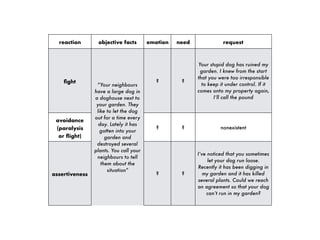
If we connect with our needs and we express
them in a respectful way (without judging,
reproaches, or aggression), we are being
assertive and this increases the probability that
these needs will be listened to and satisfied.
reaction objective facts emotion need request
fight
“Your neighbours
have a large dog in
a doghouse next to
your garden. They
like to let the dog
out for a time every
day. Lately it has
gotten into your
garden and
destroyed several
plants. You call your
neighbours to tell
them about the
situation”
? ?
Your stupid dog has ruined my
garden. I knew from the start
that you were too irresponsible
to keep it under control. If it
comes onto my property again,
I’ll call the pound
avoidance
(paralysis
or flight)
? ? nonexistent
assertiveness ? ?
I’ve noticed that you sometimes
let your dog run loose.
Recently it has been digging in
my garden and it has killed
several plants. Could we reach
an agreement so that your dog
can’t run in my garden?
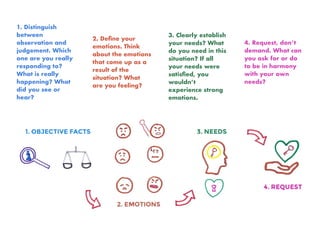
4. Request, don’t
demand. What can
you ask for or do
to be in harmony
with your own
needs?
3. Clearly establish
your needs? What
do you need in this
situation? If all
your needs were
satisfied, you
wouldn’t
experience strong
emotions.
1. Distinguish
between
observation and
judgement. Which
one are you really
responding to?
What is really
happening? What
did you see or
hear?
2. Define your
emotions. Think
about the emotions
that come up as a
result of the
situation? What
are you feeling?
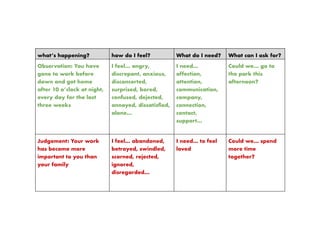
what’s happening? how do I feel? What do I need? What can I ask for?
Observation: You have
gone to work before
dawn and got home
after 10 o’clock at night,
every day for the last
three weeks
I feel… angry,
discrepant, anxious,
disconcerted,
surprised, bored,
confused, dejected,
annoyed, dissatisfied,
alone...
I need…
affection,
attention,
communication,
company,
connection,
contact,
support...
Could we… go to
the park this
afternoon?
Judgement: Your work
has become more
important to you than
your family
I feel… abandoned,
betrayed, swindled,
scorned, rejected,
ignored,
disregarded...
I need… to feel
loved
Could we… spend
more time
together?
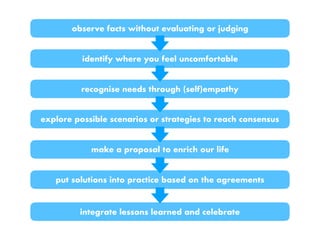
integrate lessons learned and celebrate
observe facts without evaluating or judging
identify where you feel uncomfortable
recognise needs through (self)empathy
make a proposal to enrich our life
explore possible scenarios or strategies to reach consensus
put solutions into practice based on the agreements
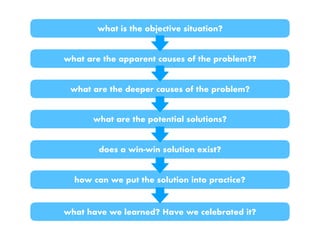
what have we learned? Have we celebrated it?
what is the objective situation?
what are the apparent causes of the problem??
what are the deeper causes of the problem?
does a win-win solution exist?
what are the potential solutions?
how can we put the solution into practice?
credits & additional references:
• How to meditate in a moment by Martin Boroson in youtube
• Atlas of emotions
• Thomas-Kilmann Conflict Mode Instrument
• Empathy Map - Gamestorming
• The basics of Non Violent Communication by Marshall B. Rosenberg in youtube
gratitude:
Thank you very much to my family, friends and teachers cause they help me to improve
Xavier Santotomás Mena
facilitador de proyectos
xsantotomas@gmail.com
+34 651 55 77 54
Me dedico a la facilitación de proyectos
que tienen en su centro un ganar inclusivo:
el desarrollo como persona, la creación de
comunidad alrededor del proyecto y la
regeneración del entorno medioambiental.
Asimismo me encanta dibujar, crear
historias y todo tipo de contenidos que
faciliten la comprensión del desarrollo de
los proyectos
http://pistascreativas.net
You are free to:
Share — copy and redistribute the material in any medium or format
Adapt — remix, transform, and build upon the material
Under the following terms:
Attribution — You must give appropriate credit, provide a link to the license,
and indicate if changes were made. You may do so in any reasonable manner,
but not in any way that suggests the licensor endorses you or your use.
NonCommercial — You may not use the material for commercial purposes
ShareAlike — If you remix, transform, or build upon the material, you must
distribute your contributions under the same license as the original
http://creativecommons.org/licenses/by-nc-sa/3.0/

how to improve our relationships using win win communication

  • 1.
    how to improveour relationships using win win communication 
  • 2.
    Improving the qualityof our attention, we can reach a state of 100% presence and 100% observation, which means mindfulness
  • 4.
    1. stop 2.calm yourself 3.rest Tip: three steps before you decide/act
  • 5.
    Non Violent Communicationpromotes comprehension of oneself and others through authenticity and empathy. The aim is to develop relationships within a win-win culture
  • 6.
  • 7.
    Empathy enables usto connect with the other person’s point of view. The word comes from a Greek word meaning “perceive the subjective experience of someone”
  • 10.
    Who are weempathizing with?
 - Who is the person we want to understand?
 - What is the situation they are in?
 - What is their role in the situation? What do they need to do?
 - What do they need to do differentely?
 - What job(s) do they want or need to get done?
 - What decision(s) do they need to make?
 - How will we know they were successful? What do they see? 
 - What do they see in the marketplace?
 - What do they see in their immediate environment?
 - What do they see others saying and doing?
 - What are they watching and reading? What do they say?
 - What have we heard them say?
 - What can we imagine them saying? What do they do?
 - What do they do today?
 - What behaviour have we observed?
 - What can we imagine them doing? What do they hear?
 - What are they hearing others say?
 - What are they hearing from friends?
 - What are they hearing from colleagues?
 - What are they hearing second hand? What do they think and feel?
 - Pains: what are their fears, frustrations and anxieties?
 - Gains: what are their wants, needs, hopes and dreams?
 - What other thoughts and feeling might motivate their behaviour?
  • 11.
    If we connectwith our needs and we express them in a respectful way (without judging, reproaches, or aggression), we are being assertive and this increases the probability that these needs will be listened to and satisfied.
  • 13.
    reaction objective factsemotion need request fight “Your neighbours have a large dog in a doghouse next to your garden. They like to let the dog out for a time every day. Lately it has gotten into your garden and destroyed several plants. You call your neighbours to tell them about the situation” ? ? Your stupid dog has ruined my garden. I knew from the start that you were too irresponsible to keep it under control. If it comes onto my property again, I’ll call the pound avoidance (paralysis or flight) ? ? nonexistent assertiveness ? ? I’ve noticed that you sometimes let your dog run loose. Recently it has been digging in my garden and it has killed several plants. Could we reach an agreement so that your dog can’t run in my garden?
  • 14.
    4. Request, don’t demand.What can you ask for or do to be in harmony with your own needs? 3. Clearly establish your needs? What do you need in this situation? If all your needs were satisfied, you wouldn’t experience strong emotions. 1. Distinguish between observation and judgement. Which one are you really responding to? What is really happening? What did you see or hear? 2. Define your emotions. Think about the emotions that come up as a result of the situation? What are you feeling?
  • 15.
    what’s happening? howdo I feel? What do I need? What can I ask for? Observation: You have gone to work before dawn and got home after 10 o’clock at night, every day for the last three weeks I feel… angry, discrepant, anxious, disconcerted, surprised, bored, confused, dejected, annoyed, dissatisfied, alone... I need… affection, attention, communication, company, connection, contact, support... Could we… go to the park this afternoon? Judgement: Your work has become more important to you than your family I feel… abandoned, betrayed, swindled, scorned, rejected, ignored, disregarded... I need… to feel loved Could we… spend more time together?
  • 16.
    integrate lessons learnedand celebrate observe facts without evaluating or judging identify where you feel uncomfortable recognise needs through (self)empathy make a proposal to enrich our life explore possible scenarios or strategies to reach consensus put solutions into practice based on the agreements
  • 17.
    what have welearned? Have we celebrated it? what is the objective situation? what are the apparent causes of the problem?? what are the deeper causes of the problem? does a win-win solution exist? what are the potential solutions? how can we put the solution into practice?
  • 18.
    credits & additionalreferences: • How to meditate in a moment by Martin Boroson in youtube • Atlas of emotions • Thomas-Kilmann Conflict Mode Instrument • Empathy Map - Gamestorming • The basics of Non Violent Communication by Marshall B. Rosenberg in youtube gratitude: Thank you very much to my family, friends and teachers cause they help me to improve
  • 19.
    Xavier Santotomás Mena facilitadorde proyectos xsantotomas@gmail.com +34 651 55 77 54 Me dedico a la facilitación de proyectos que tienen en su centro un ganar inclusivo: el desarrollo como persona, la creación de comunidad alrededor del proyecto y la regeneración del entorno medioambiental. Asimismo me encanta dibujar, crear historias y todo tipo de contenidos que faciliten la comprensión del desarrollo de los proyectos http://pistascreativas.net
  • 20.
    You are freeto: Share — copy and redistribute the material in any medium or format Adapt — remix, transform, and build upon the material Under the following terms: Attribution — You must give appropriate credit, provide a link to the license, and indicate if changes were made. You may do so in any reasonable manner, but not in any way that suggests the licensor endorses you or your use. NonCommercial — You may not use the material for commercial purposes ShareAlike — If you remix, transform, or build upon the material, you must distribute your contributions under the same license as the original http://creativecommons.org/licenses/by-nc-sa/3.0/