PSYCHOSOCI
AL SUPPORT
FOR SCHOOL
PERSONNEL
What does psychosocial mean?
Psychosocial refers to “the dynamic relationship
between the psychological and social dimension
of a person, where the one influences the other”
The psychological aspects of development refer
to an individual’s thoughts, emotions,
behaviours, memories, perceptions, and
understanding. The social aspects of
development refer to the interaction and
relationships among the individual, family, peers,
and community
What is psychosocial support?
Psychosocial support, or “PSS”, refers to
the “processes and actions that promote
the holistic wellbeing of people in their
social world. It includes support provided
by family and friends” (INEE, 2010). PSS
aims to help individuals recover after a
crisis has disrupted their lives and to
enhance their ability to return to normality
after experiencing adverse events.
What is psychosocial support for
teachers?
It comprises basic
psychological first aid skills
development, creative tools for
stress management, an
overview of important life skills
for pupils and some of the
general principles of
psychosocial support.
Isang dosenang "S" para
IWAS STRESS:
1. SPEAK TO ME
-Talk someone when you feel overwhelmed or
unable to deal with stress on your own. Venting can
help you unload feelings.
2. SOUNDS AND SONGS
-Listen to relaxing and soothing music. It can relieve
depression and increase self-esteem.
3. SENSATION TECHNIQUE (Massage)
-Indulge yourself with a whole body massage. It
helps to soothe away stress unknotting tense and
aching muscles, relieve headache and sleep
problems.
4. SPIRITUALITY
-Devote time to connect with yourself and
to God, try meditation five to ten minutes
each day and pray Him for guidance.
5.SPORTS
-Engage in playing sports like basketball,
tennis, etc. to clear your mind and release
stress.
6. STRESS DEBREIFING
-Submit oneself to brief crisis intervention
to talk about ones feeling and reactions to
the critical incidents.
7. SELF-AWARENESS
-Develop that the habit of paying attention to your
expressions of though, emotions, and behaviour,
knowing yourself, getting in touch with your feeling,
or being open to experience, the more you know
about yourself the better you are at adapting life
changes that suit your needs.
8. SCHEDULING (TIME MANAGEMENT)
-Optimize the time available to achieve gratifying
results. Use time manager application or buy some
notebook organizer.
9. SIESTA
-Take a nap, short rest, a break or recharge
"yourself" to improve productivity. It also help relax
the mind and body muscles.
10. STRETCHING
-Do simple movements to loosen muscles,
lubricate joint increase body's oxygen
supply.
11. SOCIALS
-Engage in fruitful activities that develop
your ability to deal with other people.
12. SMILE
-Smile ka naman to release stress, calm
you down, make you attractive, and make
someone else happy. Remember, your
smile is the signature of your personality...
What are the 5 principles of
psychosocial support?
(1) a sense of safety
 (2) calming
(3) self- and community
efficacy
(4) social connectedness
 (5) hope
Why do we need psychosocial support
in schools?
Providing PSS in
education enhances
academic learning,
helping students to
develop coping skills in
the face of adversity.
What are the seven psychosocial
support?
 biological,
 emotional,
 spiritual,
 cultural,
 social,
 mental
 material aspects of experience
What is the purpose of psychosocial
support?
 To addresses a person's
emotional, social, mental and
spiritual needs – all essential
elements of positive human
development. Psychosocial
support builds internal and
external resources for children
and their families to cope with
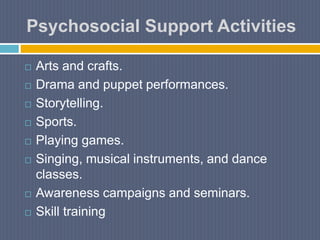
Psychosocial Support Activities
 Arts and crafts.
 Drama and puppet performances.
 Storytelling.
 Sports.
 Playing games.
 Singing, musical instruments, and dance
classes.
 Awareness campaigns and seminars.
 Skill training
YOU FOR
YOUR
SUPPORT
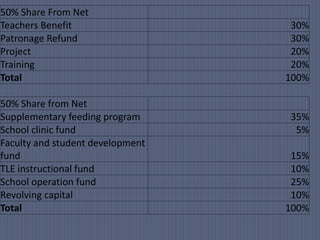
50% Share From Net
Teachers Benefit 30%
Patronage Refund 30%
Project 20%
Training 20%
Total 100%
50% Share from Net
Supplementary feeding program 35%
School clinic fund 5%
Faculty and student development
fund 15%
TLE instructional fund 10%
School operation fund 25%
Revolving capital 10%
Total 100%
MEMBERS
1 Ricel Adiwang 2500
2 Romelyn Balbido 2500
3 Nancy Dominguez 2500
4 Maricel Dulay 2500
5 Renante Maneja 2500
7 Richard Esguerra 2000
8 Nelson Versoza 2000
9 Estrina Miguel 2000
10 Estrella Manzano 2000
12 Diana Rose Pacelo 2000

psychosocial support.pptx

  • 1.
  • 2.
    What does psychosocialmean? Psychosocial refers to “the dynamic relationship between the psychological and social dimension of a person, where the one influences the other” The psychological aspects of development refer to an individual’s thoughts, emotions, behaviours, memories, perceptions, and understanding. The social aspects of development refer to the interaction and relationships among the individual, family, peers, and community
  • 3.
    What is psychosocialsupport? Psychosocial support, or “PSS”, refers to the “processes and actions that promote the holistic wellbeing of people in their social world. It includes support provided by family and friends” (INEE, 2010). PSS aims to help individuals recover after a crisis has disrupted their lives and to enhance their ability to return to normality after experiencing adverse events.
  • 4.
    What is psychosocialsupport for teachers? It comprises basic psychological first aid skills development, creative tools for stress management, an overview of important life skills for pupils and some of the general principles of psychosocial support.
  • 5.
    Isang dosenang "S"para IWAS STRESS: 1. SPEAK TO ME -Talk someone when you feel overwhelmed or unable to deal with stress on your own. Venting can help you unload feelings. 2. SOUNDS AND SONGS -Listen to relaxing and soothing music. It can relieve depression and increase self-esteem. 3. SENSATION TECHNIQUE (Massage) -Indulge yourself with a whole body massage. It helps to soothe away stress unknotting tense and aching muscles, relieve headache and sleep problems.
  • 6.
    4. SPIRITUALITY -Devote timeto connect with yourself and to God, try meditation five to ten minutes each day and pray Him for guidance. 5.SPORTS -Engage in playing sports like basketball, tennis, etc. to clear your mind and release stress. 6. STRESS DEBREIFING -Submit oneself to brief crisis intervention to talk about ones feeling and reactions to the critical incidents.
  • 7.
    7. SELF-AWARENESS -Develop thatthe habit of paying attention to your expressions of though, emotions, and behaviour, knowing yourself, getting in touch with your feeling, or being open to experience, the more you know about yourself the better you are at adapting life changes that suit your needs. 8. SCHEDULING (TIME MANAGEMENT) -Optimize the time available to achieve gratifying results. Use time manager application or buy some notebook organizer. 9. SIESTA -Take a nap, short rest, a break or recharge "yourself" to improve productivity. It also help relax the mind and body muscles.
  • 8.
    10. STRETCHING -Do simplemovements to loosen muscles, lubricate joint increase body's oxygen supply. 11. SOCIALS -Engage in fruitful activities that develop your ability to deal with other people. 12. SMILE -Smile ka naman to release stress, calm you down, make you attractive, and make someone else happy. Remember, your smile is the signature of your personality...
  • 9.
    What are the5 principles of psychosocial support? (1) a sense of safety  (2) calming (3) self- and community efficacy (4) social connectedness  (5) hope
  • 10.
    Why do weneed psychosocial support in schools? Providing PSS in education enhances academic learning, helping students to develop coping skills in the face of adversity.
  • 11.
    What are theseven psychosocial support?  biological,  emotional,  spiritual,  cultural,  social,  mental  material aspects of experience
  • 12.
    What is thepurpose of psychosocial support?  To addresses a person's emotional, social, mental and spiritual needs – all essential elements of positive human development. Psychosocial support builds internal and external resources for children and their families to cope with
  • 13.
    Psychosocial Support Activities Arts and crafts.  Drama and puppet performances.  Storytelling.  Sports.  Playing games.  Singing, musical instruments, and dance classes.  Awareness campaigns and seminars.  Skill training
  • 17.
  • 18.
    50% Share FromNet Teachers Benefit 30% Patronage Refund 30% Project 20% Training 20% Total 100% 50% Share from Net Supplementary feeding program 35% School clinic fund 5% Faculty and student development fund 15% TLE instructional fund 10% School operation fund 25% Revolving capital 10% Total 100%
  • 19.
    MEMBERS 1 Ricel Adiwang2500 2 Romelyn Balbido 2500 3 Nancy Dominguez 2500 4 Maricel Dulay 2500 5 Renante Maneja 2500 7 Richard Esguerra 2000 8 Nelson Versoza 2000 9 Estrina Miguel 2000 10 Estrella Manzano 2000 12 Diana Rose Pacelo 2000