Amr Hassan, M.D.
Lecturer of Neurology - Cairo University
June 2014Alexandria -
Pediatric Multiple Sclerosis:
Is it just an earlier onset ??
Pediatric Multiple Sclerosis
Is it just an earlier onset ??
Agenda
Pediatric Multiple Sclerosis
• Definition.
• Epidemiology .
• Risk factors.
• Pathophysiology .
• Investigations
• Clinical features and differential diagnosis.
• Treatment.
Agenda
Pediatric Multiple Sclerosis
• Definition.
• Epidemiology .
• Risk factors.
• Pathophysiology .
• Investigations
• Clinical features and differential diagnosis.
• Treatment.
Definition
• The term “ pediatric MS ” is applied to
children with MS (< 10 years of age) and
adolescents ( < 18 years of age).
Agenda
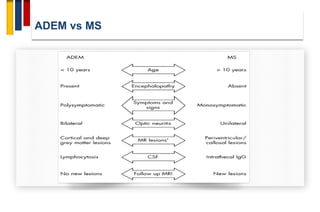
Pediatric Multiple Sclerosis
• Definition.
• Epidemiology .
• Risk factors.
• Pathophysiology .
• Investigations
• Clinical features and differential diagnosis.
• Treatment.
Agenda
Pediatric Multiple Sclerosis
• Definition.
• Epidemiology .
• Risk factors.
• Pathophysiology .
• Investigations
• Clinical features and differential diagnosis.
• Treatment.
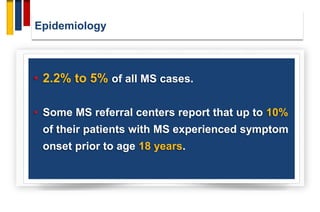
Epidemiology
• 2.2% to 5% of all MS cases.
• Some MS referral centers report that up to 10%
of their patients with MS experienced symptom
onset prior to age 18 years.
Epidemiology
Age
• Within the pediatric age group, the
incidence is highest in those between 13
and 16 years of age.
• A small, but important, subgroup is younger
than 10 years of age.
Epidemiology
Gender
Banwell B, Ghezzi A, Bar-Or A, Mikaeloff Y, Tardieu M. Multiple sclerosis in children: clinical diagnosis, therapeutic strategies,
and future directions. Lancet Neurology. 2007;6(10):887–902.
• However, for those > 10 years of
age:
Female-to-male ratio ranges from
0.8:1 in children younger than 6
years of age to 1.6:1 in patients
between 6 and 10 years of age
Epidemiology
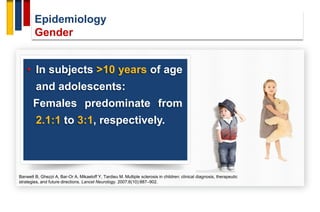
Gender
• In subjects <10 years of age
and adolescents:
Females predominate from
2.1:1 to 3:1, respectively.
Banwell B, Ghezzi A, Bar-Or A, Mikaeloff Y, Tardieu M. Multiple sclerosis in children: clinical diagnosis, therapeutic
strategies, and future directions. Lancet Neurology. 2007;6(10):887–902.
Epidemiology
Race
0
2
4
6
8
All Case
n=81
White
n=15
Hispanic
n=40
Black
n=16
Asian/PI
n=10
MS+ADS
Other ADS
MS
Per100,000person-years
Neurology. Sep 20, 2011; 77(12): 1143–1148.
Agenda
Pediatric Multiple Sclerosis
• Definition.
• Epidemiology .
• Risk factors.
• Pathophysiology .
• Investigations
• Clinical features and differential diagnosis.
• Treatment.
Agenda
Pediatric Multiple Sclerosis
• Definition.
• Epidemiology .
• Risk factors.
• Pathophysiology .
• Investigations
• Clinical features and differential diagnosis.
• Treatment.
Risk Factors
• A few studies have evaluated genetic risk
factors in pediatric MS.
• The US Pediatric MS Network has also
reported that HLA-DRB1, as in adult MS, may
be a risk factor for pediatric MS.
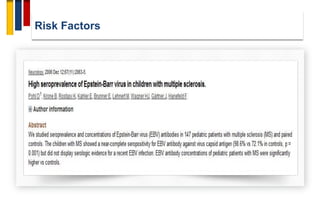
Risk Factors
Results: Obesity was associated with a significantly
increased risk of MS/CIS in girls (p = 0.005 for trend) but
not in boys (p = 0.93).
Conclusion: childhood obesity epidemic is likely to lead
to increased morbidity from MS/CIS, particularly in
adolescent girls.
Risk Factors
Association between weight class and pediatric multiple sclerosis/clinically isolated syndrome by sex Depicted are
the adjusted odds ratios (OR) and 95% confidence intervals (CI) of pediatric multiple sclerosis and clinically isolated
syndrome (MS/CIS) with increasing weight class compared with normal/underweight children (reference category) stratified
by sex. Increasing weight class was associated with increasingly higher OR for MS/CIS among girls (p for trend <0.005) but
not boys (p for trend 0.93). OR are adjusted for age at onset and race/ethnicity.
Risk Factors
• Interestingly, the risk of childhood-
onset MS as related to exposure to
passive smoking.
• The relative risk for a first episode
of MS was found to be over twice
that in the control population and
was even higher in those with
prolonged exposure (≥10 years).
Mikaeloff Y, Caridade G, Assi S, Tardieu M, Suissa S. Hepatitis B vaccine and risk of relapse after a first childhood episode of CNS inflammatory
demyelination. Brain. 2007;130(part 4):1105–1110.
Risk Factors
Risk Factors
Risk Factors
• Conclusions: These results indicate no association between
hepatitis B vaccination and the development of multiple sclerosis
Risk Factors
• Conclusion:
Lower serum 25-hydroxyvitamin D(3) levels are
associated with a subsequent relapse rate in pediatric-
onset MS or CIS.
Agenda
Pediatric Multiple Sclerosis
• Definition.
• Epidemiology .
• Risk factors.
• Pathophysiology .
• Investigations
• Clinical features and differential diagnosis.
• Treatment.
Agenda
Pediatric Multiple Sclerosis
• Definition.
• Epidemiology .
• Risk factors.
• Pathophysiology .
• Investigations
• Clinical features and differential diagnosis.
• Treatment.
Pathophysiology
• Axonal damage is typically limited
• Dense accumulation of lymphocytes and
macrophages in a prominent
perivascular distribution, with rare B
cells.
Pathophysiology
• Anti–myelin oligodendrocyte glycoprotein
(MOG) and anti–myelin basic protein (MBP)
have been studied in both adults and
children.
• In children, these anti-myelin antibodies
seem to be associated with encephalopathy
at onset.
Pathophysiology
• Lesser intrathecal antibody production (OCBs
or an elevated IgG index).
• Higher percentage of neutrophils in their CSF.
Prominent activation of the innate immune response, as opposed to
the typical activation of the adaptive response seen in older
patients.
Agenda
Pediatric Multiple Sclerosis
• Definition.
• Epidemiology .
• Risk factors.
• Pathophysiology .
• Investigations
• Clinical features and differential diagnosis.
• Treatment.
Agenda
Pediatric Multiple Sclerosis
• Definition.
• Epidemiology .
• Risk factors.
• Pathophysiology .
• Investigations
• Clinical features and differential diagnosis.
• Treatment.
Clinical Features and Differential Diagnosis
• Polysymptomatic (50–70%)
• Monosymptomatic (30–50%)
• Approximately 15 to 20% of pediatric MS patients,
most aged <11 years, present with encephalopathy
and multifocal neurological deficits difficult to
distinguish from acute disseminated
encephalomyelitis (ADEM).
ADEM vs MS
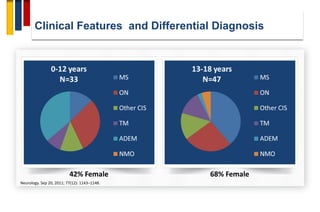
Clinical Features and Differential Diagnosis
Neurology. Sep 20, 2011; 77(12): 1143–1148.
Clinical Features and Differential Diagnosis
Pediatric Clinically Isolated Syndrome (CIS)
• A monofocal or polyfocal clinical neurological event with
presumed inflammatory demyelinating cause.
• Absence of encephalopathy that cannot be explained by
fever.
• Absence of previous clinical history of CNS demyelinating
disease.
• Other etiologies have been excluded.
• The most recent 2010 revised MS McDonald criteria on a
baseline MRI are not met.
Autoimmune Dis. 2013; 2013: 673947.
Clinical Features and Differential Diagnosis
Monophasic ADEM
• A first polyfocal clinical neurological event with presumed
inflammatory cause.
Multiphasic ADEM
• A new event of ADEM three months or more after the initial event.
• Can be associated with new or reemergence of prior clinical and MRI
findings.
• Timing in relation to steroids is no longer relevant.
• Encephalopathy that cannot be explained by fever is present.
• No new symptoms, signs, or MRI findings after three months of the
incident ADEM.
Autoimmune Dis. 2013; 2013: 673947.
Clinical Features and Differential Diagnosis
Pediatric Multiple Sclerosis
• Two or more clinical events separated by more than 30
days and involving more than one area of the CNS.
• A single clinical event plus a baseline MRI evidence for
DIS and DIT that meets the recent 2010 revised McDonald
criteria.
• ADEM followed more than three months later by a
nonencephalopathic clinical event with new lesions on
brain MRI consistent with MS.
Autoimmune Dis. 2013; 2013: 673947.
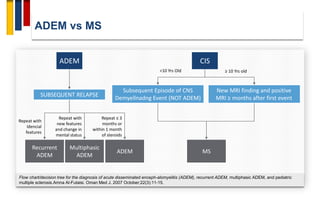
ADEM vs MS
Flow chart/decision tree for the diagnosis of acute disseminated enceph-alomyelitis (ADEM), recurrent ADEM, multiphasic ADEM, and pediatric
multiple sclerosis.Amna Al-Futaisi. Oman Med J. 2007 October;22(3):11-15.
ADEM
SUBSEQUENT RELAPSE
CIS
Subsequent Episode of CNS
Demyellnadng Event (NOT ADEM)
New MRI finding and positive
MRI ≥ months after first event
Recurrent
ADEM
Multiphasic
ADEM
ADEM MS
Repeat with
Idencial
features
Repeat with
new features
and change in
mental status
<10 Yrs Old ≥ 10 Yrs old
Repeat ≤ 3
months or
within 1 month
of steroids
Optic Neuritis
• The risk of developing MS after having an isolated
episode of ON in childhood has been reported to
range between 10% and 56%.
Bigi S, Banwell B. Pediatric multiple sclerosis. Journal of Child Neurology. 2012;27(11):1378–1383.
Optic Neuritis
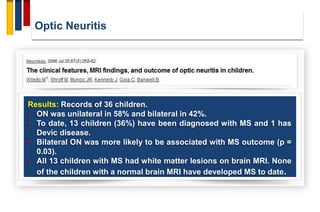
Results: Records of 36 children.
• ON was unilateral in 58% and bilateral in 42%.
• To date, 13 children (36%) have been diagnosed with MS and 1 has
Devic disease.
• Bilateral ON was more likely to be associated with MS outcome (p =
0.03).
• All 13 children with MS had white matter lesions on brain MRI. None
of the children with a normal brain MRI have developed MS to date.
Optic Neuritis
• Alper and Wang reported that 23% of pediatric
patients with ON eventually developed MS within
6 years in their study and found a strong
correlation between a normal MRI and a
monophasic clinical presentation.
• For example, MS was diagnosed in 42% of
children with an abnormal MRI, whereas 93% of
children with normal MRIs remained relapse-free.
Alper G, Wang L. Demyelinating optic neuritis in children. Journal of Child Neurology. 2009;24(1):45–48.
Patients with abnormal MRI
Alper G, Wang L. Demyelinating optic neuritis in children. Journal of Child Neurology. 2009;24(1):45–48.
Clinical outcome
in patients only
with abnormal
magnetic
resonance imaging
(MRI) of brain
according to
monosyptomatic
or
polysymptomatic
presentation
(p=0.015)
Transverse Myelitis
In the Canadian prospective study:
• 21% of the children with ADS presented with acute TM.
• TM was the first clinical event in approximately 10% of
children with MS .
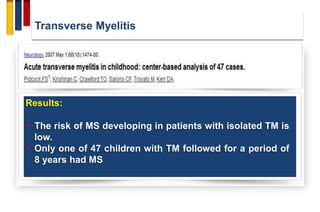
Transverse Myelitis
Results:
• The risk of MS developing in patients with isolated TM is
low.
• Only one of 47 children with TM followed for a period of
8 years had MS
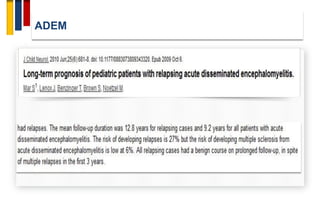
ADEM
• Some studies have suggested that 18% to 29% of
patients with ADEM as their first demyelinating attack
progress to MS.
ADEM
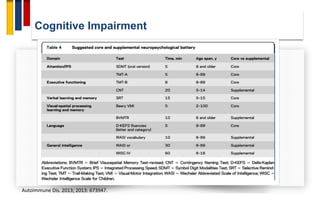
Cognitive Impairment
• Approximately one-third of children and adolescents
with MS experience cognitive impairment.
• Defined as “having at least one-third of completed test
scores falling ≥1 SD or more below published normative
data”
Cognitive Impairment
Areas of cognitive deficit can vary but often include
• Attention and speeded processing.
• Visuomotor functions.
• Memory.
• Receptive language and verbal fluency.
Cognitive Impairment
Autoimmune Dis. 2013; 2013: 673947.
Diagnostic Categories to Exclude in Pediatric
Multiple Sclerosis
Vascular/Inflammatory Disease
• CNS vasculitis/childhood primary CNS angiitis,
• Stroke,
• CADASIL,
• Autoimmune disease: systemic lupus erythematous, antiphospholipid antibody syndrome,
neurosarcoidosis, Sjogren's syndrome,
• Migraine.
Metabolic/Nutritional
• Mitochondrial encephalopathy,
• Leukodystrophies,
• B12 or folate deficiency.
CNS Infection
• Neuroborreliosis,
• Herpes simplex encephalitis,
• Influenza ANE,
• Viral encephalitis.
Malignancy
• Lymphoma,
• Astrocytoma.
Agenda
Pediatric Multiple Sclerosis
• Definition.
• Epidemiology .
• Risk factors.
• Pathophysiology .
• Investigations
• Clinical features and differential diagnosis.
• Treatment.
Agenda
Pediatric Multiple Sclerosis
• Definition.
• Epidemiology .
• Risk factors.
• Pathophysiology .
• Investigations
• Clinical features and differential diagnosis.
• Treatment.
MRI
In the prospective cohort study by Sadaka et al., the
2010 revised McDonald criteria:
• High Sensitivity (100%)
• Specificity (86%)
• Positive Predictive Value (76%)
• Negative Predictive Value (100%)
for children <12 years with non-ADEM presentations.
MRI
In younger children
• These criteria are of less predictive value
• Not appropriate for application in the context of ADEM-
like presentations.
MRI
Results:
The presence of at least two of the following
• five or more lesions
• two or more periventricular lesions.
• one brainstem lesion
Can distinguished MS from other nondemyelinating
disease controls with 85% sensitivity and 98%
specificity.
MRI
Most patients with ADEM show
(a) A diffuse bilateral pattern
(b) Absence of black holes
(c) Fewer than two PV lesions
(sensitivity 81%,
specificity 95%).
CSF
• Variable depending on the child's age.
• Age of the patient exerts a modifying effect on the CSF
cellular profile.
• More neutrophils in the CSF
OCB
• In some cases, OCB initially can be negative and
detected only later in the course of the disease.
• It has been reported that positive OCB may be found in
29% of patients with ADEM.
OCB
• Mikaeloff et al found that 94% of children with positive
OCB went on to develop MS.
• Moreover, only 40% of patients with definitive diagnosis
of MS had oligoclonal bands.
• These results suggest that OCB have low sensitivity but
high specificity for the development of MS.
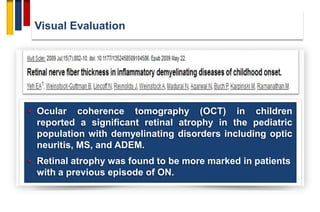
Visual Evaluation
• Ocular coherence tomography (OCT) in children
reported a significant retinal atrophy in the pediatric
population with demyelinating disorders including optic
neuritis, MS, and ADEM.
• Retinal atrophy was found to be more marked in patients
with a previous episode of ON.
Agenda
Pediatric Multiple Sclerosis
• Definition.
• Epidemiology .
• Risk factors.
• Pathophysiology .
• Investigations
• Clinical features and differential diagnosis.
• Treatment.
Agenda
Pediatric Multiple Sclerosis
• Definition.
• Epidemiology .
• Risk factors.
• Pathophysiology .
• Investigations
• Clinical features and differential diagnosis.
• Treatment.
Treatment of an attack
• IV methyl prednisolone 20–30mg/kg (maximum 1g daily)
for 3−5 days.
• Possible need for an oral taper.
• If there is an incomplete response or in case of a
severe attack, intravenous immune globulin (IVIG) at
0.4g/kg/day for 5 days or plasmapheresis should be
considered.
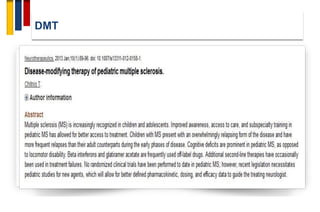
DMT
DMT
DMT
First-line therapies include
1. Intramuscular interferon (IFN)-b1a (300mcg once a
week)
2. Subcutaneous IFN b-1a (22 or 44mcg 3 times a week)
3. Subcutaneous ifn-b1 b (0.25mg every other day)
4. Glatiramer acetate (20mg/day) .
DMT
When to switch therapies?
1. Minimum time of full dose therapy of 6 months and
2. Full medication adherence and one of the following:
(a) increase or no reduction in the relapse rate or new T2
or enhancing lesion on MRI as compared to previous
treatment or
(b) ≥2 confirmed MRI or clinical relapses within a 12-
month period
DMT for refractory pediatric MS
Conclusions
• Natalizumab treatment was effective and well tolerated
in our pediatric patients with RRMS who did not
respond to initial immunomodulatory treatments.
• Therefore, it is a promising second-line therapy for
pediatric patients with RRMS.
DMT for refractory pediatric MS
Results
• Reductions in annualized relapse rates and contrast-
enhancing lesions.
• Reduction or stabilization of Expanded Disability Status
Scale scores in each patient.
DMT for refractory pediatric MS
Results
• Reductions in mean annualized relapse rates (3.7
without treatment vs 0.4 with treatment; P < .001),
median EDSS (2 without treatment vs 1 with treatment; P
< .02), and mean number of new T2/FLAIR lesions per
year (7.8 without treatment vs 0.5 with treatment; P <
.001).
DMT for refractory pediatric MS
Results
• After the discontinuation of natalizumab therapy, relapse
activity occurred in 6 of 8 patients within 6 months.
DMT for refractory pediatric MS
• Monoclonal antibody therapy (Natalizumab, daclizumab).
• Chemotherapeutic agents (Cyclophosphamide,
mitoxantrone).
• Oral medications with novel mechanisms of action
(Fingolimod, teriflunomide, and dimethyl fumarate).
Pediatric Multiple Sclerosis
Is it just an earlier onset ??
Pediatric Multiple Sclerosis
It is not just an earlier onset !
THANK YOU

Pediatric multiple sclerosis

  • 1.
    Amr Hassan, M.D. Lecturerof Neurology - Cairo University June 2014Alexandria - Pediatric Multiple Sclerosis: Is it just an earlier onset ??
  • 2.
    Pediatric Multiple Sclerosis Isit just an earlier onset ??
  • 3.
    Agenda Pediatric Multiple Sclerosis •Definition. • Epidemiology . • Risk factors. • Pathophysiology . • Investigations • Clinical features and differential diagnosis. • Treatment.
  • 4.
    Agenda Pediatric Multiple Sclerosis •Definition. • Epidemiology . • Risk factors. • Pathophysiology . • Investigations • Clinical features and differential diagnosis. • Treatment.
  • 5.
    Definition • The term“ pediatric MS ” is applied to children with MS (< 10 years of age) and adolescents ( < 18 years of age).
  • 6.
    Agenda Pediatric Multiple Sclerosis •Definition. • Epidemiology . • Risk factors. • Pathophysiology . • Investigations • Clinical features and differential diagnosis. • Treatment.
  • 7.
    Agenda Pediatric Multiple Sclerosis •Definition. • Epidemiology . • Risk factors. • Pathophysiology . • Investigations • Clinical features and differential diagnosis. • Treatment.
  • 8.
    Epidemiology • 2.2% to5% of all MS cases. • Some MS referral centers report that up to 10% of their patients with MS experienced symptom onset prior to age 18 years.
  • 9.
    Epidemiology Age • Within thepediatric age group, the incidence is highest in those between 13 and 16 years of age. • A small, but important, subgroup is younger than 10 years of age.
  • 10.
    Epidemiology Gender Banwell B, GhezziA, Bar-Or A, Mikaeloff Y, Tardieu M. Multiple sclerosis in children: clinical diagnosis, therapeutic strategies, and future directions. Lancet Neurology. 2007;6(10):887–902. • However, for those > 10 years of age: Female-to-male ratio ranges from 0.8:1 in children younger than 6 years of age to 1.6:1 in patients between 6 and 10 years of age
  • 11.
    Epidemiology Gender • In subjects<10 years of age and adolescents: Females predominate from 2.1:1 to 3:1, respectively. Banwell B, Ghezzi A, Bar-Or A, Mikaeloff Y, Tardieu M. Multiple sclerosis in children: clinical diagnosis, therapeutic strategies, and future directions. Lancet Neurology. 2007;6(10):887–902.
  • 12.
  • 13.
    Agenda Pediatric Multiple Sclerosis •Definition. • Epidemiology . • Risk factors. • Pathophysiology . • Investigations • Clinical features and differential diagnosis. • Treatment.
  • 14.
    Agenda Pediatric Multiple Sclerosis •Definition. • Epidemiology . • Risk factors. • Pathophysiology . • Investigations • Clinical features and differential diagnosis. • Treatment.
  • 15.
    Risk Factors • Afew studies have evaluated genetic risk factors in pediatric MS. • The US Pediatric MS Network has also reported that HLA-DRB1, as in adult MS, may be a risk factor for pediatric MS.
  • 16.
    Risk Factors Results: Obesitywas associated with a significantly increased risk of MS/CIS in girls (p = 0.005 for trend) but not in boys (p = 0.93). Conclusion: childhood obesity epidemic is likely to lead to increased morbidity from MS/CIS, particularly in adolescent girls.
  • 17.
    Risk Factors Association betweenweight class and pediatric multiple sclerosis/clinically isolated syndrome by sex Depicted are the adjusted odds ratios (OR) and 95% confidence intervals (CI) of pediatric multiple sclerosis and clinically isolated syndrome (MS/CIS) with increasing weight class compared with normal/underweight children (reference category) stratified by sex. Increasing weight class was associated with increasingly higher OR for MS/CIS among girls (p for trend <0.005) but not boys (p for trend 0.93). OR are adjusted for age at onset and race/ethnicity.
  • 18.
    Risk Factors • Interestingly,the risk of childhood- onset MS as related to exposure to passive smoking. • The relative risk for a first episode of MS was found to be over twice that in the control population and was even higher in those with prolonged exposure (≥10 years). Mikaeloff Y, Caridade G, Assi S, Tardieu M, Suissa S. Hepatitis B vaccine and risk of relapse after a first childhood episode of CNS inflammatory demyelination. Brain. 2007;130(part 4):1105–1110.
  • 19.
  • 20.
  • 21.
    Risk Factors • Conclusions:These results indicate no association between hepatitis B vaccination and the development of multiple sclerosis
  • 22.
    Risk Factors • Conclusion: Lowerserum 25-hydroxyvitamin D(3) levels are associated with a subsequent relapse rate in pediatric- onset MS or CIS.
  • 23.
    Agenda Pediatric Multiple Sclerosis •Definition. • Epidemiology . • Risk factors. • Pathophysiology . • Investigations • Clinical features and differential diagnosis. • Treatment.
  • 24.
    Agenda Pediatric Multiple Sclerosis •Definition. • Epidemiology . • Risk factors. • Pathophysiology . • Investigations • Clinical features and differential diagnosis. • Treatment.
  • 25.
    Pathophysiology • Axonal damageis typically limited • Dense accumulation of lymphocytes and macrophages in a prominent perivascular distribution, with rare B cells.
  • 26.
    Pathophysiology • Anti–myelin oligodendrocyteglycoprotein (MOG) and anti–myelin basic protein (MBP) have been studied in both adults and children. • In children, these anti-myelin antibodies seem to be associated with encephalopathy at onset.
  • 27.
    Pathophysiology • Lesser intrathecalantibody production (OCBs or an elevated IgG index). • Higher percentage of neutrophils in their CSF. Prominent activation of the innate immune response, as opposed to the typical activation of the adaptive response seen in older patients.
  • 28.
    Agenda Pediatric Multiple Sclerosis •Definition. • Epidemiology . • Risk factors. • Pathophysiology . • Investigations • Clinical features and differential diagnosis. • Treatment.
  • 29.
    Agenda Pediatric Multiple Sclerosis •Definition. • Epidemiology . • Risk factors. • Pathophysiology . • Investigations • Clinical features and differential diagnosis. • Treatment.
  • 30.
    Clinical Features andDifferential Diagnosis • Polysymptomatic (50–70%) • Monosymptomatic (30–50%) • Approximately 15 to 20% of pediatric MS patients, most aged <11 years, present with encephalopathy and multifocal neurological deficits difficult to distinguish from acute disseminated encephalomyelitis (ADEM).
  • 31.
  • 32.
    Clinical Features andDifferential Diagnosis Neurology. Sep 20, 2011; 77(12): 1143–1148.
  • 33.
    Clinical Features andDifferential Diagnosis Pediatric Clinically Isolated Syndrome (CIS) • A monofocal or polyfocal clinical neurological event with presumed inflammatory demyelinating cause. • Absence of encephalopathy that cannot be explained by fever. • Absence of previous clinical history of CNS demyelinating disease. • Other etiologies have been excluded. • The most recent 2010 revised MS McDonald criteria on a baseline MRI are not met. Autoimmune Dis. 2013; 2013: 673947.
  • 34.
    Clinical Features andDifferential Diagnosis Monophasic ADEM • A first polyfocal clinical neurological event with presumed inflammatory cause. Multiphasic ADEM • A new event of ADEM three months or more after the initial event. • Can be associated with new or reemergence of prior clinical and MRI findings. • Timing in relation to steroids is no longer relevant. • Encephalopathy that cannot be explained by fever is present. • No new symptoms, signs, or MRI findings after three months of the incident ADEM. Autoimmune Dis. 2013; 2013: 673947.
  • 35.
    Clinical Features andDifferential Diagnosis Pediatric Multiple Sclerosis • Two or more clinical events separated by more than 30 days and involving more than one area of the CNS. • A single clinical event plus a baseline MRI evidence for DIS and DIT that meets the recent 2010 revised McDonald criteria. • ADEM followed more than three months later by a nonencephalopathic clinical event with new lesions on brain MRI consistent with MS. Autoimmune Dis. 2013; 2013: 673947.
  • 36.
    ADEM vs MS Flowchart/decision tree for the diagnosis of acute disseminated enceph-alomyelitis (ADEM), recurrent ADEM, multiphasic ADEM, and pediatric multiple sclerosis.Amna Al-Futaisi. Oman Med J. 2007 October;22(3):11-15. ADEM SUBSEQUENT RELAPSE CIS Subsequent Episode of CNS Demyellnadng Event (NOT ADEM) New MRI finding and positive MRI ≥ months after first event Recurrent ADEM Multiphasic ADEM ADEM MS Repeat with Idencial features Repeat with new features and change in mental status <10 Yrs Old ≥ 10 Yrs old Repeat ≤ 3 months or within 1 month of steroids
  • 37.
    Optic Neuritis • Therisk of developing MS after having an isolated episode of ON in childhood has been reported to range between 10% and 56%. Bigi S, Banwell B. Pediatric multiple sclerosis. Journal of Child Neurology. 2012;27(11):1378–1383.
  • 38.
    Optic Neuritis Results: Recordsof 36 children. • ON was unilateral in 58% and bilateral in 42%. • To date, 13 children (36%) have been diagnosed with MS and 1 has Devic disease. • Bilateral ON was more likely to be associated with MS outcome (p = 0.03). • All 13 children with MS had white matter lesions on brain MRI. None of the children with a normal brain MRI have developed MS to date.
  • 39.
    Optic Neuritis • Alperand Wang reported that 23% of pediatric patients with ON eventually developed MS within 6 years in their study and found a strong correlation between a normal MRI and a monophasic clinical presentation. • For example, MS was diagnosed in 42% of children with an abnormal MRI, whereas 93% of children with normal MRIs remained relapse-free. Alper G, Wang L. Demyelinating optic neuritis in children. Journal of Child Neurology. 2009;24(1):45–48.
  • 40.
    Patients with abnormalMRI Alper G, Wang L. Demyelinating optic neuritis in children. Journal of Child Neurology. 2009;24(1):45–48. Clinical outcome in patients only with abnormal magnetic resonance imaging (MRI) of brain according to monosyptomatic or polysymptomatic presentation (p=0.015)
  • 41.
    Transverse Myelitis In theCanadian prospective study: • 21% of the children with ADS presented with acute TM. • TM was the first clinical event in approximately 10% of children with MS .
  • 42.
    Transverse Myelitis Results: • Therisk of MS developing in patients with isolated TM is low. • Only one of 47 children with TM followed for a period of 8 years had MS
  • 43.
    ADEM • Some studieshave suggested that 18% to 29% of patients with ADEM as their first demyelinating attack progress to MS.
  • 44.
  • 45.
    Cognitive Impairment • Approximatelyone-third of children and adolescents with MS experience cognitive impairment. • Defined as “having at least one-third of completed test scores falling ≥1 SD or more below published normative data”
  • 46.
  • 47.
  • 48.
  • 49.
    Cognitive Impairment Areas ofcognitive deficit can vary but often include • Attention and speeded processing. • Visuomotor functions. • Memory. • Receptive language and verbal fluency.
  • 50.
  • 51.
    Diagnostic Categories toExclude in Pediatric Multiple Sclerosis Vascular/Inflammatory Disease • CNS vasculitis/childhood primary CNS angiitis, • Stroke, • CADASIL, • Autoimmune disease: systemic lupus erythematous, antiphospholipid antibody syndrome, neurosarcoidosis, Sjogren's syndrome, • Migraine. Metabolic/Nutritional • Mitochondrial encephalopathy, • Leukodystrophies, • B12 or folate deficiency. CNS Infection • Neuroborreliosis, • Herpes simplex encephalitis, • Influenza ANE, • Viral encephalitis. Malignancy • Lymphoma, • Astrocytoma.
  • 52.
    Agenda Pediatric Multiple Sclerosis •Definition. • Epidemiology . • Risk factors. • Pathophysiology . • Investigations • Clinical features and differential diagnosis. • Treatment.
  • 53.
    Agenda Pediatric Multiple Sclerosis •Definition. • Epidemiology . • Risk factors. • Pathophysiology . • Investigations • Clinical features and differential diagnosis. • Treatment.
  • 54.
    MRI In the prospectivecohort study by Sadaka et al., the 2010 revised McDonald criteria: • High Sensitivity (100%) • Specificity (86%) • Positive Predictive Value (76%) • Negative Predictive Value (100%) for children <12 years with non-ADEM presentations.
  • 55.
    MRI In younger children •These criteria are of less predictive value • Not appropriate for application in the context of ADEM- like presentations.
  • 56.
    MRI Results: The presence ofat least two of the following • five or more lesions • two or more periventricular lesions. • one brainstem lesion Can distinguished MS from other nondemyelinating disease controls with 85% sensitivity and 98% specificity.
  • 57.
    MRI Most patients withADEM show (a) A diffuse bilateral pattern (b) Absence of black holes (c) Fewer than two PV lesions (sensitivity 81%, specificity 95%).
  • 58.
    CSF • Variable dependingon the child's age. • Age of the patient exerts a modifying effect on the CSF cellular profile. • More neutrophils in the CSF
  • 59.
    OCB • In somecases, OCB initially can be negative and detected only later in the course of the disease. • It has been reported that positive OCB may be found in 29% of patients with ADEM.
  • 60.
    OCB • Mikaeloff etal found that 94% of children with positive OCB went on to develop MS. • Moreover, only 40% of patients with definitive diagnosis of MS had oligoclonal bands. • These results suggest that OCB have low sensitivity but high specificity for the development of MS.
  • 61.
    Visual Evaluation • Ocularcoherence tomography (OCT) in children reported a significant retinal atrophy in the pediatric population with demyelinating disorders including optic neuritis, MS, and ADEM. • Retinal atrophy was found to be more marked in patients with a previous episode of ON.
  • 62.
    Agenda Pediatric Multiple Sclerosis •Definition. • Epidemiology . • Risk factors. • Pathophysiology . • Investigations • Clinical features and differential diagnosis. • Treatment.
  • 63.
    Agenda Pediatric Multiple Sclerosis •Definition. • Epidemiology . • Risk factors. • Pathophysiology . • Investigations • Clinical features and differential diagnosis. • Treatment.
  • 64.
    Treatment of anattack • IV methyl prednisolone 20–30mg/kg (maximum 1g daily) for 3−5 days. • Possible need for an oral taper. • If there is an incomplete response or in case of a severe attack, intravenous immune globulin (IVIG) at 0.4g/kg/day for 5 days or plasmapheresis should be considered.
  • 65.
  • 66.
  • 67.
    DMT First-line therapies include 1.Intramuscular interferon (IFN)-b1a (300mcg once a week) 2. Subcutaneous IFN b-1a (22 or 44mcg 3 times a week) 3. Subcutaneous ifn-b1 b (0.25mg every other day) 4. Glatiramer acetate (20mg/day) .
  • 68.
    DMT When to switchtherapies? 1. Minimum time of full dose therapy of 6 months and 2. Full medication adherence and one of the following: (a) increase or no reduction in the relapse rate or new T2 or enhancing lesion on MRI as compared to previous treatment or (b) ≥2 confirmed MRI or clinical relapses within a 12- month period
  • 69.
    DMT for refractorypediatric MS Conclusions • Natalizumab treatment was effective and well tolerated in our pediatric patients with RRMS who did not respond to initial immunomodulatory treatments. • Therefore, it is a promising second-line therapy for pediatric patients with RRMS.
  • 70.
    DMT for refractorypediatric MS Results • Reductions in annualized relapse rates and contrast- enhancing lesions. • Reduction or stabilization of Expanded Disability Status Scale scores in each patient.
  • 71.
    DMT for refractorypediatric MS Results • Reductions in mean annualized relapse rates (3.7 without treatment vs 0.4 with treatment; P < .001), median EDSS (2 without treatment vs 1 with treatment; P < .02), and mean number of new T2/FLAIR lesions per year (7.8 without treatment vs 0.5 with treatment; P < .001).
  • 72.
    DMT for refractorypediatric MS Results • After the discontinuation of natalizumab therapy, relapse activity occurred in 6 of 8 patients within 6 months.
  • 73.
    DMT for refractorypediatric MS • Monoclonal antibody therapy (Natalizumab, daclizumab). • Chemotherapeutic agents (Cyclophosphamide, mitoxantrone). • Oral medications with novel mechanisms of action (Fingolimod, teriflunomide, and dimethyl fumarate).
  • 74.
    Pediatric Multiple Sclerosis Isit just an earlier onset ??
  • 75.
    Pediatric Multiple Sclerosis Itis not just an earlier onset !
  • 76.