Clinically Isolated
Syndromes
Amr Hasan, MD,FEBN
Associate Professor of Neurology - Cairo
University
Mental map for diagnosis of MS
3
Clinical/Paraclinical/Imaging
Typical for MS
Fulfills Criteria
Atypical for MS
Red Flags Present
Work Up for Alternative
Diagnoses
Clinical/Imaging Follow
Up
Alternative Diagnosis
Established
Further clinical/imaging
typical for MS
MS Diagnosis
Typical for MS
not Fulfilling Criteria
Clinical/Imaging Follow
Up
CIS
Clinically Isolated Syndromes
Definition
Clinical features
1- Optic neuritis
2- Spinal cord syndrome
3-Brain stem syndromes
4-Less common CIS
Risk factors for conversion to MS
1-Demographic, environmental and genetic factors
2-Abnormal MRI imaging
3- Biomarkers
4-OCT
Management
1- Acute treatment
2- Disease modifying therapy
3- Vitamin D supplementation
5
Definition
CIS definition
6
• A first neurologic symptom episode "ATTACK" of an acute inflammatory
demyelinating event in the central nervous system lasting at least 24 hours
in the absence of fever or infection (Polman et al, 2011).
• This definition also provides No DIS nor DIT by MRI Brain and Cervical
Cord.
•Polman CH, Reingold SC, Banwell B, Clanet M, Cohen JA, Filippi M, Fujihara K, Havrdova E, Hutchinson M, Kappos L, Lublin FD, Montalban X, O'Connor P,
Sandberg-Wollheim M, Thompson AJ, Waubant E, Weinshenker B, Wolinsky JS. Diagnostic criteria for multiple sclerosis: 2010 revisions to the McDonald criteria. Ann
Neurol. 2011 Feb; 69(2):292-302.
7
Clinical features
ON TM BS
8
Clinically Isolated Syndrome (CIS)
• Hemiparesis or homonymous hemianopia that
may be mistaken for an acute stroke.
• Cognitive dysfunction
• Seizures, attributable to a demyelinating lesion in
the cerebral cortex.
Clinically Isolated Syndrome (CIS) : less common
10
ONSET:
Could be "subacute" (Miller et al. 2012), after which patients
may progress to MS without showing evidence of relapses
TYPES:
• Monofocal episode: single neurologic sign or symptom.
• Multifocal episode: more than one sign or symptom.
•Miller DH, Chard DT, Ciccarelli O. clinically isolated syndromes. Lancet Neurol. 2012 Feb;11(2):157-69.
Clinically Isolated Syndrome (CIS)
•Monocular
(Central Vision loss)
•Pain
(eye movement)
•Altered colour vision
•Uhthoff’s symptom
•Flashes
Optic Neuritis : Common Symptoms
Multiple Sclerosis & Eye problems | 25.08.201612
Optic Neuritis : Common Symptoms
13
14
An Egyptian Patient
• Decreased visual acuity
• VF defect
(Central/Altitudinal 29% )
• Dyschromatopsia
• Afferent Pupil Defect (RAPD)
• Optic disc swelling 35%
• Abnormal Contrast
Sensitivity
• Abnormal VEP
• Altered Flicker Perception
• Altered depth perception
• Optic disc pallor
Optic Neuritis: Physical signs
Optic Neuritis: Optic Disc
17
Optic Neuritis: VF defect
Mental map for diagnosis of ON
18
Optic Neuritis (ON)
ON Typical for MS
MRI Fulfills Criteria
ON Atypical for MS
Red Flags Present
Work Up for
Alternative Diagnoses
Clinical/Imaging Follow Up
Alternative Diagnosis
Established
Further clinical/imaging
typical for MS
MS Diagnosis
19
19
Typical
• Acute or subacute attack
• Mostly young adults (age 20-55 y)
• Unilateral visual acuity loss
• Improvement with/without treatment
• Continued improvement after
corticosteroid withdrawn
• Mild pain that worsens with eye movement
• The optic disc appears normal or mildly swollen
• Variable visual field defects may occur
• Altered perception of motion (the
pulfrich phenomenon)
• Vision blurs when body temperature rises
(Uhthoff’s phenomenon)
• Bright, fleeting flashes of light (phosphenes)
Atypical
• Progressive disease
• Age group < 12 and > 50 y
• Bilateral visual loss
• No spontaneous visual improvement
• Deterioration after corticosteroid
are discontinued
• Following loss of vision, painless to severe pain
• Severe swelling and hemorrhage in optic disc
• Variable signs and symptoms, depending
on etiology
Optic Neuritis: Typical Vs Atypical
• AION (Ischemic Optic Neuropathy)
• Vasculitic Disorders (i.e. SLE)
• Hereditary (i.e. Leber’s)
• Toxic/Nutritional (ETOH)
• Infectious (i.e.Bartonella, Lyme)
• Inflammatory (i.e. Sarcoid)
• Neoplastic/Paraneoplastic (i.e. lymphoma)
• Compressive (i.e.Tumours, Grave’s orbitopathy)
• Multiple Evanescent White Dot Syndrome [MEWDS]
• Acute Idiopathic Blind Spot Enlargement Syndrome
[AIBSE]).
Optic Neuritis: D.D.
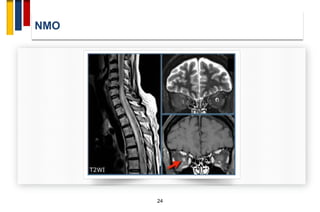
• NMO
• CRION
• ADEM
• anti-Myelin oligodendrocyte glycoprotein–associated
(MOG) optic neuritis
Optic Neuritis: D.D.
TM
23
TM
24
NMO
25
Atypical for MS
• Hyperacute onset or insidiously
progressive
• Complete transverse myelitis
• Sharp sensory level
• Radicular pain
• Areflexia
• Failure to remit
Isolated Spinal
Cord Syndrome
Typical for MS
• Evolution over hours to days
• Partial myelitis
• Purely sensory
• Deafferented upper limb
• Lhermitte’s sign
• Partial Brown-Sequard
• Spontaneous remission
Brain and spinal cord MRI
Low risk for MS (20%)
High risk for MS (60-90%)
Review McDonald criteria
• Compression e.g. intervertebral disc, tumor
• Ischemia/infarction
• Other inflammatory e.g. neuromyelitis optica,
sarcoid, lupus, Sjogren’s
• Infection e.g. syphilis, lyme, viral, tuberculosis
• Toxic/nutritional/metabolic. E.g B12 deficiency,
nitrous oxide toxicity, copper deficiency
• Arteriovenous malformation
• Non-cord “mimics” e.g. Guillain-Barre
syndrome, Myasthenia gravis
Consider
other
diagnosisMRI clearly
indicates a non-
MS diagnosis e.g.
spinal cord
compression
Abnormal
Lesions consistent
with demyelination
Normal
MRI, CSF neurophysiological,
serologic and other studies as
appropriate
26
Atypical for MS
• Hyperacute onset
• vascular territory signs e.g. lateral medullary syndrome
• age>50
• isolated trigeminal neuralgia/ fluctuating ocular/bulbar
weakness
• non-remitting, fever, meningism
Isolated Brain
Stem Syndrome
Typical for MS
• Internuclear opthalmoplegia
• 6th nerve palsy,
• multifocal signs e.g. facial
sensory loss and vertigo or
hearing loss
Brain and spinal cord MRI
Low risk for MS
(20%)
High risk for MS (60-90%)
Review McDonald criteria
• Ischemic/hemorrhagic (cavernous
angioma)
• Infiltrative
• Inflammatory (Sarcoid, lupus)
• Infection (Syphilis, listeria, lyme, viral)
• Toxic
• Nutritional
• Central pontine myelinolysis
• Neuromuscular (myasthenia gravis)
Consider
other
diagnosis
MRI clearly
indicates a non-
MS diagnosis
e.g. Hge
Abnormal
Lesions consistent
with demyelination
Normal
MRI, CSF, OCT neurophysiological,
serologic and other studies as appropriate
27
Risk factors for
conversion to MS
• Younger age of onset.
• Cognitive impairment.
• Vitamin D deficiency.
• Smoking.
• Increased EBV encoded nuclear antigen.
Demographic and environmental risk factors
29
A Biomarkers for Multiple Sclerosis:WHY ?
BIOMARKERS
30
GENETIC/IMMUNOGENETIC:
• Biomarkers specified via genomics and immunogenetic
techniques.
LABORATORY:
• All other biomarkers that can be measured in body fluids.
IMAGING:
• Biomarkers provided by imaging techniques.
BIOMARKERS
31
A. GENETIC AND IMMUNOGENETIC
BIOMARKERS
BIOMARKERS
HLA-DRB1*1501
TOB-1
Apo lipoprotein-E
32
B. LABORATORY BIOMARKERS
BIOMARKERS
33
I. Biomarkers of Immunological Activation
II. Biomarkers of Neuroprotection
III. Biomarkers of BBB disruption
IV. Biomarkers of demyelination
V. Biomarkers of Oxidative Stress
VI. Biomarkers of Axonal Damage
VII. Biomarkers of Glial Activation Dysfunction
VIII. Biomarkers of Remyelination Repair
IX. Biomarkers of Therapeutic Response
X. Prognostic Biomarkers
XI. Emering biomarkers
B. Laboratory Biomarkers
34
IV
VI
VII
VIII
III
I
35
BIOMARKERS
36
C. IMAGING BIOMARKERS
BIOMARKERS
BIOMARKERS
CLINICAL OCB MRI
37
38
MRI brain and cervical cord (1)
with Gd
Abnormal
[conversion rate 80%] (2)
Wait till
CDMS
DMT
Normal
[conversion rate 20%] (2)
Follow up
39
Conversion of CIS to CDMS
40
Conversion of CIS to CDMS
Mar Tintore et al. Brain 2015;138:1863-1874
© The Author (2015). Published by Oxford University Press on behalf of the Guarantors of Brain. All rights
reserved. For Permissions, please email: journals.permissions@oup.com
Conversion of CIS to CDMS
42
43
Management
Acute treatment
44
CIS
IV methylprednisolone PE
PLEASE
ORAL STEROIDS FOR ON
46
The ONTT was a prospective, randomized, multicenter placebo-
controlled clinical trial designed to compare the benefits of
treatment with
(1) intravenous methylprednisolone (IVMP) (250 mg administered
every 6 h for 3 days followed by oral prednisone [1 mg/kg/day]
for 11 days);
(2) oral prednisone (1 mg/kg/day); or
(3) oral placebo in 457 patients with acute optic neuritis.
Beck RW, Cleary PA, Anderson MM Jr, Keltner JL, Shults WT, Kaufman DI. A randomized, controlled trial of corticosteroids in the treatment of acute optic neuritis. The
Optic Neuritis Study Group. N Engl J Med. 1992 Feb 27. 326(9):581-8.
PLEASE
• The ONTT showed that treatment with standard-dose oral
prednisone was associated with an increased rate of new attacks
of optic neuritis.
• After 5 years, the recurrence rate was found to be higher in the
oral prednisone (1 mg/kg) group (41%) than in those who
received IVMP or oral placebo (25%).
47
1. Costello F, Burton JM. An approach to optic neuritis: the initial presentation. Expert Rev Ophthalmol. 2013. 8(6):539–551.
2. Shams PN, Plant GT. Optic neuritis: a review. Int MS J. 2009 Sep. 16(3):82-9.
PLEASE
Kasr Alaini Protocol of Manangement of CIS
48
MRI brain and cervical cord (1) with Gd
Abnormal
[conversion rate 80%] (2)
Offer DMT (3)
Normal
[conversion rate 20%] (2)
Positive radiology and/or
CSFNegative results
Follow up: Clinical (q 3 mo)
and Radiological (q 6m or
whenever indicated)
Offer DMT
Comprehensive Approach:
1- Exclude mimics
2- Further assessment: (fMRI (DTI) , CSF
analysis, cognitive assessment (4))
3- Neurophysiological
Kasr Alaini Protocol of Manangement of Multiple Sclerosis
49
• Rovira A, Tintore M. Spinal cord MRI should always be performed in clinically isolated syndrome patients:
No. Mult Scler. 2014; 20(13): 1686-7
• Barkhof F. Spinal cord MRI should always be performed in clinically isolated syndrome patients: Yes. Mult
Scler. 2014; 20(13): 1688-9
• Hutchinson M. Spinal cord MRI should always be performed in clinically isolated syndrome patients:
Commentary. Mult Scler. 2014; 20(13): 1690-1.
• Brownlee W, Miller D. Clinically isolated syndromes and the relationship to multiple sclerosis. J Clin Neurosci;
2014 Dec;21(12):2065-2071.
• Reuter F., Zaaraoui W., Crespy L., Faivre A., Rico A., Malikova I., Soulier E., Viot P., Ranjeva J., Pelletier J.,
Audoin B. Frequency of cognitive impairment dramatically increases during the first 5 years of multiple
sclerosis J Neurol Neurosurg Psychiatry 2011;82:1157-9.
• Loitfelder M, Fazekas F, Petrovic K, Fuchs S, Ropele S, Wallner-Blazek M, Jehna M, Aspeck E, Khalil M,
Schmidt R, Neuper C, Enzinger C. Reorganization in cognitive networks with progression of multiple
sclerosis: insights from fMRI. Neurology. 2011 Feb 8;76(6):526-33
REFERENCES FOR THE CHART
Kasr Alaini Protocol of Manangement of Multiple Sclerosis
50
• Jacobs L. D. et al. Intramuscular interferon beta-1a therapy initiated during a first demyelinating event in
multiple sclerosis. CHAMPS Study Group. N. Engl. J. Med. 343, 898–904 (2000).
• Kappos, L. et al. Treatment with interferon beta-1b delays conversion to clinically definite and McDonald MS
in patients with clinically isolated syndromes. Neurolog 67, 1242–1249(2006).
• Comi, G. et al. Effect of glatiramer acetate on conversion to clinically definite multiple sclerosis in patients
with clinically isolated syndrome (PreCISe study): a randomized, double-blind, placebo-controlled trial.
Lancet 374, 1503–1511 (2009).
• Comi, G. et al. Comparison of two dosing frequencies of subcutaneous interferon beta-1a in patients with a
first clinical demyelinating event suggestive of multiple sclerosis (REFLEX): a phase 3 randomized controlled
trial. Lancet Neurol. 11, 33–41 (2012).
• Morrissey, S. P. et al. The significance of brain magnetic resonance imaging abnormalities at presentation
with clinically isolated syndromes suggestive of multiple sclerosis. A 5-year follow-up study. Brain 116, 135–
146 (1993).
• Brex, P. A. et al. A longitudinal study of abnormalities on MRI and disability from multiple sclerosis.
N. Engl. J. Med. 346, 158–164 (2002).
Studies that support treatment of CIS patients
• A small randomized control trial conducted by
Derakhshandi et al. 2013, suggested that supplementation
with cholecalciferol 50,000 units weekly in patients with
optic neuritis who were vitamin D deficient reduced the risk
of conversion to MS and had favourable effects on a
number of MRI outcomes.
• The PreVANZ study being conducted in Australia and New
Zealand is a randomised, double-blind controlled trial
investigating three different doses of vitamin D versus
placebo in patients with CIS, irrespective of baseline
vitamin D levels. Results are expected in 2017.
Vitamin D supplementation
THANK YOU

clinically isolated syndromes

  • 1.
  • 2.
    Amr Hasan, MD,FEBN AssociateProfessor of Neurology - Cairo University
  • 3.
    Mental map fordiagnosis of MS 3 Clinical/Paraclinical/Imaging Typical for MS Fulfills Criteria Atypical for MS Red Flags Present Work Up for Alternative Diagnoses Clinical/Imaging Follow Up Alternative Diagnosis Established Further clinical/imaging typical for MS MS Diagnosis Typical for MS not Fulfilling Criteria Clinical/Imaging Follow Up CIS
  • 4.
    Clinically Isolated Syndromes Definition Clinicalfeatures 1- Optic neuritis 2- Spinal cord syndrome 3-Brain stem syndromes 4-Less common CIS Risk factors for conversion to MS 1-Demographic, environmental and genetic factors 2-Abnormal MRI imaging 3- Biomarkers 4-OCT Management 1- Acute treatment 2- Disease modifying therapy 3- Vitamin D supplementation
  • 5.
  • 6.
    CIS definition 6 • Afirst neurologic symptom episode "ATTACK" of an acute inflammatory demyelinating event in the central nervous system lasting at least 24 hours in the absence of fever or infection (Polman et al, 2011). • This definition also provides No DIS nor DIT by MRI Brain and Cervical Cord. •Polman CH, Reingold SC, Banwell B, Clanet M, Cohen JA, Filippi M, Fujihara K, Havrdova E, Hutchinson M, Kappos L, Lublin FD, Montalban X, O'Connor P, Sandberg-Wollheim M, Thompson AJ, Waubant E, Weinshenker B, Wolinsky JS. Diagnostic criteria for multiple sclerosis: 2010 revisions to the McDonald criteria. Ann Neurol. 2011 Feb; 69(2):292-302.
  • 7.
  • 8.
    ON TM BS 8 ClinicallyIsolated Syndrome (CIS)
  • 9.
    • Hemiparesis orhomonymous hemianopia that may be mistaken for an acute stroke. • Cognitive dysfunction • Seizures, attributable to a demyelinating lesion in the cerebral cortex. Clinically Isolated Syndrome (CIS) : less common
  • 10.
    10 ONSET: Could be "subacute"(Miller et al. 2012), after which patients may progress to MS without showing evidence of relapses TYPES: • Monofocal episode: single neurologic sign or symptom. • Multifocal episode: more than one sign or symptom. •Miller DH, Chard DT, Ciccarelli O. clinically isolated syndromes. Lancet Neurol. 2012 Feb;11(2):157-69. Clinically Isolated Syndrome (CIS)
  • 11.
    •Monocular (Central Vision loss) •Pain (eyemovement) •Altered colour vision •Uhthoff’s symptom •Flashes Optic Neuritis : Common Symptoms
  • 12.
    Multiple Sclerosis &Eye problems | 25.08.201612 Optic Neuritis : Common Symptoms
  • 13.
  • 14.
  • 15.
    • Decreased visualacuity • VF defect (Central/Altitudinal 29% ) • Dyschromatopsia • Afferent Pupil Defect (RAPD) • Optic disc swelling 35% • Abnormal Contrast Sensitivity • Abnormal VEP • Altered Flicker Perception • Altered depth perception • Optic disc pallor Optic Neuritis: Physical signs
  • 16.
  • 17.
  • 18.
    Mental map fordiagnosis of ON 18 Optic Neuritis (ON) ON Typical for MS MRI Fulfills Criteria ON Atypical for MS Red Flags Present Work Up for Alternative Diagnoses Clinical/Imaging Follow Up Alternative Diagnosis Established Further clinical/imaging typical for MS MS Diagnosis
  • 19.
    19 19 Typical • Acute orsubacute attack • Mostly young adults (age 20-55 y) • Unilateral visual acuity loss • Improvement with/without treatment • Continued improvement after corticosteroid withdrawn • Mild pain that worsens with eye movement • The optic disc appears normal or mildly swollen • Variable visual field defects may occur • Altered perception of motion (the pulfrich phenomenon) • Vision blurs when body temperature rises (Uhthoff’s phenomenon) • Bright, fleeting flashes of light (phosphenes) Atypical • Progressive disease • Age group < 12 and > 50 y • Bilateral visual loss • No spontaneous visual improvement • Deterioration after corticosteroid are discontinued • Following loss of vision, painless to severe pain • Severe swelling and hemorrhage in optic disc • Variable signs and symptoms, depending on etiology Optic Neuritis: Typical Vs Atypical
  • 20.
    • AION (IschemicOptic Neuropathy) • Vasculitic Disorders (i.e. SLE) • Hereditary (i.e. Leber’s) • Toxic/Nutritional (ETOH) • Infectious (i.e.Bartonella, Lyme) • Inflammatory (i.e. Sarcoid) • Neoplastic/Paraneoplastic (i.e. lymphoma) • Compressive (i.e.Tumours, Grave’s orbitopathy) • Multiple Evanescent White Dot Syndrome [MEWDS] • Acute Idiopathic Blind Spot Enlargement Syndrome [AIBSE]). Optic Neuritis: D.D.
  • 21.
    • NMO • CRION •ADEM • anti-Myelin oligodendrocyte glycoprotein–associated (MOG) optic neuritis Optic Neuritis: D.D.
  • 22.
  • 23.
  • 24.
  • 25.
    25 Atypical for MS •Hyperacute onset or insidiously progressive • Complete transverse myelitis • Sharp sensory level • Radicular pain • Areflexia • Failure to remit Isolated Spinal Cord Syndrome Typical for MS • Evolution over hours to days • Partial myelitis • Purely sensory • Deafferented upper limb • Lhermitte’s sign • Partial Brown-Sequard • Spontaneous remission Brain and spinal cord MRI Low risk for MS (20%) High risk for MS (60-90%) Review McDonald criteria • Compression e.g. intervertebral disc, tumor • Ischemia/infarction • Other inflammatory e.g. neuromyelitis optica, sarcoid, lupus, Sjogren’s • Infection e.g. syphilis, lyme, viral, tuberculosis • Toxic/nutritional/metabolic. E.g B12 deficiency, nitrous oxide toxicity, copper deficiency • Arteriovenous malformation • Non-cord “mimics” e.g. Guillain-Barre syndrome, Myasthenia gravis Consider other diagnosisMRI clearly indicates a non- MS diagnosis e.g. spinal cord compression Abnormal Lesions consistent with demyelination Normal MRI, CSF neurophysiological, serologic and other studies as appropriate
  • 26.
    26 Atypical for MS •Hyperacute onset • vascular territory signs e.g. lateral medullary syndrome • age>50 • isolated trigeminal neuralgia/ fluctuating ocular/bulbar weakness • non-remitting, fever, meningism Isolated Brain Stem Syndrome Typical for MS • Internuclear opthalmoplegia • 6th nerve palsy, • multifocal signs e.g. facial sensory loss and vertigo or hearing loss Brain and spinal cord MRI Low risk for MS (20%) High risk for MS (60-90%) Review McDonald criteria • Ischemic/hemorrhagic (cavernous angioma) • Infiltrative • Inflammatory (Sarcoid, lupus) • Infection (Syphilis, listeria, lyme, viral) • Toxic • Nutritional • Central pontine myelinolysis • Neuromuscular (myasthenia gravis) Consider other diagnosis MRI clearly indicates a non- MS diagnosis e.g. Hge Abnormal Lesions consistent with demyelination Normal MRI, CSF, OCT neurophysiological, serologic and other studies as appropriate
  • 27.
  • 28.
    • Younger ageof onset. • Cognitive impairment. • Vitamin D deficiency. • Smoking. • Increased EBV encoded nuclear antigen. Demographic and environmental risk factors
  • 29.
    29 A Biomarkers forMultiple Sclerosis:WHY ? BIOMARKERS
  • 30.
    30 GENETIC/IMMUNOGENETIC: • Biomarkers specifiedvia genomics and immunogenetic techniques. LABORATORY: • All other biomarkers that can be measured in body fluids. IMAGING: • Biomarkers provided by imaging techniques. BIOMARKERS
  • 31.
    31 A. GENETIC ANDIMMUNOGENETIC BIOMARKERS BIOMARKERS HLA-DRB1*1501 TOB-1 Apo lipoprotein-E
  • 32.
  • 33.
    33 I. Biomarkers ofImmunological Activation II. Biomarkers of Neuroprotection III. Biomarkers of BBB disruption IV. Biomarkers of demyelination V. Biomarkers of Oxidative Stress VI. Biomarkers of Axonal Damage VII. Biomarkers of Glial Activation Dysfunction VIII. Biomarkers of Remyelination Repair IX. Biomarkers of Therapeutic Response X. Prognostic Biomarkers XI. Emering biomarkers B. Laboratory Biomarkers
  • 34.
  • 35.
  • 36.
  • 37.
  • 38.
  • 39.
    MRI brain andcervical cord (1) with Gd Abnormal [conversion rate 80%] (2) Wait till CDMS DMT Normal [conversion rate 20%] (2) Follow up 39 Conversion of CIS to CDMS
  • 40.
  • 41.
    Mar Tintore etal. Brain 2015;138:1863-1874 © The Author (2015). Published by Oxford University Press on behalf of the Guarantors of Brain. All rights reserved. For Permissions, please email: journals.permissions@oup.com Conversion of CIS to CDMS
  • 42.
  • 43.
  • 44.
  • 45.
  • 46.
    46 The ONTT wasa prospective, randomized, multicenter placebo- controlled clinical trial designed to compare the benefits of treatment with (1) intravenous methylprednisolone (IVMP) (250 mg administered every 6 h for 3 days followed by oral prednisone [1 mg/kg/day] for 11 days); (2) oral prednisone (1 mg/kg/day); or (3) oral placebo in 457 patients with acute optic neuritis. Beck RW, Cleary PA, Anderson MM Jr, Keltner JL, Shults WT, Kaufman DI. A randomized, controlled trial of corticosteroids in the treatment of acute optic neuritis. The Optic Neuritis Study Group. N Engl J Med. 1992 Feb 27. 326(9):581-8. PLEASE
  • 47.
    • The ONTTshowed that treatment with standard-dose oral prednisone was associated with an increased rate of new attacks of optic neuritis. • After 5 years, the recurrence rate was found to be higher in the oral prednisone (1 mg/kg) group (41%) than in those who received IVMP or oral placebo (25%). 47 1. Costello F, Burton JM. An approach to optic neuritis: the initial presentation. Expert Rev Ophthalmol. 2013. 8(6):539–551. 2. Shams PN, Plant GT. Optic neuritis: a review. Int MS J. 2009 Sep. 16(3):82-9. PLEASE
  • 48.
    Kasr Alaini Protocolof Manangement of CIS 48 MRI brain and cervical cord (1) with Gd Abnormal [conversion rate 80%] (2) Offer DMT (3) Normal [conversion rate 20%] (2) Positive radiology and/or CSFNegative results Follow up: Clinical (q 3 mo) and Radiological (q 6m or whenever indicated) Offer DMT Comprehensive Approach: 1- Exclude mimics 2- Further assessment: (fMRI (DTI) , CSF analysis, cognitive assessment (4)) 3- Neurophysiological
  • 49.
    Kasr Alaini Protocolof Manangement of Multiple Sclerosis 49 • Rovira A, Tintore M. Spinal cord MRI should always be performed in clinically isolated syndrome patients: No. Mult Scler. 2014; 20(13): 1686-7 • Barkhof F. Spinal cord MRI should always be performed in clinically isolated syndrome patients: Yes. Mult Scler. 2014; 20(13): 1688-9 • Hutchinson M. Spinal cord MRI should always be performed in clinically isolated syndrome patients: Commentary. Mult Scler. 2014; 20(13): 1690-1. • Brownlee W, Miller D. Clinically isolated syndromes and the relationship to multiple sclerosis. J Clin Neurosci; 2014 Dec;21(12):2065-2071. • Reuter F., Zaaraoui W., Crespy L., Faivre A., Rico A., Malikova I., Soulier E., Viot P., Ranjeva J., Pelletier J., Audoin B. Frequency of cognitive impairment dramatically increases during the first 5 years of multiple sclerosis J Neurol Neurosurg Psychiatry 2011;82:1157-9. • Loitfelder M, Fazekas F, Petrovic K, Fuchs S, Ropele S, Wallner-Blazek M, Jehna M, Aspeck E, Khalil M, Schmidt R, Neuper C, Enzinger C. Reorganization in cognitive networks with progression of multiple sclerosis: insights from fMRI. Neurology. 2011 Feb 8;76(6):526-33 REFERENCES FOR THE CHART
  • 50.
    Kasr Alaini Protocolof Manangement of Multiple Sclerosis 50 • Jacobs L. D. et al. Intramuscular interferon beta-1a therapy initiated during a first demyelinating event in multiple sclerosis. CHAMPS Study Group. N. Engl. J. Med. 343, 898–904 (2000). • Kappos, L. et al. Treatment with interferon beta-1b delays conversion to clinically definite and McDonald MS in patients with clinically isolated syndromes. Neurolog 67, 1242–1249(2006). • Comi, G. et al. Effect of glatiramer acetate on conversion to clinically definite multiple sclerosis in patients with clinically isolated syndrome (PreCISe study): a randomized, double-blind, placebo-controlled trial. Lancet 374, 1503–1511 (2009). • Comi, G. et al. Comparison of two dosing frequencies of subcutaneous interferon beta-1a in patients with a first clinical demyelinating event suggestive of multiple sclerosis (REFLEX): a phase 3 randomized controlled trial. Lancet Neurol. 11, 33–41 (2012). • Morrissey, S. P. et al. The significance of brain magnetic resonance imaging abnormalities at presentation with clinically isolated syndromes suggestive of multiple sclerosis. A 5-year follow-up study. Brain 116, 135– 146 (1993). • Brex, P. A. et al. A longitudinal study of abnormalities on MRI and disability from multiple sclerosis. N. Engl. J. Med. 346, 158–164 (2002). Studies that support treatment of CIS patients
  • 51.
    • A smallrandomized control trial conducted by Derakhshandi et al. 2013, suggested that supplementation with cholecalciferol 50,000 units weekly in patients with optic neuritis who were vitamin D deficient reduced the risk of conversion to MS and had favourable effects on a number of MRI outcomes. • The PreVANZ study being conducted in Australia and New Zealand is a randomised, double-blind controlled trial investigating three different doses of vitamin D versus placebo in patients with CIS, irrespective of baseline vitamin D levels. Results are expected in 2017. Vitamin D supplementation
  • 52.