Amr Hasan, M.D.
Lecturer of Neurology - Cairo University
CairoNeuro 2014
Botulinum toxin in hemifacial
spasm: A real “Face Off”
2
Agenda
Hemifacial spasm
3
• Anatomy of facial muscles
• Definition
• Aetiology
• Pathophysiology .
• Investigations
• Clinical features and differential diagnosis.
• Botulium toxin in hemifacial spasm
• Video presenations
Agenda
Hemifacial spasm
4
• Anatomy of facial muscles
• Definition
• Aetiology
• Pathophysiology .
• Investigations
• Clinical features and differential diagnosis.
• Botulium toxin in hemifacial spasm
• Video presenations
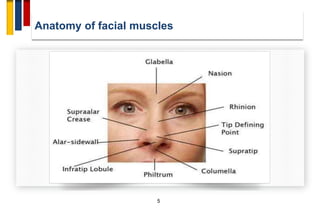
Anatomy of facial muscles
5
Anatomy of facial muscles
6
Anatomy of facial muscles
7
Anatomy of facial muscles
8
Anatomy of facial muscles
9
Anatomy of facial muscles
10
11
Anatomy of facial muscles
12
Anatomy of facial muscles
13
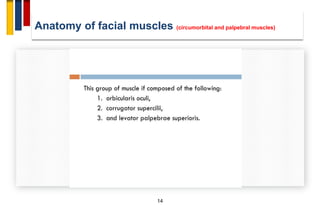
Anatomy of facial muscles (circumorbital and palpebral muscles)
14
Anatomy of facial muscles (circumorbital and palpebral muscles)
15
16
Anatomy of facial muscles (circumorbital and palpebral muscles)
17
Anatomy of facial muscles (Nasal Muscles)
18
Anatomy of facial muscles (Nasal Muscles)
19
Anatomy of facial muscles (Nasal Muscles)
20
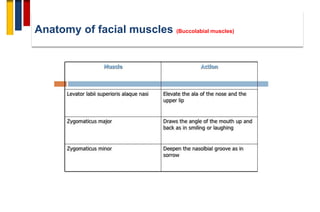
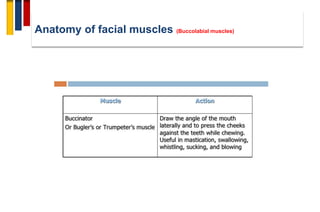
Anatomy of facial muscles (Buccolabial muscles)
21
Anatomy of facial muscles (Buccolabial muscles)
22
Anatomy of facial muscles (Buccolabial muscles)
23
Anatomy of facial muscles (Buccolabial muscles)
24
Anatomy of facial muscles (Buccolabial muscles)
25
Anatomy of facial muscles (Buccolabial muscles)
26
Anatomy of facial muscles
QUIZ
27
14
15
Agenda
Hemifacial spasm
28
• Anatomy of facial muscles
• Definition
• Aetiology
• Pathophysiology .
• Investigations
• Clinical features and differential diagnosis.
• Botulium toxin in hemifacial spasm
• Video presenations
Agenda
Hemifacial spasm
29
• Anatomy of facial muscles
• Definition
• Aetiology
• Pathophysiology .
• Investigations
• Clinical features and differential diagnosis.
• Botulium toxin in hemifacial spasm
• Video presenations
Hemifacial Spasm
Characterized by:
30
• Paroxysmal, involuntary
clonic and tonic
synchronous contraction
of the muscles
innervated by the facial
nerve on one side.
• The spasms are due to
brief burst of normal
motor units firing at high
frequency.
Agenda
Hemifacial spasm
31
• Anatomy of facial muscles
• Definition
• Aetiology
• Pathophysiology .
• Investigations
• Clinical features and differential diagnosis.
• Botulium toxin in hemifacial spasm
• Video presenations
Agenda
Hemifacial spasm
32
• Anatomy of facial muscles
• Definition
• Aetiology
• Pathophysiology .
• Investigations
• Clinical features and differential diagnosis.
• Botulium toxin in hemifacial spasm
• Video presenations
Hemifacial Spasm
Causes:
33
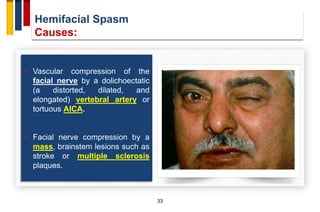
• Vascular compression of the
facial nerve by a dolichoectatic
(a distorted, dilated, and
elongated) vertebral artery or
tortuous AICA.
• Facial nerve compression by a
mass, brainstem lesions such as
stroke or multiple sclerosis
plaques.
Hemifacial Spasm
Causes:
34
• Secondary causes
such as trauma or Bell
palsy.
• Familial
• Idiopathic
35
Hemifacial Spasm
Causes:
Agenda
Hemifacial spasm
36
• Anatomy of facial muscles
• Definition
• Aetiology
• Pathophysiology .
• Investigations
• Clinical features and differential diagnosis.
• Botulium toxin in hemifacial spasm
• Video presenations
Agenda
Hemifacial spasm
37
• Anatomy of facial muscles
• Definition
• Aetiology
• Pathophysiology .
• Investigations
• Clinical features and differential diagnosis.
• Botulium toxin in hemifacial spasm
• Video presenations
Hemifacial spasm
38
transmission, which is electrical activity crossing from onephapticE
synapse.demyelinated neuron to another resulting in a false
root end zonefacial nerveat theaxonsnvolves abnormal activity ofI
demyelination.secondary to compressive damage/
facial nerveor "Kindling theory" involves increased excitability of the
nucleus due to feedback from a damaged facial nerve.
Agenda
Hemifacial spasm
39
• Anatomy of facial muscles
• Definition
• Aetiology
• Pathophysiology .
• Investigations
• Clinical features and differential diagnosis.
• Botulium toxin in hemifacial spasm
• Video presenations
Agenda
Hemifacial spasm
40
• Anatomy of facial muscles
• Definition
• Aetiology
• Pathophysiology .
• Investigations
• Clinical features and differential diagnosis.
• Botulium toxin in hemifacial spasm
• Video presenations
Hemifacial spasm
41
• Unilateral (rarely bilateral) spasm involving half of the facial
muscles, typically lasting several minutes at a time.
• Affects women more than men.
• Onset fifth and sixth decade.
• Persists during sleep.
Hemifacial spasm
42
• Painless, no sensory loss.
• Involves entire side of face.
• HS most often begins insidiously in the orbicularis oculi
muscle.
Hemifacial spasm
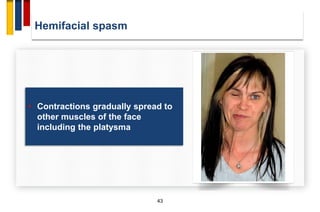
43
• Contractions gradually spread to
other muscles of the face
including the platysma
Hemifacial spasm
44
Hemifacial spasm
Differential Dx:
45
• Blepharospasm
• Meige’s syndrome (not to be confused with Meigs' syndrome,the triad of ascites,pleural effusion and benign ovarian tumor)
• Tourette’s syndrome (multiple compulsive muscle spasms associated with
utterances of bizarre sounds or vile words).
• Trigeminal Neuralgia (acute episodes of pain in the distribution of the V CN)
• Eyelid Myokymia (eyelid twitches; caffeine & stress)
• Tardive Dyskinesia (Orofacial dyskinesia, associated with dystonic
movements of the trunk and limbs, from long-term antipsychotic drug use)
• Eyelid apraxia
Hemifacial spasm
Blepharospasm:
46
• Onset: usually in adult life (sixth & seventh decade)
• 3:1 female predominance
• Always Bilateral, episodic, involuntary contractions of the orbicularis
oculi (therefore, may not involve other facial muscles).
• Disappears during sleep.
• Possible association with involuntary spasm of the lower facial
musculature (orofacial dyskinesia or Meige’s Syndrome).
Hemifacial spasm
Blepharospasm:
47
• Etiology:
• Adults: usually idiopathic (“essential blepharospasm”) related to
dysfunction of the basal ganglia and limbic system.
• May occur in patients with:
 Parkinson’s disease
 Progressive supranuclear palsy
 Huntington’s disease
 Multiple Sclerosis
 Brainstem stroke
Agenda
Hemifacial spasm
48
• Anatomy of facial muscles
• Definition
• Aetiology
• Pathophysiology .
• Investigations
• Clinical features and differential diagnosis.
• Botulium toxin in hemifacial spasm
• Video presenations
Agenda
Hemifacial spasm
49
• Anatomy of facial muscles
• Definition
• Aetiology
• Pathophysiology .
• Investigations
• Clinical features and differential diagnosis.
• Botulium toxin in hemifacial spasm
• Video presenations
Hemifacial spasm
50
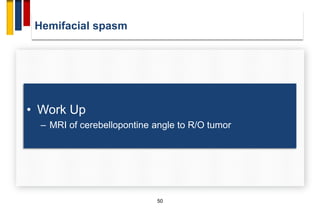
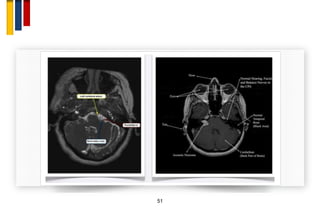
• Work Up
– MRI of cerebellopontine angle to R/O tumor
51
Agenda
Hemifacial spasm
52
• Anatomy of facial muscles
• Definition
• Aetiology
• Pathophysiology .
• Investigations
• Clinical features and differential diagnosis.
• Botulium toxin in hemifacial spasm
• Video presenations
Agenda
Hemifacial spasm
53
• Anatomy of facial muscles
• Definition
• Aetiology
• Pathophysiology .
• Investigations
• Clinical features and differential diagnosis.
• Botulium toxin in hemifacial spasm
• Video presenations
Hemifacial spasm
Treatment
54
• Pharmachologic: Carbomazepine, Baclofen, Clonazepam,
Neurontin
• Botulinum toxin
• Surgery: Janetta procedure=posterior fossa craniotomy with
insertion of inert material b/w vascular loop and VII nerve (to
decrompress the nerve).
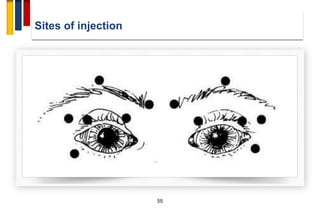
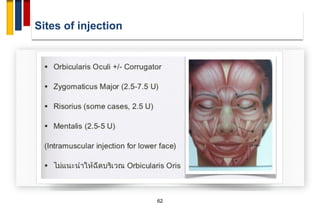
Sites of injection
55
Sites of injection
56
57
Sites of injection
Sites of injection
58
Sites of injection
59
Sites of injection
60
Sites of injection for BEB
61
Sites of injection
62
• Ptosis (7-11%)
• Lagophthalmos (5-12%)
• Symptomatic dry eyes
• Diplopia (<1%)
• Ecchymosis
• Lower facial weakness
Potential adverse effect
63
• Facial assymetry.
Agenda
Hemifacial spasm
64
• Anatomy of facial muscles
• Definition
• Aetiology
• Pathophysiology .
• Investigations
• Clinical features and differential diagnosis.
• Botulium toxin in hemifacial spasm
• Video presenations
Agenda
Hemifacial spasm
65
• Anatomy of facial muscles
• Definition
• Aetiology
• Pathophysiology .
• Investigations
• Clinical features and differential diagnosis.
• Botulium toxin in hemifacial spasm
• Video presenations
66
Case 1
• 32 ys old male.
• Unremarkable medical history.
• 3 years ago started to develop Rt HFS
• Increasing in frequency up to being continous
all over the day
• MRI Brain : Normal
67
68
Case 1
69
Case 1
Case 2
• 16 ys old girl.
• Student
• 4 years ago, she had Bell’s palsy
• Afterwhich, she started to develop Rt HFS
• Embarrasing and disfiguring
70
71
Case 2
72
Case 2
Case 3
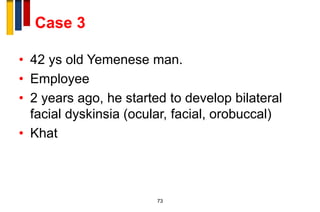
• 42 ys old Yemenese man.
• Employee
• 2 years ago, he started to develop bilateral
facial dyskinsia (ocular, facial, orobuccal)
• Khat
73
74
Case 3
75
Case 3
Pearls
76
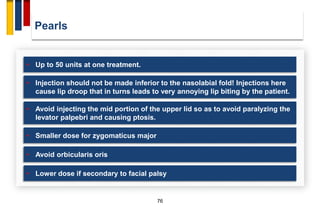
• Up to 50 units at one treatment.
• Injection should not be made inferior to the nasolabial fold! Injections here
cause lip droop that in turns leads to very annoying lip biting by the patient.
• Avoid injecting the mid portion of the upper lid so as to avoid paralyzing the
levator palpebri and causing ptosis.
• Avoid orbicularis oris
• Smaller dose for zygomaticus major
• Lower dose if secondary to facial palsy
77
78

Hemifacial spasm

  • 1.
    Amr Hasan, M.D. Lecturerof Neurology - Cairo University CairoNeuro 2014 Botulinum toxin in hemifacial spasm: A real “Face Off”
  • 2.
  • 3.
    Agenda Hemifacial spasm 3 • Anatomyof facial muscles • Definition • Aetiology • Pathophysiology . • Investigations • Clinical features and differential diagnosis. • Botulium toxin in hemifacial spasm • Video presenations
  • 4.
    Agenda Hemifacial spasm 4 • Anatomyof facial muscles • Definition • Aetiology • Pathophysiology . • Investigations • Clinical features and differential diagnosis. • Botulium toxin in hemifacial spasm • Video presenations
  • 5.
  • 6.
  • 7.
  • 8.
  • 9.
  • 10.
  • 11.
  • 12.
  • 13.
  • 14.
    Anatomy of facialmuscles (circumorbital and palpebral muscles) 14
  • 15.
    Anatomy of facialmuscles (circumorbital and palpebral muscles) 15
  • 16.
    16 Anatomy of facialmuscles (circumorbital and palpebral muscles)
  • 17.
    17 Anatomy of facialmuscles (Nasal Muscles)
  • 18.
    18 Anatomy of facialmuscles (Nasal Muscles)
  • 19.
    19 Anatomy of facialmuscles (Nasal Muscles)
  • 20.
    20 Anatomy of facialmuscles (Buccolabial muscles)
  • 21.
    21 Anatomy of facialmuscles (Buccolabial muscles)
  • 22.
    22 Anatomy of facialmuscles (Buccolabial muscles)
  • 23.
    23 Anatomy of facialmuscles (Buccolabial muscles)
  • 24.
    24 Anatomy of facialmuscles (Buccolabial muscles)
  • 25.
    25 Anatomy of facialmuscles (Buccolabial muscles)
  • 26.
  • 27.
  • 28.
    Agenda Hemifacial spasm 28 • Anatomyof facial muscles • Definition • Aetiology • Pathophysiology . • Investigations • Clinical features and differential diagnosis. • Botulium toxin in hemifacial spasm • Video presenations
  • 29.
    Agenda Hemifacial spasm 29 • Anatomyof facial muscles • Definition • Aetiology • Pathophysiology . • Investigations • Clinical features and differential diagnosis. • Botulium toxin in hemifacial spasm • Video presenations
  • 30.
    Hemifacial Spasm Characterized by: 30 •Paroxysmal, involuntary clonic and tonic synchronous contraction of the muscles innervated by the facial nerve on one side. • The spasms are due to brief burst of normal motor units firing at high frequency.
  • 31.
    Agenda Hemifacial spasm 31 • Anatomyof facial muscles • Definition • Aetiology • Pathophysiology . • Investigations • Clinical features and differential diagnosis. • Botulium toxin in hemifacial spasm • Video presenations
  • 32.
    Agenda Hemifacial spasm 32 • Anatomyof facial muscles • Definition • Aetiology • Pathophysiology . • Investigations • Clinical features and differential diagnosis. • Botulium toxin in hemifacial spasm • Video presenations
  • 33.
    Hemifacial Spasm Causes: 33 • Vascularcompression of the facial nerve by a dolichoectatic (a distorted, dilated, and elongated) vertebral artery or tortuous AICA. • Facial nerve compression by a mass, brainstem lesions such as stroke or multiple sclerosis plaques.
  • 34.
    Hemifacial Spasm Causes: 34 • Secondarycauses such as trauma or Bell palsy. • Familial • Idiopathic
  • 35.
  • 36.
    Agenda Hemifacial spasm 36 • Anatomyof facial muscles • Definition • Aetiology • Pathophysiology . • Investigations • Clinical features and differential diagnosis. • Botulium toxin in hemifacial spasm • Video presenations
  • 37.
    Agenda Hemifacial spasm 37 • Anatomyof facial muscles • Definition • Aetiology • Pathophysiology . • Investigations • Clinical features and differential diagnosis. • Botulium toxin in hemifacial spasm • Video presenations
  • 38.
    Hemifacial spasm 38 transmission, whichis electrical activity crossing from onephapticE synapse.demyelinated neuron to another resulting in a false root end zonefacial nerveat theaxonsnvolves abnormal activity ofI demyelination.secondary to compressive damage/ facial nerveor "Kindling theory" involves increased excitability of the nucleus due to feedback from a damaged facial nerve.
  • 39.
    Agenda Hemifacial spasm 39 • Anatomyof facial muscles • Definition • Aetiology • Pathophysiology . • Investigations • Clinical features and differential diagnosis. • Botulium toxin in hemifacial spasm • Video presenations
  • 40.
    Agenda Hemifacial spasm 40 • Anatomyof facial muscles • Definition • Aetiology • Pathophysiology . • Investigations • Clinical features and differential diagnosis. • Botulium toxin in hemifacial spasm • Video presenations
  • 41.
    Hemifacial spasm 41 • Unilateral(rarely bilateral) spasm involving half of the facial muscles, typically lasting several minutes at a time. • Affects women more than men. • Onset fifth and sixth decade. • Persists during sleep.
  • 42.
    Hemifacial spasm 42 • Painless,no sensory loss. • Involves entire side of face. • HS most often begins insidiously in the orbicularis oculi muscle.
  • 43.
    Hemifacial spasm 43 • Contractionsgradually spread to other muscles of the face including the platysma
  • 44.
  • 45.
    Hemifacial spasm Differential Dx: 45 •Blepharospasm • Meige’s syndrome (not to be confused with Meigs' syndrome,the triad of ascites,pleural effusion and benign ovarian tumor) • Tourette’s syndrome (multiple compulsive muscle spasms associated with utterances of bizarre sounds or vile words). • Trigeminal Neuralgia (acute episodes of pain in the distribution of the V CN) • Eyelid Myokymia (eyelid twitches; caffeine & stress) • Tardive Dyskinesia (Orofacial dyskinesia, associated with dystonic movements of the trunk and limbs, from long-term antipsychotic drug use) • Eyelid apraxia
  • 46.
    Hemifacial spasm Blepharospasm: 46 • Onset:usually in adult life (sixth & seventh decade) • 3:1 female predominance • Always Bilateral, episodic, involuntary contractions of the orbicularis oculi (therefore, may not involve other facial muscles). • Disappears during sleep. • Possible association with involuntary spasm of the lower facial musculature (orofacial dyskinesia or Meige’s Syndrome).
  • 47.
    Hemifacial spasm Blepharospasm: 47 • Etiology: •Adults: usually idiopathic (“essential blepharospasm”) related to dysfunction of the basal ganglia and limbic system. • May occur in patients with:  Parkinson’s disease  Progressive supranuclear palsy  Huntington’s disease  Multiple Sclerosis  Brainstem stroke
  • 48.
    Agenda Hemifacial spasm 48 • Anatomyof facial muscles • Definition • Aetiology • Pathophysiology . • Investigations • Clinical features and differential diagnosis. • Botulium toxin in hemifacial spasm • Video presenations
  • 49.
    Agenda Hemifacial spasm 49 • Anatomyof facial muscles • Definition • Aetiology • Pathophysiology . • Investigations • Clinical features and differential diagnosis. • Botulium toxin in hemifacial spasm • Video presenations
  • 50.
    Hemifacial spasm 50 • WorkUp – MRI of cerebellopontine angle to R/O tumor
  • 51.
  • 52.
    Agenda Hemifacial spasm 52 • Anatomyof facial muscles • Definition • Aetiology • Pathophysiology . • Investigations • Clinical features and differential diagnosis. • Botulium toxin in hemifacial spasm • Video presenations
  • 53.
    Agenda Hemifacial spasm 53 • Anatomyof facial muscles • Definition • Aetiology • Pathophysiology . • Investigations • Clinical features and differential diagnosis. • Botulium toxin in hemifacial spasm • Video presenations
  • 54.
    Hemifacial spasm Treatment 54 • Pharmachologic:Carbomazepine, Baclofen, Clonazepam, Neurontin • Botulinum toxin • Surgery: Janetta procedure=posterior fossa craniotomy with insertion of inert material b/w vascular loop and VII nerve (to decrompress the nerve).
  • 55.
  • 56.
  • 57.
  • 58.
  • 59.
  • 60.
  • 61.
  • 62.
  • 63.
    • Ptosis (7-11%) •Lagophthalmos (5-12%) • Symptomatic dry eyes • Diplopia (<1%) • Ecchymosis • Lower facial weakness Potential adverse effect 63 • Facial assymetry.
  • 64.
    Agenda Hemifacial spasm 64 • Anatomyof facial muscles • Definition • Aetiology • Pathophysiology . • Investigations • Clinical features and differential diagnosis. • Botulium toxin in hemifacial spasm • Video presenations
  • 65.
    Agenda Hemifacial spasm 65 • Anatomyof facial muscles • Definition • Aetiology • Pathophysiology . • Investigations • Clinical features and differential diagnosis. • Botulium toxin in hemifacial spasm • Video presenations
  • 66.
  • 67.
    Case 1 • 32ys old male. • Unremarkable medical history. • 3 years ago started to develop Rt HFS • Increasing in frequency up to being continous all over the day • MRI Brain : Normal 67
  • 68.
  • 69.
  • 70.
    Case 2 • 16ys old girl. • Student • 4 years ago, she had Bell’s palsy • Afterwhich, she started to develop Rt HFS • Embarrasing and disfiguring 70
  • 71.
  • 72.
  • 73.
    Case 3 • 42ys old Yemenese man. • Employee • 2 years ago, he started to develop bilateral facial dyskinsia (ocular, facial, orobuccal) • Khat 73
  • 74.
  • 75.
  • 76.
    Pearls 76 • Up to50 units at one treatment. • Injection should not be made inferior to the nasolabial fold! Injections here cause lip droop that in turns leads to very annoying lip biting by the patient. • Avoid injecting the mid portion of the upper lid so as to avoid paralyzing the levator palpebri and causing ptosis. • Avoid orbicularis oris • Smaller dose for zygomaticus major • Lower dose if secondary to facial palsy
  • 77.
  • 78.