ACUTE DISSEMINATED
ENCEPHALOMYELITIS
(ADEM)
Ade Wijaya, MD – February 2019
Outline:
• Introduction
• Epidemiology
• Diagnostic Criteria
• Classification
• Pathology
• Clinical Presentation
• Neuroimaging Features
• CSF Findings
• Differential Diagnosis
• Treatment
• Outcome
• Summary
Introduction
• An immune-mediated demyelinating CNS disorder, characterized clinically by
new-onset polyfocal neurologic symptoms including encephalopathy, coupled
with neuroimaging evidence of multifocal demyelination
• Monophasic illness
• Early childhood
• Post-infection or post-vaccine
Lucas J. An account of uncommon symptoms succeeding measles: with some additional remarks on the infection of measles and smallpox. Lond Med J 1790;11:325.
Epidemiology
• Population-based studies show the incidence of ADEM to be 0.3–0.6 per 100,000
per year.
• The median age at presentation of ADEM is 5–8 years, with male predominance
Torisu H, Kira R, Ishizaki Y, et al. Clinical study of childhood acute disseminated encephalomyelitis, multiple sclerosis, and acute transverse myelitis in FukuokaPrefecture, Japan. Brain Dev 2010;32:454–462.
Xiong CH, Yan Y, Liao Z, et al. Epidemiological characteristics of acute disseminated encephalomyelitis in Nanchang, China: a retrospective study. BMC Public Health 2014;14:111.
Pohl D, Hennemuth I, von Kries R, Hanefeld F. Paediatric multiple sclerosis and acute disseminated encephalomyelitis in Germany: results of a nationwide survey. Eur J Pediatr 2007;166:405–412. Tenembaum S, Chamoles N,
Fejerman N. Acute disseminated encephalomyelitis: a long-term follow-up study of 84 pediatric patients. Neurology 2002;59: 1224–1231
Diagnostic Criteria
Diagnosis can be made when all five of the following criteria have been met:
• A first multifocal, clinicalCNS event of presumed inflammatory demyelinating cause
• Encephalopathy that cannot be explained by fever
• Abnormal brain MRI:
• Diffuse, poorly demarcated, large (>1–2 cm) lesions predominantly involving the cerebral
white matter
• T1-hypointense lesions in the white matter in rare cases
• Deep grey matter abnormalities (eg, thalamus or basal ganglia) can be present
• No new clinical or MRI findings after 3 months of symptom onset
• Reasonable exclusion of alternative causes
Krupp LB, Tardieu M, Amato MP, et al. for the International Pediatric Multiple Sclerosis Study Group. International Pediatric Multiple Sclerosis Study Group criteria for pediatric multiple sclerosis and immune-mediated central
nervous system demyelinating disorders: revisions to the 2007 definitions. Mult Scler.2013;19:1261–67.
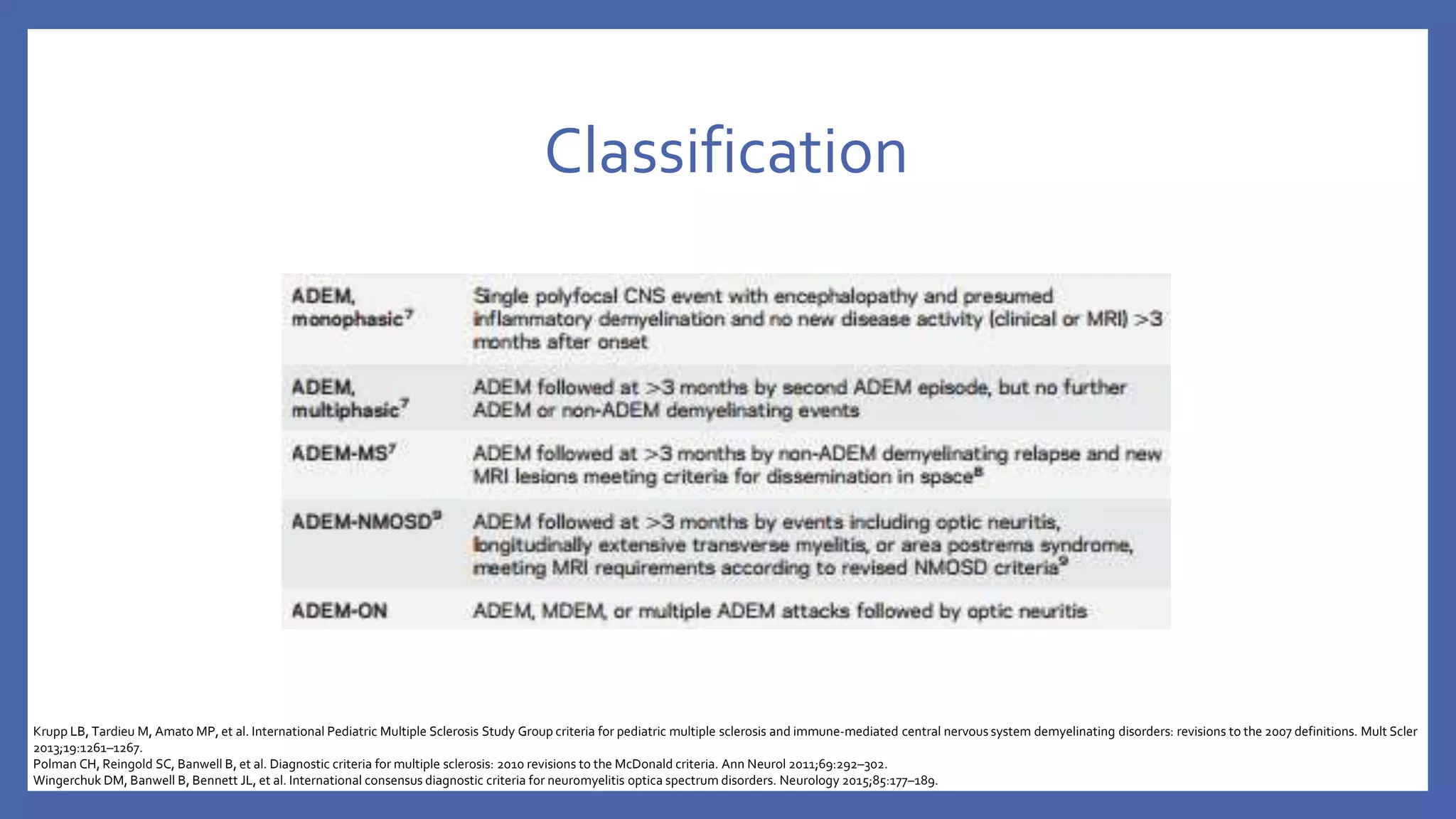
Classification
Krupp LB, Tardieu M, Amato MP, et al. International Pediatric Multiple Sclerosis Study Group criteria for pediatric multiple sclerosis and immune-mediated central nervous system demyelinating disorders: revisions to the 2007 definitions. Mult Scler
2013;19:1261–1267.
Polman CH, Reingold SC, Banwell B, et al. Diagnostic criteria for multiple sclerosis: 2010 revisions to the McDonald criteria. Ann Neurol 2011;69:292–302.
Wingerchuk DM, Banwell B, Bennett JL, et al. International consensus diagnostic criteria for neuromyelitis optica spectrum disorders. Neurology 2015;85:177–189.
Pathology
• The hallmark of ADEM pathology consists of perivenular sleeves of demyelination
associated with inflammatory infiltrates of myelin-laden macrophages,T and B
lymphocytes, occasional plasma cells, and granulocytes
• Multifocal microglial aggregates
• Diffuse cortical microglial alterations
• Whether acute hemorrhagic leukoencephalopathy (AHL) is a separate disease
entity or a hyperacute severe variant of ADEM remains controversial
• AHL lesions are characterized by the presence of hemorrhages, vessel fibrinoid
necrosis, perivascular exudation, edema, and granulocyte infiltration, with
perivascular demyelination and reactive astrocytosis
Young NP, Weinshenker BG, Parisi JE, et al. Perivenous demyelination: association with clinically defined acute disseminated encephalomyelitis and comparison with pathologically confirmed multiple sclerosis. Brain 2010; 133:333–348.
Robinson CA, Adiele RC, Tham M, Lucchinetti CF, Popescu BF. Early and widespread injury of astrocytes in the absence of demyelination in acute haemorrhagic leukoencephalitis. Acta Neuropathol Commun 2014; 2:52
Clinical Presentation
• An acute onset of encephalopathy in association with polyfocal neurologic
deficits, sometimes preceded by prodromal symptoms
• Rapidly progressive, with maximal deficits within 2 to 5 days
• 15-25 % severe presentation
• Frequent neurologic manifestations include pyramidal signs, ataxia, acute
hemiparesis, optic neuritis or other cranial nerve involvement, seizures, spinal
cord syndrome, and impairment of speech. Rarely, respiratory failure
• Seizures / status epilepticus may develop
• CCPD
Pohl D, Alper G, Van Haren K, Kornberg AJ, Lucchinetti CF, Tenembaum S, Belman AL. Acute disseminated encephalomyelitis updates on an inflammatory CNS syndrome. Neurology. 2016 Aug 30;87(9 Supplement 2):S38-45.
Neuroimaging Features
Pohl D, Alper G, Van Haren K, Kornberg AJ, Lucchinetti CF, Tenembaum S, Belman AL. Acute disseminated encephalomyelitis updates on an inflammatory CNS syndrome. Neurology. 2016 Aug 30;87(9 Supplement 2):S38-45.
CSF Findings
• Normal or mild lymphocytic pleocytosis
• Elevated CSF protein and sometimes elevated CSF IgG index
Pohl D, Alper G, Van Haren K, Kornberg AJ, Lucchinetti CF, Tenembaum S, Belman AL. Acute disseminated encephalomyelitis updates on an inflammatory CNS syndrome. Neurology. 2016 Aug 30;87(9 Supplement 2):S38-45.
Differential Diagnosis
Pohl D, Alper G, Van Haren K, Kornberg AJ, Lucchinetti CF, Tenembaum S, Belman AL. Acute disseminated encephalomyelitis updates on an inflammatory CNS syndrome. Neurology. 2016 Aug 30;87(9 Supplement 2):S38-45.
Treatment
• High-dose corticosteroids are currently widely accepted as first-line therapy
• A typical treatment regimen consists of IV methylprednisolone at a dose of 30
mg/kg/d (maximally 1,000 mg/d) for 5 days
• Followed by an oral taper over 4–6 weeks with a starting dose of prednisone of 1–2
mg/kg/d
• IVIG / PLEX
Pohl D, Alper G, Van Haren K, Kornberg AJ, Lucchinetti CF, Tenembaum S, Belman AL. Acute disseminated encephalomyelitis updates on an inflammatory CNS syndrome. Neurology. 2016 Aug 30;87(9 Supplement 2):S38-45.
Outcome
• Mostly full recovery in weeks
• Mortality rates: 1-3 %
• Longterm cognitive deficits especially in children < 5 y.o (attention, executive
function, verbal processing, and behavior, as well as IQ)
Absoud M, Parslow RC, Wassmer E, et al. Severe acute disseminated encephalomyelitis: a paediatric intensive care population-based study. Mult Scler 2011;17: 1258–1261.
Ketelslegers IA, Visser IE, Neuteboom RF, Boon M, CatsmanBerrevoets CE, Hintzen RQ. Disease course and outcome of acute disseminated encephalomyelitis is more severe in adults than in children. Mult Scler 2011;17:441–448.
Tenembaum SN. Acute disseminated encephalomyelitis. Handb Clin Neurol 2013;112:1253–1262.
Jacobs RK, Anderson VA, Neale JL, Shield LK, Kornberg AJ. Neuropsychological outcome after acute disseminated encephalomyelitis: impact of age at illness onset. Pediatr Neurol 2004;31:191–197.
Suppiej A, Cainelli E, Casara G, Cappellari A, Nosadini M, Sartori S. Long-term neurocognitive outcome and quality of life in pediatric acute disseminated encephalomyelitis. Pediatr Neurol 2014;50: 363–367
Summary
• ADEM is possibly not a single specific disease, but an inflammatory CNS syndrome
with immune-mediated demyelination and strong predilection to young children
• Monophasic illness
• Post-infectious or post-immunization
• Diagnosis: Clinical + MRI + CSF
• Treatment: high dose IVMP / IVIg / PLEX
Acute Disseminated Encephalomyelitis

Acute Disseminated Encephalomyelitis

  • 1.
  • 2.
    Outline: • Introduction • Epidemiology •Diagnostic Criteria • Classification • Pathology • Clinical Presentation • Neuroimaging Features • CSF Findings • Differential Diagnosis • Treatment • Outcome • Summary
  • 3.
    Introduction • An immune-mediateddemyelinating CNS disorder, characterized clinically by new-onset polyfocal neurologic symptoms including encephalopathy, coupled with neuroimaging evidence of multifocal demyelination • Monophasic illness • Early childhood • Post-infection or post-vaccine Lucas J. An account of uncommon symptoms succeeding measles: with some additional remarks on the infection of measles and smallpox. Lond Med J 1790;11:325.
  • 4.
    Epidemiology • Population-based studiesshow the incidence of ADEM to be 0.3–0.6 per 100,000 per year. • The median age at presentation of ADEM is 5–8 years, with male predominance Torisu H, Kira R, Ishizaki Y, et al. Clinical study of childhood acute disseminated encephalomyelitis, multiple sclerosis, and acute transverse myelitis in FukuokaPrefecture, Japan. Brain Dev 2010;32:454–462. Xiong CH, Yan Y, Liao Z, et al. Epidemiological characteristics of acute disseminated encephalomyelitis in Nanchang, China: a retrospective study. BMC Public Health 2014;14:111. Pohl D, Hennemuth I, von Kries R, Hanefeld F. Paediatric multiple sclerosis and acute disseminated encephalomyelitis in Germany: results of a nationwide survey. Eur J Pediatr 2007;166:405–412. Tenembaum S, Chamoles N, Fejerman N. Acute disseminated encephalomyelitis: a long-term follow-up study of 84 pediatric patients. Neurology 2002;59: 1224–1231
  • 5.
    Diagnostic Criteria Diagnosis canbe made when all five of the following criteria have been met: • A first multifocal, clinicalCNS event of presumed inflammatory demyelinating cause • Encephalopathy that cannot be explained by fever • Abnormal brain MRI: • Diffuse, poorly demarcated, large (>1–2 cm) lesions predominantly involving the cerebral white matter • T1-hypointense lesions in the white matter in rare cases • Deep grey matter abnormalities (eg, thalamus or basal ganglia) can be present • No new clinical or MRI findings after 3 months of symptom onset • Reasonable exclusion of alternative causes Krupp LB, Tardieu M, Amato MP, et al. for the International Pediatric Multiple Sclerosis Study Group. International Pediatric Multiple Sclerosis Study Group criteria for pediatric multiple sclerosis and immune-mediated central nervous system demyelinating disorders: revisions to the 2007 definitions. Mult Scler.2013;19:1261–67.
  • 6.
    Classification Krupp LB, TardieuM, Amato MP, et al. International Pediatric Multiple Sclerosis Study Group criteria for pediatric multiple sclerosis and immune-mediated central nervous system demyelinating disorders: revisions to the 2007 definitions. Mult Scler 2013;19:1261–1267. Polman CH, Reingold SC, Banwell B, et al. Diagnostic criteria for multiple sclerosis: 2010 revisions to the McDonald criteria. Ann Neurol 2011;69:292–302. Wingerchuk DM, Banwell B, Bennett JL, et al. International consensus diagnostic criteria for neuromyelitis optica spectrum disorders. Neurology 2015;85:177–189.
  • 7.
    Pathology • The hallmarkof ADEM pathology consists of perivenular sleeves of demyelination associated with inflammatory infiltrates of myelin-laden macrophages,T and B lymphocytes, occasional plasma cells, and granulocytes • Multifocal microglial aggregates • Diffuse cortical microglial alterations • Whether acute hemorrhagic leukoencephalopathy (AHL) is a separate disease entity or a hyperacute severe variant of ADEM remains controversial • AHL lesions are characterized by the presence of hemorrhages, vessel fibrinoid necrosis, perivascular exudation, edema, and granulocyte infiltration, with perivascular demyelination and reactive astrocytosis Young NP, Weinshenker BG, Parisi JE, et al. Perivenous demyelination: association with clinically defined acute disseminated encephalomyelitis and comparison with pathologically confirmed multiple sclerosis. Brain 2010; 133:333–348. Robinson CA, Adiele RC, Tham M, Lucchinetti CF, Popescu BF. Early and widespread injury of astrocytes in the absence of demyelination in acute haemorrhagic leukoencephalitis. Acta Neuropathol Commun 2014; 2:52
  • 8.
    Clinical Presentation • Anacute onset of encephalopathy in association with polyfocal neurologic deficits, sometimes preceded by prodromal symptoms • Rapidly progressive, with maximal deficits within 2 to 5 days • 15-25 % severe presentation • Frequent neurologic manifestations include pyramidal signs, ataxia, acute hemiparesis, optic neuritis or other cranial nerve involvement, seizures, spinal cord syndrome, and impairment of speech. Rarely, respiratory failure • Seizures / status epilepticus may develop • CCPD Pohl D, Alper G, Van Haren K, Kornberg AJ, Lucchinetti CF, Tenembaum S, Belman AL. Acute disseminated encephalomyelitis updates on an inflammatory CNS syndrome. Neurology. 2016 Aug 30;87(9 Supplement 2):S38-45.
  • 9.
    Neuroimaging Features Pohl D,Alper G, Van Haren K, Kornberg AJ, Lucchinetti CF, Tenembaum S, Belman AL. Acute disseminated encephalomyelitis updates on an inflammatory CNS syndrome. Neurology. 2016 Aug 30;87(9 Supplement 2):S38-45.
  • 10.
    CSF Findings • Normalor mild lymphocytic pleocytosis • Elevated CSF protein and sometimes elevated CSF IgG index Pohl D, Alper G, Van Haren K, Kornberg AJ, Lucchinetti CF, Tenembaum S, Belman AL. Acute disseminated encephalomyelitis updates on an inflammatory CNS syndrome. Neurology. 2016 Aug 30;87(9 Supplement 2):S38-45.
  • 11.
    Differential Diagnosis Pohl D,Alper G, Van Haren K, Kornberg AJ, Lucchinetti CF, Tenembaum S, Belman AL. Acute disseminated encephalomyelitis updates on an inflammatory CNS syndrome. Neurology. 2016 Aug 30;87(9 Supplement 2):S38-45.
  • 12.
    Treatment • High-dose corticosteroidsare currently widely accepted as first-line therapy • A typical treatment regimen consists of IV methylprednisolone at a dose of 30 mg/kg/d (maximally 1,000 mg/d) for 5 days • Followed by an oral taper over 4–6 weeks with a starting dose of prednisone of 1–2 mg/kg/d • IVIG / PLEX Pohl D, Alper G, Van Haren K, Kornberg AJ, Lucchinetti CF, Tenembaum S, Belman AL. Acute disseminated encephalomyelitis updates on an inflammatory CNS syndrome. Neurology. 2016 Aug 30;87(9 Supplement 2):S38-45.
  • 13.
    Outcome • Mostly fullrecovery in weeks • Mortality rates: 1-3 % • Longterm cognitive deficits especially in children < 5 y.o (attention, executive function, verbal processing, and behavior, as well as IQ) Absoud M, Parslow RC, Wassmer E, et al. Severe acute disseminated encephalomyelitis: a paediatric intensive care population-based study. Mult Scler 2011;17: 1258–1261. Ketelslegers IA, Visser IE, Neuteboom RF, Boon M, CatsmanBerrevoets CE, Hintzen RQ. Disease course and outcome of acute disseminated encephalomyelitis is more severe in adults than in children. Mult Scler 2011;17:441–448. Tenembaum SN. Acute disseminated encephalomyelitis. Handb Clin Neurol 2013;112:1253–1262. Jacobs RK, Anderson VA, Neale JL, Shield LK, Kornberg AJ. Neuropsychological outcome after acute disseminated encephalomyelitis: impact of age at illness onset. Pediatr Neurol 2004;31:191–197. Suppiej A, Cainelli E, Casara G, Cappellari A, Nosadini M, Sartori S. Long-term neurocognitive outcome and quality of life in pediatric acute disseminated encephalomyelitis. Pediatr Neurol 2014;50: 363–367
  • 14.
    Summary • ADEM ispossibly not a single specific disease, but an inflammatory CNS syndrome with immune-mediated demyelination and strong predilection to young children • Monophasic illness • Post-infectious or post-immunization • Diagnosis: Clinical + MRI + CSF • Treatment: high dose IVMP / IVIg / PLEX

Editor's Notes

  • #2 Are your classroom colors different than what you see in this template? That’s OK! Click on Design -> Variants (the down arrow) -> Pick the color scheme that works for you! Feel free to change any “You will…” and “I will…” statements to ensure they align with your classroom procedures and rules!