GRADES 1 to 12
DAILY LESSON LOG
School: STO. NIÑO INTEGRATED SCHOOL Grade Level: 4,7
Teacher: CHARLOTTE O. CORALDE Learning Area: MATHEMATICS
Teaching Dates and
Time: NOVEMBER 22, 2024 (DAY 5) Quarter: 2nd
QUARTER
MATHEMATICS 4 MATHEMATICS 7
I. CURRICULUM CONTENT, STANDARDS, AND LESSON COMPETENCIES
A. Content Standards The learners should have knowledge and understanding of
Addition and subtraction of similar fractions, including mixed
numbers.
The learners demonstrate knowledge and
understanding of subsets of real numbers.
B. Performance Standards By the end of the quarter, the learners are able to perform
addition and subtraction of similar fractions, including mixed
numbers.
By the end of the quarter, the learners are able to
illustrate the different subsets of real numbers (NA).
C. Learning Competencies and
Objectives
Learning Competency
1. Determine similar and dissimilar fractions
2. Add and subtract similar fractions two proper fractions,
two mixed numbers, a mixed number and a proper fraction,
a whole number and a proper fraction, and a whole number
and a mixed number.
The learners…
1. Describe and illustrate the different subsets of real
numbers.
2. Find the union, and intersection of the set of real
numbers and its subsets.
3. Plot numbers in a real number line.
4. Arrange real numbers in increasing or decreasing
order.
D. Content
Addition and Subtraction of Similar Fractions
a. Addition and Subtraction of two proper fractions
b. Addition and Subtraction of two mixed numbers
c. Addition and Subtraction of a mixed number and a
proper fraction
d. Addition and Subtraction of a whole number and a
proper fraction
e. Addition and Subtraction of a whole number and a
mixed number
Subsets of Real Numbers
Plotting Numbers in a Number Line
Ordering Real Numbers
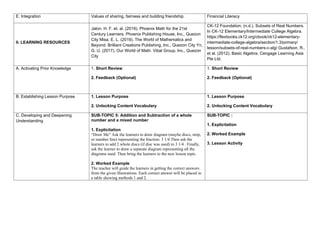
E. Integration Values of sharing, fairness and building friendship. Financial Literacy
II. LEARNING RESOURCES
Jalon, H. F. et. al. (2019). Phoenix Math for the 21st
Century Learners. Phoenix Publishing House, Inc., Quezon
City Misa, E. L. (2019). The World of Mathematics and
Beyond. Brilliant Creations Publishing, Inc., Quezon City Yn,
G. U. (2017). Our World of Math. Vibal Group, Inc., Quezon
City
CK-12 Foundation. (n.d.). Subsets of Real Numbers.
In CK-12 Elementary/Intermediate College Algebra.
https://flexbooks.ck12.org/cbook/ck12-elementary-
intermediate-college-algebra/section/1.3/primary/
lesson/subsets-of-real-numbers-c-alg/ Gustafson, R.,
et al. (2012). Basic Algebra. Cengage Learning Asia
Pte Ltd.
A. Activating Prior Knowledge 1. Short Review
2. Feedback (Optional)
1. Short Review
2. Feedback (Optional)
B. Establishing Lesson Purpose 1. Lesson Purpose
2. Unlocking Content Vocabulary
1. Lesson Purpose
2. Unlocking Content Vocabulary
C. Developing and Deepening
Understanding
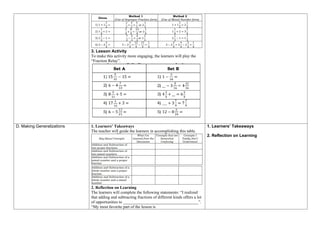
SUB-TOPIC 5: Addition and Subtraction of a whole
number and a mixed number
1. Explicitation
“Draw Me” Ask the learners to draw diagram (maybe discs, strip,
or number line) representing the fraction: 3 1/4 Then ask the
learners to add 2 whole discs (if disc was used) to 3 1/4 . Finally,
ask the learner to draw a separate diagram representing all the
diagrams used. Then bring the learners to the new lesson topic.
2. Worked Example
The teacher will guide the learners in getting the correct answers
from the given illustrations. Each correct answer will be placed in
a table showing methods 1 and 2.
SUB-TOPIC :
1. Explicitation
2. Worked Example
3. Lesson Activity
3. Lesson Activity
To make this activity more engaging, the learners will play the
“Fraction Relay”.
D. Making Generalizations 1. Learners’ Takeaways
The teacher will guide the learners in accomplishing this table.
2. Reflection on Learning
The learners will complete the following statements: “I realized
that adding and subtracting fractions of different kinds offers a lot
of opportunities to ____________________________________”.
“My most favorite part of the lesson is
1. Learners’ Takeaways
2. Reflection on Learning
_______________________ because
________________________.”
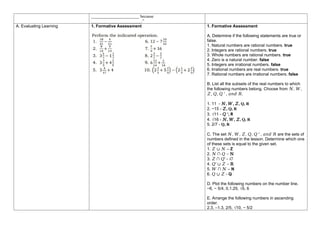
A. Evaluating Learning 1. Formative Assessment 1. Formative Assessment
A. Determine if the following statements are true or
false.
1. Natural numbers are rational numbers. true
2. Integers are rational numbers. true
3. Whole numbers are rational numbers. true
4. Zero is a natural number. false
5. Integers are irrational numbers. false
6. Irrational numbers are real numbers. true
7. Rational numbers are irrational numbers. false
B. List all the subsets of the real numbers to which
the following numbers belong. Choose from 𝑁, 𝑊,
𝑍, 𝑄, 𝑄 ′ , 𝑎𝑛𝑑 𝑅.
1. 11 - 𝑁, 𝑊, 𝑍, Q, R
2. −15 - 𝑍, Q, R
3. √11 - 𝑄 ′, R
4. √16 - 𝑁, 𝑊, 𝑍, Q, R
5. 2/7 - Q, R
C. The set 𝑁, 𝑊, 𝑍, 𝑄, 𝑄 ′ , 𝑎𝑛𝑑 𝑅 are the sets of
numbers defined in the lesson. Determine which one
of these sets is equal to the given set.
1. 𝑍 ∪ 𝑁 – Z
2. 𝑁 ∩ 𝑄 – N
3. 𝑍 ∩ 𝑄′ - ∅
4. 𝑄′ ∪ 𝑍 – R
5. 𝑊 ∩ 𝑁 – N
6. 𝑄 ∪ 𝑍 - Q
D. Plot the following numbers on the number line.
−6, − 5/4, 0,1.25, √5, 6
E. Arrange the following numbers in ascending
order.
2.3, –1.3, 2/5, √10, − 5/2
B. Teacher’s Remarks
C. Teacher’s Reflection
A..No. of learners who earned 80% in
the evaluation
___ of Learners who earned 80% above ___ of Learners who earned 80% above
B.No. of learners
who require additional activities for
remediation who scored below 80%
___ of Learners who require additional activities for
remediation
___ of Learners who require additional activities for
remediation
C. Did the remedial lessons work?
No. of learners who have caught up
with the lesson
___Yes ___No
____ of Learners who caught up the lesson
___Yes ___No
____ of Learners who caught up the lesson
D. No. of learners who continue to
require remediation
___ of Learners who continue to require remediation ___ of Learners who continue to require remediation
E. Which of my teaching strategies
worked well? Why
did these work?
Strategies used that work well:
___ Group collaboration
___ Games
___ Solving Puzzles/Jigsaw
___ Answering preliminary
activities/exercises
___ Carousel
___ Diads
___ Think-Pair-Share (TPS)
___ Rereading of Paragraphs/
Poems/Stories
___ Differentiated Instruction
___ Role Playing/Drama
___ Discovery Method
___ Lecture Method
Why?
___ Complete IMs
___ Availability of Materials
___ Pupils’ eagerness to learn
___ Group member’s Cooperation in doing their tasks
Strategies used that work well:
___ Group collaboration
___ Games
___ Solving Puzzles/Jigsaw
___ Answering preliminary
activities/exercises
___ Carousel
___ Diads
___ Think-Pair-Share (TPS)
___ Rereading of Paragraphs/
Poems/Stories
___ Differentiated Instruction
___ Role Playing/Drama
___ Discovery Method
___ Lecture Method
Why?
___ Complete IMs
___ Availability of Materials
___ Pupils’ eagerness to learn
___ Group member’s Cooperation in
Doing their tasks
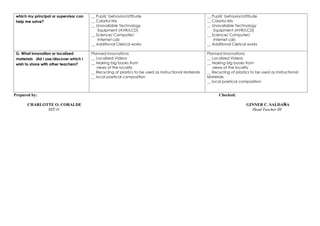
F. What difficulties did I encounter __ Bullying among pupils __ Bullying among pupils
which my principal or supervisor can
help me solve?
__ Pupils’ behavior/attitude
__ Colorful IMs
__ Unavailable Technology
Equipment (AVR/LCD)
__ Science/ Computer/
Internet Lab
__ Additional Clerical works
__ Pupils’ behavior/attitude
__ Colorful IMs
__ Unavailable Technology
Equipment (AVR/LCD)
__ Science/ Computer/
Internet Lab
__ Additional Clerical works
G. What innovation or localized
materials did I use/discover which I
wish to share with other teachers?
Planned Innovations:
__ Localized Videos
__ Making big books from
views of the locality
__ Recycling of plastics to be used as Instructional Materials
__ local poetical composition
Planned Innovations:
__ Localized Videos
__ Making big books from
views of the locality
__ Recycling of plastics to be used as Instructional
Materials
__ local poetical composition
Prepared by: Checked:
CHARLOTTE O. CORALDE GINNER C. SALDAÑA
SST-I1 Head Teacher III

Mathematics 4 and 7 - WEEK 8- D5 Q2.docx

  • 1.
    GRADES 1 to12 DAILY LESSON LOG School: STO. NIÑO INTEGRATED SCHOOL Grade Level: 4,7 Teacher: CHARLOTTE O. CORALDE Learning Area: MATHEMATICS Teaching Dates and Time: NOVEMBER 22, 2024 (DAY 5) Quarter: 2nd QUARTER MATHEMATICS 4 MATHEMATICS 7 I. CURRICULUM CONTENT, STANDARDS, AND LESSON COMPETENCIES A. Content Standards The learners should have knowledge and understanding of Addition and subtraction of similar fractions, including mixed numbers. The learners demonstrate knowledge and understanding of subsets of real numbers. B. Performance Standards By the end of the quarter, the learners are able to perform addition and subtraction of similar fractions, including mixed numbers. By the end of the quarter, the learners are able to illustrate the different subsets of real numbers (NA). C. Learning Competencies and Objectives Learning Competency 1. Determine similar and dissimilar fractions 2. Add and subtract similar fractions two proper fractions, two mixed numbers, a mixed number and a proper fraction, a whole number and a proper fraction, and a whole number and a mixed number. The learners… 1. Describe and illustrate the different subsets of real numbers. 2. Find the union, and intersection of the set of real numbers and its subsets. 3. Plot numbers in a real number line. 4. Arrange real numbers in increasing or decreasing order. D. Content Addition and Subtraction of Similar Fractions a. Addition and Subtraction of two proper fractions b. Addition and Subtraction of two mixed numbers c. Addition and Subtraction of a mixed number and a proper fraction d. Addition and Subtraction of a whole number and a proper fraction e. Addition and Subtraction of a whole number and a mixed number Subsets of Real Numbers Plotting Numbers in a Number Line Ordering Real Numbers
  • 2.
    E. Integration Valuesof sharing, fairness and building friendship. Financial Literacy II. LEARNING RESOURCES Jalon, H. F. et. al. (2019). Phoenix Math for the 21st Century Learners. Phoenix Publishing House, Inc., Quezon City Misa, E. L. (2019). The World of Mathematics and Beyond. Brilliant Creations Publishing, Inc., Quezon City Yn, G. U. (2017). Our World of Math. Vibal Group, Inc., Quezon City CK-12 Foundation. (n.d.). Subsets of Real Numbers. In CK-12 Elementary/Intermediate College Algebra. https://flexbooks.ck12.org/cbook/ck12-elementary- intermediate-college-algebra/section/1.3/primary/ lesson/subsets-of-real-numbers-c-alg/ Gustafson, R., et al. (2012). Basic Algebra. Cengage Learning Asia Pte Ltd. A. Activating Prior Knowledge 1. Short Review 2. Feedback (Optional) 1. Short Review 2. Feedback (Optional) B. Establishing Lesson Purpose 1. Lesson Purpose 2. Unlocking Content Vocabulary 1. Lesson Purpose 2. Unlocking Content Vocabulary C. Developing and Deepening Understanding SUB-TOPIC 5: Addition and Subtraction of a whole number and a mixed number 1. Explicitation “Draw Me” Ask the learners to draw diagram (maybe discs, strip, or number line) representing the fraction: 3 1/4 Then ask the learners to add 2 whole discs (if disc was used) to 3 1/4 . Finally, ask the learner to draw a separate diagram representing all the diagrams used. Then bring the learners to the new lesson topic. 2. Worked Example The teacher will guide the learners in getting the correct answers from the given illustrations. Each correct answer will be placed in a table showing methods 1 and 2. SUB-TOPIC : 1. Explicitation 2. Worked Example 3. Lesson Activity
  • 3.
    3. Lesson Activity Tomake this activity more engaging, the learners will play the “Fraction Relay”. D. Making Generalizations 1. Learners’ Takeaways The teacher will guide the learners in accomplishing this table. 2. Reflection on Learning The learners will complete the following statements: “I realized that adding and subtracting fractions of different kinds offers a lot of opportunities to ____________________________________”. “My most favorite part of the lesson is 1. Learners’ Takeaways 2. Reflection on Learning
  • 4.
    _______________________ because ________________________.” A. EvaluatingLearning 1. Formative Assessment 1. Formative Assessment A. Determine if the following statements are true or false. 1. Natural numbers are rational numbers. true 2. Integers are rational numbers. true 3. Whole numbers are rational numbers. true 4. Zero is a natural number. false 5. Integers are irrational numbers. false 6. Irrational numbers are real numbers. true 7. Rational numbers are irrational numbers. false B. List all the subsets of the real numbers to which the following numbers belong. Choose from 𝑁, 𝑊, 𝑍, 𝑄, 𝑄 ′ , 𝑎𝑛𝑑 𝑅. 1. 11 - 𝑁, 𝑊, 𝑍, Q, R 2. −15 - 𝑍, Q, R 3. √11 - 𝑄 ′, R 4. √16 - 𝑁, 𝑊, 𝑍, Q, R 5. 2/7 - Q, R C. The set 𝑁, 𝑊, 𝑍, 𝑄, 𝑄 ′ , 𝑎𝑛𝑑 𝑅 are the sets of numbers defined in the lesson. Determine which one of these sets is equal to the given set. 1. 𝑍 ∪ 𝑁 – Z 2. 𝑁 ∩ 𝑄 – N 3. 𝑍 ∩ 𝑄′ - ∅ 4. 𝑄′ ∪ 𝑍 – R 5. 𝑊 ∩ 𝑁 – N 6. 𝑄 ∪ 𝑍 - Q D. Plot the following numbers on the number line. −6, − 5/4, 0,1.25, √5, 6 E. Arrange the following numbers in ascending order. 2.3, –1.3, 2/5, √10, − 5/2
  • 5.
    B. Teacher’s Remarks C.Teacher’s Reflection A..No. of learners who earned 80% in the evaluation ___ of Learners who earned 80% above ___ of Learners who earned 80% above B.No. of learners who require additional activities for remediation who scored below 80% ___ of Learners who require additional activities for remediation ___ of Learners who require additional activities for remediation C. Did the remedial lessons work? No. of learners who have caught up with the lesson ___Yes ___No ____ of Learners who caught up the lesson ___Yes ___No ____ of Learners who caught up the lesson D. No. of learners who continue to require remediation ___ of Learners who continue to require remediation ___ of Learners who continue to require remediation E. Which of my teaching strategies worked well? Why did these work? Strategies used that work well: ___ Group collaboration ___ Games ___ Solving Puzzles/Jigsaw ___ Answering preliminary activities/exercises ___ Carousel ___ Diads ___ Think-Pair-Share (TPS) ___ Rereading of Paragraphs/ Poems/Stories ___ Differentiated Instruction ___ Role Playing/Drama ___ Discovery Method ___ Lecture Method Why? ___ Complete IMs ___ Availability of Materials ___ Pupils’ eagerness to learn ___ Group member’s Cooperation in doing their tasks Strategies used that work well: ___ Group collaboration ___ Games ___ Solving Puzzles/Jigsaw ___ Answering preliminary activities/exercises ___ Carousel ___ Diads ___ Think-Pair-Share (TPS) ___ Rereading of Paragraphs/ Poems/Stories ___ Differentiated Instruction ___ Role Playing/Drama ___ Discovery Method ___ Lecture Method Why? ___ Complete IMs ___ Availability of Materials ___ Pupils’ eagerness to learn ___ Group member’s Cooperation in Doing their tasks F. What difficulties did I encounter __ Bullying among pupils __ Bullying among pupils
  • 6.
    which my principalor supervisor can help me solve? __ Pupils’ behavior/attitude __ Colorful IMs __ Unavailable Technology Equipment (AVR/LCD) __ Science/ Computer/ Internet Lab __ Additional Clerical works __ Pupils’ behavior/attitude __ Colorful IMs __ Unavailable Technology Equipment (AVR/LCD) __ Science/ Computer/ Internet Lab __ Additional Clerical works G. What innovation or localized materials did I use/discover which I wish to share with other teachers? Planned Innovations: __ Localized Videos __ Making big books from views of the locality __ Recycling of plastics to be used as Instructional Materials __ local poetical composition Planned Innovations: __ Localized Videos __ Making big books from views of the locality __ Recycling of plastics to be used as Instructional Materials __ local poetical composition Prepared by: Checked: CHARLOTTE O. CORALDE GINNER C. SALDAÑA SST-I1 Head Teacher III